

Altitude Sickness Medication: Diamox, Dosage & What Actually Works
Introduction: Diamox or Acetazolamide
Picture this: You have booked your first EBC trek. You are ready to fly to Kathmandu, take a flight to Lukla, and spend sixteen days in the mountains. As you do some research, someone in a forum mentions Diamox, and suddenly, you are digging medical PDFs, wondering whether you actually need it.
Here is the short answer: Acetazolamide ( or Diamox) is the most commonly prescribed medication for altitude sickness. It is not a magic pill, though. Whether you need it depends almost entirely on your trek profile, your personal history, and the itinerary you are following.
Medical Disclaimer: This guide is for general educational purposes only and is not a substitute for professional medical advice. Always consult a qualified physician before taking any medication for altitude sickness.
What Is the Best Medication for Altitude Sickness?
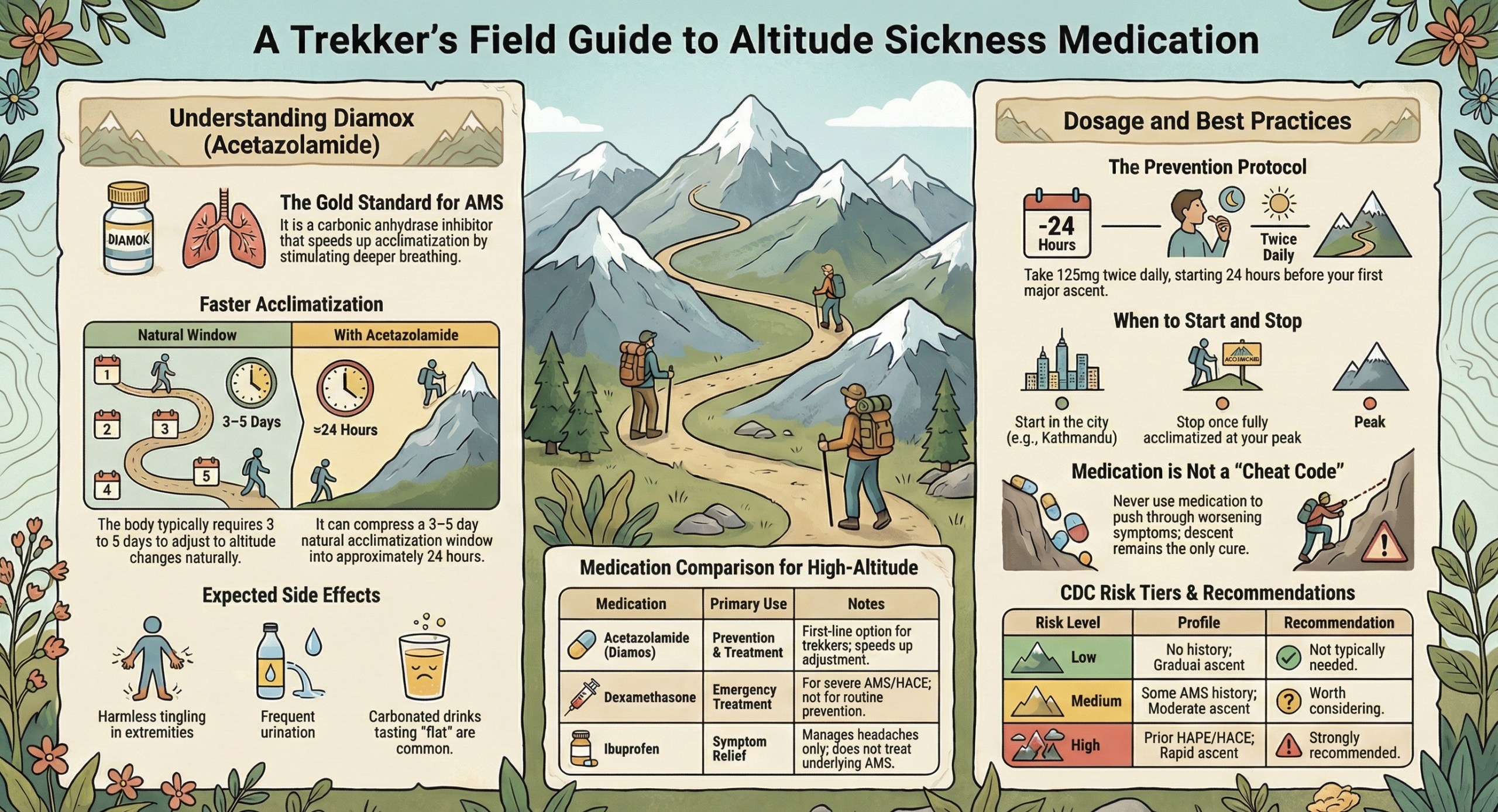
The drug of choice is always acetazolamide, sold under the brand name Diamox. It stimulates faster, deeper breathing, which accelerates the body’s acclimatization process rather than just masking symptoms like headache.
Acetazolamide may be the most prescribed, but it is not the only drug used in altitude illness management.
| Medication | Primary Use | When It’s Used | Notes |
| Acetazolamide (Diamox) | Prevention + treatment of AMS | Before and during ascent | First-line option; commonly prescribed |
| Dexamethasone | Emergency treatment of severe AMS, HACE | Serious symptoms; evacuation situations | A corticosteroid — not for routine prevention; carried by guides and rescue teams |
| Ibuprofen | Headache relief in mild AMS | Symptom management | Treats headache only; does not address underlying AMS |
| Nifedipine | Emergency treatment of HAPE | Life-threatening lung fluid accumulation | Specialist use; not a trekker’s self-medication option |
The important distinction: Dexamethasone and Nifedipine are emergency medications. They are carried by experienced guides and rescue teams on routes like EBC and Manaslu for life-threatening situations. They’re not alternatives to acetazolamide for everyday prevention.
Ibuprofen (typically 400 mg) is useful for managing headache in mild AMS and is worth carrying regardless. It does not treat the cause, but it can make the acclimatization window more bearable.
How Diamox Actually Works
Your body’s adjustment to altitude is essentially a breathing problem. At 5,000 m, every breath delivers roughly half the oxygen it would at sea level. To compensate, your body needs to breathe more, but the signal chain that triggers this response takes days to calibrate.
Acetazolamide is a carbonic anhydrase inhibitor. In plain terms, it nudges your kidneys to release bicarbonate, which slightly acidifies your blood. That acidification tells your brain to breathe harder. More oxygen in, faster acclimatization.
According to the CDC Yellow Book (2026 edition), the ventilatory acclimatization that normally takes 3–5 days is compressed to approximately one day with acetazolamide. That is a meaningful difference on a trek where every acclimatization day counts.
It also helps with something most trekkers do not expect: sleep. Above around 2,700 m, periodic irregular breathing becomes nearly universal and wrecks your rest at altitude. Acetazolamide improves nocturnal oxygen saturation and reduces it significantly, which means you wake up feeling less wrecked the morning before a big climb.
What it does not do is allow you to cheat the mountain. It cannot prevent HAPE or HACE if you are ascending recklessly. It does not eliminate AMS risk, but reduces it. And it will not save you from a bad itinerary.
Diamox Dosage for Altitude Sickness
Based on current wilderness medicine guidelines and the CDC Yellow Book (2026):
Important: These are standard reference dosages. Your physician may adjust based on your weight, health history, and risk profile. Always follow your prescribing doctor’s specific guidance.
For Prevention
The standard prevention dose is 125 mg twice daily, starting the day before you ascend above 3,000 m and continuing for the first two days at altitude, longer if you keep ascending.
| Use | Dose | Frequency |
| Standard | 125 mg | Twice daily |
| Body weight >100 kg | 250 mg | Twice daily |
The 125 mg dose is increasingly preferred over the older 250 mg standard because it produces far fewer side effects while maintaining effectiveness. The CDC specifically flags 250 mg for trekkers over 100 kg.
For Treatment
If AMS symptoms appear, the commonly used treatment dose is 250 mg twice daily. This is taken alongside rest at the same altitude, not as an enhancement to push higher.
| Use | Dose | Frequency |
| Treatment of AMS | 250 mg | Twice daily |
One important note: If symptoms are worsening despite medication, descent is the only answer. Diamox is not a substitute for going down.
How to Take Diamox on a Nepal Trek
Timing is everything here, and most first-time trekkers get it slightly wrong.
Start the day before ascent. Not the morning you fly to Lukla or drive to the trailhead. For an EBC trek, that means taking acetazolamide the day before your Lukla flight, when you are still in Kathmandu. By the time you land at 2,860 m, the medication is already active.
Continue for the first 2–3 days at each new altitude band. On the EBC route, this aligns with your rest days at Namche Bazaar (3,440 m) and Dingboche (4,360 m). On the Manaslu Circuit, it applies from Samagaun onwards. On Annapurna Base Camp, the compressed profile makes the early days particularly important.
Stop once you are fully acclimatized at your highest point. No need to continue during descent as the work is done.
A few practical things that matter on the trail:
- Take it with food. An empty stomach makes nausea more likely.
- Drink more water than you think you need. Acetazolamide is a mild diuretic, and dehydration is already a risk at altitude.
- Avoid alcohol for the first 48–72 hours at any new elevation. It suppresses the respiratory drive that the medication is trying to stimulate and independently increases AMS risk.
Do You Actually Need Diamox?
The CDC Yellow Book (2026) categorizes AMS risk into three tiers based on your altitude illness history, your sleeping altitude on day one, and your rate of ascent:
| Risk Level | Your Profile | Recommendation |
| Low | No AMS history · sleeping altitude <2,750 m on day 1 · ascent ≤500 m/night | Not typically needed |
| Medium | Some AMS history · sleeping 2,750–3,400 m on day 1 · faster ascent with rest days | Worth considering |
| High | HAPE/HACE history · sleeping >3,400 m on day 1 · rapid ascent without rest days | Strongly recommended |
The reality on most Himalayan treks: you land at Lukla (2,860 m) and reach Namche (3,440 m) within two days. That puts most trekkers squarely in the “Medium” category from day one, regardless of fitness level.
You should seriously consider acetazolamide if:
- You have had AMS before on any previous trek. Prior history is the strongest predictor of future AMS
- Your itinerary is compressed with fewer rest days than standard
- You are heading above 4,000 m with limited experience at altitude
- You are flying directly into high altitude (common on Tibet itineraries as Lhasa sits at 3,656 m)
You may not need it if:
- You are on a well-paced itinerary with proper acclimatization days built in
- You have completed similar-altitude treks before without symptoms
- Your travel medicine physician has assessed your risk as low based on your profile
The honest answer for most people planning Everest Base Camp is that it is worth the conversation with your doctor. Acetazolamide is inexpensive, widely available on prescription, and the cost of the conversation is zero.
Side Effects of Diamox: What to Actually Expect
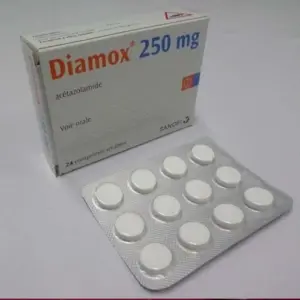
Diamox has a reputation that puts people off. Here is what is actually going on.
Tingling in your hands, feet, and face: This is the most common side effect and the one that surprises people most. It starts a few hours after your first dose and continues throughout the course. It is harmless. If you are not experiencing it at all, it may be a sign that the medication is not at a full therapeutic level.
More bathroom trips: Acetazolamide is mildly diuretic. You will urinate more, especially in the first day or two. On a trek, this mostly means planning on long days between lodges.
Your beer tastes weird: Specifically, carbonated drinks taste flat or metallic. The enzyme that normally helps you taste carbonation is the same one that acetazolamide inhibits. Your Everest brew at Namche will taste off. This is a good sign that the medication is working.
Mild nausea: Some people experience this, almost always on an empty stomach. Food fixes it.
If you develop a skin rash, hives, or any sign of an allergic reaction, stop immediately and seek medical attention.
Who Should Avoid Diamox?
Acetazolamide is not appropriate for everyone. Your physician will screen for these, but you should know them before your consultation.
Sulfonamide (sulfa) allergy: Acetazolamide is chemically related to sulfonamide antibiotics. People with a documented sulfa allergy may react to it. This is the most significant contraindication. If you have had a reaction to sulfa drugs, flag it to your doctor before they prescribe acetazolamide.
Kidney disease or kidney stones: Acetazolamide affects how the kidneys handle bicarbonate and may increase the risk of stone formation. Anyone with a history of kidney issues should discuss this carefully with their physician.
Pregnancy: Acetazolamide is generally not recommended during pregnancy. The risk-benefit calculation at altitude is a conversation for your obstetrician.
Certain medications: It can interact with some diuretics, lithium, and other drugs. Disclose your complete medication list to your prescribing doctor.
This is precisely why the pre-trek physician consultation is not optional if you are considering medication. It takes fifteen minutes and eliminates guesswork.
Medication vs. Acclimatization: The Most Important Thing
Medication supports acclimatization. It does not replace it.
The trekkers who get into serious trouble at altitude are not usually the ones who forgot their Diamox. They are the ones who skipped the Namche rest day because they felt fine, pushed through a mild headache at Dingboche, and treated medication as a green light to move faster.
No dose of acetazolamide makes a compressed itinerary safe. The rules still apply:
- No more than 300–500 m of sleeping altitude gain per night above 3,000 m.
- Rest days at Namche Bazaar and Dingboche on the EBC routes. These are not optional extras.
- Never ascend with active AMS symptoms, regardless of what is in your pack.
Acetazolamide gives your body a better chance. The itinerary gives it the time. You need both.
For acclimatization schedules, route-specific risk profiles, and how to read early symptoms on the trail, see our complete altitude sickness guide.
Quick Reference
| Question | Answer |
| Best medication for altitude sickness | Acetazolamide (Diamox) |
| Standard prevention dose | 125 mg twice daily (250 mg if >100 kg) |
| When to start | The day before ascending above 3,000 m |
| Treatment dose | 250 mg twice daily |
| Main side effects | Tingling, frequent urination, flat taste in carbonated drinks |
| Sulfa allergy + Diamox | Not an automatic contraindication — discuss with your doctor |
| Does it replace acclimatization? | No. Never. |
So, Should You Take Diamox?
Acetazolamide is a well-studied, commonly prescribed, and genuinely useful tool for trekkers heading into high altitudes. If taken at the right dose & started at the right time, alongside a sensible ascent profile, it meaningfully reduces AMS risk and makes the acclimatization window more manageable.
But it is exactly that: a tool. The mountains do not care what is in your pack. They respond to patience, preparation, and the willingness to turn around when the situation calls for it. Medication just helps your body keep up.
If you are planning a high-altitude route, always see a travel medicine physician at least four to six weeks before departure. If you’re wondering how to detect signs and symptoms of AMS, check out our guide on AMS signs and symptoms.
Planning a high-altitude trek in Nepal? Explore our itineraries: built with acclimatisation days, experienced guides, and safety protocols designed for high-altitude terrain. 👉 Browse our Nepal trekking trips