

Magical Bhutan Tour

Magical Bhutan Tour

Magical Bhutan Tour

Magical Bhutan Tour

Magical Bhutan Tour
Magical Bhutan Tour

Activity
Tour
Duration
10 Days
Grading
Easy
Max Altitude:
3,000m. / 9,843ft.
Best Season
March till April & October till November
Style of Trip
Cultural Tour
Group Size
2-10 People
Accommodation
Hotel
Meals
Breakfast, Lunch, Dinner
Why Choose the Magical Bhutan Tour?
The 10-day Magical Bhutan journey allows you to experience the country in a slower, more immersive way; combining cultural landmarks, spiritual valleys, and Himalayan landscapes into a balanced itinerary. It touches the western region, which is the heart and soul of Bhutan, and then goes a bit further to explore the mystical central region.
- Explore Western Bhutan, the cultural gateway of the kingdom: Western Bhutan, centered in Paro and Thimphu, introduces you to the country’s living culture. This region blends traditional Bhutanese life with modern governance and is home to iconic dzongs, skillful arts, and the country’s only international airport.
- Visit the iconic Taktsang Monastery (Tiger Nest, Western Bhutan): A highlight of any Bhutan tour, Taktsang Monastery (Tiger’s Nest) is a sacred cliffside monastery in Paro Valley. Experience both spiritual significance and dramatic Himalayan views, which make the Tiger’s Nest hike one of Bhutan’s most memorable experiences.
- Discover Central Bhutan, the spiritual heart of the country: Central Bhutan is said to be the first inhabited part of Bhutan. It offers a deeper, quieter experience with ancient monasteries, myth-rich landscapes, and preserved traditions.
- Experience the serene Phobjikha Valley (Gangtey, Central Bhutan): A glacial valley known for its wide landscapes, silence, and endangered black-necked cranes. Gangtey offers a completely different pace of Bhutan, with peaceful, natural, and immersive surroundings.
- Explore Bumthang Valley, Bhutan’s spiritual core (Central Bhutan): Bumthang is home to some of the oldest temples and monasteries in Bhutan. It is widely regarded as the spiritual heartland of the kingdom, offering a deeper cultural and religious context beyond mainstream routes.
- Immerse yourself in Bhutan’s living culture and traditions: Across the journey, Bhutanese culture is experienced in its purest form, through monasteries, dzongs, festivals, and everyday religious life that remains deeply preserved.
- Connect with local life through village walks and rural experiences: Walk through traditional villages and experience Bhutanese hospitality firsthand, where the daily rural life remains closely tied to nature, community, and heritage.
- Optional cultural experiences like cooking or meditation sessions: Enhance your journey with immersive experiences such as traditional Bhutanese cooking or guided meditation with monks, offering a deeper cultural connection.
Trip Introduction
Overview of the Magical Bhutan Tour
The Magical Bhutan Tour is an immersive 10-day journey designed for travelers seeking a deeper experience beyond the standard western region of Bhutan. The tour extends to the central part of Bhutan, believed to be the magical region of saints and treasure-seekers.
It touches historical sites, ancient monasteries, traditional villages and farms, rich natural forest, and meaningful cultural encounters with the friendly locals.
Western Bhutan serves as the cultural gateway of the kingdom, home to historic dzongs, traditional Bhutanese life, and the country’s only international airport, located in Paro. This region blends heritage, spirituality, and modern Bhutanese identity through its monasteries, fortresses, and vibrant local culture.
On the other hand, Central Bhutan is a region said to be the first inhabited part of Bhutan. It is also the spiritual heartland of Bhutan, known for its sacred monasteries, ancient legends, and unspoiled landscapes. The region offers a deeper insight into Bhutanese Buddhism and the country’s rich cultural heritage.
With fewer people travelling, Central Bhutan offers more of the authentic Bhutan culture, nature, and serene atmosphere.
Tour Overview at a Glance
| Feature | Details |
| Route Overview | Paro → Thimphu → Punakha → Gangtey → Bumthang → Paro |
| Tour Type | Cultural, Spiritual & Scenic Bhutan Tour |
| Best For | Culture lovers, scenic travelers, spiritual & immersive Himalayan experience seekers |
| Activity Level | Easy to Moderate |
| Highest Elevation | 3,000m |
| Accommodation | Hotels & Traditional Bhutanese Lodges |
| Transportation | Private Vehicle Throughout the Tour |
| Start / End Point | Paro, Bhutan |
Key Destinations of the Magical Bhutan Tour
The Magical Bhutan Tour encompasses the following beautiful destinations, which highlight the best of what the kingdom has to offer:
Paro (2,266 m)
Paro Valley is one of the most scenic and fertile valleys in Bhutan. It stretches from Chuzom to the slopes of Mount Jomolhari near the Tibetan border. Known for its traditional farmhouses, monasteries, and riverside landscapes, Paro is also home to the iconic Tiger’s Nest Monastery (Taktsang), one of Bhutan’s most sacred pilgrimage sites.
Thimphu (2,248 m)
Thimphu, the capital of Bhutan, is the country’s cultural and political center and home to the Royal Family. The city blends modern Bhutanese life with ancient traditions through monasteries, museums, markets, and spiritual landmarks. Northern Thimphu also borders Jigme Dorji National Park, which offers glimpses of Bhutan’s rich biodiversity.
Punakha Valley (1,242 m)
The former capital of Bhutan, Punakha, is known for its river valleys, traditional villages, and the magnificent Punakha Dzong. The dzong is located at the confluence of the Pho Chhu and Mo Chhu rivers. With its warmer climate and fertile landscapes, Punakha offers a different perspective of Bhutanese culture and rural life.
Gangtey (Phobjikha Valley)
Phobjikha Valley is a peaceful glacial valley on the edge of the Black Mountains and one of Bhutan’s most important conservation areas. Famous for the migration of endangered black-necked cranes during winter, Gangtey is also known for its open landscapes, quiet atmosphere, and preserved traditional lifestyle.
Bumthang Valley
Widely regarded as the spiritual heartland of Bhutan, Bumthang is home to some of the country’s oldest monasteries, sacred temples, and important Buddhist legends. Spread across a series of lush valleys between 2,600 and 4,500 meters, Bumthang offers a deeper cultural and spiritual experience beyond Bhutan’s main tourist circuit.
Why choose Far Out Nepal’s Magical Bhutan Tour
The Magical Bhutan tour package is ideal for those who are looking to spend more time in Bhutan. This journey is designed to offer a slower, more immersive experience through both Western and Central Bhutan, to help you experience Bhutan beyond surface-level sightseeing.
- Designed for cultural immersion, not rushed sightseeing: The tour is intentionally paced to give you time to experience monasteries, villages, landscapes, and local life without constantly moving between destinations.
- Includes Bhutan’s most iconic spiritual and natural experiences: From hiking to Tiger’s Nest Monastery to exploring the peaceful Phobjikha Valley and sacred monasteries of Bumthang, the journey combines Bhutan’s major highlights with deeper cultural experiences.
- Carefully structured 10-day itinerary with logical travel pacing: The trip is designed to gradually transition from Bhutan’s cultural centers to its spiritual valleys, creating a smoother and more rewarding travel experience across different regions of the country.
- Experience Bhutan beyond the standard tourist circuit: Regions like Gangtey and Bumthang offer a more authentic side of Bhutan, where traditions remain deeply preserved, and tourism is less commercialized compared to the main valleys.
- A slower Himalayan travel experience with meaningful local interaction: Village walks, monastery visits, traditional Bhutanese hospitality, and optional cultural activities create opportunities for genuine connection with local life and traditions.
- Ideal for travelers seeking both comfort and depth: This Bhutan tour is suitable for travelers who want a well-organized small-groups experience that combines cultural insight, scenic beauty, spiritual exploration, and comfortable travel pacing in one itinerary.
- Led by experienced Himalayan travel specialists, the tour is operated with regional expertise and local coordination. This ensures smooth logistics, cultural insight, and a more meaningful Bhutan travel experience from arrival to departure.
Detail itinerary of Magical Bhutan Tour
Day 01: Fly to Paro & Drive to Thimphu
Your Bhutan journey begins with one of the most scenic Himalayan flights in the world.
On clear days, the flight over Paro offers breathtaking aerial views of snow-capped Himalayan peaks, forested ridges, and deep mountain valleys before descending into Bhutan’s only international airport.
As the aircraft enters Paro Valley, you’ll also catch your first glimpse of traditional Bhutanese landscapes, including the winding rivers, terraced fields, hillside monasteries, and the impressive Paro Dzong and Ta Dzong overlooking the valley.
After completing immigration formalities, you will be welcomed by our Bhutanese representative and begin a scenic 1.5-hour drive to Thimphu, the capital city of Bhutan.
The journey follows mountain roads and river valleys into a city where traditional Bhutanese culture coexists with modern Himalayan life. This journey to Thimphu also serves as your first introduction to the country’s unique identity, architecture, and way of life. We will spend the night in Thimphu.

Activity: Flight 1 hours+Tour+1 hour drive

Location: Thimphu

Max. Altitude: 2,334m/7,657ft.

Accommodation: Hotel

Meal: Lunch, Dinner
Day 02: Exploring Thimphu | Bhutan’s Cultural Capital
Today is dedicated to exploring Thimphu, the capital of Bhutan and the cultural center of the kingdom. Despite being Bhutan’s largest city, Thimphu retains a distinctly traditional atmosphere where monasteries, prayer flags, and Bhutanese architecture remain central to daily life.
We will begin the day with a visit to the 12th-century Changangkha Lhakhang. This is one of the oldest temples in Bhutan, beautifully situated on a ridge overlooking the Thimphu Valley. This sacred temple offers insight into Bhutan’s long-standing Buddhist traditions and spiritual heritage.
We will continue our tour with a visit to the Institute for Zorig Chusum, commonly known as the School of Traditional Arts. Students at this institute are trained in Bhutan’s 13 traditional arts and crafts, including painting, wood carving, embroidery, sculpture, and calligraphy. The visit provides a deeper understanding of Bhutan’s efforts to preserve its cultural identity through education and craftsmanship.
Later, we will visit the Folk Heritage Museum, which showcases traditional Bhutanese rural life through historical artifacts, household items, and preserved architectural styles. The museum offers a glimpse into the everyday lifestyle, customs, and agricultural heritage of Bhutanese communities.
In the evening, we will visit the magnificent Tashichho Dzong, also known as the “Fortress of the Glorious Religion.” This impressive fortress-monastery houses government offices, the secretariat of His Majesty the King, and the central monk body, making it one of Bhutan’s most important political and religious landmarks.
Activity: Full Day Tour
Location: Thimphu
Max. Altitude: 2,334m/7,657ft.
Accommodation: Hotel
Meal: Breakfast,Lunch,Dinner
Day 03: Drive to Punakha via Dochula Pass
After breakfast, we will begin a scenic drive from Thimphu to Punakha, one of Bhutan’s most beautiful river valleys and the former capital of the kingdom. The journey passes through changing landscapes of pine forests, mountain roads, and rural villages, offering a closer look at Bhutanese countryside life.
En route, we will also cross the famous Dochula Pass (3,100 m), one of Bhutan’s most scenic mountain passes. On clear days, the pass offers panoramic views of the eastern Himalayas, while the iconic 108 memorial stupas (Druk Wangyal Chortens) create one of the country’s most recognizable cultural landscapes. Built by Her Majesty Ashi Dorji Wangmo Wangchuck, the stupas commemorate Bhutanese soldiers who lost their lives during the 2003 conflict in Southern Bhutan.
During spring, the forests around Dochula are often filled with blooming rhododendrons, adding vibrant color to the Himalayan scenery.
We will continue toward Punakha with a short countryside walk through rice fields and traditional villages to Chimi Lhakhang, also known as the Fertility Temple. Built in 1499 in honor of Lama Drukpa Kunley (or the legendary “Divine Madman”), the temple is one of Bhutan’s most unique spiritual sites. It also remains an important pilgrimage destination for couples seeking blessings for fertility and family.
Later, we will arrive in Punakha and visit the magnificent Punakha Dzong, one of the finest examples of Bhutanese architecture. Built in 1637 at the confluence of the Pho Chhu and Mo Chhu rivers, the dzong serves as the winter residence of the central monk body. Its intricate woodwork, courtyards, and sacred temples make it one of Bhutan’s most important cultural and religious landmarks. We will also be spending the night here in Punakha.
Activity: Drive & Tours: Approx. 6 hours
Location: Gangtey
Max. Altitude: 3,000m/9,843ft.
Accommodation: Hotel
Meal: Breakfast,Lunch,Dinner
Day 04: Drive to Gangtey (Phobjikha Valley)
Today’s journey takes you deeper into the Bhutanese Himalayas as you travel to the peaceful Gangtey region (also known as the Phobjikha Valley), one of Bhutan’s most scenic and untouched glacial valleys.
The drive first follows the Punak Tsang Chhu River toward Wangdue Phodrang, where we will visit the historic Wangdue Phodrang Dzong. It was originally founded in 1638 by Zhabdrung Ngawang Namgyal and offers commanding views of the surrounding landscapes and river valleys, being perched above the valley.
From here, the road gradually climbs through forests of oak, pine, and rhododendron toward Pele La Pass (3,420 m), or the traditional boundary between Western and Central Bhutan. Prayer flags flutter across the mountain pass, while changing landscapes reveal Bhutan’s dramatic Himalayan terrain.
Descending from the pass, we will enter the breathtaking Phobjikha Valley. This is a broad glacial valley known for its untouched natural beauty, peaceful atmosphere, and traditional rural lifestyle.
Later, we will enjoy the scenic Gangtey Nature Trail, a gentle walk through pine forests, open meadows, and traditional villages connecting Gangtey Monastery to the valley floor. The walk offers excellent opportunities to experience the quiet rhythm of Bhutanese countryside life and panoramic valley views.
In the evening, you may explore the valley at your own pace or visit the beautiful Gangtey Gompo, an important Nyingma monastery overlooking the Phobjikha Valley, before spending the night at Gangtey.
Activity: 3 hrs drive
Location: Gangtey
Max. Altitude: 2,900m/9,514ft.
Accommodation: Hotel
Meal: Breakfast,Lunch,Dinner
Day 05: Drive to Bumthang via Trongsa
After breakfast, we will begin the journey toward Bumthang, the spiritual heartland of Bhutan and one of the country’s most culturally significant regions.
In the morning, there is an opportunity to visit the Phobjikha Crane Sanctuary near Gangtey Monastery and observe the endangered black-necked cranes during their migration season (November to March). The sanctuary also offers insight into Bhutan’s strong commitment to environmental conservation and sustainable tourism.
The drive then rejoins the east-west highway, climbing once again toward Pele La Pass (3,420 m). On clear days, distant views of peaks such as Jomolhari, Jichu Drake, and Kang Bum can often be seen from the pass.
We will be continuing eastward, stopping at the beautiful Chendebji Chorten, an 18th-century stupa built in Nepali style and surrounded by forested hills and traditional villages.
Later, we will arrive in Trongsa, the ancestral home of Bhutan’s royal family and an important historical center of the kingdom. Here we will explore the impressive Trongsa Dzong, the largest fortress in Bhutan, along with the nearby Ta Dzong Museum, which houses royal artifacts, historical relics, and exhibits related to Bhutan’s monarchy and cultural heritage.
After exploring Trongsa, we will continue the scenic drive through forested valleys toward Bumthang, renowned for its sacred monasteries, spiritual traditions, and deep historical significance within Bhutanese Buddhism.
Activity: Tour: Approx. 6/7 hours
Location: Bumthang
Max. Altitude: 2,800m/9,186ft.
Accommodation: Hotel
Meal: Breakfast,Lunch,Dinner
Day 06: Explore Bumthang | Bhutan’s Spiritual Heartland
Today is dedicated to exploring Bumthang Valley, one of Bhutan’s most sacred and historically important regions. Often referred to as the spiritual center of Bhutan, Bumthang is home to some of the country’s oldest monasteries, revered pilgrimage sites, and deeply rooted Buddhist traditions.
The valley is closely associated with Guru Rinpoche (Padmasambhava) and generations of revered Buddhist masters known as tertöns or “treasure revealers,” who played a major role in shaping Bhutanese Buddhism.
After breakfast, we will visit one of Bhutan’s holiest meditation sites. Guru Rinpoche is believed to have meditated there and subdued local spirits during the spread of Buddhism across the Himalayas. Sacred legends and spiritual symbolism remain deeply woven into the landscapes of Bumthang.
We will continue to Jambay Lhakhang, one of the oldest temples in Bhutan, built in the 7th century by the Tibetan King Songtsen Gampo. This sacred temple is an important pilgrimage site and a remarkable example of early Himalayan Buddhist architecture.
Later, we will enjoy a short hike to Tamshing Lhakhang, founded in 1501 by the famous Bhutanese saint Pema Lingpa. The monastery is renowned for its ancient Buddhist murals, spiritual relics, and preserved religious traditions.
In the afternoon, we will visit Jakar Dzong, also known as the “Castle of the White Bird,” which overlooks the valley and serves as the administrative and spiritual center of Bumthang.
Afterwards, we will spend some time wandering around the local market area and experiencing everyday life in one of Bhutan’s most culturally rich regions.
Activity: Approx. 6 hrs
Location: Bumthang
Max. Altitude: 2,800m/9,186ft.
Accommodation: Hotel
Meal: Breakfast,Lunch,Dinner
Day 07: Explore Ura Valley | Rural & Cultural Bhutan
The excursion today takes you to the beautiful Ura Valley, one of the most traditional and culturally preserved villages in Bhutan. Located about 42 kilometers from Bumthang, Ura offers a rare glimpse into Bhutan’s timeless rural lifestyle, where stone houses, narrow lanes, and agricultural traditions continue much as they have for generations.
The drive to Ura passes through scenic mountain landscapes and high-altitude forests, with occasional views of Gangkhar Puensum (7,500 m) on clear days, which is also the highest mountain in Bhutan and the world’s highest unclimbed peak.
Unlike Bhutan’s larger valleys, Ura retains a distinctly old-world atmosphere and is often regarded as one of the most authentic communities in the Bumthang region. The valley has also long played an important role in Bhutan’s spiritual and cultural heritage and is believed to have been among the earliest settled areas in the country.
During your visit, we will explore the traditional village and visit Ura Lhakhang. This is an important local monastery known for hosting the annual Ura Tsechu Festival, one of Bhutan’s vibrant religious celebrations held each spring. We will enjoy our lunch here in the valley before returning to Bumthang through the scenic Himalayan countryside to spend the night there.
Activity: Full Day
Location: Bumthang
Max. Altitude: 2,800m/9,186ft.
Accommodation: Hotel
Meal: Breakfast,Lunch,Dinner
Day 08: Fly to Paro & Explore the Valley
This morning, you will be transferred to the airport for a scenic domestic flight back to Paro Valley. Upon arrival in Paro, you will be transferred to your hotel, where you can enjoy some time to relax after the journey through Central Bhutan.
In the afternoon, we will visit Ta Dzong, the historic watchtower built in 1649 to defend Paro Dzong. Today, it serves as the National Museum of Bhutan, housing an impressive collection of Bhutanese art, religious artifacts, traditional weapons, textiles, and cultural relics that offer deeper insight into the kingdom’s history and identity.
Later, you can enjoy a relaxed stroll through Paro Town, where traditional Bhutanese architecture, local shops, cafés, and everyday life create a charming atmosphere beneath the surrounding Himalayan landscape.
Activity: 35 m flight
Location: Paro
Max. Altitude: 2,265m/7,431ft.
Accommodation: Hotel
Meal: Breakfast,Lunch,Dinner
Day 09: Visit Taktsang Monastery (Tiger’s Nest)
Today we will visit the iconic Taktsang Monastery (Tiger’s Nest), Bhutan’s most sacred and recognizable spiritual landmark. After breakfast, we will drive to the trailhead before beginning the scenic uphill hike through pine forests overlooking the Paro Valley.
Perched dramatically on a cliffside around 900 meters above the valley floor, Tiger’s Nest is one of the most important pilgrimage sites in Bhutan. According to Bhutanese Buddhist tradition, Guru Rinpoche flew to this site on the back of a tigress and meditated in a cave here during the 8th century, leading to the monastery’s spiritual significance today.
The hike offers beautiful valley views, prayer flags, forest trails, and a memorable cultural experience in the heart of the Bhutanese Himalayas. To learn more about the hike, check our blog: The Complete Hike to the Tiger’s Nest →
After exploring the monastery and surrounding viewpoints, return to Paro for the evening.
Activity: Tour & Hike : Approx. 6
Location: Paro
Max. Altitude: 2,250m/7,382ft.
Accommodation: Hotel
Meal: Breakfast, Lunch, Dinner
Day 10: Departure
Your Magical Bhutan Tour concludes today as you transfer to Paro International Airport for your onward flight. After 10 days of exploring Bhutan’s valleys, monasteries, and cultural landscapes, you depart with lasting memories of a journey through one of the world’s most unique Himalayan kingdoms.
From the spiritual serenity of Bumthang to the dramatic heights of Tiger’s Nest, this Bhutan experience is designed to stay with you long after you leave.
Final Farewell & Next Journey
If Bhutan has inspired you to explore more of the Himalayas, this journey can also be extended or combined with Nepal cultural tours or trekking experiences for a deeper regional adventure.
Activity: Airport transfer
Location: Paro
Max. Altitude: 2,250m/7,382ft.
Accommodation: Hotel (Check Out Time Is Before 12Noon)
Meal: Breakfast
Need assistance with booking your trip? Inquire Now
Inclusions in Magical Bhutan Tour
- 02 nights twin sharing accommodation at Thimphu
- 01 night twin sharing accommodation at Gangtey
- 02 nights twin sharing accommodation at Bumthang
- 02 night twin sharing accommodation at Punakha
- 02 nights twin sharing accommodation at Paro
- Meal Plan : Breakfast, Lunch and Dinner (as stated in the program)
- Sightseeing tour as stated in the program
- Entrance fee during the tour
- Local English speaking guide
- Private Transportation during the tour
- Visa Fee
- Arrival/departure transfers
Trip Excludes
- Bhutan flight fare
- Insurance to cover your trek/travel, medical, baggage lost
- Expenses of personal nature
- Any extra cost involve incase of natural disaster, political turmoil, flight cancellation or delay, sickness etc
- Anything not mentioned in our include box
- Tips for guide and driver expected but not mandatory
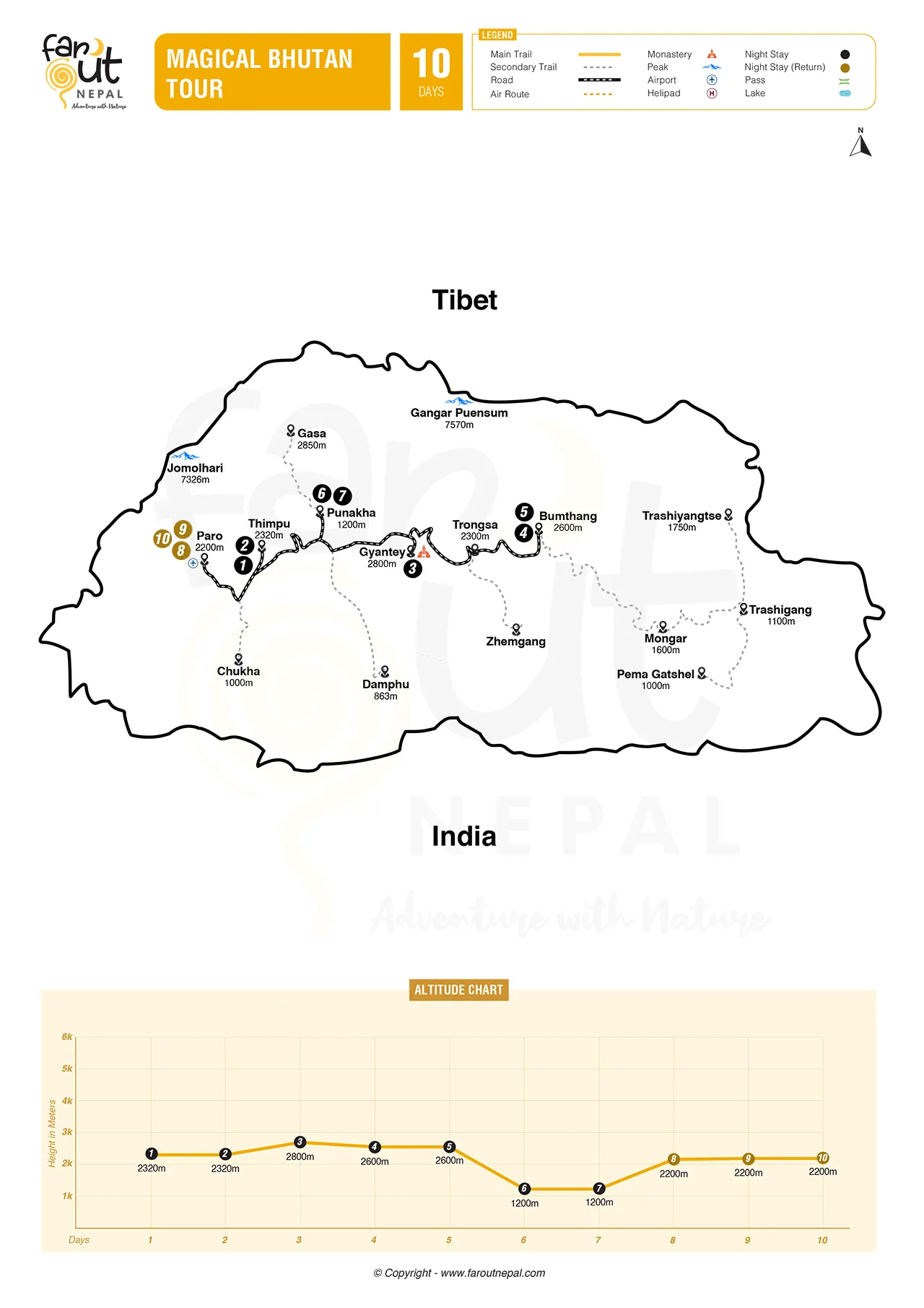
Trip map of Magical Bhutan Tour
Trip Information
Duration of the Magical Bhutan Tour
The Magical Bhutan Tour is a carefully designed 10-day journey covering the cultural and spiritual regions of Western and Central Bhutan.
- The itinerary is structured to balance travel time, sightseeing, and rest
- Each region is paced to allow gradual altitude and cultural immersion
- The 10-day format ensures coverage of both major highlights and deeper valleys like Gangtey and Bumthang
Who This Tour Is Suitable For
This Bhutan tour is ideal for travelers who enjoy cultural exploration with light physical activity.
- Suitable for most age groups with basic mobility
- Ideal for culture-focused travelers rather than high-intensity trekkers
- Recommended for those comfortable with walking tours and moderate hikes
- Not suitable for travelers requiring fully sedentary travel programs
- No advanced trekking experience is required.
Overall Activity Level
This tour falls into the Easy to Moderate activity category.
- Most sightseeing involves short walks around monasteries, dzongs, and villages.
- Daily travel is by private vehicle with frequent scenic stops
- Some days include light hiking or nature trails
- Pace is designed to allow rest and acclimatization
This makes the tour accessible to a wide range of travelers, including first-time visitors to the Himalayas and those looking for a complete Bhutan experience without rushing through destinations.
Best Time to Visit Bhutan
Bhutan can be visited throughout the year, but the experience changes significantly depending on the season. Weather conditions directly affect the visibility of the Himalayas, festival activity, road travel, and overall comfort during sightseeing and trekking.
The Magical Bhutan tour is best experienced in seasons that offer clear mountain views, stable weather, and cultural vibrancy, especially across Western and Central Bhutan, where altitude and climate vary along the route.
Bhutan in Spring (March–May)
Spring is one of the most visually rewarding times for the Magical Bhutan Tour. You can see the valleys and forests come alive with blooming rhododendrons and fresh greenery across the Himalayan landscape.
- Clear and pleasant weather across Paro, Thimphu, and Punakha
- Rhododendron blooms in higher altitude regions like Gangtey and Dochula Pass
- Ideal conditions for hiking, including the Tiger’s Nest Monastery trek
- Good balance of temperature and visibility across the entire route
Best for travelers who want vibrant landscapes and comfortable touring conditions.
Bhutan in Autumn (September–November)
Autumn is widely considered the best overall season for the Magical Bhutan tour due to its stable weather and exceptional mountain visibility.
- Crystal-clear Himalayan views, especially from mountain passes
- Dry and stable conditions are ideal for long road journeys
- Major festivals (Tsechus) often take place during this period
- Excellent photography conditions across all regions
Best for travelers prioritizing visibility, culture, and reliable travel conditions.
Visa Information
All visitors need a visa to enter Bhutan, except for visitors from India, who require a permit. Nationals of Bangladesh and the Maldives, as well as nationals of Switzerland and Thailand who hold diplomatic or government-official passports, are also eligible for a visa on arrival at their port of entry.
Visitors from India will need a permit to enter Bhutan and are required to hold an Indian passport or an Indian voter ID card. Indian nationals under the age of 18 may enter with a birth certificate or passport and must be accompanied by a legal guardian. Indian nationals are eligible for a permit on arrival, but it is recommended that a permit be obtained in advance to reduce the processing time at the port of entry.
How do I apply for the visa or permit?
Tourists can apply for their visa or permit through this website (Bhutan Immigration Services Portal), or the option is you can buy a package tour from the License Tour Operator, and they will assist you in all the arrangements, like obtaining a visa, booking accommodation, and sightseeing tour, etc.
Although Bangladeshi and Maldivian tourist can process their visas on arrival at the port of entry and Indian tourists can process their permits on arrival, it is recommended that these be applied for in advance to reduce the wait time at the port of entry.
What documents do I need for a visa?
For Tourist:
- Digital copy of the passport
- Passport validity: Minimum 6 months from the intended date of departure from Bhutan
- Recent digital Passport-size photograph
- Proof of occupation
- Contact details
- Travel insurance (recommended)
For Non-Tourist
For non-tourists, visit doi.gov.bt
Charges/Fee:
The visa will be processed by the Tourism Council of Bhutan (TCB) once the full payment of the visa fee, USD $40, and the SDF fee, USD $100 per person per night. Once the payment has been made, they will process and issue the clearance letter.
For those who are booking through the agency, you will need to make a full payment of your entire tour then the company will process obtaining the visa. To receive the visa clearance letter, it might take a couple of days, depending on the season.
At your point of entry, you will be required to show your visa clearance letter, and the visa will then be stamped into your passport.
Customs Declaration:
Bhutan follows strict but clear customs regulations to protect its cultural and environmental integrity.
- All travelers must complete a customs declaration form
- Personal-use electronics (cameras, laptops, binoculars) must be declared
- Items such as antiques, weapons, narcotics, and wildlife products are prohibited
- Customs officers may inspect baggage if required
Traveler’s Notes:
Bhutan maintains strict entry regulations to preserve its cultural and environmental integrity, so it is important to ensure all documents are accurate and submitted on time.
- Visa clearance must be completed before boarding your flight to Bhutan
- Entry is only permitted through Paro International Airport for international travelers
- Indian citizens follow a separate entry permit system and do not require a visa
Once approved, your visa ensures seamless entry and coordination upon arrival in Bhutan.
Physical Fitness Required for Bhutan
The Magical Bhutan Tour is designed as a moderate-paced cultural journey, but it does include a few active components such as walking tours, monastery visits, and a full-day hike to Tiger’s Nest. Overall, it is suitable for most travelers with average fitness levels who are comfortable walking for a few hours at a time.
Tiger’s Nest Hike (Key Physical Activity)
The most physically demanding part of the itinerary is the hike to Tiger’s Nest Monastery (Taktsang) on Day 09.
- Total hiking time: approximately 4–5 hours round trip
- Steady uphill trail through pine forests with rest stops along the way
- Elevation gain of around 900 meters from the valley floor
- Horse support is available for part of the ascent (optional, at extra cost)
While challenging, the hike is manageable for most reasonably fit travelers and is considered a highlight of the entire journey.
What to Expect Physically
Daily travel and sightseeing are designed to be comfortable, with flexibility built into the itinerary.
- Some walking on uneven terrain, especially in rural areas
- Occasional long drives between valleys (with scenic breaks)
- Higher altitude regions may feel slightly more tiring initially
- Ample time is included for rest and adjustment
The itinerary is intentionally paced to balance exploration and relaxation.
Sustainable Development Fee (SDF)
Bhutan follows a unique “High Value, Low Impact” tourism model designed to preserve its culture, environment, and way of life. A key part of this system is the Sustainable Development Fee (SDF), a mandatory government levy applied to all international visitors.
Instead of being a separate hidden charge, the SDF is included in your tour package, so you don’t have to manage or calculate it separately. Its purpose is to ensure that tourism directly contributes to Bhutan’s long-term sustainability.
Photography Guidelines in Bhutan
Bhutan is an exceptionally photogenic destination, with dramatic Himalayan landscapes, ancient monasteries, prayer flags, and traditional village life. However, photography here is also guided by strong cultural and religious respect, especially inside sacred spaces. Photography is widely allowed in outdoor areas, but restrictions apply in religious and sensitive sites.
- Photography is allowed in most outdoor landscapes and village areas
- Always ask permission before photographing people
- Respect local customs and avoid intrusive or staged photography
- Drones are generally restricted and require special permission
Monasteries & Religious Sites
Bhutan’s monasteries and temples are active places of worship, and strict rules apply inside sacred areas.
- Photography is not allowed inside shrine rooms and inner sanctums
- Some monasteries allow photography in courtyards only
- Always follow your guide’s instructions at each site
- Remove hats and remain respectful when entering religious spaces
Tiger’s Nest & Scenic Locations
Outdoor photography opportunities are among the highlights of the tour, especially at iconic locations.
- Tiger’s Nest viewpoint offers one of the most photographed Himalayan scenes.
- Mountain passes like Dochula provide panoramic landscape shots
- Valleys such as Phobjikha and Bumthang are ideal for nature photography
- Early morning and late afternoon light offer the best conditions
Practical Tips
A few simple preparations will help you make the most of your photography experience.
- Carry extra batteries and memory cards (limited availability locally)
- Use protective gear for dust and mountain weather conditions
- Keep your camera secure during hikes and on uneven terrain
- Be mindful of cultural sensitivity when composing shots
Accommodation in Bhutan
The accommodation is carefully selected to match the country’s regulated tourism standards while ensuring comfort, cleanliness, and an authentic cultural experience. Across this 10-day journey, Bhutan’s hospitality infrastructure varies between urban centers like Thimphu and Paro and more remote valleys such as Gangtey and Bumthang.
This variation is part of what makes the journey feel natural, immersive, and connected to the landscape.
Standard Accommodation
This itinerary is based on government-approved standard hotel categories that ensure comfort while maintaining Bhutan’s sustainable tourism model.
- Accommodation is based on comfortable 3-star category hotels
- Rooms include basic modern amenities with clean, reliable facilities
- Properties are selected for safety, hygiene, and location convenience
- In rural regions, accommodations may include boutique lodges or family-run stays
Upgrade Options
For travelers seeking a more premium experience, upgraded accommodation options are available in selected locations.
- Luxury 4–5 star hotels available in Paro, Thimphu, and Punakha
- Boutique resorts offering valley or river views in select regions
- Premium wellness-focused properties in high-demand areas
- Custom upgrades can be arranged based on budget and preference
Upgrades are subject to availability and seasonal demand. If you prefer higher-end properties, please let us know in advance.
Regional Accommodation Differences
Accommodation style varies depending on the destination you are visiting during the tour.
- Paro & Thimphu: Wider range of hotels from standard to luxury categories
- Punakha: Scenic riverside lodges and boutique properties
- Gangtey (Phobjikha Valley): Simple, peaceful lodges focused on nature immersion
- Bumthang: Traditional-style accommodations reflecting local Bhutanese culture
What to Expect in Bhutan
Bhutan’s accommodation is not designed for luxury excess but for meaningful comfort within a culturally immersive environment.
- Clean and safe rooms with essential facilities
- Warm Bhutanese hospitality in all regions
- Limited but reliable luxury options in major towns
- Strong focus on environmental and cultural harmony
The experience is intentionally simple, peaceful, and closely connected to Bhutan’s natural surroundings.
Food & Meals in Bhutan
Food in Bhutan is an essential part of the travel experience, offering a mix of traditional Bhutanese cuisine, Indian-inspired dishes, and simple international options.
Throughout this 10-day tour, meals are included in your tour package and are typically served in hotels or selected local restaurants along the route. Your Bhutan tour includes daily meals to ensure convenience and consistency throughout the journey:
- Breakfast, lunch, and dinner are included in the package
- Meals are usually served buffet-style in hotels or designated restaurants
- Options typically include Bhutanese, Indian, and vegetarian dishes
- In larger towns like Paro and Thimphu, limited Western and Chinese options are also available
Bhutanese Cuisine
Bhutanese food is known for its bold flavors, especially its use of chili and cheese, which form the foundation of many traditional dishes.
- Local dishes are often spicy and chili-based (a key part of Bhutanese cuisine)
- Popular dishes include Ema Datshi (chili and cheese stew), vegetable curries, and rice-based meals.
- Red rice is commonly served as a staple across most regions
- Meals are simple, hearty, and designed for the Himalayan climate
Food Safety & Hygiene
Food hygiene standards in Bhutan are generally good, especially in hotels and licensed restaurants included in the itinerary. However, basic travel precautions are still recommended.
- Drink only bottled or purified water throughout the trip
- Avoid tap water, fountain drinks, and ice cubes
- Eat only well-cooked food served in trusted establishments
- Peel fruits and avoid raw salads unless hygiene is confirmed
These simple precautions ensure a safe and comfortable travel experience. Your tour guide can assist in coordinating dietary preferences throughout the journey. Make sure to let us know in advance.
Money, Currency & ATMs for Bhutan
Understanding how money works in Bhutan is important because the country operates with a cash-first travel system, especially outside major towns. While modern payment options exist in some places, most travel expenses during your tour will be handled in cash.
Cash & Currency in Bhutan
The official currency of Bhutan is the Ngultrum (BTN), which is pegged to the Indian Rupee.
- 1 USD ≈ 86 BTN (approximate, subject to fluctuation)
- Indian Rupees are widely accepted in Bhutan (except ₹500/₹2000 notes in some cases)
- USD, EUR, and GBP can be exchanged in major towns
- Smaller denominations are easier to use in rural areas
Bhutan is still a largely cash-based economy, especially in remote valleys like Gangtey and Bumthang.
- Cash is required for small shops, local markets, and rural areas
- Credit cards are accepted only in select hotels and handicraft stores
- ATMs are limited and not always reliable outside Paro and Thimphu
- Carry sufficient cash for personal expenses and emergencies
ATM & Card Facilities
ATM access exists, but should not be relied upon as your primary source of money.
- ATMs are available in Paro and Thimphu
- Withdrawal limits may be low, and machines can be inconsistent
- Visa and MasterCard are accepted at a few high-end establishments
- Network downtime is common in rural areas
Best Practices for Carrying & Spending Money
Your core travel costs are already included in the package, but personal expenses vary depending on individual preferences.
- Recommended cash: USD $30–50 per person per day
- Covers souvenirs, snacks, drinks, and optional activities
- Higher budget recommended for luxury upgrades or personal shopping
- Keep emergency reserve cash separate from daily spending
- Carry USD in good condition (no tears or damage)
- Prefer smaller denominations for easier transactions
- Keep money in multiple secure locations (not all in one place)
- Exchange currency only at authorized counters or banks
Safety & Travel Insurance for Bhutan
Bhutan is widely regarded as one of the safest travel destinations in the world, with extremely low crime rates and a strong culture of hospitality. Travelers can move freely and comfortably throughout the country, including cities, valleys, and rural regions.
Bhutan maintains a peaceful and stable environment for both locals and visitors. The country has a very low crime rate across all regions. Locals are generally helpful, respectful, and welcoming to tourists, making it safe for solo travelers, couples, and group tours. Public spaces, hotels, and transport are also considered secure. Most travelers experience Bhutan as a calm, relaxed, and secure destination.
However, due to Bhutan’s mountainous terrain and limited emergency infrastructure in remote areas, it is important to travel responsibly and be prepared with adequate insurance coverage.
Travel Insurance for Bhutan (Highly Recommended)
While Bhutan is safe, travel insurance is strongly recommended due to the nature of travel in mountainous regions.
- Covers medical emergencies and unexpected illness
- Recommended for trip delays or cancellations
- Important for evacuation coverage in remote areas
- Should include adventure or high-altitude travel coverage
Personal Safety Tips
Although Bhutan is very safe, standard travel precautions are still advised.
- Keep valuables secure and use hotel safes where available
- Carry essential documents in a secure travel pouch
- Avoid leaving belongings unattended in public areas
- Follow the guide’s instructions during hikes and excursions
Emergency Support
Your tour includes local support throughout the journey.
- A licensed Bhutanese guide accompanies you throughout the trip
- Assistance available for medical, travel, or logistical emergencies
- Coordination with local services in case of urgent situations
- Reliable communication channels in major towns
Medical Facilities
Medical infrastructure is available but limited outside major towns.
- Basic and emergency medical services are available in Paro and Thimphu
- Rural valleys have limited healthcare facilities
- Serious cases may require transfer to larger towns
- Your guide assists in coordinating medical support if needed
Being prepared ensures a quick response in case of any health issues.
Connectivity Situation in Bhutan
Bhutan has improved, but still has limited connectivity compared to most modern travel destinations. This is part of Bhutan’s preserved Himalayan infrastructure, where digital access is balanced with environmental and cultural priorities. Internet and mobile networks are available in major towns, but can be slower or intermittent in remote valleys such as Gangtey and Bumthang.
- Expect occasional network breaks during long drives
- Some monasteries and high-altitude regions have no signal
- This allows for a more immersive, distraction-free experience
- Communication is easily restored in the next town or hotel
Mobile Network in Bhutan
Mobile coverage is available across most populated regions, especially along your travel route.
- Local SIM cards are available from Bhutan Telecom and TashiCell
- Coverage is strong in Paro, Thimphu, and Punakha
- The signal may be weaker or intermittent in remote valleys like Gangtey and Bumthang.
- Prepaid SIMs can be easily purchased on arrival with a passport copy
Internet Connection
Internet access is available in most hotels, though speeds may vary depending on location.
- WiFi is available in most hotels included in the tour
- Speed is generally good in cities, slower in rural areas
- Connectivity may drop during travel between valleys and passes
- Cafés and public internet access are limited outside major towns
eSIM & International Roaming
Bhutan currently does not fully support modern eSIM systems in the same way as larger countries.
- eSIM options are not widely available locally
- International roaming may work, but it can be expensive
- Local SIM cards remain the most practical solution
- Your guide can assist with SIM setup upon arrival
Electricity & Power in Bhutan
Bhutan’s electricity system is generally reliable in cities and major towns like Paro, but like many Himalayan destinations, supply can be less stable in remote valleys and during adverse weather conditions. Most hotels included in your tour are equipped with backup arrangements, but occasional short outages can still occur in rural regions.
Voltage & Frequency
Bhutan uses a standard South Asian power system compatible with most international electronics.
- Voltage: 220–240V; Frequency: 50Hz
- Most modern chargers (phones, cameras, laptops) are compatible without converters.
- Common plug types: C, D, and G
- Type D is most commonly found in older hotels
- Types C and G are more common in newer and upgraded properties
- A universal travel adapter is highly recommended for convenience
Practical Tips for Travelers
A few simple preparations will ensure uninterrupted use of your devices during the trip.
- Fully charge devices before long drives or excursions
- Carry a power bank for remote travel days
- Bring a universal plug adapter
- Avoid relying on continuous charging in rural lodges
These small steps help ensure your electronics remain functional throughout the journey.
Concluding Your Magical Bhutan Journey
The Magical Bhutan Tour (10 Days) is designed as a complete journey through Western and Central Bhutan, bringing together the country’s most iconic landscapes, spiritual landmarks, and living cultural traditions in a single, well-paced itinerary.
From the arrival in Paro to the final hike to Tiger’s Nest Monastery, every day is structured to offer a gradual immersion into Bhutan’s unique rhythm of life.
This is not just a sightseeing itinerary. It is a curated Himalayan experience that balances exploration with reflection, allowing you to move through valleys, monasteries, and villages at a pace that feels natural and meaningful.
A Journey That Stays With You
Bhutan leaves a lasting impression, not through scale or luxury, but through its silence, its landscapes, and its deeply rooted way of life. The monasteries, valleys, and mountain passes are not just destinations, but moments that stay with you long after the journey ends.
From prayer flags on high passes to the quiet presence of ancient monasteries, this tour offers a rare opportunity to experience a country that has preserved its identity in a rapidly changing world.
Whether you are seeking a cultural immersion, a spiritual retreat, or a Himalayan adventure, this Bhutan tour can be tailored to match your travel style → Get in touch with us to customize your 10-day Bhutan experience or combine it with Nepal for a broader Himalayan journey.
Frequently Asked Questions
What is the Magical Bhutan Tour?
The Magical Bhutan Tour is a guided multi-day cultural journey through Bhutan covering major destinations like Paro, Thimphu, and Punakha, with monastery visits, Himalayan landscapes, traditional architecture, and Bhutanese cultural experiences.
How many days are ideal for a Bhutan tour?
A Bhutan tour is ideally 7 to 10 days long, allowing enough time to explore Bhutan’s main cultural valleys, monasteries, scenic routes, and spiritual landmarks without rushing the experience.
What is included in a Bhutan tour package?
Most Bhutan tour packages include accommodation, meals, licensed guide services, private transportation, sightseeing, permits, and government tourism fees required for international visitors.
What places are covered in the Magical Bhutan Tour?
The Magical Bhutan Tour usually covers Paro, Thimphu, and Punakha, including attractions such as Tiger’s Nest Monastery, Punakha Dzong, Buddha Dordenma, and scenic Himalayan valleys.
What is the best time to visit Bhutan?
The best time to visit Bhutan is during spring (March–May) and autumn (September–November), when the weather is pleasant, mountain visibility is clear, and Bhutan’s major cultural festivals take place.
Is Bhutan suitable for luxury travel?
Yes, Bhutan is considered one of Asia’s leading luxury travel destinations due to its exclusive tourism model, premium hospitality, peaceful landscapes, and curated cultural experiences.
Do I need a tour operator to visit Bhutan?
Yes, international travelers must book Bhutan trips through licensed Bhutan tour operators, as independent tourism is restricted under Bhutan’s regulated travel system.
What makes Bhutan tours unique?
Bhutan tours are unique because they combine Himalayan scenery, Buddhist culture, sustainable tourism, and limited visitor numbers, creating a more peaceful and immersive travel experience.
What is the typical Bhutan tour itinerary?
A typical Bhutan tour itinerary includes arrival in Paro, sightseeing in Thimphu, visits to Punakha Valley, monastery exploration, and the hike to Tiger’s Nest before departure.
What is Tiger’s Nest Monastery in Bhutan?
Tiger’s Nest Monastery, also known as Paro Taktsang, is Bhutan’s most famous monastery, built on a cliffside above Paro Valley, and is one of the country’s most important spiritual landmarks.
Are Bhutan tours suitable for families and seniors?
Yes, most Bhutan cultural tours are suitable for families and seniors because they involve comfortable travel routes, moderate sightseeing, and flexible itineraries.
What type of accommodation is available on Bhutan tours?
Bhutan tours offer accommodation ranging from standard 3-star hotels to luxury resorts and wellness lodges, depending on the travel package selected.
Can Bhutan tours be combined with Nepal tours?
Yes, Bhutan tours are commonly combined with Nepal itineraries, especially Kathmandu and Himalayan cultural routes, creating a broader Himalayan travel experience.
Is Bhutan expensive for tourists?
Bhutan is generally considered a premium destination because of its regulated tourism policy, which prioritizes sustainable, low-volume tourism over mass travel.
Why choose a guided Bhutan tour package?
A guided Bhutan tour package simplifies permits, transport, accommodation, and local logistics while providing cultural insights through licensed Bhutanese guides.
Reviews on Magical Bhutan Tour
Special Savings and Discounts for Group Travelers!
-
1 -
person
US$ 2,700.-
-
2 -
5 person
US$ 2,340.-
-
6 over
9999
US$ 2,300.-
US$ 2