


Dhaulagiri 17 Days Trek

Dhaulagiri 17 Days Trek

Dhaulagiri 17 Days Trek

Dhaulagiri 17 Days Trek

Dhaulagiri 17 Days Trek
Dhaulagiri Trek

Activity
Trek
Duration
17 Days
Grading
Challenging
Max Altitude:
5,360m. / 17,585ft.
Best Season
April & October
Style of Trip
Camping Trek
Group Size
2 - 12 People
Accommodation
Hotel and Camping
Meals
Breakfast, Lunch, Dinner
Why Choose the Dhaulagiri Circuit Trek?
The Dhaulagiri Circuit Trek is not just another high-altitude route in Nepal, but a full-scale Himalayan expedition that demands preparation, resilience, and a genuine appetite for remote wilderness, unlike more commercialized trails in the Everest or Annapurna regions.
- A Challenging Experience: The circuit trail is one of the most challenging treks in Nepal. It is designed for experienced trekkers who are comfortable with sustained altitude and physically intense conditions.
- One of the most Remote: This is a remote trek compared to the popular trek routes, with days spent on a challenging trail and minimal human settlement. It offers long stretches of uninterrupted natural terrain and true isolation.
- Expedition at its core: The lower section of the trail has an option of simple basic lodges. However, at higher altitudes, a full-style expedition setup is required, including camping logistics, support staff, and technical equipment, forming an essential part of the journey rather than optional support.
- Cross 5000+m: Overnight stays in extremely high-altitude environments such as Hidden Valley (5,100 meters) or French Pass (5,300m), where acclimatization and endurance become critical parts of the experience.
- Mountaineering Addition: The trek includes glacier walking and high-altitude crossings where equipment such as crampons, ice axes, helmets, and fixed ropes may be necessary under guide supervision.
- Culture & Nature Symbiosis: The trek begins in traditional Magar and Gurung settlements, where agricultural landscapes and cultural villages gradually give way to increasingly remote and rugged terrain as elevation increases.
- Veterans Only: Prior experience in high-altitude trekking is strongly recommended, as sustained exposure above 5,000 meters places significant physical and mental demand on trekkers throughout the route.
- A Unique Experience: Days are spent moving through vast, silent landscapes where the scale of Dhaulagiri and its surrounding peaks dominates every horizon, and the experience gradually shifts from a trek into a once-in-a-lifetime experience.
Trip Introduction
Dhaulagiri Circuit Trek Overview
The Dhaulagiri Circuit Trek is a true high-altitude expedition in western Nepal. This trek is designed for experienced trekkers who are prepared for long, remote, and physically demanding days in alpine terrain. Unlike standard teahouse treks, this route moves deep into isolated valleys surrounding the Dhaulagiri massif, where glacier crossings, high passes, and camping-based logistics define the entire journey.
This trek is widely regarded as one of the most challenging routes in Nepal. This is not only because of its elevation gains but also due to the sustained wilderness exposure and technical nature of certain sections. The experience gradually transitions from forested valleys into glacial landscapes. Trekkers eventually reach extreme high-altitude environments such as French Pass and Hidden Valley, where weather and terrain conditions become significantly more demanding.
- Mount Dhaulagiri I rises to 8,167 meters, making it the seventh-highest mountain in the world and the central feature of this massive Himalayan circuit.
- The surrounding Dhaulagiri range includes fifteen peaks above 7,000 meters, creating a continuous wall of high Himalayan terrain throughout the trek.
What ultimately defines the Dhaulagiri Circuit Trek is not just its difficulty. It’s also the progression into increasingly extreme environments where the landscape becomes more glaciated, the air thinner, and the margin for error significantly smaller. This makes it a true Himalayan expedition rather than a conventional trek.
Quick Facts of the Dhaulagiri Trek
- Duration: 17 Days
- Maximum Altitude: ~5,360m (French Pass)
- Difficulty: Very Strenuous / Expedition Level
- Trek Type: Camping + Glacier Crossing Expedition
- Best Season: Spring (Mar–May) & Autumn (Oct–Nov)
- Starting Point: Beni (accessible from Pokhara by road)
- Ending Point: Marpha / Jomsom region (varies by itinerary)
- Permits Required: ACAP + TIMS (plus guide-led expedition management recommended)
- Key Highlights: Italian Base Camp, Dhaulagiri Base Camp, Hidden Valley, French Pass, Dhampus Pass
- Terrain Type: Forest trails, river valleys, moraine fields, glacier crossings, high alpine passes
- Physical Preparation Level: High fitness required, with prior multi-day trekking experience strongly recommended
So, are you ready to take on the Dhaulagiri trekking challenge? If yes, get in touch with our Dhaulagiri Expedition Experts.
Dhaulagiri Circuit Trek Route Overview
The journey begins near Beni and gradually ascends through rural settlements, forested terrain, and river valleys before reaching the remote base camp zones of the Dhaulagiri range. From here, the route advances into glacial regions leading toward high passes and the Hidden Valley.
The Dhaulagiri Circuit
Beni (830m) → Darbang (~1,180m) → Muri (~1,850m) → Italian Base Camp (~3,660m) → Dhaulagiri Base Camp (~4,750m) → French Pass (5,360m) → Hidden Valley (~5,200m) → Dhampus Pass (~5,240m) → Marpha (~2,670m) (Exit point)
- The route begins in lowland river valleys and gradually ascends into glacier-dominated alpine terrain.
- The most technical sections occur between Dhaulagiri Base Camp → French Pass → Hidden Valley.
- The descent via Dhampus Pass to Marpha reconnects with the Annapurna region.
Dhaulagiri Icefall: What to Expect
The Dhaulagiri Icefall section is one of the most technically sensitive and visually extreme parts of the entire circuit. This is where the route transitions directly across glacial formations and unstable ice structures formed by the movement of the Dhaulagiri glacier system.
This section requires careful navigation under supervision, as conditions can change rapidly depending on temperature and snowfall, making timing and decision-making critical for safety.
- The icefall consists of broken glacier formations, crevasses, and shifting ice structures that require careful route selection and expert guidance.
- Trekking through this zone often involves the use of technical equipment such as crampons, ropes, and helmets, depending on seasonal conditions.
- It is considered one of the highest-risk segments of the entire circuit, requiring strict adherence to guide instructions and group coordination.
- The terrain is physically demanding and mentally intense, as movement is slow, controlled, and highly dependent on weather stability and ice conditions.
This section reinforces the expedition nature of the Dhaulagiri Circuit Trek, where standard trekking transitions into a controlled high-altitude mountaineering environment.
Dhaulagiri Base Camp Explained
The Dhaulagiri Base Camp segment forms an essential part of the overall circuit, offering a direct view into the heart of the massif and serving as a critical acclimatization and progression zone before entering higher and more technical terrain.
About the Dhaulagiri Base Camp
Dhaulagiri Base Camp is a remote high-altitude campsite located at the base of the Dhaulagiri massif, surrounded by glaciers, ice walls, and steep alpine terrain that marks the transition into the expedition phase of the trek.
Italian Base Camp Dhaulagiri
Italian Base Camp serves as an early high-altitude staging point on the route, often used for initial acclimatization and preparation before moving deeper into the Dhaulagiri region.
Base Camp vs Circuit Trek
While the base camp trek focuses primarily on reaching the foothills of the massif, the circuit trek extends far beyond this point, crossing glaciers, high passes, and remote valleys to complete a full loop around the Dhaulagiri range.
Trek Challenges and Considerations: Dhaulagiri Trek
The Dhaulagiri Circuit Trek is not just physically demanding. It also requires careful planning, risk awareness, and the ability to operate in remote, high-altitude environments where external support is extremely limited. Understanding these challenges beforehand is critical for both safety and overall success on the route.
- High altitude exposure and acclimatization risk: Despite planned acclimatization days, trekkers spend extended periods above 4,000 meters, where the risk of Acute Mountain Sickness (AMS) remains significant and can escalate quickly without proper pacing and monitoring.
- Rugged and technically demanding terrain: The route includes steep ascents, loose moraine, glacier crossings, and uneven, rocky trails, requiring strong footing, endurance, and in some sections, the use of technical equipment under guide supervision.
- Unpredictable high-altitude weather conditions: Weather patterns can shift rapidly, especially near French Pass and Dhampus Pass, where snowfall, strong winds, and low visibility can impact both safety and route accessibility.
- Remoteness and lack of infrastructure: Large sections of the trek have no access to medical facilities, communication networks, or modern amenities, meaning evacuation and emergency response can be delayed and highly dependent on logistics.
- Seasonal route closures and pass conditions: Heavy snowfall, particularly during shoulder seasons or unexpected weather shifts, can block key high passes, forcing itinerary changes or, in some cases, early termination of the trek.
Detail itinerary of Dhaulagiri Trek
Day 01: Arrival in Kathmandu
Your journey begins with your arrival at Tribhuvan International Airport in Kathmandu. First, you will complete immigration formalities, including visa processing, before collecting your luggage and proceeding to the arrival area. A representative from Far Out will be waiting outside the terminal with a display board to welcome you and coordinate your transfer to the hotel.
Once checked in, you can take time to rest after your journey or explore the nearby surroundings, depending on your arrival time. Later in the day, a detailed trek briefing will be done by our team. Here, you will be introduced to the expedition plan, route conditions, safety protocols, and final gear checks to ensure you are fully prepared for the Dhaulagiri Circuit Trek.

Activity: Airport transfer: Approx. 30m

Location: Kathmandu

Max. Altitude: 1,300m/4,265ft.

Accommodation: Hotel

Meal: NA
Day 02: Kathmandu Sightseeing & Trek Preparation
The day is dedicated to final trek preparations along with a guided cultural tour of Kathmandu Valley. You can experience Nepal’s heritage while we ensure all logistics are in place before departure. The city guide meets you at the hotel and begins the tour with a visit to Swayambhunath Stupa. It’s an ancient Buddhist site perched on a hilltop overlooking the valley, believed to be over 2,000 years old. It is also known for its panoramic views and spiritual significance.
From here, you will drive approximately 18 kilometers east to Bhaktapur Durbar Square. It’s a historic royal palace complex renowned for its well-preserved temples, intricate wood carvings, and traditional Newari architecture. The day concludes with a visit to Pashupatinath Temple, one of the most sacred Hindu temples in the world. It’s located along the banks of the Bagmati River and serves as an important spiritual and ceremonial site.
After the tour, you will have time for any last-minute gear checks or shopping before returning to the hotel, where final preparations for the Dhaulagiri trek will be completed.
Activity: Preparation + Tour
Location: Kathmandu
Max. Altitude: 1,300m/4,265ft.
Accommodation: Hotel
Meal: Breakfast
Day 03: Fly to Pokhara | Drive to Muri
After breakfast, the journey officially begins with a short scenic flight from Kathmandu to Pokhara. Upon arrival, you continue by road toward Beni, the administrative center of Myagdi district and the traditional starting point for the Dhaulagiri Circuit Trek.
After a brief stop for lunch in Beni, the route transitions into a rugged off-road drive toward Muri, along the Myagdi Khola. The journey passes through forested sections, terraced farmlands, and scattered hillside settlements. The trek gradually moves deeper into more remote terrain as the road conditions become rough and unpaved.
As the drive progresses, you may begin to catch intermittent views of the Dhaulagiri massif. By late afternoon or evening, you will arrive in Muri. This is a traditional hillside village that serves as the first overnight stop and marks the transition from road travel to trekking in the days to come.
Activity: 30 minuts flight + 8 hrs. drive
Location: Muri
Max. Altitude: 1,740m/5,709ft.
Accommodation: Lodge
Meal: Breakfast, Lunch, Dinner
Day 04: Trek to Boghara/Bagar
The true beginning of the trekking phase begins today as you leave Muri behind and enter the remote trails of the Dhaulagiri.
The day starts with clear morning views of the Dhaulagiri range. This sets the tone for the journey ahead as the landscape begins to shift from cultivated hillsides to more rugged and forested terrain. The trail descends steeply from the village, where the path can be narrow and uneven in sections, with dense bamboo and rhododendron forests covering it.
As you progress, the route gradually turns northward, entering a deeper valley where the surroundings become more isolated and dramatic. You’re also welcomed by wider views opening across the river gorge and surrounding hills.
The day concludes with a steady walk toward Boghara (also referred to as Bagar), a small settlement located along the river valley. We will set up camp for the night here and begin adjusting to the rhythm of expedition-style trekking.
Activity: Trek: Approx. 5hrs
Location: Boghara
Max. Altitude: 2,000m/6,562ft.
Accommodation: Tented Camp
Meal: Breakfast, Lunch, Dinner
Day 05: Trek to Dobang
After breakfast, the trail continues deeper into the Dhaulagiri region as you follow the Myagdi Khola upstream through increasingly dense forest.
The day begins with a steady ascent from the campsite near Boghara. As you progress, the route becomes more scenic and distinctive, passing beneath towering cliffs where traditional honey-hunting sites with large natural beehives suspended on rock faces can be seen.
The trail remains varied throughout the day, alternating between gradual climbs and flatter forested stretches, maintaining a consistent but manageable pace. A midday stop at Lipshe for lunch provides a brief rest before continuing deeper into the valley.
By late afternoon, you arrive at Dobang, a forest clearing that serves as a common campsite along the route. From here, the surrounding landscape begins to open slightly, and on clear days, you are rewarded with distant yet impressive views of the Dhaulagiri massif.
Activity: Trek : Approx. 6hrs
Location: Dobang
Max. Altitude: 2,260m/7,415ft.
Accommodation: Tented Camp
Meal: Breakfast, Lunch, Dinner
Day 06: Trek to Sallaghari
Today’s trek continues through thick, moisture-rich forest as the trail gradually gains elevation and the environment becomes more alpine. The route winds through dense vegetation with sections of narrow trail that require steady footing as you move deeper into the valley.
Early in the day, you cross the Konaban Khola and begin a steady climb toward a natural viewpoint that reveals striking views of Dhaulagiri’s west face. This marks one of the first close and dramatic perspectives of the massif toward the high mountain zone. We will then reach the valley via a cantilever bridge to the east bank of the Myagdi Khola, adding a distinct structural and visual highlight to the route.
After crossing the river, the trail eases slightly before reaching Sallaghari, a quiet forest clearing surrounded by pine and alpine vegetation. This campsite offers a more open setting compared to previous days, with a noticeable shift in atmosphere as you move closer to the high-altitude sections of the Dhaulagiri Circuit.
Activity: Trek: Approx. 6 ½hrs
Location: Sallaghari
Max. Altitude: 3,010m/9,875ft.
Accommodation: Tented Camp
Meal: Breakfast, Lunch, Dinner
Day 07: Trek to Italian Base Camp
The trek gradually gains altitude as you move further into the shifting upper alpine valley. After crossing the Choriban Khola, the dense forest starts to thin out, revealing wider views and the first close perspective of Dhaulagiri I’s massive west face.
The trail continues through sections of bamboo and scattered vegetation before ascending steadily toward Italian Base Camp. This scenic campsite is positioned directly beneath the towering west wall of Dhaulagiri. The setting here is dramatic, with steep rock and ice faces rising above the valley, marking a clear transition from forested trekking terrain into the high mountain zone.
Activity: 4hrs Walk
Location: Italian Base Camp
Max. Altitude: 3,600m/11,811ft.
Accommodation: Tented Camp
Meal: Breakfast, Lunch, Dinner
Day 08: Italian Base Camp: Acclimatization Day
We reserved today for acclimatization. This allows your body to adjust to the increasing altitude before moving further into higher and more demanding terrain. You can take a short hike around the surrounding ridgelines if you feel well, helping with acclimatization while enjoying closer views of the Dhaulagiri massif.
Others can rest at camp and recover, as proper acclimatization is critical for the days ahead, as altitude gain becomes more significant. The dramatic setting beneath the west face of Dhaulagiri makes this a rewarding place to rest. You can observe the changing mountain conditions and prepare for the next phase of the trek.
Activity: Rest & Acclimatization
Location: Italian Base Camp
Max. Altitude: 3,600m/11,811ft.
Accommodation: Tented Camp
Meal: Breakfast, Lunch, Dinner
Day 09: Trek to Glacier Camp
This is a shorter but more technical day as you move into true glacial terrain. You will have gradual acclimatization today while adapting to changing ground conditions. The trail descends from Italian Base Camp to the lateral moraine before transitioning onto the Chhonbardan Glacier, where the landscape shifts to ice and unstable rocks.
Depending on conditions, sections of the glacier may require the use of ropes for safety, as footing can be uneven and constantly changing. The pace is steady and controlled, with careful navigation through this high-altitude environment.
The day ends as we reach Glacier Camp, where tents are set up on levelled platforms along the glacier, marking your first overnight stay in a fully glaciated zone and a clear step into the expedition phase of the Dhaulagiri Circuit Trek.
Activity: Trek: Approx. 3 ½ hrs
Location: Glacier Camp
Max. Altitude: 4,200m/13,780ft.
Accommodation: Tented Camp
Meal: Breakfast, Lunch, Dinner
Day 10: Trek to Dhaulagiri Base Camp
Today’s trek takes you deeper into the high alpine zone as you follow a rugged, raw, and exposed route across glacier moraine. The trail is slow and deliberate, moving over loose rock, ice, and uneven surfaces as you approach the heart of the Dhaulagiri massif.
As you gain elevation, the landscape opens dramatically, revealing a vast glacial basin surrounded by towering Himalayan peaks. Upon reaching Dhaulagiri Base Camp (4,740m), you are completely enclosed by giants such as Mt. Mukut, Tukuche Peak, Sita Chuchura, and the immense north face of Dhaulagiri I.
The setting here is stark and powerful. You will take in an expansive field of ice and rock where the scale of the surrounding mountains becomes overwhelming, marking one of the most visually striking and remote points of the entire trek.
Activity: 4hrs Walk
Location: Dhaulagiri Base camp
Max. Altitude: 4,740m/15,551ft.
Accommodation: Tented Camp
Meal: Breakfast, Lunch, Dinner
Day 11: Dhaulagiri Base Camp: Acclimatization Day
Today is reserved for acclimatization at Dhaulagiri Base Camp. This is done for your body to adjust before crossing into higher and more demanding sections of the trek. You may take a short walk around the camp or nearby ridgelines (if conditions permit), but the focus remains on rest, hydration, and monitoring how your body responds to the altitude.
Depending on weather conditions and the overall condition of the group, the schedule may be adjusted, with the option to spend an additional night at base camp if required. This flexibility is important, as the next stage of the trek involves higher altitude exposure and more challenging terrain.
Activity: Acclimatization Day
Location: Dhaulagiri Base Camp
Max. Altitude: 4,740m/15,551ft.
Accommodation: Tented Camp
Meal: Breakfast, Lunch, Dinner
Day 12: Trek to Hidden Valley via French Pass
You will face one of the most challenging and rewarding days of the trek as you cross the highest point of the route. An early start is essential as you ascend along the Chhonbardan Glacier, moving steadily over snow and ice toward French Pass at 5,360 meters.
From the pass, you are rewarded with expansive panoramic views of surrounding peaks, including Dhampus Peak, Tukuche, and Dhaulagiri I. This is considered one of the most dramatic viewpoints of the entire journey. After taking in the views, the trail descends along moderate snowy slopes into Hidden Valley (5,050m).
Hidden Valley is a vast, isolated high-altitude plateau and the highest campsite on the trek, surrounded by snow-covered peaks and open alpine terrain. The environment here feels extremely remote and exposed, reinforcing the expedition nature of the Dhaulagiri Circuit.
Activity: Trek: Approx. 7hrs
Location: Hidden Valley
Max. Altitude: 5,050m/16,568ft.
Accommodation: Tented Camp
Meal: Breakfast, Lunch, Dinner
Day 13: Cross Dhampus Pass | Trek to Yak Kharka
This is another long and demanding day as you trek 14 km crossing Dhampus Pass (5200m), one of the final high-altitude challenges of the trek. The route involves a steady ascent over snow-covered terrain, requiring endurance and careful pacing as you approach the pass.
From the top, you are rewarded with wide panoramic views, including striking perspectives of the Annapurna range rising above deep shadowwy valleys. After spending some time at the pass, the trail descends steeply toward Yak Kharka, with terrain gradually shifting from snow and ice to more open alpine pasture.
Yak Kharka sits above the Marpha Valley and offers a noticeably different landscape after days in glaciated terrain, marking the beginning of the descent phase and a gradual return toward lower elevations.
Activity: Trek: Approx. 8hrs
Location: Yak Kharka
Max. Altitude: 5,258m/17,251ft.
Accommodation: Tented Camp
Meal: Breakfast, Lunch, Dinner
Day 14: Trek to Marpha | Drive to Pokhara
Today marks the transition out of the high mountain environment as you descend nearly 1,000 meters toward the Kali Gandaki Valley. The trail gradually leaves the alpine terrain behind, entering a drier landscape as you approach Marpha, a well-known village on the Annapurna Circuit.
Marpha is famous for its traditional stone houses, narrow alleys, and apple orchards, offering a sharp contrast to the remotely rugged sections of the Dhaulagiri region. After a short rest and time in the village, you will take a vehicle and drive to Pokhara.
The drive follows the Kali Gandaki corridor, eventually bringing you back to the relative comfort of Pokhara. We will stay here overnight and begin to unwind after completing the core section of the trek.
Activity: Trek : Approx. 3 hrs trek+ Drive Approx. 6 hrs
Location: Pokhara
Max. Altitude: 900m/2,953ft.
Accommodation: Hotel
Meal: Breakfast, Lunch
Day 15: Fly to Kathmandu from Pokhara
After breakfast, you will take a short scenic flight from Pokhara back to Kathmandu. This marks the end of the unforgettable trekking journey. On arrival, you will be transferred to your hotel.
The rest of the day is free for leisure or independent activities. You can choose to relax, explore the city, or revisit areas of interest around Kathmandu at your own pace.
Activity: Flight 30 minutes
Location: Kathmandu
Max. Altitude: 1,300m/4,265ft.
Accommodation: Hotel (Check In Time after 1400 hrs)
Meal: Breakfast
Day 16: Back Up Day in Kathmandu
This day is kept as a contingency buffer to account for any potential delays during the trek, particularly due to weather conditions or route changes in the high passes. Such flexibility is important for expedition-style treks like Dhaulagiri, where conditions can be unpredictable.
If everything goes as planned, the day is free for leisure or independent activities, allowing you to rest, explore Kathmandu, or make the most of your remaining time before departure.
Activity: Back Up Day
Location: Kathmandu
Max. Altitude: 1,300m/4,265ft.
Accommodation: Hotel
Meal: Breakfast
Day 17: Departure
After breakfast and final preparations, you will be transferred to Tribhuvan International Airport in Kathmandu according to your flight schedule. This marks the end of your Dhaulagiri Circuit Trek journey and your departure from Nepal.
Activity: Airport transfer
Location: Kathmandu
Max. Altitude: 1,300m/4,265ft.
Accommodation: Hotel (Check Out Time Before 12 Noon)
Meal: Breakfast
Departures Dates
Need assistance with booking your trip? Inquire Now
Inclusions in Dhaulagiri Trek
- 4 nights twin sharing accommodation in medium class hotel in Kathmandu on BB
- 12 nights/13 Days Dhaulagiri Circuit trek
- Crew & porter support,
- Two men tent; kitchen tent; toilet tent; mattress; chair and table.
- Breakfast, lunch and dinner
- Transportation Kathmandu to Beni in a private vehicle then on a local jeep to Sibang.
- Local English-speaking guide for sightseeing tour
- Private transportation in Kathmandu for sightseeing tour
- Entrance fee during sightseeing tour
- All arrival/departure transfers
- Insurance for staff and porters
- Duffle bag
- Satellite Telephone for emergency call
- Portable altitude chamber
- Basic First Aid Kit
Trip Excludes
- 30 days Nepal Visa can be obtained at Tribhuvan International Airport upon payment of US $ 50.- cash. Your passport should have atleast 6 months validity on the day of departure from Nepal. One can also opt for online system for further details please check the link i.e. immi.gov.np
- Meals: Lunch and dinner during your stay in Kathmandu
- Your personal gears for the trip i.e. sleeping bags, trekking gears, personal medicines, Insurance etc
- Conservation Park Fee
- TIM’s Card fee
- Flight ticket Pokhara/Kathmandu
- Insurance – as this is an adventure trip it is important to have an insurance coverage for health, life, accidents and helicopter rescue in case of emergency evacuation.
- Any extra cost incurred in case of delay or cancellation of flight, any political turmoil, natural disaster, sickness etc.
- Entrance fee for visiting monasteries etc
- Anything not mentioned in our include box
Trip map of Dhaulagiri Trek
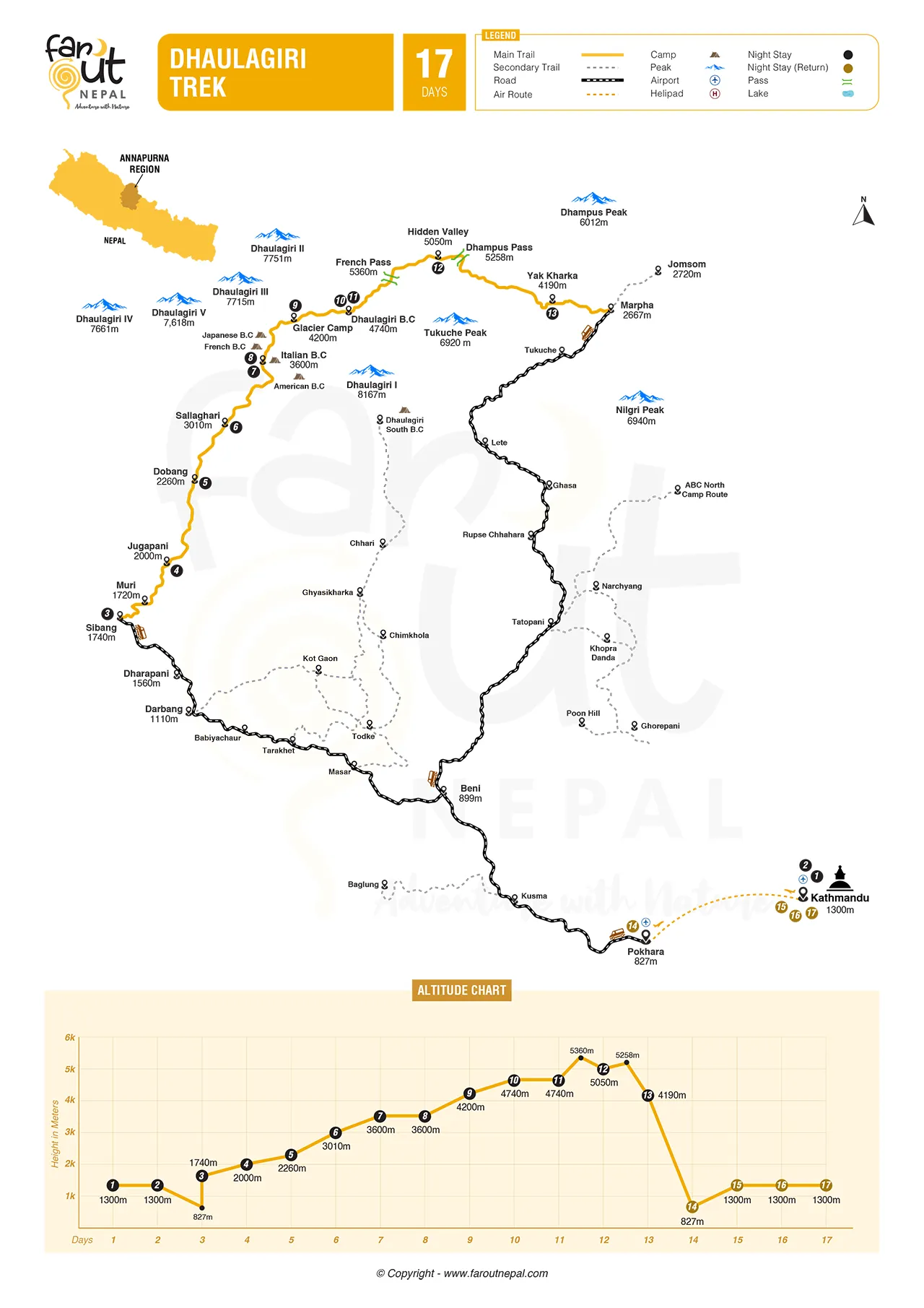
Dhaulagiri Circuit Trek | Essential Information
Dhaulagiri Circuit Trek Cost
The Dhaulagiri Circuit Trek is a fully supported camping expedition. This means the costs are significantly higher than standard teahouse treks due to logistics, remoteness, and technical requirements.
Total Cost Range: Approx. USD 2,000 – 3,500+ per person (depending on group size and services)
What the Cost Includes
- Trek permits (ACAP + TIMS)
- Professional licensed trekking guide
- Full camping logistics (tents, kitchen, dining setup)
- Meals during the expedition
- Porters and support staff
- Transportation (Kathmandu–Pokhara–Beni–return)
Why the Dhaulagiri Trek is Expensive
The Dhaulagiri Circuit requires a full expedition setup rather than a standard trekking service.
- No permanent lodges in remote sections
- Glacier travel requires technical safety equipment
- Large logistics team required (cook, Sherpa crew, porters)
- High-altitude risk management and contingency planning
Remember that you are not paying for comfort. You are paying for expedition infrastructure and safety execution.
How Difficult is the Dhaulagiri Circuit Trek?
The Dhaulagiri Circuit Trek is widely regarded as one of the most challenging trekking routes in Nepal. It’s not only due to the altitude gain but also because of the combination of sustained isolation, technical terrain, and extended glacier travel.
Duration: 17 Days
The actual trekking day is 13 days of trekking and travelling. The rest of the time will be spent in the Kathmandu valley and one night in Pokhara.
Elevation: 5,360 m
Difficulty: Strenuous (Walking hours from 5 to 8 hours per day)
Physical Difficulty
This trek involves long trekking days across steep ascents, moraine fields, and unstable terrain in the high-altitude. This often requires 6–8 hours of continuous movement in remote conditions with limited recovery support. The physical strain accumulates quickly due to the lack of teahouse infrastructure and the need to operate in a fully camping-based system.
Technical Difficulty
Certain sections of the route require glacier navigation where trekkers may need crampons, ice axes, helmets, and rope-assisted movement. These conditions are not constant but occur in critical high-altitude segments, particularly near glacier crossings and pass approaches.
Mental Endurance
Beyond physical challenge, the trek demands strong mental resilience due to long isolation, harsh weather variability, and the absence of external facilities. The psychological aspect of continuous wilderness exposure becomes a defining factor in overall success.
Is The Dhaulagiri Trek Right For You?
The Dhaulagiri Circuit Trek is not designed for casual trekkers. It’s for seasoned adventurers seeking an unfiltered Himalayan experience.
Ideal For:
- Experienced high-altitude trekkers
- Adventurers familiar with long trekking days
- Trekkers comfortable with camping expeditions
- Trekkers who are okay with climbing technicalities
Not Suitable For:
- First-time trekkers
- Travelers without altitude experience
- Anyone seeking lodge-based comfort trekking
This is a full expedition, not a guided sightseeing trek.
Preparation for the Dhaulagiri Circuit Trek
The Dhaulagiri Circuit Trek is a high-altitude expedition reaching up to 5,360m, involving glacier travel, long trekking days, and remote camping conditions. Proper preparation is essential to ensure safety, endurance, and enjoyment throughout the journey.
This trek is not only physically demanding but also mentally challenging due to isolation, altitude exposure, and changing terrain. A structured training approach before arrival in Nepal significantly improves performance on the trail.
Mental Preparation
Before committing to this expedition, it is important to assess your readiness for high-altitude and remote trekking conditions:
- Evaluate whether you are comfortable trekking above 5,000m+ environments for multiple days
- Consult your doctor or GP if you have any pre-existing medical conditions
- Prepare mentally for discomfort, cold conditions, and limited connectivity
- Build resilience through practices like breathing control or meditation, which help during long and difficult trekking days
Physical Preparation
Physical conditioning should ideally begin at least 4–6 months before departure, especially if you are not a regular high-altitude trekker. The goal is to build endurance, leg strength, and cardiovascular capacity.
Training consistently helps reduce fatigue, improve recovery, and minimise injury risk on steep and technical terrain. For a structured training guide, see our Himalayan preparation resource: Himalayan Trek Training Guide.
Altitude Problem on the Dhaulagiri Circuit Trek
The Dhaulagiri Circuit Trek reaches extreme altitude levels, with sleeping elevations above 4,000m and high passes up to 5,360m (French Pass). At these heights, oxygen levels drop significantly, increasing the risk of Acute Mountain Sickness (AMS) and other altitude-related conditions. Even well-conditioned trekkers can be affected.
Early recognition of the AMS symptoms and immediate action are critical, especially in remote sections where evacuation options are limited. The only effective treatment for severe altitude sickness is descending to a lower elevation without delay. You can also check out several AMS prevention measures beforehand for mild symptoms here: Preventing AMS.
Best Time for the Dhaulagiri Circuit Trek
Choosing the right season is critical for safety, visibility, and successful crossing of French Pass and Dhampus Pass. The ideal trekking periods are when the weather is relatively stable, skies are clear, and snow conditions on the passes are manageable. Outside these windows, the route can become dangerous or completely impassable due to heavy snowfall or unstable conditions.
Recommended Seasons
- Spring (Mid-April to Early May): Stable snow conditions, improving visibility, and safer glacier crossings as winter snow begins to settle
- Autumn (Early October to Mid-November): Best overall conditions with clear skies, stable weather patterns, and optimal mountain visibility
Seasonal Considerations
- The weather in the Dhaulagiri region is highly unpredictable due to rapid climate shifts at high altitude
- Heavy snowfall can block French Pass and Dhampus Pass even during peak seasons
- Early monsoon or late winter conditions can significantly increase expedition risk
Essential Gear For Dhaulagiri Trek
This is a high-altitude glacier expedition, and proper equipment is mandatory for safety. We will also provide you with the full list once the trip is confirmed.
Technical Gear
- Crampons (for glacier and ice sections)
- Ice axe (self-arrest and safety use)
- Climbing helmet (icefall and rockfall zones)
- Harness + rope system (guided sections)
Cold Weather Gear
- Down jacket (expedition grade)
- Thermal base layers
- Windproof outer shell
- Insulated gloves and socks
Other Essentials
- High-altitude sleeping bag (–15°C or lower)
- Trekking boots with ankle support
- Headlamp + backup batteries
Logistics for the Dhaulagiri Circuit Trek
The Dhaulagiri Circuit Trek is a fully supported expedition-style camping trek. It’s designed for small groups operating in remote, infrastructure-free terrain. Everything from accommodation to meals and logistics is organised as a self-sustained mountain expedition.
Access & Transportation
Access to the Dhaulagiri Circuit Trek involves a combination of air travel and long overland driving, gradually transitioning from Nepal’s urban centres into remote Himalayan terrain.
- The journey begins with a 30-minute flight from Kathmandu to Pokhara, offering quick access to the western Himalayan region
- From Pokhara, a long overland drive of approximately 6–7 hours leads toward the trekking region
The road conditions change significantly along the route:
- Up to Beni, the drive follows a relatively well-constructed blacktopped/metallic road
- Beyond Beni, the route becomes a rough mountain track following river valleys and hillside terrain
- The final stretch toward the trailhead (Sibang/Muri region, depending on itinerary variation) is uneven, slow, and highly dependent on weather and road conditions
Group Size
To maintain safety, efficiency, and a high-quality expedition experience, group size is intentionally kept small.
- Preferred group size: 2 to 10 trekkers
- Small groups allow better acclimatisation, pacing and personalised guide support
- Essential for managing glacier crossings, rope sections, and remote logistics efficiently
This trek is not designed for large tour groups due to its technical and remote nature.
Trek Style: Full Camping Expedition
The Dhaulagiri Circuit has very limited lodging infrastructure beyond the lower villages. From the upper valley onward, the route becomes fully self-supported.
- The entire trek operates as a camping-based expedition
- All equipment (tents, kitchen gear, food supplies) is carried from Kathmandu
- Expedition crew includes guides, cooks, and porters
Expedition Support Includes:
- Experienced trekking guide/expedition leader
- The cooking team prepares all meals on the trail
- Porters carrying group logistics and equipment
- Sherpa support for camp setup and high-altitude sections
This structure ensures self-sufficiency in completely remote alpine environments.
Accommodation at the Dhaulagiri Circuit
Accommodation is in expedition-grade tents designed for cold, high-altitude conditions.
- Tent type: A good tent will be provided during the trip
- Shared on a twin basis for space efficiency and warmth
- Foam mattress with an insulated base provided
- Sleeping bag must be carried by trekkers
Camping Infrastructure Includes:
- Dedicated dining tent with seating arrangements
- Separate kitchen tent for meal preparation
- Toilet tent for sanitation in remote zones
- Fully mobile campsite setup relocated daily
Camps are designed to function in glacier and high-altitude moraine environments.
Meals & Drinking Water
All meals are freshly prepared by the expedition cook team and designed to support high-energy output in cold conditions.
Daily Meal Structure:
- Breakfast: Porridge, muesli, cereal, eggs, bread or chapati
- Lunch: Rice, vegetables, pasta, salads, light protein options
- Dinner (3-course): Soup + main course (rice/pasta/meat/veg) + dessert
- Tea, coffee, and hot drinks are provided throughout the day
- Special dietary requirements can be accommodated with prior notice
Hygiene & Safety:
- All food is hygienically prepared under controlled conditions
- Water is boiled and treated before consumption
- Vegetables are disinfected using standard purification methods
- Hand hygiene supported with antiseptic solutions
Our Dhaulagiri Crew
The Dhaulagiri Circuit is led by a highly experienced expedition team familiar with glacier travel and high-altitude operations.
- Licensed trekking guides with high-altitude experience
- Basic medical knowledge and emergency response training
- Strong familiarity with Dhaulagiri route conditions
Porter System:
- Each porter carries approx 25–30 kg
- Trekkers carry only a light daypack
- Porter welfare is prioritised with proper clothing and equipment support
Porters are a critical part of the expedition logistics system.
Baggage Management
Luggage logistics are streamlined for remote expedition travel.
- Main baggage carried by porters throughout the trek
- Trekkers carry a day pack for only essentials and personal gear (water, jacket, camera, medication, sunscreen)
- Duffel bag provided for trekking gear in Kathmandu
- Extra luggage can be stored safely in the Kathmandu hotel storage
Airline Limit:
- Domestic flight baggage allowance: ~15 kg
- Excess baggage may incur additional charges
Travel Insurance for Dhaulagiri Circuit
Travel insurance is compulsory for the Dhaulagiri Circuit Trek due to the expedition nature of the route and the lack of medical infrastructure in remote regions.
Your policy must include:
- Emergency helicopter evacuation coverage from high altitude (5,000m+)
- Medical treatment and hospitalization coverage in Nepal
- Trip cancellation or interruption protection
- Coverage for trekking activities in alpine and glacier terrain
Without valid insurance, participation in this trek is not permitted due to the high-risk environment. You can learn more about trekking insurance here: Trekking Insurance for Nepal.
Health, Vaccinations & Medical Preparation
The Dhaulagiri Circuit Trek is a high-altitude expedition involving prolonged exposure to above 4,000m and multiple crossings above 5,000m. Proper health preparation is essential.
- Consult your doctor before joining if you have pre-existing conditions
- Ensure overall fitness for prolonged high-altitude exertion
- Dental and general health check-ups are recommended before travel
Vaccinations:
- No mandatory vaccination certificate is required for entry into Nepal
- However, consult a travel clinic for recommended immunizations based on your medical profile
On-Trek Health Practices:
- Maintain strict hygiene (hand sanitisers, clean water usage)
- Avoid raw or unsafe food sources
- Prefer cooked vegetarian meals where possible
- Stay hydrated and avoid alcohol or smoking during the trek
- Move at a controlled pace to reduce altitude stress
First Aid Kit:
A basic group medical kit is carried by the expedition team; however, personal preparation is strongly advised.
- Standard first aid supplies are provided by the guide team
- Trekkers should carry personal medication and doctor-recommended supplies
- Include altitude sickness medication if prescribed
- Any personal health requirements must be communicated in advance
In remote glacier zones, early response and self-awareness are critical due to evacuation limitations.
Nepali Visa Requirements
All foreign nationals require a visa to enter Nepal. For most travellers joining the Dhaulagiri Circuit Trek, the easiest option is obtaining a Visa on Arrival at Tribhuvan International Airport, Kathmandu.
Entry Visa Details:
- A visa can be obtained at Nepal embassies abroad or directly on arrival in Kathmandu
- The passport must be valid for at least 6 months from the date of entry
- Visa fee must be paid in US dollars (cash recommended) or equivalent currency
You can learn more about the visa procedure here: Nepali Visa process.
Pre-Application (Optional)
To speed up the arrival process, you can also apply in advance:
- Complete the online visa application via the official Nepal Immigration portal
- Submit required documents at a Nepalese embassy or consulate (optional)
- Alternatively, finalise the process directly at the airport visa counter upon arrival
Note: Immigration procedures are straightforward, but queues vary depending on the season and flight arrivals.
Permits for The Dhaulagiri Trek
To legally and safely complete the trek, the following permits are required:
- ACAP Permit – Annapurna Conservation Area entry permit
- TIMS Card – Trekking Information Management System registration
- Licensed guide support is strongly recommended due to the technical terrain and remoteness
For organizing these permits initially, we will need to have a digital passport-size photograph along with a scanned copy of the passport, where all the required details are mentioned.
Trek The Dhaulagiri Circuit with Far Out
The Dhaulagiri Circuit Trek is one of the most remote, physically demanding, and logistically complex trekking routes in Nepal. It is not a standard teahouse trail, but a full-scale Himalayan expedition that traverses deep valleys, glacial systems, and high mountain passes above 5,000 meters.
Success on this route depends on more than fitness alone. It requires preparation, altitude awareness, the right equipment, and a disciplined expedition mindset. From glacier crossings to isolated camps and unpredictable mountain weather, every stage of the journey demands respect for the environment and careful decision-making.
This is a trek where conditions can change rapidly, and where experience and organization directly impact safety and success.
Why Trek Dhaulagiri with Far Out?
With Far Out Nepal, you get:
- Experienced high-altitude expedition leadership
- Fully organised camping infrastructure across remote terrain
- Glacier travel safety systems, including ropes and technical support
- Small-group operations for higher safety and personalised guidance
- Strong emergency planning and real-time decision-making support
We operate the Dhaulagiri Circuit as an expedition-grade Himalayan journey, not a commercial sightseeing trek. Far Out Nepal is also committed to low-impact, responsible expedition tourism across all Himalayan routes. We also strongly encourage responsible trekking practices, including “Leave No Trace” principles throughout the expedition.
If you are looking for comfort, this is not the route. If you are looking for the Himalayas in their rawest, most powerful form, Dhaulagiri delivers exactly that.
So, if you’re ready for the challenge, reach out to us through enquiry or WhatsApp and get ready for an unforgettable adventure!
Frequently Asked Questions
What is the Dhaulagiri Circuit Trek?
The Dhaulagiri Circuit Trek is a remote and challenging expedition-style trek in Nepal. It circles Mount Dhaulagiri (8,167m), the seventh-highest mountain in the world & involves crossing high passes, glaciers, and isolated valleys with minimal infrastructure.
How difficult is the Dhaulagiri Circuit Trek?
The Dhaulagiri Circuit Trek is considered a very difficult high-altitude expedition trek requiring camping, glacier travel, and crossing technical passes above 5,000 meters. It is suitable only for experienced trekkers with strong physical fitness.
How long does the Dhaulagiri Circuit Trek take?
The Dhaulagiri Circuit Trek typically takes 15 to 20 days, depending on weather conditions, acclimatization needs, and route variation. The remote terrain and high passes significantly influence the total duration.
What is the cost of the Dhaulagiri Circuit Trek?
The Dhaulagiri Circuit Trek cost usually ranges from $1,800 to $3,500+ per person due to its expedition nature. This is due to the inclusion of camping equipment, permits, guide team, porters, and logistics in a remote region.
What is the highest altitude of the Dhaulagiri Circuit Trek?
The highest point of the Dhaulagiri Circuit Trek is typically French Pass at 5,360 meters, followed by Dhampus Pass at 5,200 meters. These high-altitude crossings make it one of Nepal’s most challenging trekking routes.
Is the Dhaulagiri Circuit Trek dangerous?
The Dhaulagiri Circuit Trek is considered high-risk due to glacier crossings, avalanches, steep ascents, and extreme altitude. Proper acclimatization, experienced guides, and expedition logistics are essential for safety.
What permits are required for the Dhaulagiri Circuit Trek?
The Dhaulagiri Circuit Trek requires multiple permits, including the Annapurna Conservation Area Permit (ACAP) and restricted area permits, depending on the route section. These are mandatory for all trekkers.
What is the best time for the Dhaulagiri Circuit Trek?
The best time for the Dhaulagiri Circuit Trek is spring (March–May) and autumn (September–November), when weather conditions are more stable and high passes are safer to cross.
What kind of accommodation is available on the Dhaulagiri Circuit Trek?
Accommodation on the Dhaulagiri Circuit Trek is primarily camping-based due to the remote nature of the route. There are no permanent teahouses in most sections, so full expedition camping support is required.
What is the route of the Dhaulagiri Circuit Trek?
The Dhaulagiri Circuit Trek route typically starts from Beni and passes through Italian Base Camp, Glacier Camp, Hidden Valley, and high mountain passes before descending toward Jomsom or Marpha.
What is the Italian Base Camp in the Dhaulagiri Trek?
Italian Base Camp is the first major acclimatization point on the Dhaulagiri Circuit Trek, located beneath the west face of Mount Dhaulagiri. It serves as the base for preparing for higher glacier sections.
What is the Dhaulagiri Base Camp altitude?
The Dhaulagiri Base Camp sits at approximately 4,740 meters above sea level, surrounded by glaciers and steep Himalayan terrain.
Is the Dhaulagiri Circuit Trek suitable for beginners?
No, the Dhaulagiri Circuit Trek is not suitable for beginners due to its high altitude, glacier crossings, and remote camping conditions requiring prior high-altitude trekking experience.
What kind of food is available on the Dhaulagiri Circuit Trek?
Food on the Dhaulagiri Circuit Trek is provided through expedition camping setups, typically including simple cooked meals such as rice, lentils, pasta, and soups prepared by the support crew.
How cold does it get on the Dhaulagiri Circuit Trek?
Temperatures on the Dhaulagiri Circuit Trek can drop below -15°C at high camps, especially near passes and glacier sections, even during trekking seasons.
Do I need a guide for the Dhaulagiri Circuit Trek?
Yes, a licensed guide and full expedition team are mandatory for the Dhaulagiri Circuit Trek due to its technical difficulty, remoteness, and strict permit regulations.
What makes the Dhaulagiri Circuit Trek unique?
The Dhaulagiri Circuit Trek is unique because it is one of Nepal’s most remote and least commercialized expeditions, offering glacier travel, high mountain passes, and complete isolation from standard trekking infrastructure.
Reviews on Dhaulagiri Trek
Special Savings and Discounts for Group Travelers!
-
1 -
person
US$ 3,050
-
2 -
3 person
US$ 2,550
-
4 -
5 person
US$ 2,500
-
6 -
9 person
US$ 2,150
-
10 over
9999
US$ 2,100
US$ 3