


Mt. Kailash Spiritual Tour

Mt. Kailash Spiritual Tour

Mt. Kailash Spiritual Tour

Mt. Kailash Spiritual Tour
Mt Kailash Spiritual Tour

Activity
Tour
Duration
16 Days
Grading
Difficult
Max Altitude:
5,600m. / 18,373ft.
Best Season
April-June & September-October
Style of Trip
Spiritual
Group Size
4 to 10 People
Accommodation
Hotel & Lodges
Meals
Breakfast
Why Choose the Mount Kailash Spiritual Tour?
Beginning in Lhasa, you’ll gain insight into Tibetan life and Buddhism while acclimatising to the altitude. From there, the route unfolds across the vast Tibetan Plateau, passing sacred lakes, ancient monasteries, and spectacular Himalayan scenery. By the time you arrive at Mount Kailash and Lake Manasarovar, you’ll have experienced not only the destination itself but also the landscapes, cultures, and traditions that make this journey one of the most remarkable adventures in Tibet.
- Waiting for Visa: Opportunity to explore 2000 years spiritual and cultural Kathmandu Valley. Visit stupas, ancient palaces, temples, and have a gentle hike.
- Begin your journey in Tibet’s cultural and spiritual capital: Spend time exploring Lhasa, where centuries-old monasteries, pilgrimage routes, and historic landmarks provide a meaningful introduction to Tibetan culture, while simultaneously acclimating to the journey ahead.
- Travel across one of the world’s highest landscapes: Journey through the immense Tibetan Plateau, where vast grasslands, high mountain passes, and open horizons create a sense of scale unlike anywhere else in the Himalayas. The route itself is as memorable as the destinations it passes through.
- Follow a route shaped by pilgrimage, history, and tradition: Beyond the famous landmarks, you’ll travel through regions that have been important to traders, monks, and pilgrims for centuries. The journey offers a deeper understanding of Tibet’s enduring cultural and spiritual heritage.
- Experience Tibet beyond the typical sightseeing circuit: As the landscape becomes increasingly remote, you’ll encounter traditional settlements, sacred sites, and untouched scenery that many visitors to Tibet never reach. This western section of the plateau reveals a quieter and more authentic side of the region.
- Witness the different side of Mount Everest: Visit the area around Rongbuk Monastery and enjoy views of Mount Everest from the Tibetan side. The vast plateau setting provides a very different perspective from the trekking routes more commonly associated with the mountain.
- Discover the serenity of Lake Manasarovar: Set beneath the Himalayan skyline, Lake Manasarovar is considered sacred by multiple faiths and remains one of Tibet’s most significant pilgrimage destinations. Its peaceful atmosphere offers a striking contrast to the rugged terrain surrounding it.
- Reach one of the world’s most sacred mountains: For centuries, pilgrims have journeyed to Mount Kailash in search of spiritual merit, personal reflection, and cultural connection. Whether you undertake the kora or simply witness the mountain’s presence, it is a destination that leaves a lasting impression.
- Benefit from an itinerary designed for both comfort and discovery: The route has been carefully structured to balance altitude acclimatization, cultural exploration, and scenic travel. This measured pace allows you to fully appreciate each stage of the journey while preparing for the higher elevations of western Tibet.
Trip Introduction
A Journey Through Tibet towards Mount Kailash
The Lhasa to Mt Kailash Spiritual Tour is more than a visit to Tibet’s most famous landmarks. It’s also a journey through the cultural, spiritual, and natural heart of the Tibetan Plateau.
Beginning in Kathmandu and continuing into Tibet’s historic capital of Lhasa, this expedition gradually unfolds across ancient cities, sacred monasteries, dramatic Himalayan landscapes, and remote high-altitude wilderness before reaching the revered Mount Kailash and Lake Manasarovar.
The journey is carefully designed to balance cultural discovery with altitude acclimatization. In Lhasa, you’ll explore centuries of Tibetan history and spirituality while giving your body time to adapt to the plateau’s elevation. From there, the route follows the historic overland trail to Gyantse, Xigatze, and Xegar, passing en route turquoise lakes, traditional farming villages, high mountain passes with prayer flags fluttering, and a view of some of Tibet’s most spectacular scenery
As the journey continues westward, the landscape becomes increasingly remote and dramatic. You’ll visit Rongbuk Monastery, the highest monastery in the world, and enjoy unforgettable views of Mount Everest from the Tibetan side. Beyond Everest lies the vast Ngari region, a land of open horizons, sacred lakes, nomadic settlements, and one of the most spiritually significant sites in Asia, Mt. Kailash.
Quick Facts
| Category | Details |
| Duration | 20 Days |
| Highest Point | Dolma La Pass (5,630m) |
| Trek Duration | Approx. 3 Days (Mount Kailash Kora) |
| Accommodation | Hotels, Guesthouses & Basic Lodges |
| Meals | Included as per the itinerary |
| Group Type | Fixed Departure & Private Groups Available |
Mount Kailash: The Sacred Center of Tibet
Rising to 6,714 meters above sea level, Mount Kailash stands apart from every other mountain in the Himalayas. Revered by Hindus, Buddhists, Jains, and followers of the Bon tradition, it has been a destination for pilgrims for thousands of years.
For Hindus, Mount Kailash is believed to be the abode of Lord Shiva. Tibetan Buddhists know it as Kang Rinpoche, the “Precious Jewel of Snow,” while Jains associate it with the spiritual liberation of Rishabhanatha, the first Tirthankara. Followers of the ancient Bon religion regard the mountain as the spiritual center of their faith and the soul of Tibet itself.
Unlike many famous peaks, Mount Kailash is not climbed. Instead, pilgrims undertake the sacred kora, which is a 53-kilometer circuit around the mountain. Completing the kora is considered one of the world’s most significant pilgrimage experiences and remains a deeply meaningful spiritual journey for people from diverse faiths and backgrounds.
At the foot of the mountain lies Lake Manasarovar, one of the highest freshwater lakes in the world. Surrounded by snow-capped peaks and vast open landscapes, the lake is regarded as a place of purification, reflection, and spiritual renewal.
A Rewarding High-Altitude Adventure From Tibet to Kailash
This journey takes place entirely within the Tibetan Plateau, where elevations remain above 3,600 meters for much of the route. The highest point of the expedition is reached during the Kailash Kora, where travelers cross the Dolma La Pass at approximately 5,630 meters.
While the itinerary has been carefully planned to support gradual acclimatization, travelers should be prepared for the physical demands of high-altitude travel. Long driving days, remote terrain, and the challenging conditions of the kora require a reasonable level of fitness and a spirit of adventure.
The reward is an experience unlike any other, as you’ll be crossing one of the world’s most extraordinary landscapes, encountering centuries-old spiritual traditions, and reaching destinations that few travelers ever have the opportunity to experience.
Why Travel to Mt. Kailash with Far Out Nepal?
A journey to Mount Kailash deserves more than transportation between destinations. It deserves thoughtful pacing, meaningful experiences, and reliable support throughout the journey.
At Far Out Nepal, we design this itinerary to go beyond simply reaching Kailash. By combining time in Kathmandu, cultural & spiritual immersion in Lhasa, views of Mount Everest, and the complete Mount Kailash Kora, the route creates a more rewarding and balanced experience across Tibet.
From documentation support and travel coordination to experienced local operations and carefully planned progression through high-altitude regions, our focus is to make this extraordinary journey feel smoother, more comfortable, and more meaningful from beginning to end.
What makes this journey different:
- A more complete Tibet experience combining Lhasa, Everest & Mount Kailash
- Gradual progression that is designed for a better overall travel rhythm
- End-to-end coordination for permits, logistics, and preparation
- A balance of cultural discovery, scenic landscapes, and pilgrimage experience
- Support from planning to the final return to Kathmandu
If you’re ready to explore Tibet’s most sacred destinations, our team is here to help you plan every detail: from permits and logistics to choosing the best departure for your travel goals.
Contact Far Out Nepal today to discuss departures, permits, availability, and trip customization options → [Inquire About This Tour]
Detail itinerary of Mt Kailash Spiritual Tour
Day 01: Arrival in Kathmandu & Trip Preparation
Welcome to Nepal, the gateway to the Himalayas and the starting point of your journey to Tibet and Mount Kailash. Upon arrival at Tribhuvan International Airport, you’ll be greeted by our representative and transferred to your hotel in Kathmandu.
After check-in, you’ll have time to rest and recover from your international flight before attending a short trip briefing with your guide or tour coordinator. During this session, we’ll review the journey ahead, answer any questions, and ensure all arrangements are in place for your upcoming Tibet adventure.
Kathmandu serves as more than just a transit point. For centuries, it has been an important crossroads for travelers, pilgrims, and traders journeying between the Himalayan regions. Before heading toward Tibet, you’ll have the opportunity to experience the atmosphere of this historic valley while completing the necessary preparations for the expedition.
Important Visa Information
To process your Chinese Group Visa, travelers are required to arrive in Kathmandu early in the day. Passports and visa documents must be submitted to the Chinese Visa authorities before noon on the day of arrival. We recommend scheduling your international flight to arrive in Kathmandu during the morning to allow sufficient time for visa processing procedures.
Travel Tips:
- Apply for Your Nepal Visa Online:
Although you can obtain a Nepali visa at Tribhuvan International Airport upon arrival, Tribhuvan International Airport can be busy during peak tourist seasons, and visa-on-arrival queues may take time. We recommend applying for your Nepal visa online before your trip to speed up the immigration process. (Nepali-Port-Online-Services) - Meeting Our Representative:
After completing immigration formalities and collecting your luggage, proceed to the arrival hall, where our representative will be waiting to welcome you. As the arrival area can be crowded during busy periods, please look carefully for our office placard with your name or company logo. - Currency Exchange and SIM Cards:
If you need to exchange foreign currency or purchase a local SIM card, both services are available at the airport. Alternatively, your guide will be happy to assist you with these arrangements upon your arrival in Kathmandu. - Transfer to Your Hotel:
From the terminal, it’s a short walk to the parking area where your vehicle will be waiting. Most hotels in Kathmandu are around a 20–25-minute drive from the airport, offering your first glimpse of the city’s vibrant atmosphere. - Hotel Check-in Time:
Standard hotel check-in time in Kathmandu is generally 3:00 PM. However, if your room is ready earlier, most hotels will gladly accommodate an early check-in whenever possible.

Activity: Airport transfer : Approx. 30m

Location: Kathmandu

Max. Altitude: 1,298m/4,259ft.

Accommodation: Hotel

Meal: NA
Day 02: Exploring the Cultural Heritage of Kathmandu Valley
Before crossing into Tibet, we will spend a day discovering the cultural and spiritual heritage of the Kathmandu Valley. Home to centuries-old temples, palaces, and sacred sites, the valley has long served as a crossroads of Hindu and Buddhist traditions and remains one of the most culturally significant regions in the Himalayas.
The day begins at Swayambhunath, one of Nepal’s oldest and most revered Buddhist monuments. Perched on a hill overlooking the valley, the stupa is closely linked to local legends about the formation of Kathmandu and continues to attract pilgrims from across the Himalayan world. The panoramic views and peaceful atmosphere offer an inspiring introduction to the spiritual traditions that connect Nepal and Tibet.
Later, we will continue to Patan Durbar Square, the historic heart of Patan. It is also a UNESCO World Heritage Site celebrated for its exceptional Newari architecture, intricate wood carvings, and centuries of artistic craftsmanship. You can wander through ancient courtyards (including the Tushahity (Royal Bath) in Sundari Chowk), royal palaces, and beautifully preserved temples that showcase the cultural richness of the Kathmandu Valley.
In the afternoon, you can enjoy Thamel, Kathmandu’s lively traveler district. Its colorful streets, local shops, cafés, and markets provide a glimpse into the modern rhythm of the city while offering an opportunity to make any final preparations before departing for Tibet.
Travel Tips:
There are two ways to reach Swayambhunath, and both involve an uphill walk.
- Eastern Entrance: Climb the 365 stone steps, a rewarding part of the spiritual experience. The ascent can be steep, so comfortable walking shoes and clothing are recommended.
- Western Entrance: This route offers a gentler climb and is a good option if you prefer an easier approach.
- Swayambhunath is also known as the Monkey Temple, so watch out for the monkeys.
- Wear a comfortable dress, walking shoes, as some places require an uphill walk.
Activity: Tour approx : 6 to 7 hours
Location: Kathmandu
Max. Altitude: 1,300m/4,265ft.
Accommodation: Hotel
Meal: Breakfast
Day 03: Ancient Heritage & Himalayan Views in Bhaktapur
Route: Kathmandu → Changunarayan → Nagarkot → Bhaktapur → Kathmandu
Today’s exploration combines ancient heritage, gentle hiking, and panoramic Himalayan scenery, offering a memorable final day in Nepal before the journey continues toward Tibet.
The morning begins at Changu Narayan Temple, widely regarded as Nepal’s oldest surviving Hindu temple. Perched on a ridge overlooking the Kathmandu Valley, this UNESCO World Heritage Site is renowned for its intricate stone carvings, historic inscriptions, and remarkable early Nepalese craftsmanship. The temple provides a fascinating glimpse into the cultural and religious traditions that have shaped the Himalayan region for centuries.
From Changu Narayan, we will set out on a scenic hike through traditional villages, terraced farmland, and forested trails toward Nagarkot. The walk offers a peaceful introduction to Nepal’s countryside and an opportunity to experience local life away from the city. At an elevation of 2,195 meters, Nagarkot is famous for its sweeping Himalayan panoramas and, on clear days, views stretching across some of the region’s highest peaks.
In the afternoon, we will continue to Bhaktapur Durbar Square, one of the finest examples of medieval urban planning and architecture in Nepal. You can wander through beautifully preserved courtyards, ancient temples, and palace complexes that showcase the artistic achievements of the Newar civilization. Before entering Tibet’s vast and remote high-altitude regions, this day offers a deeper appreciation of the cultural foundations of the Himalayas.
Travel Tips:
- Hike: Involves a gentle hike
- Wear a comfortable dress, walking shoes, as some places require an uphill walk.
Activity: Approx.: 07 hours
Location: Kathmandu
Max. Altitude: 1,300m/4,265ft.
Accommodation: Hotel
Meal: Breakfast
Day 04: Sacred Kathmandu | Boudhanath & Pashupatinath
The day is dedicated to two of Nepal’s most significant spiritual landmarks, offering a deeper understanding of the religious traditions that continue to shape life in the country. As the journey to Tibet and Mount Kailash approaches, these sacred sites provide valuable cultural and spiritual context for the experiences ahead.
The morning begins at Boudhanath Stupa, one of the largest Buddhist stupas in the world and the spiritual center of Nepal’s Buddhist community. Encircled by monasteries, prayer wheels, and traditional Tibetan shops, the stupa serves as a gathering place for pilgrims, monks, tourists, and devotees. Walking the kora around Boudhanath offers a meaningful introduction to the pilgrimage traditions that will become increasingly significant throughout the journey in Tibet.
In the afternoon, we will continue to the Pashupatinath Temple, Nepal’s most revered Hindu temple and one of the most important shrines dedicated to Lord Shiva. Situated along the sacred Bagmati River, Pashupatinath has drawn pilgrims from across South Asia for centuries. The temple’s spiritual significance resonates strongly with the journey ahead, as Mount Kailash is traditionally regarded as the divine abode of Lord Shiva himself.
As evening approaches, you can witness the vibrant Bagmati Arati ceremony, where prayers, music, fire offerings, and devotion come together in a powerful expression of faith. The ceremony offers a memorable glimpse into the living spiritual traditions of Nepal.
Activity: 7 hours
Location: Kathmandu
Max. Altitude: 1,300m/4,265ft.
Accommodation: Hotel
Meal: Breakfast
Day 05: Fly to Lhasa | Gateway to the Tibetan Plateau
You will begin your Tibetan adventure today as you will depart Kathmandu and fly across the Himalayas to Lhasa, the historic and spiritual heart of Tibet. For many travelers, arriving in Lhasa is a long-awaited milestone. More than simply a destination, Lhasa serves as the cultural and spiritual gateway to Tibet.
Considered as one of the most scenic flights in the world, the journey offers spectacular aerial views of the Himalayan range. On clear days, passengers may glimpse some of the highest mountains, including Mount Everest, Kangchenjunga, and Makalu, along with the vast landscapes of southern Tibet unfolding beyond the mountain chain.
Upon arrival at Lhasa Gonggar Airport, you’ll complete immigration formalities before receiving a traditional Tibetan welcome, often marked by the presentation of a white khata (ceremonial scarf), a symbol of goodwill and hospitality.
The drive from the airport to Lhasa follows the banks of the mighty Yarlung Tsangpo River or the Brahmaputra. As you approach the city, you’ll begin to notice the distinct architecture, prayer flags, monasteries, and cultural influences that make Tibet unlike anywhere else in the Himalayas.
After checking into your hotel, the remainder of the day is reserved for rest and acclimatization. At an elevation of approximately 3,650 meters, taking it easy during your first hours in Tibet is essential for a comfortable journey in the days ahead.
Travel Tips:
- Before leaving, make sure you have your passport, Group Visa, Tibet Travel Permit, and flight tickets.
- Arrive at the airport at least 3 hours before departure. Leave your hotel about 3½ hours before your flight.
- The Kathmandu to Lhasa flight takes approximately 1 hour and 20 minutes.
- Lhasa is 2 hours 15 minutes ahead of Kathmandu.
- Upon arrival in Lhasa, take the rest of the day to relax and acclimatize to the high altitude. Avoid sightseeing or strenuous activities.
Activity: 6 hours approx
Location: Nyelam
Max. Altitude: 3,750m/12,303ft.
Accommodation: Hotel
Meal: Breakfast
Day 06: Discovering Tibet's Great Monastic Tradition
After a day of acclimatization, we will begin exploring the spiritual foundations of Tibetan Buddhism through two of Tibet’s most influential monastic institutions. These monasteries were once home to thousands of monks and played a central role in shaping religious life throughout Tibet and the wider Himalayan region.
The day begins at Drepung Monastery, founded in the 15th century and once regarded as the largest monastery in the world. Set against the slopes of Mount Gephel, the sprawling monastic complex served as an important center of Buddhist learning. It was even historically associated with the Dalai Lamas before the construction of the Potala Palace. As you explore its assembly halls, chapels, and courtyards, you’ll gain a deeper understanding of Tibetan Buddhist philosophy and centuries of spiritual tradition.
In the afternoon, we will continue to Sera Monastery, one of the most celebrated monasteries in Tibet. Founded in 1419, Sera remains an active center of Buddhist study and practice. The highlight of the visit is the famous monastic debate session, where monks engage in lively philosophical discussions through a unique combination of gestures, questions, and formal reasoning. This centuries-old tradition offers a fascinating glimpse into the rigorous educational system that remains at the heart of Tibetan Buddhism.
Throughout the day, prayer flags flutter across mountain ridges, pilgrims circle sacred shrines, and monks continue traditions that have endured for generations, offering an authentic introduction to Tibet’s living spiritual heritage. These experiences add a deeper dimension to the pilgrimage journey that unfolds in the days ahead.
Travel Tips:
Acclimatization & Health
In Lhasa, some travelers may feel mild altitude symptoms. In case of serious effects, talk with your guide for guidance.
To ensure a smooth journey:
- Move slowly and avoid rushing
- Drink plenty of water
- Eat light meals
- Reduce or avoid smoking
- Get proper rest
Monastery Etiquette: Respecting Tibetan Culture
When visiting monasteries during your Lhasa cultural tour, please follow these guidelines:
- Avoid wearing shorts or sleeveless tops (shoulders should be covered).
- Remove sunglasses and hats before entering chapels.
- Photography inside chapels is generally not permitted.
- Walk clockwise around religious sites unless instructed otherwise.
Respecting local customs ensures a meaningful and culturally sensitive experience.
Activity: Acclimatization Day
Location: Nyelam
Max. Altitude: 3,750m/12,303ft.
Accommodation: Hotel
Meal: Breakfast
Day 07: Lhasa’s Spiritual Heart | Potala Palace & Jokhang Temple
Today is one of the most significant cultural highlights of the entire journey, offering a deeper understanding of Tibet’s spiritual identity. The day focuses on two of Lhasa’s most important UNESCO World Heritage Sites, both central to Tibetan history, religion, and daily life.
The morning begins at Potala Palace, an architectural masterpiece rising above the city of Lhasa. Once the winter residence of the Dalai Lamas, the palace is a powerful symbol of Tibetan governance, spirituality, and cultural heritage. Inside its vast complex of halls, chapels, and corridors, thousands of murals, statues, and sacred relics reflect centuries of religious devotion and artistic achievement. From its terraces, panoramic views of Lhasa provide a striking contrast between the city below and the Himalayan landscape beyond.
Later, we will continue to Jokhang Temple, considered the most sacred temple in Tibetan Buddhism. Located at the center of the old city, Jokhang is the ultimate pilgrimage destination for Tibetan devotees, many of whom travel long distances prostrating along the way. Inside, the atmosphere is deeply spiritual, filled with the scent of butter lamps, chanting monks, and continuous prayer rituals that have remained unchanged for centuries.
Surrounding the temple is Barkhor Street, a lively circuit of pilgrimage paths and traditional market streets. Here, pilgrims, monks, and travelers move together through a vibrant mix of devotion and daily commerce, offering a rare glimpse into living Tibetan culture.
Travel Tips:
- There are 1,080 steps to reach the top of Potala Palace (3,700m), so walk slowly and don’t rush; otherwise, rushing might cause high altitude sickness;
- Today your tour will be mainly outdoors, please bring some water, a hat, sun cream, and sunglasses with you.
- Wear comfortable dresses and shoes, as you will have an uphill walk
- Bring sun protection and water.
- Photography inside the palace is prohibited.
Activity: 7 hrs approx
Location: Saga
Max. Altitude: 4,650m/15,256ft.
Accommodation: Hotel
Meal: Breakfast
Day 08: Crossing the Tibetan Plateau | Lhasa to Shigatse via Sacred Lakes & Passes
You will begin your journey across the vast western Tibetan landscape as you leave Lhasa and travel toward Shigatse, Tibet’s second-largest city and an important cultural and administrative center. The drive itself is one of the most scenic sections of the entire overland route. It offers a dramatic transition from Lhasa’s cultural valley into the open high-altitude expanse of the Tibetan Plateau.
Soon after departure, the road climbs toward the high mountain pass of Khamba La (4,791m), where expansive views of the surrounding Himalayan peaks open up. From here, the turquoise waters of Yamdrok Lake come into view, stretching across the landscape like a vast inland sea framed by snow-covered peaks. This is one of Tibet’s most sacred lakes, deeply embedded in local spiritual traditions and regional mythology.
As our journey continues, the landscape gradually shifts from high alpine terrain to fertile valleys as you approach the historic town of Gyantse. Here, you will visit the renowned Kumbum Stupa, an extraordinary multi-tiered chorten decorated with intricate murals and chapels that reflect centuries of Buddhist tradition. Gyantse itself has historically served as a key trading and cultural hub between central and western Tibet.
In the late afternoon, the road continues across open valleys and rugged highland terrain before arriving in Shigatse. Upon arrival, you will check into your hotel and enjoy the rest of the evening at leisure. The city offers a quieter atmosphere compared to Lhasa, reflecting its role as a gateway toward the more remote regions of western Tibet.
Travel Tips:
- Long drive ahead, so make sure to prepare yourself well with water, travel gear, dry food, etc.
- Wear comfortable dresses and shoes, as you may have an uphill walk
- Bring sun protection and water.
Activity: Drive : 270km/approx. 7 hrs.
Location: Chiu Gompa
Max. Altitude: 4,590m/15,059ft.
Accommodation: Guest House
Meal: Breakfast
Day 09: From Xigatse to Xegar | Everest Views Across the High Himalayan Passes
Today, the journey continues westward from Xigatze into increasingly remote high-altitude terrain as you travel toward Xegar, a key stop on the route toward Everest Base Camp and western Tibet.
The morning begins with a visit to Tashilhunpo Monastery, one of the most important monastic institutions in Tibet and the traditional seat of the Panchen Lama. The monastery complex, with its golden roofs, towering statues, and sprawling courtyards, reflects the spiritual and political significance of Xigatze in Tibetan history.
Leaving the city behind, the road gradually ascends into a landscape of vast plateaus and high mountain passes. The route crosses Gyatso La (5,200m), one of the highest points of the journey so far, where prayer flags flutter across the ridgelines, and the air becomes noticeably thinner. This section of the drive marks a clear transition into the high Himalayan frontier region.
As the journey continues, you will reach Gawula Pass (5,198m), where the Himalayas finally open into a dramatic panoramic skyline. From this viewpoint, you are likely to see the first clear sight of Mount Everest, rising above the surrounding peaks in a distant but unmistakable silhouette. This moment is often one of the most memorable highlights of the entire overland journey, as the world’s highest mountain comes into view from the Tibetan side.
By late afternoon, the road descends toward Xegar, a small high-altitude settlement that serves as a key staging point for travelers heading toward Everest Base Camp or continuing onward to western Tibet and Mount Kailash.
Activity: Drive : Approx. 40 kms/1 hour
Location: Darchen
Max. Altitude: 4,650m/15,256ft.
Accommodation: Hotel
Meal: Breakfast
Day 10: Journey to Everest | Rongbuk Monastery & Everest Base Camp Region
Today is one of the most extraordinary days of the entire journey as you travel deeper into the Mount Everest region. The landscape becomes increasingly remote, stark, and awe-inspiring as the road climbs higher into the world’s highest mountain environment.
The journey begins across vast high-altitude plains before ascending toward Pang La Pass (5,145m), where, weather permitting, the Himalayas open into one of the most dramatic panoramic viewpoints in Tibet. From here, it is possible to see four of the world’s highest peaks: Everest, Lhotse, Makalu, and Cho Oyu rising across the horizon in a continuous wall of snow and rock.
Continuing deeper into the reserve, the road leads to Rongbuk Monastery, the highest monastery in the world and one of the most unique religious sites on Earth. Set against the backdrop of Everest’s north face, the monastery offers a rare blend of spiritual life and extreme natural environment. Monks continue their daily practices in one of the most remote inhabited places on the planet.
From here, travelers proceed toward the Everest Base Camp viewing area, where the north face of Mount Everest becomes visible in its full scale, rising dramatically above the surrounding glaciers and ridgelines. The experience is less about proximity and more about perspective as you stand before the world’s highest peak in its raw Tibetan setting.
As evening approaches, we will return to the Rongbuk area for overnight accommodation. Conditions here are extremely basic due to the altitude and remoteness, adding to the authenticity of staying at the edge of the Everest region.
Operational Notes
- Visibility of Mount Everest depends entirely on weather conditions and cannot be guaranteed.
- Accommodation at Rongbuk is basic and subject to extreme weather conditions.
- During the winter months (Nov–Mar), tented accommodations at Everest Base Camp are closed.
- Facilities in this region are limited due to altitude and remoteness
- The Everest viewpoint area is located near Rongbuk Monastery rather than the historical Base Camp zone
This day needs special treatment.
Activity: Drive : 7 Kms + Trek : 13 Kms/approx. 6 hours
Location: Dirapuk
Max. Altitude: 4,920m/16,142ft.
Accommodation: Guest House
Meal: Breakfast
Day 11: Drive to Saga via Pelku Tso Lake
After breakfast, we will continue our journey west into the Ngari Plateau, passing through pristine landscapes. You can enjoy the views of snow-capped peaks, grasslands, and lakes, such as Pelku Tso Lake. The sight of Mt. Shishapangma (8,027m), one of the world’s highest mountains, is a highlight of the day.
As you move on, you will reach Saga, the transfer hub of western Tibet, which marks the entry point to the Mount Kailash region. If needed, we will stop in Saga to purchase any essential items for the Kailash trek while spending our night there.
Activity: 22kms/08 hrs approx trek
Location: Saga
Max. Altitude: 4,670m/15,322ft.
Accommodation: Guest House
Meal: Breakfast
Day 12: Drive to Holy Manasarovar Lake
Today’s drive takes us through Saga Valley, where you can admire endless snow-capped peaks, vast grasslands, and grazing yaks. Keep an eye out for Tibetan nomads and traders along the way. As we approach the sacred Lake Manasarovar, the first glimpse of Mt. Kailash appears.
Lake Manasarovar, revered by Hindus, Buddhists, Jains, and Bon followers, is said to be the source of the four great rivers: Indus, Ganges, Sutlej, and Brahmaputra. Overnight stay near Lake Manasarovar.
Activity: 7 kms trek/3 hours trek; Drive: 6 hours approx.
Location: Saga
Max. Altitude: 4,650m/15,256ft.
Accommodation: Hotel
Meal: Breakfast
Day 13: Drive Around Lake Manasarovar, Visit Chiu Gompa Monastery & Drive to Darchen
Today, we will take a bus ride around Lake Manasarovar, a revered site for its sacred significance. Along the way, we will also visit Chiu Gompa Monastery, located on a hilltop offering magnificent views of the lake and Mt. Kailash (if the weather permits). From here, we will continue the drive to Darchen, the gateway to the Kailash Kora trek.
Activity: Drive : Approx. 275/ 06 hours' drive
Location: Nyelam
Max. Altitude: 3,750m/12,303ft.
Accommodation: Hotel
Meal: Breakfast
Day 14: Drive to Tarboche & Trek to Dirapuk
We will start the day with a 5 km eco-bus ride to Sarshung Valley, then embark on a 6-hour trek to Dirapuk, which sits at an elevation of 4,890 m. Along the way, we will pass the sky burial sites, ruined chortens, and many mani walls. You can enjoy stunning views of Mt. Kailash’s western face as you hike.
Overnight at Dirapuk Gompa. If the weather is favorable, we can also watch the sunset over Mount Kailash from this vantage point.
Activity: 8 hours approx./180 Kms
Location: Dirapuk
Max. Altitude: 1,300m/4,265ft.
Accommodation: Hotel
Meal: Breakfast
Day 15: Crossing Dolma La | Trek to Zuthulphuk
Route: Dirapuk → Dolma La Pass → Gauri Kund → Zuthulphuk
Today is the most demanding and meaningful day of the Mount Kailash journey as we cross the highest point of the sacred kora route and experience one of the world’s most remarkable pilgrimage trails.
Starting early in the morning, the trail gradually ascends through a rugged high-altitude landscape toward the trip’s highest altitude point, the Dolma La Pass (5,630m). This section requires patience, steady pacing, and determination as the thinner air and steep terrain make progress slower than usual.
For many pilgrims, crossing Dolma La represents far more than a physical achievement. In local spiritual traditions, the pass symbolizes transformation, renewal, and leaving behind old burdens before beginning a new chapter.
Near the summit lies Shivasthal, a deeply symbolic place where pilgrims leave prayer flags and personal offerings as part of long-standing spiritual customs. The atmosphere here is unlike anywhere else on the journey: quiet, reflective, and marked by centuries of devotion.
After reaching the pass, the route descends steeply toward the turquoise waters of Gauri Kund, a sacred lake associated with Hindu tradition and considered an important spiritual landmark along the kora.
The final section becomes gentler as the trail follows the valley toward Zuthulphuk, allowing you time to reflect on the accomplishment of crossing the toughest section of the pilgrimage route. Along the way, you may encounter Tibetan pilgrims performing full-body prostrations: an extraordinary act of devotion that can take weeks or even months to complete.
Arriving in Zuthulphuk, you should enjoy a well-earned rest after one of the most memorable and rewarding days of the expedition.
Important Information
- This is the most physically demanding day of the itinerary and requires good stamina and careful pacing.
- High altitude may make trekking feel significantly more challenging than expected.
- If you feel unable to continue for health or personal reasons, notify your guide as early as possible to arrange return logistics to Darchen (additional costs may apply)
- Trekking duration and conditions vary depending on weather, trail conditions, and individual pace.
Activity: Backup Day
Location: Kathmandu
Max. Altitude: 1,300m/4,265ft.
Accommodation: Hotel
Meal: Breakfast
Day 16: Trek To Zongta & Drive Across Western Tibet (Dongba)
Route: Zuthulphuk → Zongta → Darchen → Dongba / Saga
Today marks the completion of one of the world’s most meaningful pilgrimage journeys as we will finish the final stage of the sacred Mount Kailash Kora before beginning the return across western Tibet.
Compared to the previous day’s demanding ascent over Dolma La Pass, today’s walk will be shorter and gentler. The trail gradually follows the valley downstream toward Zongta, allowing time to absorb the landscapes and reflect on the experience of completing the kora.
Along the route, you’ll pass long stretches of Mani stone walls, which are carefully arranged stones engraved with Buddhist prayers and sacred inscriptions. These centuries-old devotional markers serve as a reminder that Mount Kailash remains a living pilgrimage destination visited by travelers and pilgrims from across Asia.
By late morning, our trek will conclude, as the vehicles await our return to Darchen. After collecting luggage and enjoying lunch, our journey will continue eastward across the open landscapes of western Tibet.
As the road stretches across broad valleys and distant mountain ranges, many travelers will find this section unexpectedly memorable. This is not because of what is ahead, but because of the opportunity to reflect on everything experienced over the past days.
By evening, we will arrive in Dongba (or Saga, depending on operational arrangements & road and weather conditions) for overnight rest.
Activity: Airport transfer : 30 mins
Location: Kathmandu
Max. Altitude: 1,300m/4,265ft.
Accommodation: Hotel (Hotel Check Out Time is before 1100 hrs)
Meal: Breakfast
Day 17: Return Toward the Nepal Border | Across Western Tibet to Kerung
Today marks the final full day in Tibet as we’ll begin the journey back toward the Nepal border, traveling across the vast landscapes that have shaped the experiences of the past weeks.
Leaving western Tibet behind, the road gradually retraces sections of the overland route through broad valleys, remote settlements, and ever-changing Himalayan scenery. With the Mount Kailash pilgrimage now complete, the pace of the journey will be quieter and more reflective.
Along the way, you can enjoy views of traditional Tibetan villages, grazing yak pastures, open plateau landscapes, and mountain ridges stretching across the horizon. Depending on route conditions, the journey may pass near Lake Pieko, whose calm waters provide a final reminder of Tibet’s remarkable natural beauty.
As the road approaches southern Tibet, the environment slowly begins to change once again. The vast openness of the plateau gradually gives way to steeper valleys and greener landscapes as you near the border region.
We will arrive in Kerung in the evening and settle in for your final overnight stay in Tibet before crossing back into Nepal the following day.
Day 18: Return to Kathmandu
Today will mark the final stage of your journey as you leave Tibet behind and return to Nepal, bringing your Mount Kailash adventure to a close.
After breakfast, we will travel toward the Nepal–Tibet border and complete immigration and border formalities. Once all procedures are completed, we will continue the overland drive back to Kathmandu.
The journey follows mountain roads through changing landscapes as the high Tibetan Plateau gradually gives way to greener valleys and the more densely populated hills of Nepal. Depending on road and seasonal conditions (particularly during the monsoon period), sections of the route may be rough and travel times can vary.
By evening, we will arrive back in Kathmandu, where you’ll be transferred to your hotel.
Although the physical journey concludes here, many travelers find that the experience of crossing Tibet, reaching Mount Kailash, and completing the sacred kora remains with them long after returning home.
Important Information
- Border procedures may require a waiting time, depending on traffic and seasonal conditions.
- Travel duration can vary due to weather and road conditions
- Mountain roads in some sections may be rough, particularly during the monsoon season
- Vehicle changes are required after crossing the border
Activity: Drive Back to Kathamandu
Location: Kathmandu
Max. Altitude: 1,300m/4,265ft.
Accommodation: Hotel
Meal: Breakfast
Day 19: Kathmandu Buffer Day | Relaxation & Exploration
Route: Free Day in Kathmandu
Overnight: Kathmandu (Optional)
This day will be intentionally left flexible to provide additional comfort and reliability for your overall journey.
As our travel across Tibet and the Himalayas can occasionally be affected by weather, road conditions, border procedures, or operational adjustments, this day serves as a contingency day to help ensure a smoother overall experience.
If the journey proceeds as scheduled, you can enjoy free time in Kathmandu to rest, explore independently, or simply reflect on the experiences of the past two weeks.
You may choose to revisit favorite neighborhoods, explore local cafés and artisan shops, discover additional cultural sites, or enjoy a slower pace after completing the high-altitude journey across Tibet and Mount Kailash.
For many travelers, this final day becomes an opportunity to absorb the significance of the places visited and celebrate the completion of an extraordinary Himalayan expedition.
Activity: Free Day
Location: Kathmandu
Max. Altitude: 1,300m/4,265ft.
Accommodation: Hotel
Meal: Breakfast
Day 20: Departure from Kathmandu (Hotel Check Out Time is before 1100 hrs)
Today marks the conclusion of your Lhasa to Mount Kailash journey.
After breakfast and according to your flight schedule, our team will transfer you to the airport for your onward departure. Depending on your departure time, you may have a final opportunity to enjoy the atmosphere of Kathmandu before leaving Nepal.
As your journey comes to an end, we hope the landscapes of Tibet, the spiritual significance of Mount Kailash, and the experiences shared along the way remain meaningful long after returning home.
Thank you for traveling with us, and we look forward to welcoming you again for another Himalayan adventure in Nepal, Tibet, Bhutan, and beyond in the future.
Activity: Departure
Location: NA
Accommodation: NA
Meal: Breakfast
Need assistance with booking your trip? Inquire Now
Inclusions in Mt Kailash Spiritual Tour
- Arrival / Departure Transfers by A Private Vehicle
- Twin Sharing Accommodation at Four Star Category hotel on BB in Kathmandu
- Local English-Speaking guide in Kathmandu during Sightseeing Tours with monumental entrance fees
- Kathmandu/Nyelam/Kathmandu by a Private Vehicle
- Luxury Bus on Tibet Side
- Best available accommodation during Mt. Kailash Spiritual tour on a BB basis
- Local English-Speaking Tibetan Guide in Tibet
- All Permits for Mt. Kailash Spiritual Tour
- Tibet / China Visa Fee
- Complimentary Duffel Bag
- Basic First Aid Kit
Trip Excludes
- Travel Insurance
- Evacuation Cost in the event of emergency
- Meals lunch & dinner in Kathmandu and Tibet
- Cost of Hiring Horse/Pony/Porter during the 3 days Kailash Parikarma
- Expenses Of Personal Nature
- Anything not included in our include box
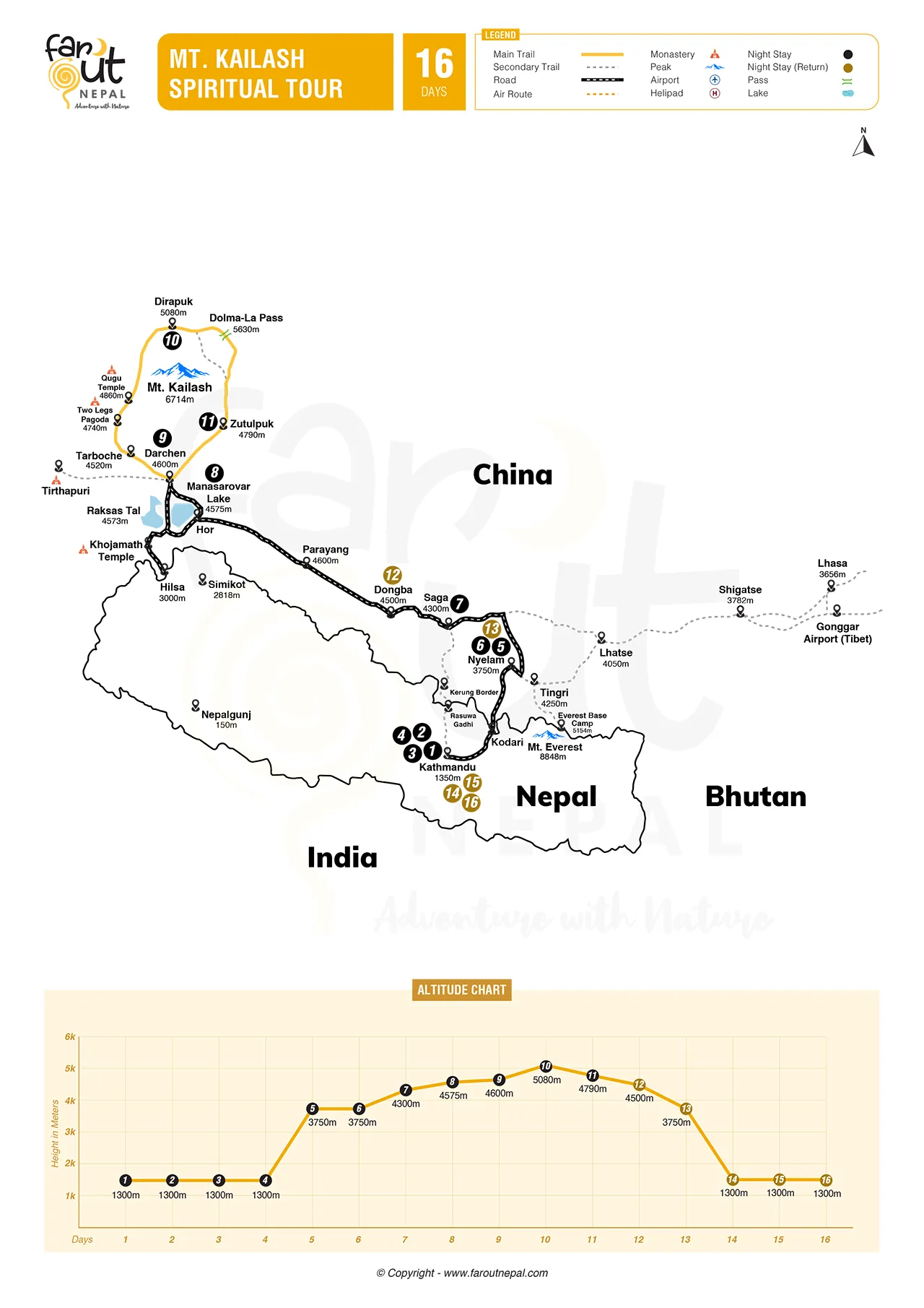
Trip map of Mt Kailash Spiritual Tour
Trip Information
Duration of the Lhasa Mt. Kailash Spiritual Tour
This journey combines cultural discovery, high-altitude overland travel, and one of the world’s most meaningful pilgrimage experiences across Nepal and Tibet. From exploring Kathmandu and Lhasa, completing the sacred Mount Kailash Kora, to witnessing Mount Everest, the itinerary has been designed to balance acclimatization, exploration, and spiritual immersion.
Trip Details
- Total Duration: 20 Days
- Kathmandu Stay: Approx. 6 Nights (includes visa processing and cultural exploration)
- Tibet Stay: Approx. 13 Nights/14 Days
- Maximum Elevation: 5,630m (Dolma La Pass during the Mount Kailash Kora)
- Trip Style: Cultural Tour • Pilgrimage • High-Altitude Overland Journey • Trekking Experience
This itinerary is designed not simply to reach Mount Kailash, but to create a more complete Himalayan experience by combining cultural landmarks, scenic overland routes, altitude adaptation, and the spiritual significance of the Kailash pilgrimage.
Who Is This Trip Best For?
This journey is ideal for travelers who:
- Want to combine Lhasa, Everest, and Mount Kailash in one expedition
- Prefer a more immersive Tibet experience instead of a direct Kailash-only route
- Seek both cultural exploration and spiritual significance
- Are comfortable traveling in remote, high-altitude environments
- Want a structured itinerary with logistical support throughout the journey
Is This Trip Suitable for Beginners?
Yes, many travelers complete this journey without previous trekking experience. However, this trip is better suited to travelers who:
- Maintain a reasonable level of fitness
- Are comfortable with simple travel conditions
- Can walk for extended periods
- Understand the realities of high-altitude travel
This trip may not be suitable for travelers seeking luxury travel, short travel days, or highly predictable conditions.
Difficulty Level & Physical Preparation
This is a challenging high-altitude journey that combines overland travel across Tibet with multi-day trekking around Mount Kailash. While the route does not require technical climbing experience, travelers should be prepared for long travel days, changing conditions, and sustained exposure to altitude.
Trip Difficulty: Challenging
The recommended fitness level required is from moderate to good. You should be comfortable with:
- Walking for several hours at high altitude
- Multi-day travel in remote regions
- Basic accommodation in some locations
- Long overland drives across Tibet
- Cold mornings and changing mountain weather
- Limited facilities in remote areas
The most physically demanding part of the journey is the Mount Kailash Kora, especially the crossing of Dolma La Pass, which involves sustained uphill trekking followed by a steep descent. Altitude (not trekking distance) is typically the greatest challenge.
What Makes This Trip Challenging?
Large portions of the itinerary take place above 3,500m, where oxygen levels are significantly lower than at sea level. Key elevations include Lhasa, Xigatze, Mansarovar, and the Dolma Pass (5,630 m). Your energy levels, walking pace, and recovery time may feel different at these elevations.
The Mount Kailash Kora
The sacred kora is completed over multiple days and includes:
- Stage 1: Darchen to Dirapuk Monastery: 6 hrs walk – 20 kms – 200m ascent
- Stage 2: Dirapuk Monastery to Dzultripuk Monastery: 7/8 hrs- 18 kms – 600m ascent
- Stage 3: Dzultripuk Monastery: 3 / 4 hrs – 14 kms – 150 m descent
Features:
- Rocky and uneven terrain
- Gradual and steep uphill sections
- Descents on loose and rugged paths
- Long walking hours at altitude
- Variable weather conditions
- Dolma La Pass crossing: 5,630 m
The objective is not speed. It is completing the journey steadily and comfortably.
How to Prepare Before the Trip
Physical preparation can significantly improve your overall experience. The recommended preparation includes:
- Regular walking or hiking several weeks before departure
- Cardio activities such as cycling, jogging, or stair climbing
- Light strength training for legs and core
- Prior high-altitude travel (helpful but not required)
Mental preparation is equally important. Flexibility, patience, and realistic expectations contribute greatly to enjoying remote Himalayan travel.
Altitude Considerations for the Kailash Region
Traveling across Tibet and completing the Mount Kailash Kora means spending extended periods at high elevation. Understanding the effects of altitude on the body and preparing accordingly can significantly improve both comfort and safety throughout the journey.
Altitude affects people differently, regardless of age, fitness level, or previous travel experience. Being physically fit does not eliminate the possibility of altitude-related discomfort.
Understanding High Altitude
As elevation increases, oxygen availability decreases. This itinerary includes multiple days above 3,500m, with the highest point reaching 5000+ m. At these elevations, your body may require more time to adapt.
Common Symptoms of Altitude Discomfort
Mild altitude-related symptoms can occur and may include headache, unusual tiredness, shortness of breath, dizziness, difficulty sleeping, mild nausea, etc. These symptoms should never be ignored. If symptoms worsen or become severe, immediate communication with your guide is essential. You can learn more about the symptoms of AMS here → [Altitude Sickness: Symptoms to Watch out For]
How to Reduce the Risk of Altitude Issues
We advise you to use this guide to reduce altitude sickness → [How to Lessen the Risk of AMS]. The following habits can also help support adaptation:
- Drink water consistently throughout the day
- Walk at a steady and sustainable pace
- Eat regularly, even if your appetite decreases
- Avoid alcohol and excessive exertion
- Dress appropriately to avoid unnecessary fatigue
- Rest whenever needed
- Inform your guide early if symptoms develop
During the Mount Kailash Kora, maintaining a comfortable rhythm is more important than moving quickly.
Medical Preparation Before Departure
Before joining this trip, we strongly recommend the following:
- Scheduling a medical check-up if you have existing health concerns.
- Medical clearance may be requested for high-altitude participation depending on operational requirements.
- Bring all prescribed medications in sufficient quantity.
- Carrying a personal first-aid kit for minor issues, which may include personal prescription, pain relief medication, motion sickness medication (if required), antiseptic, etc.
- Carrying electrolyte tablets and energy snacks
Any altitude medication should only be used based on professional medical advice.
Oxygen & Emergency Support
Emergency oxygen support is carried during overland travel and the Mount Kailash section for emergencies when operationally available.
Please note:
- Oxygen is an emergency support measure, not a substitute for acclimatization
- Guides may recommend descending, resting, or modifying activity depending on conditions
- In certain situations, continuing the journey may not be advisable
Your safety and well-being take priority over itinerary completion. If you have concerns about whether this trip is suitable for you, contact our team before confirming your reservation.
Best Time for the Lhasa Mt Kailash Spiritual Tour
The Lhasa to Mount Kailash journey operates during the period when weather, road access, and travel conditions across Tibet are generally most favorable. Choosing the right season can have a major impact on visibility, comfort, and the overall experience.
May: Early Season with Clear Mountain Views
May marks the beginning of the main travel season for Tibet and Mount Kailash. Conditions are generally stable with cooler temperatures and good visibility across the plateau.
Why travel in May?
- Crisp mountain views
- Cooler daytime temperatures
- Pleasant conditions for overland travel
- Less summer haze
Ideal for travelers prioritizing scenery and a quieter atmosphere.
June: Balanced Conditions for Travel & Exploration
Kathmandu is usually hot and humid, reaching up to 29°C/ 12°C, and receives around 196 mm of rain, but the weather in Tibet can be better and quite a good time for travel. In June, the weather in Lhasa is pleasant, at around 19°C/ 7°C, and rainfall is around 80 mm, whereas in the Mt. Kailash area, it will be around 15°C/ 0°C. The rainfall is relatively low in the Kailash region, and occasional light rain or showers are possible.
So, travelling in June is quite a nice season, but Mt. Kailash can be quite crowded due to a lot of pilgrimage tours. Temperatures become slightly warmer while mountain conditions generally remain favorable.
Why travel in June?
- Comfortable trekking temperatures
- Longer daylight hours
- Good conditions for sightseeing and photography
- More stable travel conditions in many areas
Recommended for travelers seeking a balanced overall experience.
September: Excellent Visibility & Trekking Conditions
September is widely regarded as one of the strongest months for Mount Kailash journeys. After the summer weather pattern transitions, skies are often clearer, and temperatures remain comfortable.
Why travel in September?
- Excellent mountain visibility
- Comfortable temperatures for trekking
- Clearer skies across the Tibetan Plateau
- Beautiful seasonal landscapes
Ideal for travelers who want strong trekking conditions and broad mountain views.
Weather Conditions to Expect
Regardless of the season, the weather in Tibet can change quickly.
During the journey, expect:
- Strong sun exposure at altitude
- Cold mornings and evenings
- Wind in exposed passes
- Temperature variation between regions
- Occasional rain or snow, depending on elevation
Layered clothing is strongly recommended.
Seasonal Comparison
| Season | Conditions | Visibility | Trek Comfort | Crowd Level | Priority |
| May | Cool & Stable | Excellent | Moderate | Moderate | Cooler Conditions |
| June | Mild & Balanced | Very Good | Excellent | Moderate–High | Overall Balance |
| September | Clear & Comfortable | Excellent | Excellent | Moderate | Mountain Visibility |
Packing Essentials & Clothing
Packing well for the Lhasa to Mount Kailash journey is less about carrying more, but carrying the right items. This trip combines city exploration, long overland travel, cold mornings, high-altitude trekking, and remote conditions. Temperatures and weather can change quickly, especially above 4,000 meters, so a flexible layering system works better than heavy packing.
Clothing (Layering System Recommended)
Layering allows you to adapt throughout the journey as temperatures change between Kathmandu, Lhasa, the Everest region, and Mount Kailash.
Base layer (for moisture management) can be Thermal tops and bottoms or breathable shirts. For warmth, an insulated layer or a lightweight sweater should be donned. Outer layers are mostly for weather protection, so a waterproof jacket and trekking pants are recommended. Besides these, the following essentials are also recommended:
- Down or insulated jacket
- Warm hat or beanie
- Gloves suitable for cold conditions
- Neck gaiter or scarf
Footwear
Your footwear can significantly affect comfort during the journey.
Recommended:
- Comfortable trekking shoes or hiking boots
- Footwear should be well broken-in before departure
- Lightweight sandals or casual shoes for evenings
- Multiple pairs of trekking socks
Avoid bringing completely new boots for the trip.
Daypack & Trekking Equipment
For sightseeing days and the Mount Kailash Kora:
- Small daypack (approximately 20–30L)
- Reusable water bottle or hydration system
- Water purification method (tablets or filter)
- Trekking poles (optional but helpful)
- Headlamp or small flashlight
- Rain cover for backpack
High altitude increases sun exposure significantly. You should bring UV-protection sunglasses, high-SPF sunscreen, wet wipes or tissues, sanitizer, and a moisturizer.
While these are not essential, they’re often appreciated:
- Travel pillow
- Ear plugs
- Eye mask
- Lightweight towel
- Journal or notebook and reading material for longer drives
Electronics & Connectivity
Power access becomes less predictable in remote regions. Recommended:
- Universal adapter
- Power bank & portable charger
- Charging cables
- Camera and extra batteries
Cold weather can reduce battery performance.
Packing Philosophy for The Kailash Journey
A simple rule: Pack for changing weather, not extreme weather.
Focus on layers, comfort, and practicality rather than bringing too much. The right equipment makes the journey easier, but the best preparation is staying flexible and traveling light.
Accommodation For the Mt. Kailash Spiritual Tour
Accommodation and food are selected based on location, accessibility, and overall travel experience, not luxury standards.
Accommodation During the Journey
Comfort levels vary throughout the itinerary, and understanding this in advance helps create more realistic expectations and a smoother experience.
Kathmandu: Comfortable City Stay
In Kathmandu, accommodation is arranged in well-located hotels that provide a comfortable environment before and after the Tibet journey. Typical facilities include:
- Private rooms
- Attached bathrooms
- Hot showers
- Wi-Fi (subject to availability)
Lhasa & Major Tibetan Cities: Standard Hotel Accommodation
In destinations such as Lhasa and Xigatze, accommodation generally offers comfortable hotel facilities suitable for rest and acclimatization. Typical features may include:
- Twin-sharing rooms
- Attached bathrooms
- Heating availability (varies by season)
- Basic hotel amenities
Accommodation standards may differ from international urban expectations.
Everest & Mount Kailash Region: Basic Mountain Accommodation
As the journey moves into remote areas, including Rongbuk, Manasarovar, and the Mount Kailash route, accommodation becomes significantly simpler. You can expect:
- Basic guesthouses or lodges
- Shared facilities in some locations
- Limited heating
- Limited water availability
- Simple sleeping arrangements
Remote mountain accommodation prioritizes practicality and location over comfort.
Room Sharing & Single Supplements
Unless otherwise requested:
- Accommodation is generally arranged on a twin-sharing basis
- Solo travelers may be paired with another traveler of the same gender when applicable
- Single-room requests may be available in selected locations, but cannot be guaranteed throughout remote regions
Meals During the Journey
Meals are arranged to provide practical and consistent support throughout the trip, which includes breakfast, lunch, and dinner as outlined in the itinerary. Meal styles vary depending on location and available ingredients.
What Type of Food to Expect
Food choices become more limited at higher elevations and in remote areas. Throughout the journey, meals may include:
Nepal
- Nepali meals
- International options
- Rice, noodles, vegetables, soups
Tibet
- Tibetan and Chinese-style meals
- Vegetable dishes
- Rice and noodle-based meals
- Soups and simple seasonal menus
For Vegetarian Meals
Vegetarian options are generally available throughout the trip and are commonly preferred during the Mount Kailash section. If you have dietary requirements, it’s better to inform us before departure. But specialized dietary requests cannot always be guaranteed outside major cities.
Drinking Water
Staying hydrated is essential during high-altitude travel. Recommendations:
- Carry a reusable water bottle
- Use boiled, filtered, or treated drinking water
- Bring your preferred purification method if desired
This journey is designed around access to extraordinary places, not premium accommodation.
Visa, Permits & Required Documents
Travelling to Tibet and Mount Kailash requires additional documentation and travel arrangements beyond a standard international trip. Because entry regulations and administrative procedures may change over time, final requirements will be confirmed during booking.
Passport Requirements
To participate in this journey, your passport should meet the following conditions:
- Minimum 9 months’ validity from the travel date
- Sufficient blank pages for visas and entry procedures
- The passport condition should be undamaged and fully readable
Please verify passport validity early to avoid delays during processing.
Required Documents
Document requirements may vary depending on nationality and current travel regulations. Commonly requested documents include:
- Passport copy
- Original passport (when required for processing)
- Recent passport-size photographs
- Completed application forms
- Additional supporting documents, if requested by the authorities
You’re also advised to keep these documents with you during the travel as well.
Tibet Travel Arrangements
Travel within Tibet requires additional travel authorization beyond standard international entry requirements. These arrangements are generally coordinated in advance and may include permits and administrative processing related to:
- Entry into Tibet
- Regional travel authorization
- Route approvals for restricted areas
- Group travel procedures are applicable
Travel documents and approvals are typically finalized before departure.
Chinese Visa Process
Chinese visa procedures can differ depending on:
- Nationality
- Current government policies
- Place of application
- Processing timelines
Because requirements can change, travelers should avoid applying independently unless instructed.
Chinese Embassy Working Hours: Monday to Friday – 09:30 hrs. to 11:30 hrs.
Visa-free entry
China now grants unilateral visa-free access and has signed mutual visa exemption agreements with 75 countries. They can stay in China for up to 30 days without a visa for business, tourism, exchange, transit, or visiting family.
Important: This visa-free entry applies to mainland China. However, Tibet is a special administrative region, and a Tibet Travel Permit is still required even if you enter China without a visa. Upon receiving your scanned copy of the passport, the agency will get you the Tibet Travel Permit.
Important Timeline for Preparation
To help ensure smooth processing:
Start your processing 45–60 days before departure
During this period:
- Confirm passport validity
- Submit required documents
- Complete the requested forms
- Finalize trip details
Late submissions may affect processing timelines.
Border & Immigration Procedures
This itinerary includes multiple immigration and checkpoint procedures. Travelers should expect:
- Passport verification
- Luggage inspection, where applicable
- Vehicle transfers at border areas
- Administrative waiting periods depend on conditions
Patience and flexibility are important during cross-border travel.
Currency & Customs
- Currency Exchange: Chinese Yuan (CNY) is the accepted currency. Approximate conversion rates:
- 1 USD = 7.26 CNY (as of March 2025)
- 1 CNY = INR 11.78 (subject to fluctuation)
- Credit cards are not accepted; cash exchange is recommended.
- Valuable personal items must be declared at customs.
- Antiques without proper certification may be confiscated.
Travel Insurance (Strongly Recommended)
Although not a visa requirement, travel insurance is strongly recommended for this journey.
Consider coverage for:
- High-altitude travel
- Medical treatment
- Emergency evacuation
- Trip interruption
- Weather-related delays
- Lost or delayed baggage
Please review policy details carefully before purchase.
Important Notes
- Entry requirements may change without prior notice
- Government regulations may affect routes or travel schedules
- Additional documentation may occasionally be requested
- Final approval decisions remain with the relevant authorities
Tibet logistics can seem complex at first, but you won’t be expected to manage the process alone. From document preparation and travel guidance to permit coordination and pre-departure support, our team will help you prepare each step before departure.
Booking Information for the Mt. Kailash Spiritual Tour
Every traveler approaches Mount Kailash differently.
Some prefer the shared energy and community of a group departure, while others value flexibility, privacy, and a more personalized pace. To accommodate different travel styles, we offer both scheduled group departures and private journey options.
Group Departures
Our standard departures are designed for travelers who want to experience Tibet and Mount Kailash with the support of a professionally organized itinerary and shared logistics.
Typical Group Size
Approximately 24–40 Travelers
Group departures are ideal for travelers who:
- Prefer structured planning and coordinated logistics
- Enjoy meeting fellow travelers from different backgrounds
- Want a cost-efficient way to experience Tibet and Mount Kailash
- Value support throughout permits, transportation, and border procedures
Group departures are accompanied by operational staff and local support teams according to itinerary requirements.
Private Departures
For travelers seeking greater flexibility and personalization, private departures are available upon request. Private trips may be suitable for:
- Families
- Small groups of friends
- Pilgrimage groups
- Corporate or community groups
- Travelers with preferred travel dates
Private departures offer:
- Greater schedule flexibility
- Tailored pacing where operationally possible
- Dedicated travel arrangements
- Customized extensions before or after the trip
Availability depends on season, permits, and operational feasibility.
Booking Process
We aim to keep the reservation process straightforward.
Step 1: Send Your Inquiry
Contact our team with preferred travel dates, number of travelers, nationality information, and any special requests you have.
Step 2: Confirm Availability
Our team will confirm departure availability and review the documentation requirements before providing the final pricing and preparation details.
Step 3: Secure Your Reservation
An advance payment is required to confirm participation. Once confirmed, preparation and documentation guidance will begin.
Payment Schedule
Booking Amount: Advance payment in INR is required.
Reservation Deposit
50% payment: 20 days before departure
Final Payment
Remaining balance: 10 days before departure
Payment instructions and available payment methods will be provided during confirmation.
Cancellation Policy
Because this journey involves permits, preparation, and operational arrangements, cancellation terms apply.
Cancellation Charges
| Cancellation Timing | Cancellation Fee |
| 30+ days before departure | 25% |
| 15–29 days before departure | 50% |
| Less than 15 days | Non-refundable |
Any applicable processing costs, government fees, or third-party charges may follow applicable booking terms.
Ready to Begin Your Mount Kailash Journey?
Whether you’re joining a scheduled departure or planning a private pilgrimage, our team is here to help you prepare for every step of the journey, from permits and planning to the final return to Kathmandu.