


Essence of Tibet Tour

Essence of Tibet Tour: Tibetan Monks

Central Tibet Tour

Central Tibet Tour

Central Tibet Tour
Essence of Tibet Tour

Activity
Tour
Duration
08 Days
Grading
Moderate
Max Altitude:
5,045m. / 16,552ft.
Best Season
April-June & September-October
Style of Trip
Spiritual, Cultural, Nature
Group Size
2-10 People
Accommodation
Hotel/Resort/Guest House
Meals
Breakfast
Why Choose the Essence of Tibet Tour?
Tibet offers countless travel experiences, from short cultural escapes to extended overland adventures. While many iconic landmarks are featured across different itineraries, the Essence of Tibet Tour is perfect for travelers seeking the region’s cultural, historical, and spiritual highlights within a comfortable timeframe. Below are some of the key reasons why this journey may be the ideal match for your interests and schedule.
- Good Time Frame: The Essence of Tibet tour explores the birthplace of Tibetan civilization, sacred monasteries, breathtaking lakes, and timeless Himalayan landscapes at a relaxed and comfortable pace.
- Enjoy a Well-Paced Acclimatization Itinerary: Designed with a gradual ascent from lower elevations (3,100 m), the tour strikes a balance between cultural discovery, scenic overland travel, and acclimatization. This makes it an ideal choice for travelers seeking a deeper understanding of Tibet.
- Discover the Birthplace of Tibetan Civilization: Explore the historic Yarlung Valley, home to Tibet’s earliest kings, ancient monasteries, and the roots of Tibetan culture and Buddhism.
- Experience the Spiritual Heart of Tibet: Visit Lhasa, where iconic landmarks such as the Potala Palace, Jokhang Temple, Barkhor Street, Sera Monastery, and Drepung Monastery reveal centuries of religious and cultural heritage.
- Witness the Beauty of Sacred Himalayan Landscapes: Journey across the breathtaking Yamdrok Lake, cross the panoramic Khamba La Pass, and admire the dramatic scenery of the Karo La Glacier along one of Tibet’s most scenic overland routes.
- Explore Historic Gyantse: Discover the former trading hub of Gyantse, renowned for the magnificent Pelkor Chode Monastery, the unique Gyantse Kumbum Stupa, and the historic Gyantse Dzong fortress.
- Visit Xigatze, Tibet’s Second-Largest City: Experience Xigatze, home to the revered Tashilhunpo Monastery, the traditional seat of the Panchen Lama, and an important center of Tibetan Buddhism.
- Gain Insight into Authentic Tibetan Culture: Observe daily monastic life, encounter devoted pilgrims, visit traditional Tibetan communities, and experience customs & hospitality that have been preserved for centuries.
- Travel with Seamless Logistics: From Tibet travel permit coordination and transportation to comfortable accommodations and experienced local guides, every aspect of your journey is carefully arranged for a smooth and worry-free experience.
- Ideal for First-Time Visitors to Tibet: Combining Tibet’s most celebrated landmarks with lesser-visited historical treasures, this itinerary offers one of the most comprehensive introductions to the region’s history, spirituality, and natural beauty.
Trip Introduction
The Essence of Tibet Tour: A Pilgrimage to the Origins of Tibetan Society
The Essence of Tibet tour program offers a profound cultural immersion into the place of origin for Tibetan royalty, religious thought, and national identity.
Over the course of a nine-day expedition, travelers follow the path from Tibet’s birthplace, the Yarlung Valley, to the spiritual epicenter of Lhasa, eventually crossing high Himalayan passes to reach the storied communities of Gyantse and Xigatze.
Going further than conventional excursions that limit the focus to the capital, this journey encompasses the expansive narrative of the region. Every stop along the way, whether that’s the earliest Buddhist sanctums and royal strongholds or the majestic mountain glaciers and ancient merchant crossroads, unfolds a vital chapter in the Tibetan story.
By combining strategic elevation gain with premier local expertise and seamless permit management, this tour serves as a definitive introduction to the high plateau.
The Allure of Exploring the Essence of Tibet Tour
Traversing Central Tibet gives you the golden opportunity to experience the region through four essential lenses: its ancestral beginnings, its religious devotion, its commercial legacy, and its living spiritual heritage.
Together, these locations offer a comprehensive perspective on the Tibetan soul that no single city can encapsulate.
Yarlung Valley: The Ancient Cradle of the Tibetan People
Long before Lhasa ascended as the political heart of the plateau, the fertile Yarlung Valley served as the primary seat of power for the Tubo Kingdom. Recognized as the birthplace of the nation, this valley guards the legends of the first monarchs and the earliest monastic foundations. Commencing the expedition here offers critical historical insight and facilitates a more comfortable transition to the higher altitudes encountered later in the journey.
- Stand before Yumbulakhang, the first fortress and royal residence in Tibetan history.
- Witness the intricate artistry at Tradruk Monastery, among the oldest temples, and home to sacred relics.
- Examine the legacy of ancient rulers at the royal necropolis located in the Chongye Valley.
- Explore the sacred grounds of Samye Monastery, the very first Buddhist institution established in the region.
- Absorb the serene atmosphere of the Yarlung Tsangpo Valley, where the roots of this civilization first took hold.
Lhasa: The Sacred Center of Faith and Heritage
The narrative moves from the ancestral valley to Lhasa, a city that has served as the anchor of Tibetan identity for over a millennium. As the historic home of the Dalai Lamas and the pinnacle of the Buddhist world, Lhasa merges grand architectural feats with a living tapestry of pilgrimage and devotion. In this city, ancient rituals are not merely historical echoes but the heartbeat of contemporary daily life.
- Visit Dadong Village, a hidden cultural gem near Lhasa. Renowned for its well-preserved heritage, the village offers an authentic insight into traditional Tibetan customs, crafts, and rural life.
- Venture through the halls of the Potala Palace, an architectural wonder and the defining symbol of the plateau.
- Offer prayers at the Jokhang Temple, widely revered as the holiest site for all Tibetan Buddhists.
- Join the flow of devotees along Barkhor Street, a vibrant circuit of spiritual practice and traditional craftsmanship.
- Step into Tibet’s first modern museum, where over 2,500 artifacts offer a captivating journey through Tibetan culture, history, religion, and traditions
- Discover Norbulingka, the “Jeweled Garden” and former Summer Palace of the Dalai Lamas. This UNESCO World Heritage Site is renowned for its lush gardens, scenic ponds, historic pavilions, and peaceful atmosphere.
- Observe the dynamic philosophical exchanges at Sera Monastery, where the art of monastic debating is preserved.
Gyantse: A Gateway of Trade and Ancient Traditions
As you depart the capital, the overland journey reveals its own spectacular beauty. From the panoramic heights of the Khamba La Pass, the turquoise Yamdrok Lake comes into view, along with the rugged Karo La Glacier. Your destination is Gyantse, a town that flourished as a pivotal trade hub connecting Tibet to Nepal and India. The town today also remains a bastion of historic fortifications and spiritual art.
- Marvel at the sacred turquoise waters of Yamdrok Lake, a site of immense spiritual importance.
- Pause at the Karo La Glacier to see ancient ice fields reaching toward the plateau road.
- Explore Pelkor Chode Monastery, unique for its unified representation of various Buddhist schools.
- Ascend the multi-tiered Gyantse Kumbum, a masterpiece of stupa architecture and sacred iconography.
- Visit the Gyantse Dzong, a fortress that tells the story of the town’s strategic and defensive past.
Xigatze: The Spiritual Seat of the Panchen Lamas
The expedition concludes in Shigatse, the second city of the plateau and a critical center of religious life. As the traditional residence of the Panchen Lama, Xigatse provides a window into the spiritual diversity of the region and an authentic glimpse into the daily life of modern Tibetans. The city’s expansive monasteries and bustling markets create a resonant finale for your exploration of the region.
- Walk through Tashilhunpo Monastery, the monumental seat of the Panchen Lama.
- Browse local markets for regional crafts, artwork, and traditional Tibetan goods.
- Encounter the authentic rhythms of Tibetan life outside the primary capital.
- Deepen your knowledge of the Panchen Lama’s vital role within the Gelug school.
- Meander through historic districts where time-honored customs meet contemporary Tibetan society.
A Single Journey, Four Eras of the Tibetan Soul
The Essence of Tibet Tour is designed as more than a visit to four remarkable cities; being a chronological passage through the region’s soul.
The Yarlung Valley reveals the birth of the culture, Lhasa embodies its spiritual heart, Gyantse preserves its history of exchange, and Xigatze represents its enduring religious leadership. Linking these pillars are sacred waters, alpine glaciers, and some of the most awe-inspiring overland routes on the planet.
Whether this is your first arrival on the Roof of the World or you are returning to seeking a more profound connection, our itinerary provides a holistic view of the region’s history and landscape, serving as a prelude to the detailed day-by-day plan provided below.
Ready to Discover the Birthplace of Tibetan Civilization?
Let Far Out Nepal take care of the permits, planning, and logistics while you experience one of the world’s most extraordinary cultural journeys. Contact our travel specialists today to start planning your Central Tibet adventure →
Detail itinerary of Essence of Tibet Tour
Day 01: Fly to Lhasa & Journey to Tsedang
The Essence of Tibet Tour will begin with one of the world’s most spectacular mountain flights as you travel from Kathmandu to Lhasa’s Gonggar Airport. On clear days, the journey offers breathtaking aerial views of the Himalayan range, including Kanchenjunga, Makalu, and Mount Everest, providing an unforgettable introduction to the land where you can touch the sky.
After completing immigration formalities, you’ll meet your local Tibetan guide before setting out on a scenic drive to Tsedang, the gateway to the historic Yarlung Valley. Unlike many Tibet itineraries that head directly to Lhasa, spending your first night in Tsedang allows you to begin your journey at a lower altitude, helping your body adjust more gradually. This also subtly introduces you to the region where Tibetan civilization first emerged.
As you travel through the Yarlung Valley, you’ll catch your first glimpses of Tibet’s expansive landscapes, traditional villages, and the Yarlung Tsangpo River. The peaceful surroundings provide a gentle introduction to the country’s unique geography and culture before exploring its historic landmarks in the coming days.
You can enjoy a restful evening in Tsedang as you prepare to explore the birthplace of Tibetan civilization the following day.
Acclimatization Tips
Although Tsedang sits at a more comfortable 3,100 meters, your body is still adjusting to the Tibetan Plateau. To help ensure a smooth start to the journey, we recommend:
- Complete rest after arriving at your hotel.
- Drink plenty of water throughout the day.
- Enjoy light, nutritious meals.
- Avoid strenuous physical activity and alcohol.
- Inform your guide if you experience persistent symptoms such as headaches, dizziness, or nausea.
This gradual introduction is one of the key advantages of the Essence of Tibet Tour, reducing the likelihood of altitude-related discomfort before continuing to higher elevations.

Activity: Flight 1.5 hours + 1.3 hours drive to Tsedang

Location: Tsedang

Max. Altitude: 3,100m/10,171ft.

Accommodation: Hotel
Day 02: Explore Tsedang | Discover the Birthplace of Tibetan Civilization
The day will be dedicated to exploring Tsedang and the legendary Yarlung Valley, widely regarded as the birthplace of Tibetan civilization. Long before Lhasa became Tibet’s capital, this fertile valley was home to the country’s ancient history and the foundations of Tibetan Buddhism. Visiting these historic sites provides valuable insight into how Tibet’s culture, religion, and identity developed over the centuries.
Yumbulakhang Palace (3,841 m): Tibet’s First Royal Palace
We will begin the day with a visit to Yumbulakhang Palace, dramatically perched on a hill overlooking the Yarlung Valley. According to Tibetan legend, this was the first palace ever built in Tibet during the reign of King Nyatri Tsenpo, the kingdom’s first ruler. Its commanding position offers sweeping views across the valley while introducing the myths and royal history that shaped early Tibetan civilization.
Tradruk Monastery (3,591m): One of Tibet’s Oldest Sacred Temples
We will continue to Tradruk Monastery, one of the oldest Buddhist monasteries in Tibet. It was founded during the reign of King Songtsen Gampo in the 7th century. Revered as one of Tibet’s twelve geomantic temples, the monastery is home to the famous pearl Thangka depicting Avalokiteshvara (Chenrezig). The peaceful atmosphere and centuries-old architecture provide a fascinating glimpse into the early spread of Buddhism across Tibet.
Chongye Valley (3,824 m): The Royal Tombs of Ancient Tibet
Later, we will visit the historic Chongye Valley, where the burial mounds of Tibet’s ancient kings rest beneath the surrounding mountains. These impressive royal tombs preserve the legacy of Tibet’s earliest dynasties, offering a rare insight into the country’s pre-Buddhist Bon traditions and early beliefs that existed before Buddhism dominated the nation.
Later, you can enjoy a peaceful evening in Tsedang as you prepare to continue your journey to Samye Monastery and Lhasa, where the next chapters of Tibet’s spiritual and cultural history await.
Beyond its remarkable historical significance, day two also serves an important purpose in your journey. Spending another day in Tsedang allows your body additional time to acclimatize naturally before traveling to the higher elevations of Lhasa and the Tibetan Plateau.
Travel Tips:
When visiting monasteries during your Lhasa cultural tour, please follow these guidelines:
- Avoid wearing shorts or sleeveless tops (shoulders should be covered).
- Remove sunglasses and hats before entering chapels.
- Photography inside chapels is generally not permitted.
- Walk clockwise around religious sites unless instructed otherwise.
- Respecting local customs ensures a meaningful and culturally sensitive experience
Activity: Tour: approx. 6 hours
Location: Tsedang
Max. Altitude: 3,100m/10,171ft.
Accommodation: Hotel

Meal: Breakfast
Day 03: Visit to Samye Monastery | Driving to Lhasa | Visiting Dadong Village en-route
Today, we will be driving to the heart and soul of Tibet, Lhasa. En route, we will visit Dadong Village.
Samye Monastery: The Birthplace of Tibetan Buddhism
Morning starts with a visit to Samye Monastery, the first Buddhist monastery ever established in Tibet. Built in the 8th century during the reign of King Trisong Detsen, Samye introduced organized Buddhist learning to the Tibetan Plateau. It also remains one of the country’s most significant religious sites. Its distinctive mandala-inspired layout, influenced by various architectural styles, symbolizes the Buddhist universe and marks the beginning of Tibet’s enduring Buddhist tradition.
Dadong Village: We will continue our journey with a drive to Dadong Village near the outskirts of Lhasa. One of Tibet’s best-preserved ancient villages, Dadong retains a timeless charm and offers a glimpse into traditional rural Tibetan life. Rich in cultural heritage, the village preserves age-old customs, traditional crafts, and farming practices that reflect Tibet’s enduring way of life.
Also, we will visit the 2000-year-old Nimatang Temple, which is the birthplace of Tibetan medicine, followed by the Medicine Buddha Temple, which is greatly admired by the locals. Later, we will visit White Temple, constructed by Genna Doji in the 12th century. This temple is devoted to an assortment of valuable Buddha statues and a collection of meticulously handcrafted Kagyur, made of gold. Overnight at the hotel.
Altitude Gain: 450 m Higher
Lhasa is at 3,650 m, gaining around 450m high, so drink plenty of water, eat good food, and avoid too much stress. So, you should move slowly.
Activity: Tour + Drive: Approx. 7-8 hours
Location: Tsedang
Max. Altitude: 3,100m/10,171ft.
Accommodation: Hotel
Meal: Breakfast
Day 04: Exploring Lhasa: Potala Palace, Jokhang Temple & Barkhor Street
Today will be dedicated to exploring Lhasa, the spiritual, cultural, and political heart of Tibet for more than thirteen centuries. Home to some of the world’s most revered Buddhist landmarks, Lhasa offers an extraordinary opportunity to witness living traditions that have shaped Tibetan identity for generations. From magnificent palaces and sacred temples to bustling pilgrimage streets, every corner of the city tells a story of faith, resilience, and devotion.
Potala Palace: The Iconic Symbol of Tibet
We’ll begin our exploration of the magnificent Potala Palace, one of the world’s most recognizable landmarks and a UNESCO World Heritage Site. It was originally commissioned by King Songtsen Gampo in the 7th century and later expanded by the Fifth Dalai Lama. The palace has served as the winter residence of successive Dalai Lamas and the political center of Tibet for centuries.
Rising dramatically above Red Hill, the thirteen-storey palace contains more than a thousand rooms filled with gilded stupas, ancient scriptures, intricate murals, and priceless Buddhist artifacts. As you wander through its labyrinth of halls and staircases, you’ll gain a remarkable understanding of Tibet’s religious leadership, artistic heritage, and architectural brilliance.
Jokhang Temple: Tibet’s Holiest Sanctuary
We will continue to the revered Jokhang Temple, the spiritual heart of Tibetan Buddhism. Built in 647 AD, this ancient temple has welcomed pilgrims for centuries, many of whom travel thousands of kilometers to offer prayers before Tibet’s most revered and sacred statue of Jowo Shakyamuni.
Inside, the scent of burning incense, the flicker of yak butter lamps, and the quiet chants of monks create an atmosphere unlike anywhere else in the Himalayas. Visiting Jokhang is not simply sightseeing, but an opportunity to witness one of the world’s oldest living spiritual traditions in practice.
Barkhor Street: Experience the Rhythm of Old Lhasa
Surrounding Jokhang Temple is the vibrant Barkhor Street, Lhasa’s historic pilgrimage circuit and one of the city’s most atmospheric neighborhoods. Throughout the day, pilgrims steadily walk the sacred kora, spinning prayer wheels and chanting mantras as they circle the temple in an act of unwavering devotion.
As you wander through the lively streets, you can browse traditional Tibetan handicrafts, prayer flags, jewelry, thangka paintings, and local delicacies while observing everyday life unfold around you. Barkhor beautifully captures the intersection of spirituality, commerce, and culture that defines old Lhasa.
You can finally relax at your hotel in the evening after a memorable day exploring Tibet’s most celebrated cultural and spiritual landmarks. Overnight at the hotel.
Today’s Tips:
- There are 1,080 steps to reach the top of the Potala Palace. Walk at a slow, steady pace and avoid rushing, as the high altitude may cause shortness of breath or increase the risk of altitude sickness.
- Photography is not permitted inside the Potala Palace, so please respect the site regulations.
- Today’s sightseeing is mostly outdoors. Be sure to carry plenty of water, wear a hat, apply sunscreen, and bring sunglasses to protect yourself from the strong high-altitude sun.
Activity: Tour: Approx. 7 hours
Location: Xigatse
Max. Altitude: 3,900m/12,795ft.
Accommodation: Hotel
Meal: Breakfast
Day 05: Lhasa: Tibetan Museum, Norbulingka & Sera Monasteries
Our tour today will focus on the Tibet Museum, the ancient summer Palace, having the largest man-made park in Tibet, and the Gelugpa Monastery to witness the interesting philosophical Buddhist debate.
Tibet Museum: The First Modern Museum of Tibet
Tibet Museum, the first modern museum in Tibet and one of the country’s finest cultural attractions. Home to an impressive collection of prehistoric artifacts, the museum showcases exquisite Buddha statues in various postures, imperial jade seals, gold albums, royal gifts from Chinese emperors, and beautifully preserved Thangka paintings. Its architecture is equally captivating, blending traditional Tibetan design with modern architectural elements to create a landmark that reflects Tibet’s rich cultural heritage.
Norbulingka: Ancient Summer Palace with the Largest Man-Made Park
Continue to Norbulingka, the former summer palace of the Dalai Lamas and the largest man-made park in Tibet. Spanning over 3.6 million square meters, this UNESCO World Heritage Site is renowned for its peaceful gardens, elegant pavilions, and vibrant collection of more than 100 rare Himalayan and exotic plant species.
A stroll through Norbulingka offers a refreshing glimpse into Tibet’s royal history, natural beauty, and tranquil atmosphere.
Sera Monastery: Witness the Famous Monk Debates
In the afternoon, we will continue to Sera Monastery, another of Tibet’s great Gelug monasteries, established in 1419. While its temples and beautifully preserved murals are impressive, Sera is best celebrated for its monastic debate sessions, an educational tradition that has continued for hundreds of years.
You can watch as monks engage in lively philosophical discussions, punctuating their arguments with energetic hand gestures and distinctive claps. These debates are not performances but an essential part of Buddhist education, helping monks sharpen their understanding of Buddhist philosophy, ethics, and logic through disciplined dialogue. Few experiences offer a more authentic insight into Tibetan intellectual and spiritual traditions than witnessing these debates firsthand.
You can enjoy your final evening in Tibet’s historic capital, reflecting on a journey through ancient monasteries, sacred landscapes, and the enduring traditions of Tibetan Buddhism before your departure the following day. Overnight at the hotel.
Activity: Tour: Approx. 8 hours
Location: Lhasa
Max. Altitude: 3,650m/11,975ft.
Accommodation: Hotel
Meal: Breakfast
Day 06: Journey to Gyantse via Yamdrok Lake & the High Passes
Today will be one of the most scenic and rewarding days of your Central Tibet Tour. Leaving the fertile Yarlung Valley behind, we’ll travel deeper into the Tibetan Plateau, where ancient monasteries, sacred lakes, and glacier-covered peaks combine to create one of the most unforgettable road journeys in the Himalayas.
The day not only connects two of Tibet’s most important historic regions but also showcases the breathtaking landscapes that make overland travel across Tibet an experience.
Yamdrok Lake: One of Tibet’s Holiest Lakes
Continuing westward, we will ascend to Khamba La Pass (4,794 m), where one of Tibet’s most iconic panoramas unfolds before us. From the summit, you can gaze across the brilliant turquoise waters of Yamdrok Lake, stretching gracefully through the surrounding mountains. The lake also belongs to the four sacred lakes of Tibet. On clear days, the snow-covered summit of Nojin Kangtsang (7,252 m) rises dramatically in the distance, creating one of the most photographed landscapes in Tibet.
Karo La Pass & Glacier
The journey continues over Karo La Pass (5,045 m), where the magnificent Karo La Glacier descends remarkably close to the roadside. Towering walls of ancient ice, colorful prayer flags, and rugged alpine scenery make this one of the most memorable stops along the Friendship Highway and a favorite location for photography.
Arriving in the historic town of Gyantze
Descending from the high passes, we’ll travel through traditional farming villages and broad valleys before arriving in Gyantze, one of Tibet’s oldest and most historically important towns. Once a thriving commercial center connecting Tibet with Nepal, Bhutan, and India, Gyantze retains much of its traditional character despite the passage of time.
After checking into your hotel, you can enjoy a leisurely walk through Gyantze Old Town, where narrow streets, whitewashed Tibetan homes, local shops, and centuries-old architecture provide an authentic glimpse into everyday life beyond the larger cities.
We will then spend the night in the historic trading town of Gyantze before continuing onward to Xigatze the following day.
Travel Tips:
- Prepare for a 06-hour drive journey crossing high Passes, Yamdrok Lake, and spending a night at Gyantse Village (3,950m)
- Carry water, snacks, dry food, and personal medicines.
- Wear comfortable clothing and shoes, plus some warm layers.
- Bring sun protection: hat, sunscreen, sunglasses, and a scarf.
- Hotels en route may be basic, but we aim for the best available accommodation
Activity: Tour + Drive: Approx. 7 hours
Location: Gyantse
Max. Altitude: 3,950m/12,959ft.
Accommodation: Hotel
Meal: Breakfast
Day 07: Discover Gyantse's Buddhist Treasures & Journey to Xigatze
This morning will be dedicated to exploring the remarkable cultural heritage of Gyantse. Once an important historical trading center, Gyantse is renowned for its distinctive Buddhist architecture, centuries-old monasteries, and artistic treasures that continue to reflect Tibet’s rich religious traditions.
After exploring the town’s most celebrated landmarks, the journey continues west to Xigatse, the historic capital of the Tsang region and the traditional seat of the Panchen Lama, where another important chapter of Tibetan Buddhism awaits
Pelkor Chode Monastery: A Symbol of Religious Harmony
We will begin the day at Pelkor Chode Monastery, one of Tibet’s most remarkable religious complexes. The monastery is known for bringing together and maintaining the harmony of the three major schools of Tibetan Buddhism. Inside its 15th century assembly halls, you can admire centuries-old Buddhist statues, intricate murals, and the magnificent image of the Present Buddha, one of the monastery’s most revered treasures.
Gyantse Kumbum: Tibet’s Architectural Masterpiece
Within the monastery complex stands the extraordinary Gyantse Kumbum, the largest and best-preserved chorten of its kind in Tibet. Built in a distinctive Nepalese architectural style, this 34-meter-high stupa contains numerous chapels adorned with exquisite murals and Buddhist artwork dating back more than six centuries. As you ascend through its different levels, each chamber reveals another layer of Tibetan Buddhist philosophy. At the top, you will finally be rewarded with the panoramic views over Gyantse, the surrounding valley, and the historic Gyantse Dzong fortress.
Journey to Xigatse
Leaving Gyantse behind, we will enjoy a comfortable drive across the fertile Nyang Chu Valley toward Xigatze, Tibet’s second-largest city and the traditional capital of the historic Tsang Province. Compared with the quieter atmosphere of Gyantse, Xigatze offers a vibrant blend of ancient monasteries, bustling local markets, and modern Tibetan life, making it an ideal place to experience another side of Central Tibet.
Explore the Local Market
After checking into your hotel (where we will stay the night later), you should take time to stroll through one of Xigatze’s lively local markets. You can browse stalls selling traditional handicrafts, prayer flags, locally produced goods, and Tibetan souvenirs while observing the rhythms of everyday life. It’s an excellent opportunity to experience the city’s welcoming atmosphere before visiting its most famous monastery the following day.
Activity: Tour + Drive: Approx. 7 hours
Location: Xigatse
Max. Altitude: 3,900m/12,795ft.
Accommodation: Hotel
Meal: Breakfast
Day 08: Visit Tashilhunpo Monastery & Return to Lhasa via the Yarlung Tsangpo River
Today will begin with a visit to one of the most important religious institutions in Tibet, followed by taking the scenic northern route back to Lhasa. Combining centuries of spiritual heritage with spectacular landscapes, this journey offers a deeper appreciation of both Tibet’s religious traditions and the vast natural beauty of the Tibetan Plateau.
After exploring Tashilhunpo Monastery, we’ll travel east through broad river valleys, traditional farming communities, and dramatic Himalayan scenery as the Yarlung Tsangpo River guides our return to the historic capital.
Tashilhunpo Monastery: The Seat of the Panchen Lama
We will begin the morning at the magnificent Tashilhunpo Monastery, founded in 1447 by Gendun Drup, or the First Dalai Lama. As the traditional seat of the Panchen Lama, the monastery remains one of the most influential centers of the Gelug School of Tibetan Buddhism and continues to play an active role in Tibetan religious life.
You can explore its impressive assembly halls and peaceful courtyards, along with the towering Buddhist statues and the monastery’s remarkable architecture. Beyond its artistic beauty, Tashilhunpo offers valuable insight into Tibetan Buddhist philosophy, monastic education, and centuries of spiritual tradition that continue to thrive today.
Scenic Drive Along the Yarlung Tsangpo River
Leaving Xigatze behind, return to Lhasa along the picturesque northern route. Following the course of the Yarlung Tsangpo River (or the Brahmaputra River after it enters India), the drive reveals a constantly changing landscape of fertile valleys, rugged mountains, traditional Tibetan villages, and open grasslands, shaped by the river.
Compared to the more mountainous southern route, this journey offers a different perspective of Central Tibet, showcasing the river that has sustained Tibetan civilization for thousands of years while providing countless opportunities to admire the expansive scenery.
Arrival in Lhasa
By late afternoon, we will arrive in Lhasa. You can enjoy a relaxed evening in the city, giving yourself time to unwind after the hotel check-in. Overnight at the hotel
Activity: Tour + Drive: Approx. 7-8 hours
Location: Lhasa
Max. Altitude: 3,650m/11,975ft.
Accommodation: Hotel
Meal: Breakfast
Day 09: Departure from Lhasa
After eight unforgettable days exploring the cultural and spiritual heart of Tibet, your Central Tibet Tour comes to an end. From the ancient Yarlung Valley and Tibet’s first Buddhist monasteries to the magnificent Potala Palace, sacred temples, historic trading towns, and breathtaking Himalayan landscapes, you’ve experienced the many chapters that have shaped Tibetan civilization for centuries.
At the scheduled time, your guide will accompany you on the transfer to Lhasa Gonggar International Airport for your onward flight. Whether you’re returning home or continuing your adventure through Nepal, China, or beyond, you’ll leave with a deeper appreciation of Tibet’s remarkable history, living Buddhist traditions, and spectacular mountain scenery.
Thank you for choosing Far Out Nepal to accompany you on your journey through Central Tibet. We hope the memories of its sacred monasteries, welcoming communities, dramatic landscapes, and timeless traditions remain with you long after you leave the Tibetan Plateau.
We wish you a great onward journey and look forward to seeing you on another Himalayan adventure in the future.
Activity: Airport transfer: Approx. 01 hour
Location: Lhasa
Max. Altitude: 3,650m/11,975ft.
Accommodation: Hotel (Check out before 12 Noon)
Meal: Breakfast
Need assistance with booking your trip? Inquire Now
Inclusions in Essence of Tibet Tour
- 02 nights’ accommodation at Tsedang on BB basis
- 01-night twin accommodation at Gyantse on BB basis
- 01-night accommodation at Xigatse on BB
- 03 nights’ accommodation at Lhasa on BB
- Sightseeing tours as stated in the program
- Local English-speaking guide
- Private Transportation during tours and travel
- Entrance fee during the sightseeing tour
- Arrival/Departure transfers
Trip Excludes
- China Visa Fee
- Tibet Special permit
- Lunch and dinner
- Flight tickets
- Travel Insurance
- Expenses of personal nature.
- Any extra cost incurred in case of political turmoil, flight cancellation, natural disaster, epidemics etc
- Anything not mentioned in our include box.
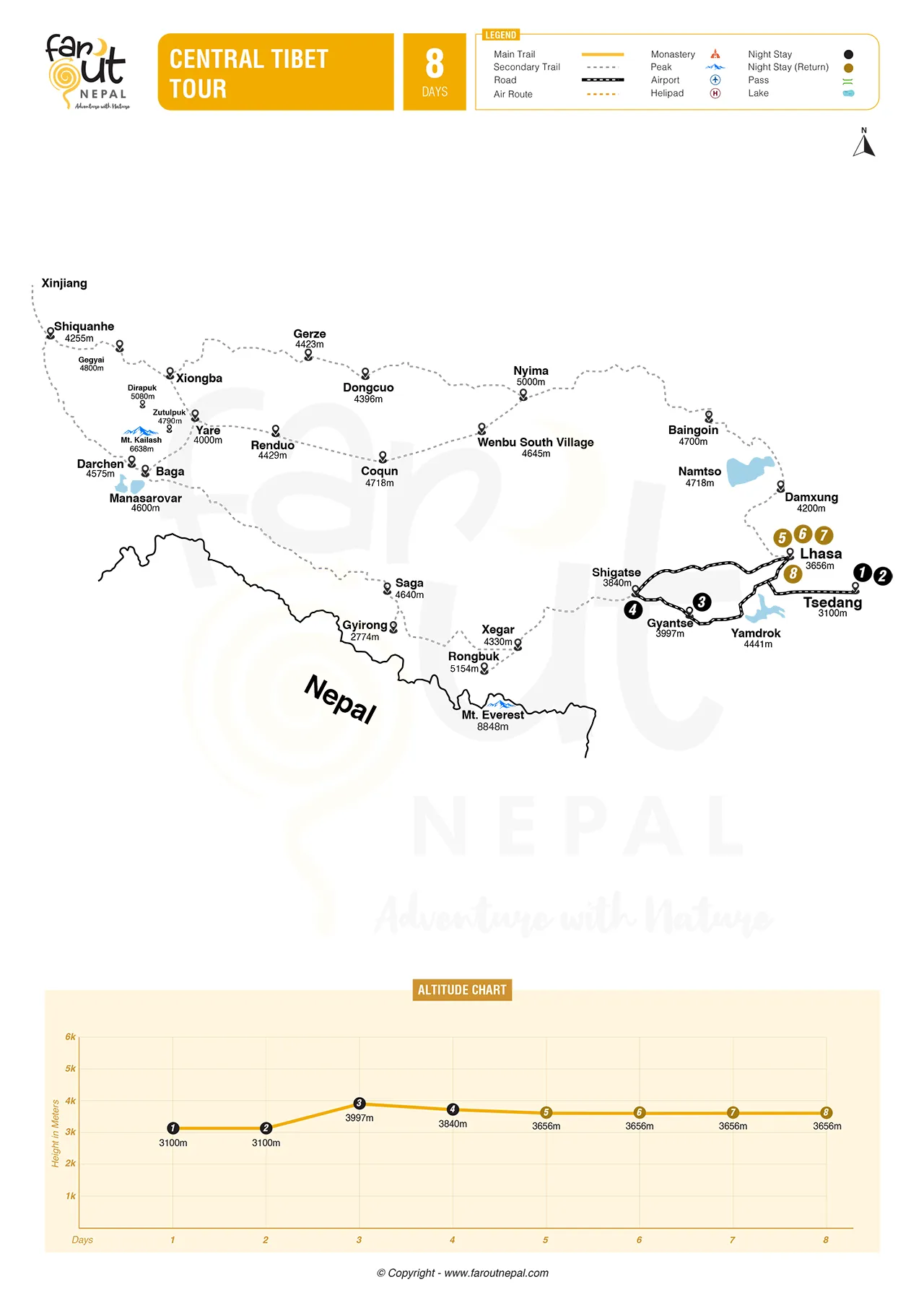
Trip map of Essence of Tibet Tour
Essential Tibet Trip Information
Planning a journey to Tibet is unlike planning most international holidays. From high-altitude travel and permit requirements to cultural experiences and scenic overland drives, it’s essential to understand what to expect before booking. The Central Tibet Tour is designed to provide a balanced introduction to Tibet’s history, spirituality, and landscapes while ensuring a comfortable pace for first-time visitors.
| Category | Details |
| Tour Duration | 9 Days / 8 Nights |
| Tour Style | Cultural, Historical & Scenic Overland Tour |
| Highest Overnight Stay | Gyantse (3,950 m) |
| Starting Elevation | Tsedang (3,100 m) |
| Accommodation | Comfortable tourist-standard hotels |
| Transportation | International flight, private vehicle, and airport transfers |
| Group Size | Small-group departures with personalized service |
| Ideal For | First-time visitors to Tibet, cultural explorers, photographers, history enthusiasts, and travelers seeking a comprehensive introduction to Tibetan civilization |
| Not Suitable For | Travelers looking for trekking, mountaineering, or Everest Base Camp expeditions |
| Travel Documents Required | Valid passport, Tibet Travel Permit, and applicable Chinese Visa or China Group Visa |
Why this itinerary is different: Unlike many Tibet tours that begin in Lhasa at 3,650 m, the Central Tibet Tour starts in Tsedang (3,100 m). Spending your first two nights at a lower elevation gives your body additional time to acclimatize before continuing to higher-altitude destinations, while also introducing you to the Yarlung Valley, widely regarded as the birthplace of Tibetan civilization.
Can Foreigners Travel Independently in Tibet?
No. Foreign passport holders are not permitted to travel independently in Tibet. All visitors must follow a pre-arranged itinerary with a licensed tour operator and an authorized Tibetan guide.
Whether you’re traveling solo, with family, or in a private group, your operator is responsible for arranging permits, accommodation, transportation, and local guiding throughout the trip.
What Documents Do You Need for Tibet?
Most travelers will require:
- A passport valid for at least six months.
- A Chinese Visa or a China Group Visa, depending on your entry point.
- A Tibet Travel Permit (TTP) issued by the Tibet Tourism Bureau.
Additional permits are only required if you’re visiting restricted regions such as Mount Kailash, Everest Base Camp (North), or Eastern Tibet.
What Is the Tibet Travel Permit?
The Tibet Travel Permit is the official authorization required for foreign travelers to enter the Tibet Autonomous Region. It must be obtained before arrival and may be checked by airlines or railway authorities before boarding.
Unlike a visa, the permit cannot be applied for independently. It is arranged exclusively through a licensed tour operator after your itinerary has been confirmed.
China Visa vs. China Group Visa
The visa required depends on where your journey begins:
- From Mainland China: A standard Chinese Visa is generally required.
- From Kathmandu, Nepal: Travelers usually need a China Group Visa, which is processed through the Chinese Embassy in Kathmandu.
Our team will advise you on the correct visa requirements based on your nationality and travel route.
How Far Out Nepal Makes It Easy
When you book the Central Tibet Tour with us, we coordinate:
- Tibet Travel Permit processing
- China Visa or China Group Visa guidance
- Licensed English-speaking Tibetan guide
- Hotel bookings and private transportation
- Airport transfers
- Pre-departure assistance and on-ground support
Our goal is to make your journey to Tibet smooth, fully compliant with current regulations, and completely hassle-free.
Book Early
Since Tibet travel permits require advance processing and regulations may change, we recommend booking several weeks before departure. Once your trip is confirmed, we’ll provide a clear document checklist and guide you through every step until you’re ready to begin your Central Tibet adventure.
Ready to explore Tibet? Contact our travel experts today →
Altitude & Acclimatization for Tibet
Sitting on the Tibetan Plateau, much of Central Tibet lies above 3,000 meters (9,840 ft), with several scenic mountain passes exceeding 4,500 meters (14,760 ft). While these elevations are part of what makes Tibet’s landscapes so extraordinary, they also require visitors to allow their bodies time to adjust.
The Central Tibet Tour has been carefully designed with acclimatization in mind. Instead of heading directly to Lhasa (3,650 m) upon arrival, the journey begins in Tsedang (3,100 m), where you’ll spend your first two nights exploring the historic Yarlung Valley. This gradual ascent helps your body adapt naturally to the altitude before continuing to higher destinations such as Gyantse and the mountain passes along the route.
Why This Itinerary Starts in Tsedang
Many Tibet tours begin immediately in Lhasa, requiring travelers to adjust to an elevation of 3,650 meters as soon as they land. The Central Tibet Tour takes a different approach by introducing you to Tibet through Tsedang, located approximately 550 meters lower.
This itinerary offers several important advantages:
- Gradual acclimatization is recommended before reaching higher elevations.
- Reduced the likelihood of altitude-related discomfort during the first few days.
- An opportunity to explore the Yarlung Valley, the birthplace of Tibetan civilization.
- A more relaxed start to your journey after arriving from sea level or lower elevations.
By combining acclimatization with meaningful cultural experiences, the itinerary makes your first days in Tibet both comfortable and rewarding.
Understanding Altitude Sickness
Altitude sickness, also known as Acute Mountain Sickness (AMS), can affect anyone traveling above 2,500 meters, regardless of age or fitness level. Most altitude sickness symptoms are mild and temporary as your body adjusts to the reduced oxygen levels. Common symptoms include mild headache, fatigue, dizziness, difficulty sleeping, etc. These symptoms often improve within the first 24 to 48 hours when travelers pace themselves and stay well hydrated. You can learn about preventing altitude sickness from our article here: [Preventing AMS].
Best Time to Visit Central Tibet
Central Tibet is a rewarding destination for much of the year. Thanks to its dry climate, high-altitude landscapes, and rich cultural heritage, each season offers a unique travel experience. Whether you’re seeking crystal-clear Himalayan views, vibrant monasteries, or colorful festivals, the best time to visit depends on your interests.
Spring (April to June)
Spring is one of the best seasons for exploring Central Tibet. Mild temperatures, blooming valleys, and excellent mountain visibility create ideal conditions for sightseeing and photography.
It’s a great time for:
- Visiting monasteries and historic landmarks in comfortable weather.
- Exploring the Yarlung Valley as the landscape comes to life.
- Photographing Yamdrok Lake, Karo La Glacier, and Himalayan panoramas.
Daytime temperatures generally range between 10°C and 20°C (50°F–68°F), while mornings and evenings remain cool.
Summer (July to August)
Although it’s the monsoon season in Nepal, much of Central Tibet lies in the Tibetan Plateau’s rain shadow and receives relatively little rainfall. Longer daylight hours and greener landscapes make summer an enjoyable time for cultural tours.
Highlights include:
- Lush scenery and vibrant rural landscapes.
- Extended daylight for sightseeing.
- Local markets and everyday Tibetan life.
Brief showers are possible, but prolonged heavy rainfall is uncommon across most of Central Tibet.
Autumn (September to October)
Autumn is widely considered the best time to visit Central Tibet. Stable weather, crisp air, and exceptional visibility make it the peak season for sightseeing and photography.
This season offers:
- Spectacular Himalayan views.
- Comfortable temperatures for road travel and exploration.
- Beautiful autumn colors across valleys and farmland.
- Excellent photography conditions at Potala Palace, Yamdrok Lake, and the high mountain passes.
Winter (November to March)
Winter offers a quieter and more peaceful experience, with snow-capped mountains, fewer visitors, and tranquil monasteries. While colder temperatures and shorter days require extra preparation, travelers are rewarded with a more intimate glimpse of Tibet’s cultural heritage.
Some accommodations and tourism services may operate on reduced schedules during the coldest months.
Festivals & Cultural Experiences
Planning your visit around a Tibetan festival adds another dimension to the journey. Throughout the year, monasteries host religious ceremonies, masked dances, prayer gatherings, and community celebrations that offer a deeper understanding of Tibetan Buddhism and local traditions.
If your travel dates coincide with a festival, your guide will help you make the most of the experience.
Our Recommendation
For most travelers, April to June and September to October offer the best overall experience. These months combine pleasant weather, clear mountain views, excellent road conditions, and ideal sightseeing opportunities, making them perfect for first-time visitors to Central Tibet.
Accommodation for the Central Tibet Tour
A comfortable place to rest and nourishing meals are essential when traveling across the Tibetan Plateau. Throughout the Central Tibet Tour, we’ve selected reliable tourist-standard hotels and planned meal arrangements that allow you to relax after each day’s sightseeing while experiencing local Tibetan hospitality.
Although tourism infrastructure in Tibet differs from that of major international cities, you’ll enjoy comfortable accommodation in each destination, along with opportunities to sample authentic Tibetan cuisine and familiar Chinese dishes during your journey.
Accommodation
During the tour, you’ll spend:
- 2 nights in Tsedang
- 1 night in Gyantse
- 1 night in Shigatse
- 3 nights in Lhasa
Hotels are selected for their cleanliness, comfort, convenient locations, and suitability for high-altitude travel. Rooms typically include:
- Comfortable twin or double occupancy
- Private en-suite bathroom
- Hot shower
- Wi-Fi (where available)
- Breakfast at the hotel
Single rooms can usually be arranged for an additional supplement, subject to availability.
Food & Dining
Breakfast is provided each morning at your hotel, while lunches and dinners allow you the flexibility to explore Tibet’s diverse culinary traditions.
Throughout the journey, you’ll have opportunities to enjoy:
- Traditional Tibetan dishes such as momos, thukpa, tsampa, and yak-based specialties.
- Popular Chinese and Sichuan cuisine is widely available in major cities.
- Simple Western meals at selected cafés and restaurants in Lhasa.
- Fresh seasonal vegetables, rice, noodles, soups, and locally prepared meals.
One of the cultural highlights of the tour is enjoying an authentic Tibetan meal with a local family, offering a deeper appreciation of everyday life and hospitality beyond the region’s famous landmarks.
Comfort at High Altitude
Because much of Central Tibet lies above 3,000 meters, accommodation and dining facilities may be simpler than those in large metropolitan destinations. However, the hotels and restaurants included or recommended throughout the journey are chosen to provide a comfortable and enjoyable travel experience while supporting gradual acclimatization.
Transportation During the Central Tibet Tour
Traveling through Central Tibet is as much about the journey as it is about the destinations. From scenic Himalayan flights to breathtaking overland drives, every stage of this itinerary has been carefully planned to ensure a comfortable, safe, and memorable travel experience.
Entering Tibet from Kathmandu
Kathmandu is one of the most convenient gateways to Tibet, offering direct flights to Lhasa and streamlined China Group Visa processing for travelers entering from Nepal. It also provides the opportunity to explore Nepal’s UNESCO World Heritage Sites while your travel documents are being finalized.
The flight from Kathmandu to Lhasa Gonggar International Airport is considered one of the world’s most spectacular mountain journeys. On clear days, you’ll enjoy aerial views of Everest, Lhotse, Makalu, Cho Oyu, and Kanchenjunga before landing on the Tibetan Plateau.
Upon arrival, you’ll be met by your licensed Tibetan guide and transferred to Tsedang in the historic Yarlung Valley. Beginning the tour at 3,100 meters, rather than heading directly to Lhasa, allows for a more gradual acclimatization while introducing you to the birthplace of Tibetan civilization.
Comfortable Private Transportation
All overland travel is provided in comfortable tourist vehicles selected according to group size and road conditions.
Depending on your group, transportation may include:
- Private SUV or 4WD for smaller groups
- Tourist van or minibus for larger groups
- Experienced local driver
- Licensed English-speaking Tibetan guide throughout the journey
Regular sightseeing, photography, and comfort stops are included along the route.
The Journey Is Part of the Experience
The drives between Tsedang, Gyantse, Shigatse, and Lhasa are among the highlights of the tour. Rather than simply connecting destinations, they showcase the diverse landscapes of the Tibetan Plateau. Along the way, you’ll experience the turquoise waters of Yamdrok Lake, the spectacular Karo La Glacier, traditional Tibetan villages, expansive high-altitude landscapes, and many more.
These carefully planned routes transform every transfer into a memorable part of the adventure.
Safe, Comfortable & Well Planned
Central Tibet’s main highways are generally well-maintained, making overland travel comfortable throughout the journey. Although some sections cross winding mountain passes, the itinerary is paced with regular breaks, cultural visits, and scenic viewpoints to ensure a relaxed travel experience.
From your arrival in Tibet to your final airport transfer, every aspect of transportation is professionally arranged, allowing you to simply sit back, enjoy the spectacular scenery, and immerse yourself in the cultural heart of Tibet.
Staying Safe & Healthy During the Central Tibet Tour
Central Tibet is a safe and rewarding destination, and with proper preparation, most travelers enjoy a comfortable journey. The Central Tibet Tour is carefully designed with gradual acclimatization, experienced local guides, and well-planned logistics to help you travel confidently across the Tibetan Plateau.
While the region’s high altitude requires extra awareness, staying healthy is largely about pacing yourself, staying hydrated, and following your guide’s recommendations.
Health Tips for a Comfortable Tibet Journey
To make the most of your trip:
- Drink plenty of water to stay hydrated.
- Take it easy during the first few days and avoid strenuous activity.
- Eat regular, balanced meals to maintain your energy.
- Dress in layers, as temperatures can change quickly.
- Protect yourself from the strong high-altitude sun with sunscreen, sunglasses, and a hat.
Giving your body time to adjust is the best way to enjoy Central Tibet comfortably.
Medical Facilities
Major cities such as Lhasa, Shigatse, and Tsedang have hospitals, clinics, and pharmacies for routine medical care. Medical facilities become more limited in smaller towns, so we recommend bringing enough prescription medication for the entire trip, along with a copy of your prescription if required.
Travel Insurance
Comprehensive travel insurance is strongly recommended for all visitors to Tibet. Your policy should ideally cover:
- Emergency medical treatment
- Trip cancellation or interruption
- Personal belongings and baggage
- Emergency medical evacuation, if necessary
Before purchasing a policy, confirm that it covers travel within the Tibet Autonomous Region and high-altitude destinations. For more information, see our [Travel Insurance Guide].
Drinking Water & Hygiene
Tap water in Tibet is not safe to drink. Bottled and boiled water are readily available throughout the tour, and your guide can recommend safe places to refill your bottle. Practicing good hand hygiene and choosing freshly prepared meals will also help reduce the risk of minor travel-related illnesses.
What to Pack for the Central Tibet Tour
Packing for the Central Tibet Tour is simple, but it’s important to be prepared for the region’s high altitude and changing weather. Even during spring and autumn, temperatures can vary considerably between sunny afternoons, cool evenings, and high mountain passes. Dressing in layers is the best way to stay comfortable throughout your journey.
Clothing
We recommend packing:
- Lightweight, moisture-wicking base layers
- Warm fleece or insulated jacket
- Waterproof and windproof outer jacket
- Comfortable walking or trekking trousers
- Breathable T-shirts or long-sleeved shirts
- Warm beanie and sun hat or cap
- Lightweight gloves and scarf (especially in spring and autumn)
- Comfortable walking or hiking shoes with a good grip
- Extra socks and undergarments
Travel Essentials
Be sure to carry:
- Passport (valid for at least six months)
- Tibet Travel Permit (arranged by Far Out Nepal)
- Chinese Visa or China Group Visa (where applicable)
- Travel insurance documents
- Printed or digital copies of important travel documents
- Small daypack for daily excursions
Health & Personal Care
The dry climate and strong UV exposure on the Tibetan Plateau make a few personal items particularly important.
We recommend bringing:
- Sunscreen (SPF 50+)
- Lip balm and moisturizer
- Sunglasses with UV protection
- Reusable water bottle
- Personal toiletries
- Hand sanitizer
- Basic first-aid kit and personal medications
- Altitude medication, if recommended by your doctor
Electronics
Central Tibet offers outstanding opportunities for photography, so don’t forget your electronics.
Recommended items include:
- Camera and spare batteries
- Extra memory cards
- Smartphone and charger
- Power bank and charging cables
- Universal travel adapter (China uses Type A, C, and I plugs)
Electricity is available at all overnight accommodations, although carrying a power bank is useful during longer sightseeing days.
Optional Items
Depending on your travel style, you may also find these useful:
- Binoculars
- Travel pillow for road journeys
- Lightweight rain jacket (summer departures)
- Notebook or travel journal
- Snacks for longer drives
Pack Light, Travel Comfortably
Unlike a trekking expedition, the Central Tibet Tour doesn’t require technical outdoor gear. You’ll travel by comfortable private vehicle and stay in hotels each night, so focus on versatile clothing, comfortable footwear, and everyday travel essentials.
If you have any questions before departure, our team will be happy to provide a season-specific packing list and advice to help you prepare for your journey.
Practical Information for the Central Tibet Tour
Understanding a few practical details before you travel will help ensure a smooth and enjoyable journey through Central Tibet. Here’s what you need to know before you go.
Currency & Payments
The official currency used throughout Tibet is the Chinese Yuan (CNY/RMB). Banks, ATMs, and larger businesses are available in major cities such as Lhasa, Xigatze, and Tsedang. However, many smaller shops, local markets, cafés, and roadside vendors still operate on a cash-only basis. We recommend carrying enough Chinese Yuan for:
- Meals not included in the tour
- Drinks and snacks
- Souvenirs
- Personal expenses
- Optional tips for guides and drivers
Internet & Mobile Connectivity
Most hotels provide Wi-Fi, although connection speeds may vary depending on your location. International roaming is available through some mobile providers, while purchasing a local SIM card is another option for travelers who require regular internet access.
Please note that many popular websites and apps: Google services, Gmail, WhatsApp, Facebook, Instagram, and YouTube, may not be accessible in Tibet without a VPN. If staying connected is important, we recommend preparing your devices before entering China.
Electricity
Electricity is available throughout the tour, and all overnight accommodations provide charging facilities for phones, cameras, and other electronic devices. China uses 220V electricity (50Hz) with Type A, C, and I power sockets, so bringing a universal travel adapter is recommended.
Language
The primary language spoken in Tibet is Tibetan, while Mandarin Chinese is also widely used. Throughout the tour, you’ll be accompanied by an experienced English-speaking Tibetan guide, who will assist with communication, explain local customs, and provide historical and cultural insights at each destination.
Time Zone
Tibet follows China Standard Time (CST, UTC+8) year-round. Although geographically far west, Tibet observes the same official time zone as the rest of China, so sunrise and sunset times may differ from what some travelers expect.
Emergency Assistance
Your safety and comfort remain our priority throughout the journey. If you require assistance at any stage of the tour, your guide and our local support team are available to help with travel arrangements, unexpected situations, or practical advice.
With Far Out Nepal and our trusted Tibetan partners managing the logistics, you can travel with confidence and focus on enjoying your experience in the heart of Tibet.
Photography Guide for the Central Tibet Tour
From ancient monasteries and sacred lakes to sweeping Himalayan landscapes and vibrant street scenes, the Central Tibet Tour offers some of the most rewarding photography opportunities on the Tibetan Plateau. Whether you’re carrying a professional camera or simply using your smartphone, every stage of the journey presents a chance to capture Tibet’s remarkable history, living culture, and breathtaking natural beauty.
The clear mountain air and changing light, particularly during the early morning and late afternoon, provide ideal conditions for both landscape and architectural photography.
Iconic Photography Locations
Throughout the journey, you’ll visit many of Tibet’s most photogenic landmarks, including:
- The magnificent Potala Palace, overlooking the city of Lhasa.
- The turquoise waters of Yamdrok Lake.
- The hilltop Yumbulakhang Palace in the historic Yarlung Valley.
- The intricate Gyantse Kumbum and Pelkor Chode Monastery.
- The dramatic Karo La Glacier and surrounding Himalayan scenery.
- The bustling pilgrimage route around Jokhang Temple and Barkhor Street.
Beyond these iconic sites, traditional Tibetan villages, fertile river valleys, colorful prayer flags, and everyday life provide endless opportunities for authentic travel photography.
Photography Tips for the Tibetan Plateau
The combination of high altitude, strong sunlight, and changing weather requires a little preparation. We recommend:
- Carrying spare camera batteries, as cooler temperatures can reduce battery life.
- Bringing extra memory cards for extended sightseeing days.
- Using a polarizing filter to enhance lakes and mountain landscapes.
- Protecting your equipment from dust during overland journeys.
- Keeping your camera easily accessible. You’ll encounter tons of photo opportunities throughout the drive, not just at the major attractions.
Capture the Spirit of Tibet
Some of the most memorable photographs aren’t of famous landmarks, but of the moments in between, like a pilgrim spinning prayer wheels at Jokhang Temple, monks debating philosophy at Sera Monastery, farmers working the fertile fields of the Yarlung Valley, or prayer flags dancing in the wind beneath snow-capped peaks. These authentic moments reveal the living culture of Tibet and often become the photographs that travelers cherish most long after the journey ends.
Travelling Responsibly in Tibet
The Central Tibet Tour offers the opportunity to experience one of the world’s most culturally and spiritually significant regions. As visitors, we all share a responsibility to travel thoughtfully, respecting local traditions, supporting local communities, and helping preserve Tibet’s unique cultural and natural heritage for future generations.
Respect Local Customs
Many of the monasteries, temples, and sacred sites you visit remain active places of worship. Showing respect for local customs enriches your experience while helping preserve these traditions.
During your journey, we recommend that you:
- Dress modestly when visiting monasteries and temples.
- Walk clockwise around stupas, prayer wheels, and sacred sites.
- Ask permission before photographing monks or local residents.
- Follow photography restrictions where they apply.
- Avoid touching religious objects unless invited to do so.
- Follow your guide’s advice when visiting active religious sites.
These simple gestures demonstrate respect for Tibetan culture and create more meaningful interactions with local communities.
Support Local Communities
Tourism plays an important role in supporting families and small businesses across Central Tibet. Throughout the tour, you’ll have opportunities to:
- Purchase locally made handicrafts and traditional artwork.
- Enjoy meals at locally owned restaurants.
- Learn about Tibetan culture from experienced local guides.
- Experience authentic hospitality, including a traditional meal with a Tibetan family.
Choosing local businesses helps ensure that tourism directly benefits the communities you visit.
Travel with Curiosity and Respect
Beyond its famous landmarks, Tibet is a living culture shaped by centuries of history, faith, and tradition. Taking the time to learn about local customs, observe daily life, and engage respectfully with the people you meet will enrich your journey far beyond sightseeing.
Some of the most memorable experiences come not from visiting iconic places, but from understanding the stories, beliefs, and traditions that continue to define life on the Roof of the World.
Our Commitment
Far Out Nepal works with trusted local Tibetan partners to deliver journeys that are responsible, culturally respectful, and fully compliant with local regulations. By supporting local guides, carefully planning our itineraries, and encouraging sustainable travel practices, we strive to create meaningful experiences that benefit both our travelers and the communities that welcome them.
We believe the best journeys are those that create lasting memories while leaving a positive impact on the places and people that make them possible.
Why Travel to Central Tibet With Far Out Nepal?
Planning a journey to Tibet is different from planning an ordinary holiday. Beyond choosing the right itinerary, it involves travel permits, visa coordination, local regulations, high-altitude travel, and reliable on-the-ground support. That’s where Far Out Nepal makes the difference.
With years of experience operating Himalayan journeys across Nepal, Tibet, and Bhutan, we work closely with trusted local Tibetan partners to deliver a seamless, well-organized, and culturally enriching travel experience. From your first inquiry until you departed from Tibet, our team is here to ensure every detail is taken care of, so you can focus on experiencing the heart of Tibetan civilization.
Why travelers choose Far Out Nepal
- Our experience across Nepal, Tibet, and Bhutan allows us to provide practical advice, realistic itineraries, and regional knowledge that goes beyond a standard Tibet tour.
- We coordinate your Tibet Travel Permit and guide China Visa or China Group Visa requirements, making the planning process simple and stress-free.
- Travel with knowledgeable English-speaking Tibetan guides who bring each monastery, historic site, and cultural tradition to life through local insight and personal experience.
- Our Central Tibet Tour is planned to balance sightseeing with comfortable acclimatization, beginning in Tsedang before gradually ascending to Tibet’s major cultural destinations.
- Whether you’re joining a scheduled departure, arranging a private journey, or combining Tibet with Nepal or Bhutan, we’ll help tailor the experience to suit your travel plans.
Ready to Discover the Birthplace of Tibetan Civilization?
Some journeys introduce you to famous landmarks. Others immerse you in the history, spirituality, and traditions that have shaped an entire civilization. The Central Tibet Tour offers both.
From the ancient Yarlung Valley and Tibet’s first royal palace to the sacred monasteries of Lhasa, the historic streets of Gyantse, and the spiritual legacy of Shigatse, this journey provides one of the most complete introductions to the cultural heart of Tibet. Combined with breathtaking Himalayan landscapes, centuries-old Buddhist traditions, and carefully paced travel for comfortable acclimatization, it offers an experience that extends far beyond ordinary sightseeing.
Whether you’re planning your first visit to Tibet or looking for a deeper cultural journey across the Tibetan Plateau, our team is ready to help you every step of the way.
The birthplace of Tibetan civilization is waiting. Begin your journey with Far Out Nepal today.
→ Inquire Now | → Request a Custom Itinerary | → Talk to a Tibet Travel Expert
Reviews on Essence of Tibet Tour
Special Savings and Discounts for Group Travelers!
-
4 -
5 person
US$ 1,750
-
6 -
9 person
US$ 1,700
-
10 over
9999
US$ 1,675
US$