

Nepal Bhutan Tibet Tour

Nepal Bhutan Tibet Tour

Nepal Bhutan Tibet Tour
Nepal Bhutan Tibet Tour

Activity
Tour
Duration
16 Days
Grading
Difficult
Max Altitude:
3,650m. / 11,975ft.
Best Season
Apr-May & Sept -Oct
Style of Trip
Spiritual, Cultural, Historical
Group Size
2-10 People
Accommodation
Hotel
Meals
Breakfast, Lunch, Dinner
Why Choose This Nepal Bhutan Tibet Tour?
The trip brings together three distinct Himalayan worlds in a single, continuous experience. Enjoy ancient cities, sacred monasteries, high mountain passes, and living Buddhist traditions unfold gradually across Nepal, Bhutan, and Tibet, revealing the cultural and natural essence of the Himalayas in one seamless expedition.
- Explore Three Himalayan Destinations seamlessly: Travel through Nepal, Bhutan, and Tibet on a carefully designed multi-country Himalayan experience that combines culture, spirituality, history, and mountain landscapes into one unforgettable expedition.
- Experience the Cultural Diversity of the Himalayas: Discover how each Himalayan region preserves its own traditions, architecture, religious practices, and way of life while remaining deeply connected through centuries of Buddhist influence and mountain heritage.
- Travel Through Ancient Buddhist Civilizations: From peaceful monasteries and sacred pilgrimage sites to traditional fortress towns and Himalayan spiritual centers, this journey offers deep insight into the cultural heart of the Himalayas.
- Witness Constantly Changing Himalayan Landscapes: Experience dramatic scenery throughout the journey, including Himalayan mountain ranges, forested valleys, high-altitude plateaus, glacial rivers, and remote cultural landscapes unique to each destination.
- Enjoy a Professionally Managed Multi-Country Experience: Travel confidently with organized regional flights, experienced local guides, Tibet permit assistance, Bhutan visa arrangements, comfortable accommodations, and thoughtfully paced itineraries designed for smooth Himalayan travel.
- Ideal for Cultural, Spiritual & Experiential Travelers: This Nepal, Tibet, and Bhutan tour is perfect for travelers seeking meaningful cultural experiences, Buddhist heritage, Himalayan scenery, photography opportunities, and immersive journeys beyond traditional sightseeing.
Trip Introduction
Nepal Bhutan Tibet Tour | Journey Across the Sacred Himalayas
Experience the cultural and spiritual heart of the Himalayas through Nepal, Bhutan, and Tibet on one seamless Himalayan journey through ancient cities, sacred monasteries, dramatic mountain landscapes, and living Buddhist traditions.
Few journeys in the world combine the cultural diversity, spiritual depth, and dramatic landscapes of the Himalayas as seamlessly as our Nepal Tibet Bhutan tour. This tour is designed for travelers seeking more than a standard holiday. It is a carefully paced Himalayan cultural journey connecting three distinct regions shaped by centuries of Buddhism, pilgrimage routes, mountain civilizations, and spiritual heritage.
From the living heritage of Kathmandu to the monastery valleys of Paro and the spiritual atmosphere of Lhasa, this multi-country Himalayan experience combines cultural exploration, breathtaking scenery, spiritual discovery, and meaningful travel experiences into one unforgettable expedition.
Although these destinations share ancient Buddhist traditions and Himalayan geography, each offers a completely different atmosphere and travel experience. Together, these destinations create far more than a multi-country itinerary. They form a connected Himalayan cultural journey shaped by religion, geography, trade routes, monasteries, and centuries of mountain heritage.
Quick Expedition Snapshot
| Category | Details |
| Total Duration | 16 Days |
| Tour Style | Cultural, Spiritual & Himalayan Expedition |
| Highest Elevation | Approx. 4,750 meters |
| Activity Level | Easy to Moderate |
| Accommodation | Standard to Luxury Options Available |
| Transportation | Scenic Himalayan Flights & Private Ground Transport |
| Best Seasons | Spring & Autumn |
| Ideal For | Cultural Travelers, Spiritual Seekers & Himalayan Explorers |
| Permit Requirement | Tibet Travel Permit & Group Visa Required |
Why Combine Nepal, Bhutan & Tibet in One Journey?
A Nepal Bhutan Tibet tour offers a rare opportunity to experience three distinct Himalayan cultures within a single carefully planned expedition.
Nepal: The Cultural Gateway to the Himalayas
Nepal introduces travelers to the spiritual and cultural foundations of the Himalayan world. UNESCO enlisted ancient temples, Buddhist stupas, medieval cities, and vibrant local life make Nepal one of the richest cultural destinations in South Asia. Lonely Planet has listed Nepal as one of the top 10 travel destinations, making it a must-visit. While waiting for your visa for Tibet, travelers can explore:
- UNESCO World Heritage Sites in Kathmandu Valley
- Buddhist pilgrimage sites and monasteries
- Traditional markets and local culture
- Himalayan scenery and mountain flights
- Hindu-Buddhist cultural coexistence
Bhutan: The Last Himalayan Buddhist Kingdom
Bhutan offers a slower and more immersive cultural experience centered around Buddhist philosophy, monastery life, and environmental preservation. Unlike many destinations in Asia, Bhutan carefully manages tourism to preserve its traditions, landscapes, and cultural identity.
Highlights include:
- Traditional dzongs and monasteries
- Peaceful Scenic Himalayan valleys
- Bhutanese Buddhist traditions
- Hiking to Tiger’s Nest Monastery
- Carbon-neutral nation
- Gross National Happiness philosophy
Tibet: The Spiritual Heart of the Tibetan Plateau
Tibet adds a completely different dimension to the journey with its dramatic landscapes, ancient monasteries, and deeply rooted Tibetan Buddhist heritage. Traveling through Tibet provides insight into one of the world’s most unique high-altitude civilizations.
Highlights include:
- Potala Palace and Jokhang Temple
- Barkhor Street, a lively market and pilgrim circuit
- Monk Debates at a famous Gelugpa monastery
- Yamdrok Tso (Turquoise Lake), a sacred lake with a backdrop of snow-capped mountains
- Himalayan plateau landscapes
- Tashilhunpo Monastery at Xigatse, a spiritual and architectural wonder
- Tibetan culture and architecture
- High-altitude Himalayan scenery
Plan Your Nepal Bhutan Tibet Tour With Far Out Nepal
Our Nepal Tibet Bhutan tour offers one of the most rewarding cultural journeys in the Himalayas, combining ancient Buddhist traditions, sacred monasteries, dramatic mountain landscapes, and deeply rooted Himalayan heritage into one unforgettable experience.
Whether you are drawn by spiritual exploration, Buddhist heritage, cultural discovery, photography, history, or immersive travel experiences beyond traditional sightseeing, this journey through Nepal, Bhutan, and Tibet offers a rare opportunity to experience three distinct Himalayan worlds in a single carefully crafted expedition.
Detail itinerary of Nepal Bhutan Tibet Tour
Day 01: Arrival in Kathmandu
Your Nepal Bhutan Tibet journey begins upon arrival at Kathmandu via Tribhuvan International Airport, where our representative will greet you and assist with your transfer to the hotel.
After check-in, you will receive a short pre-trip briefing covering the complete itinerary, travel flow across Nepal, Bhutan, and Tibet, along with important documentation procedures.
During this stage, passport collection and formal processing for the Chinese visa application (required for Tibet entry) will be completed and submitted to the relevant authorities.
If arrival time permits, you will visit Swayambhunath, one of the most iconic Buddhist stupas overlooking the Kathmandu Valley. Often called the “Monkey Temple,” it offers a peaceful introduction to Nepal’s spiritual landscape and Himalayan cultural heritage.
This first day is not just about arrival. It establishes the foundation for a smooth multi-country Himalayan journey, ensuring all documentation, permits, and logistics are properly coordinated before travel continues deeper into the Himalayas.

Activity: Airport Transfer: Approx. 30 minutes

Location: Kathmandu

Max. Altitude: 1,300m/4,265ft.

Accommodation: Hotel

Meal: NA
Day 02: Discovering the Kathmandu Valley
Today, you explore the cultural and artistic heart of Kathmandu Valley, where ancient royal cities, traditional marketplaces, and sacred temples reveal the layered history of Nepal.
The day unfolds through ancient royal cities, traditional marketplaces, and sacred temples, offering a deeper understanding of the Kathmandu Valley’s living cultural heritage before your journey continues into the wider Himalayas.
Explore the Artistic Heritage of Patan
We will begin the day in Patan Durbar Square, a UNESCO World Heritage Site known for its Newari architecture, intricately carved temples, and historic palace courtyards. This former royal city offers a close look at the artistic traditions that shaped classical Himalayan urban culture.
You will also explore key heritage spaces such as Sundari Chowk, known for its detailed stone craftsmanship and historical significance within the old palace complex.
Discover Nepal’s Living Cultural Traditions
Continue to the Nepali Folk Musical Instrument Museum, home to hundreds of traditional instruments used by Nepal’s diverse ethnic communities. This experience provides insight into the country’s living cultural diversity beyond its monuments and architecture.
Explore Kathmandu’s Traditional Market Culture
Later, we will walk through some of Kathmandu’s most historic marketplaces:
- Indra Chowk: A traditional market space dedicated to the Hindu deity Indra
- Ason Tole: One of the oldest trading centers in the valley, known for spices and daily goods
- Thamel: Kathmandu’s vibrant cultural and tourism hub
These areas reflect the everyday rhythm of Kathmandu, where history and modern life exist side by side.
Evening Spiritual Experience at Pashupatinath
In the evening, visit Pashupatinath Temple, the most sacred Hindu temple in Nepal, dedicated to Lord Shiva and located along the Bagmati River.
Here, you will witness the evening aarti ceremony, a deeply spiritual ritual of devotion that brings together pilgrims, priests, and visitors in a powerful cultural and religious experience.
Activity: Tour : Approx. 7 hours
Location: Kathmandu
Max. Altitude: 1,300m/4,265ft.
Accommodation: Hotel
Meal: Breakfast
Day 03: Heritage Temples, Himalayan Views & Medieval Bhaktapur
Today, we will journey beyond the Kathmandu Valley core into a blend of ancient spiritual heritage, Himalayan viewpoints, and preserved medieval city life in Nepal.
This day is designed as a gradual transition from temple architecture to mountain landscapes, ending in one of the best-preserved historical cities in the Himalayas.
Ancient Heritage at Changunarayan Temple
Begin the day with a visit to Changunarayan Temple, the oldest Hindu temple in Nepal and a UNESCO World Heritage Site dating back to the Licchavi period. Dedicated to Lord Vishnu, this hilltop temple is renowned for its intricate stone and wood carvings, ancient inscriptions, and deep cultural significance in Nepalese history. The peaceful surroundings also offer panoramic views over the surrounding hills and valley landscapes.
Scenic Hike Through Villages to Nagarkot
From Changunarayan, continue with a gentle hike toward Nagarkot, passing through traditional villages, terraced fields, and forested ridgelines. This section of the journey introduces a more natural Himalayan setting, where rural life, landscape, and mountain air define the experience. Nagarkot, situated at approximately 2,195 meters, is widely known for its sweeping Himalayan views, including sunrise and sunset panoramas (weather permitting).
This transition marks a shift from cultural monuments to open Himalayan landscapes.
Medieval Architecture of Bhaktapur Durbar Square
In the afternoon, explore Bhaktapur Durbar Square, one of the best-preserved medieval city squares in the Kathmandu Valley. Here, you will discover:
- the iconic 55-Window Palace
- traditional pagoda-style temples
- intricately carved courtyards
- living Newari culture and craftsmanship
Unlike museum-style heritage sites, Bhaktapur remains a living city where ancient architecture and daily life exist side by side.
Activity: Drive, Tour, Hike : Approx 07 hours
Location: Kathmandu
Max. Altitude: 1,300m/4,265ft.
Accommodation: Hotel
Meal: Breakfast
Day 04: Spiritual Immersion & Tibet Visa Formalities
Today is a reflective and culturally rich day in Kathmandu, centered around spiritual learning, Buddhist heritage immersion, and essential travel formalities for your onward journey into Tibet.
Morning Wellness & Preparation
We will begin the day with a guided yoga and meditation session designed to relax the body and prepare the mind for high-altitude travel ahead. This quiet start helps align with the slower spiritual rhythm that becomes central as the journey moves deeper into the Himalayas.
Sacred Exploration of Boudhanath Stupa
We will visit the Boudhanath Stupa after. It is one of the most important centers of Tibetan Buddhism outside Tibet and a UNESCO World Heritage Site. This massive white dome stupa is surrounded by monasteries, prayer wheels, chanting monks, and devotional rituals that have continued for centuries. It is not only a monument but also a living spiritual ecosystem.
Buddhist Learning & Monastic Experience
Within the Boudhanath area, you will engage in guided cultural and spiritual experiences, including:
- Introductory teachings on Buddhism and its origins in Nepal
- Understanding core principles introduced by Siddhartha Gautama, born in Lumbini, Nepal.
- Interaction with monks and monastery environments (subject to availability)
- Observing daily monastic life and rituals around the stupa
This session is designed as an introduction to Buddhist philosophy rather than academic study, offering insight into the living tradition practiced across the Himalayas.
Traditional Thangka Art Experience
You can also participate in a guided introduction to Thangka painting, one of the most important sacred art forms in Tibetan Buddhism. Under the guidance of local artists, you will learn the symbolic meaning, structure, and spiritual significance behind this detailed art form. The experience offers hands-on engagement with traditional techniques rooted in Buddhist scripture and Himalayan artistic heritage.
Ritual Life at Boudhanath Stupa
Explore the living spiritual practices that define the stupa environment, including:
- Kora (circumambulation): walking clockwise around the stupa as a meditative practice symbolizing the path to enlightenment.
- Prayer wheel spinning: a ritual believed to spread blessings and mantras into the world.
- Butter lamp offerings: symbolic acts representing wisdom and spiritual illumination.
These practices reflect the continuous spiritual life that surrounds the stupa throughout the day.
Important Travel Formalities: Tibet Permit Collection
During the day, final processing and collection of your Chinese visa and Tibet Travel Permit will be completed through the Chinese Embassy arrangements.
This step is essential for entry into Tibet and marks the completion of your Nepal-based documentation phase before continuing the Himalayan journey.
Activity: Full Day activities
Location: Kathmandu
Max. Altitude: 1,300m/4,265ft.
Accommodation: Hotel
Meal: Breakfast
Day 05: Fly to Paro | Arrival in Bhutan & Thimphu Sightseeing
Today, we will leave Nepal and fly into the Himalayan kingdom of Bhutan, one of the most scenic mountain flights in the world. If the weather permits, the journey offers spectacular views of snow-covered Himalayan peaks before descending into Paro.
As you approach Paro, you will see lush green hills, river valleys, and traditional Bhutanese architecture scattered across the landscape, giving you an impression of Bhutan’s preserved Himalayan environment.
Arrival in Paro & Transfer to Thimphu
Upon landing at Paro International Airport, we will complete immigration formalities and meet our local representative for assistance and onward travel coordination. From Paro, we’ll begin a scenic drive of approximately 1.5 hours to Thimphu, Bhutan’s capital city, passing through river valleys, forested hills, and traditional villages along the way. After check-in and lunch, the afternoon is dedicated to the initial exploration of Bhutan’s cultural and spiritual landmarks.
National Memorial Chorten
We will visit the National Memorial Chorten, a deeply revered religious site built in memory of the third King of Bhutan, Jigme Dorji Wangchuck. This stupa is a major center of daily devotion for locals, where prayer wheels, chanting, and circumambulation reflect Bhutan’s living Buddhist traditions.
Tashichho Dzong: Seat of Government & Monastic Authority
We will continue to Tashichho Dzong, an impressive fortress-monastery that houses Bhutan’s central monastic body and key government offices. This landmark represents the integration of spiritual and administrative authority in Bhutanese governance and remains one of the most important structures in the country.
Buddha Dordenma & Kuenselphodrang Nature Park
Later, we will drive to Kuenselphodrang Nature Park to visit the massive Buddha Dordenma statue, one of the largest Buddha statues in the world. Overlooking the Thimphu Valley, this site symbolizes peace, compassion, and spiritual aspiration, with thousands of smaller Buddha statues housed within the structure itself. The location also offers panoramic views of the valley and the surrounding Himalayan landscape.
Important Notes
- Bhutan entry is strictly regulated; passport clearance is completed at Paro Airport.
- Flight schedules to and from Paro are highly weather-dependent
- Moderate walking is required at monument sites
- Sightseeing order may adjust depending on arrival timing
Activity: Flight : 1 hour flight + Drive 1 & Half Hours + Tours approx. 4 hours
Location: Thimphu
Max. Altitude: 2,334m/7,657ft.
Accommodation: Hotel
Meal: Breakfast, Lunch, Dinner
Day 06: Thimphu to Punakha via Dochu-La Pass
Today, we will leave Thimphu and journey deeper into central Bhutan, crossing high mountain terrain before descending into the warm river valley of Punakha.
This is one of the most scenic drives in Bhutan, where landscapes shift dramatically from alpine forests to subtropical valleys within a few hours.
Dochu-La Pass | Himalayan Panorama (3,100m)
We will ascend to Dochu La Pass, one of Bhutan’s most scenic mountain passes, marked by 108 memorial chortens and prayer flags fluttering across the ridgeline. On clear days, the pass offers panoramic views of the eastern Himalayas, creating a powerful contrast between snow-capped peaks and the forested valleys below.
The surrounding rhododendron forests add seasonal color, especially during spring bloom (late April to May).
Descent into Punakha Valley
From the pass, we’ll descend gradually into the warmer Punakha Valley, where landscapes transition into lush rice fields, rivers, and traditional villages. This descent marks a clear environmental and cultural shift within Bhutan, from alpine spirituality to fertile river valley life.
Punakha Dzong: Fortress at the River Confluence
We will visit the Punakha Dzong, one of Bhutan’s most iconic fortress-monasteries, located at the meeting point of the Pho Chu and Mo Chu rivers. Built in 1637, this monumental structure has historically served as both a religious and administrative center and remains the winter residence of Bhutan’s central monastic body. The dzong’s riverside setting, intricate woodwork, and grand courtyards make it one of the most visually striking cultural landmarks in the Himalayas.
Chimi Lhakhang: Temple of Fertility
Later, we will take a short walk to Chimi Lhakhang, a hilltop monastery dedicated to Lama Drukpa Kunley, known as the “Divine Madman.” The temple is widely visited for fertility blessings and is surrounded by a peaceful rural village setting, offering insight into Bhutan’s unique blend of spirituality and folklore.
Activity: Drive : Approx. 3 hours + tours
Location: Punakha
Max. Altitude: 1,200m/3,937ft.
Accommodation: Hotel
Meal: Breakfast, Lunch, Dinner
Day 07: Punakha to Paro | Scenic Valley Drive & Cultural Stops
Today, we’ll leave the river valleys of Punakha and journey back toward western Bhutan, traveling through forests, riverside settlements, and historic cultural sites before arriving in Paro.
This is a transition day designed to combine light exploration with scenic driving, allowing time to absorb Bhutan’s diverse landscapes before the upcoming hike to Tiger’s Nest.
Khamsum Yulley Namgyal Chorten | Riverside Spiritual Hike
We will begin the morning with a scenic walk through rice fields and traditional countryside paths leading to Khamsum Yulley Namgyal Chorten. Built under the patronage of Queen Ashi Tshering Yangdon Wangchuck, this hilltop chorten is dedicated to world peace and protection. The hike itself offers peaceful valley views, rural landscapes, and a gradual immersion into Bhutan’s spiritual architecture. The chorten is notable for its detailed Nyingma Buddhist iconography and symbolic mandala-based structure.
Riverside Picnic & Valley Atmosphere
After the hike, we’ll enjoy a relaxed riverside picnic in the Punakha Valley area, surrounded by river landscapes, forested hills, and traditional Bhutanese countryside. This pause is intentionally designed as a recovery and reflection moment before the longer drive toward Paro.
En Route Cultural Stop: Semtokha Dzong
We will continue our journey with a visit to Semtokha Dzong, the oldest dzong in Bhutan, originally built in 1629. Today, it functions as an important center for language and cultural studies. It represents Bhutan’s long-standing commitment to preserving its linguistic and spiritual heritage. This stop provides historical context for Bhutan’s dzong architecture tradition before entering Paro.
Arrival in Paro & Rest
We’ll continue the scenic drive into Paro, passing through forested valleys and mountain roads that gradually transition into the cultural heart of western Bhutan. Upon arrival, check in to your hotel and spend the evening at leisure to rest and prepare for upcoming high-altitude hiking experiences, including the Tiger’s Nest Monastery trek.
Activity: 3 hours drive
Location: Paro
Max. Altitude: 2,195m/7,201ft.
Accommodation: Hotel
Meal: Breakfast, Lunch, Dinner
Day 08: Paro | Hike to Taktsang Monastery (Tiger’s Nest)
Today, you undertake the most iconic experience of your Bhutan journey: a hike to Taktsang Monastery, famously known as Tiger’s Nest.
Dramatically perched on a cliffside approximately 900 meters above the Paro Valley, this sacred monastery is one of the most important spiritual sites in the Himalayan world and a defining symbol of Bhutanese Buddhism. The experience is not just a visit, but a gradual ascent into both landscape and meaning.
The Ascent: From Valley to Cliffside Sanctuary
We’ll begin the hike from the base trail outside Paro, gradually ascending through pine forests, prayer flag corridors, and panoramic viewpoints overlooking the valley. Along the way, the monastery becomes visible across the cliff face, creating a powerful visual focus that draws travelers upward through the landscape. The full hike typically takes around 4–5 hours round trip (depending on pace).
Taktsang Monastery: The Sacred Cliffside Sanctuary
At the top, you can explore Taktsang Monastery, believed to be the meditation site of Guru Rinpoche in the 8th century. The monastery complex is built into the cliff itself, consisting of temples, meditation caves, and sacred chambers that reflect centuries of Buddhist devotion and pilgrimage. The atmosphere here is quiet, reflective, and deeply spiritual, amplified by the dramatic Himalayan setting.
Descent, Rest & Refreshments
After exploring the monastery, we’ll begin the descent back to the valley, taking in changing perspectives of the cliffside structure and surrounding landscape. A specially arranged refreshment and lunch stop is provided along the trail or base area, allowing time to rest and reflect after the hike. Horseback assistance is available up to the viewpoint for travelers who prefer not to complete the full ascent.
To get the detailed itinerary of the hike, you can check out our blog: A guide for the Tiger’s Nest Hike →
Activity: 5 hours drive
Location: Paro
Max. Altitude: 2,195m/7,201ft.
Accommodation: Hotel
Meal: Breakfast, Lunch, Dinner
Day 09: Fly from Paro | Return to the Kathmandu Valley
After breakfast, you’ll be transferred to Paro International Airport for your scenic return flight to Kathmandu, leaving behind the peaceful Himalayan landscapes of Bhutan. This short but spectacular flight once again offers aerial views of forested valleys, river systems, and distant Himalayan peaks as you cross back into Nepal.
Upon arrival, you will be transferred to your hotel for check-in and rest.
Rest, Reflection & Free Time in Kathmandu
The remainder of the day is kept free for rest and personal exploration. After an immersive journey through Bhutan’s monasteries, valleys, and mountain trails, this day allows time to unwind, reflect, and transition back into the cultural rhythm of Kathmandu. You may choose to relax at your hotel or explore nearby areas of the city at your own pace.
Activity: Flight (Approx. 1 hour) + 30 minutes Airport Transfer
Location: Kathmandu
Max. Altitude: 1,300m/4,265ft.
Accommodation: Hotel
Meal: Breakfast
Day 10: Fly from Kathmandu to Lhasa | Entry into the Tibetan Plateau
Today, we’ll leave Kathmandu and enter the high-altitude world of Tibet, flying from Nepal into one of the most dramatic Himalayan air corridors in the world.
The journey to Lhasa offers one of the most scenic mountain flights on earth, with breathtaking aerial views of the Himalayas, including Mount Everest, Kanchenjunga, and (weather permitting) the turquoise waters of Yamdrok Lake. This flight marks a clear transition from the cultural valleys of Nepal into the vast Tibetan Plateau.
Arrival in Lhasa & the first steps in Tibet
Upon landing at Gonggar Airport, you will complete immigration and entry formalities before meeting your local Tibetan guide. A traditional welcome gesture (Hada scarf offering) marks your arrival into the cultural and spiritual landscape of Tibet. From the airport, begin a scenic drive of approximately 1 hour along the Yarlung Tsangpo River toward Lhasa.
Acclimatization & Rest in Lhasa (3,650m)
Upon arrival at your hotel, the remainder of the day is reserved for rest and altitude acclimatization. At 3,650 meters, Lhasa requires a gradual adjustment period to ensure comfort and safety before exploring major cultural landmarks in the following days. This rest phase is an essential part of high-altitude travel in Tibet.
Activity: Flight : 2 hours + Drive 01 hour
Location: Lhasa
Max. Altitude: 3,650m/11,975ft.
Accommodation: Hotel
Meal: Breakfast
Day 11: Lhasa | Drepung & Sera Monasteries Experience
Today, you explore two of the most important monastic institutions in Lhasa, offering deep insight into the spiritual, philosophical, and educational traditions of Tibetan Buddhism in Tibet. This day focuses on understanding the monastic system that has shaped Tibetan culture for centuries through study, debate, and religious practice.
Drepung Monastery: The Great Seat of Tibetan Learning
You will begin your day with a visit to Drepung Monastery, one of the “Great Three” Gelugpa monasteries and historically the largest monastic institution in Tibet. Set on the hillside west of Lhasa, the monastery appears as a vast white complex cascading down the mountain slopes, reflecting a historical center of Buddhist learning. Inside, you will observe prayer halls, assembly courtyards, and monastic quarters that together represent centuries of disciplined religious scholarship and practice.
Sera Monastery: Monk Debates & Living Philosophy
In the afternoon, we will continue to Sera Monastery, another of the great Gelugpa monasteries and a key center of Tibetan Buddhist education. Unlike Drepung’s scale and architecture, Sera is best known for its monk debate session. Here, you can watch monks engage in dynamic philosophical discussions using gestures, clapping, and structured argumentation. This debate tradition is one of the most visually and intellectually engaging aspects of Tibetan monastic life, offering a rare opportunity to witness Buddhist philosophy in active practice.
Understanding the Tibetan Monastic System
Together, Drepung and Sera represent two complementary dimensions of Tibetan Buddhism:
- Large-scale monastic education and structure (Drepung)
- Interactive philosophical training and debate culture (Sera)
These institutions have historically shaped not only religious life but also education, governance, and cultural identity across the Tibetan plateau.
Activity: Approx.: 6 hours
Location: Lhasa
Max. Altitude: 3,650m/11,975ft.
Accommodation: Hotel
Meal: Breakfast
Day 12: Lhasa | Potala Palace, Jokhang Temple & Barkhor Pilgrimage Circuit
Today, we will explore the spiritual and architectural heart of Lhasa, experiencing the most important cultural and religious landmarks of Tibet. This day brings together royal heritage, living pilgrimage traditions & sacred urban life, and offers a complete understanding of the revered Tibetan Buddhism.
Potala Palace: The Icon of Tibetan Civilization
In the morning, we’ll visit the Potala Palace, the most iconic landmark of Tibet and a UNESCO World Heritage Site. Originally established in the 7th century and later expanded as the winter residence of the Dalai Lamas, the palace stands as a monumental symbol of Tibetan Buddhism, governance, and cultural identity. Perched high above Lhasa, the structure contains thousands of rooms, sacred chapels, and historic artifacts, making it one of the most significant architectural and spiritual complexes in the Himalayan world.
Jokhang Temple: The Spiritual Center of Tibet
After lunch, we will continue to Jokhang Temple. It is considered the holiest temple in Tibetan Buddhism and a major pilgrimage destination for devotees across the plateau. Built in the 7th century, the temple is a living center of faith where pilgrims perform full-body prostrations as an act of devotion, often traveling long distances to reach this sacred site. Its architecture reflects a unique blend of Tibetan, Nepalese, Indian, and Han Chinese influences, representing Tibet’s historical cultural connections across Asia.
Barkhor Street: Pilgrimage & Living Culture
Surrounding Jokhang Temple, we’ll explore Barkhor Street, a vibrant pilgrimage circuit where religious devotion and daily commerce coexist. Here, pilgrims walk clockwise around the temple while prayer wheels spin, incense burns, and traditional markets operate alongside sacred ritual spaces. This area offers one of the most authentic views of living Tibetan culture, where spirituality is seamlessly integrated into everyday life.
Tibetan Traditional Medicine (Optional Cultural Extension)
If time permits, we’ll visit the Tibetan Traditional Medicine Hospital before ending our journey. It’s an institution dedicated to preserving ancient healing systems based on herbal medicine, diagnosis, and holistic wellness practices developed over centuries in the Tibetan plateau.
Activity: Approx. 6 hours tour
Location: Lhasa
Max. Altitude: 3,650m/11,975ft.
Accommodation: Hotel
Meal: Breakfast
Day 13: Scenic Drive from Lhasa to Xigatse | Yamdrok Lake & Gyantse
Today begins one of the most spectacular overland journeys in Tibet, traveling from Lhasa across high mountain passes, glaciers, and historic Tibetan settlements toward Xigatse. This drive introduces the vast open landscapes of the Tibetan Plateau, where geography, spirituality, and isolation combine to create one of the world’s most unique travel environments.
Yamdrok Lake: Sacred Turquoise Waters of Tibet
After departing Lhasa, we’ll be ascending into the mountains toward Yamdrok Lake, one of the three sacred lakes of Tibet. Situated at approximately 4,441 meters above sea level, the lake is renowned for its vivid turquoise waters surrounded by expansive peaks and plateau scenery. The contrast between the deep blue lake, high-altitude skies, and barren mountain terrain creates one of the most iconic landscapes in Tibet.
Crossing the Tibetan Plateau & Karo La Glacier
We will continue across high mountain roads and passes toward the impressive Karo La Glacier, where massive ice formations descend dramatically toward the roadside. This section of the drive highlights the raw geological scale of the Tibetan Plateau, with wide-open valleys, glacial terrain, and distant Himalayan ridgelines shaping the journey.
Gyantse: Historic Trade & Monastic Town
We’ll arrive in Gyantse, historically one of Tibet’s most important trading centers along Himalayan caravan routes. Here, you can visit Palkhor Monastery, known for its unique multi-level Kumbum stupa and extensive collection of Buddhist imagery and chapels. The monastery reflects a blend of artistic, religious, and regional influences that developed through centuries of Tibetan cultural exchange.
Continue to Xigatse
From Gyantse, we’ll continue westward to Xigatse, the second-largest city in Tibet and an important historical center of Tibetan Buddhism. Upon arrival, you check into your hotel and rest after a full day of high-altitude scenic travel across the plateau.
Activity: Drive & Tour: Approx. 8 hrs
Location: Xigatse
Max. Altitude: 3,900m/12,795ft.
Accommodation: Hotel
Meal: Breakfast
Day 14: Tashilhunpo Monastery & Return Drive to Lhasa
Today begins with a visit to one of the most important monastic centers in Tibet before returning eastward across the Tibetan Plateau to Lhasa. This journey offers a final opportunity to experience Tibet’s vast landscapes, remote settlements, and spiritual heritage beyond the capital region.
Tashilhunpo Monastery: Seat of the Panchen Lama
In the morning, we’ll visit the Tashilhunpo Monastery, located at the base of Drolmari Mountain in Xigatse. Founded in 1447, this major Gelugpa monastery historically served as the seat of the Panchen Lama. It is also considered one of Tibet’s most influential centers of Buddhist learning, philosophy, and spiritual leadership. The monastery complex is known for its golden rooftops, large assembly halls, sacred chapels, murals, and important religious relics. One of its most notable features is the towering gilded statue of the Future Buddha (Maitreya), one of the largest Buddhist statues in Tibet.
Scenic Return Journey Across the Tibetan Plateau
After the monastery visit, we’ll begin the return drive to Lhasa via the northern overland route. The journey passes through broad plateau valleys, rivers, mountain landscapes, and traditional Tibetan villages, offering a final perspective on the scale and remoteness of the Tibetan highlands. Compared to the earlier scenic route through Yamdrok Lake, today’s drive highlights a quieter and more expansive side of Tibet’s geography.
Arrival Back in Lhasa
Upon arrival in Lhasa, you’ll check into your hotel and enjoy the evening at leisure after completing your extended overland journey through central Tibet. This return to the capital also marks the closing phase of your Tibetan expedition.
Activity: Tour & Drive (270kms) : Approx. 7 hours
Location: Lhasa
Max. Altitude: 3,650m/11,975ft.
Accommodation: Hotel
Meal: Breakfast
Day 15: Fly from Lhasa to Kathmandu | Return to Nepal
After completing your journey across Tibet, you’ll be transferred to Gonggar Airport for your return flight to Kathmandu. This scenic Himalayan flight once again offers spectacular aerial views of high mountain landscapes, glacial valleys, and sections of the Himalayan range as you cross back into Nepal. The return journey marks the conclusion of your extended exploration through Nepal, Bhutan, and Tibet.
Arrival in Kathmandu
Upon arrival in Kathmandu, you will meet our representative for airport assistance and hotel transfer. The remainder of the day is reserved for rest and personal time after your high-altitude Himalayan expedition. You may choose to relax at your hotel, enjoy a quiet evening in the city, or revisit nearby cultural areas at your own pace.
Activity: Drive : Approx. 01 hour + 2 hours flight + 30 minutes drive
Location: Kathmandu
Max. Altitude: 1,300m/4,265ft.
Accommodation: Hotel
Meal: Breakfast
Day 16: Departure from Kathmandu
After breakfast, you can enjoy your final moments in Kathmandu, reflecting on your journey across Nepal, Bhutan, and Tibet. Depending on your flight schedule, you may have time for some last-minute shopping, café visits, or a relaxed morning at your hotel before departure.
Airport Transfer & Farewell
At the appropriate time, our team will transfer you to Tribhuvan International Airport for your onward international flight. Hotel check-out time is typically before 12:00 noon, though late check-out arrangements may be possible depending on availability.
As your Nepal Bhutan Tibet journey comes to an end, we hope the monasteries, landscapes, cultures, and spiritual traditions of the Himalayas leave lasting memories long after your return home.
Namaste and safe travels.
Activity: Airport transfer : 30 Minutes
Location: Kathmandu
Max. Altitude: 1,300m/4,265ft.
Accommodation: Hotel (Check Out Before 12 Noon)
Meal: Breakfast
Need assistance with booking your trip? Inquire Now
Inclusions in Nepal Bhutan Tibet Tour
Breakfast and transfer to the airport.
Nepal :
- 05 nights twin sharing accommodation in Kathmandu on BB basis
- Sightseeing tours as stated above with local guide, private transportation and entrance fee
- Arrival/departure transfers
Bhutan :
- 05 nights/06 days Bhutan tour inclusive of twin sharing accommodation on Full Board basis (Breakfast, Lunch and Dinner), tour with the Local Guide, entrance fee during the tour, private vehicle, visa fee.
Tibet :
- 04 nights/05 days Tibet Tour inclusive of twin sharing accommodation on BB basis, Local guide for the tour, private vehicle during sightseeing tour, entrance fee, Tibet Travel permit.
- Arrival/departure transfers
Trip Excludes
- Nepal entry visa i.e. 30 days for US $ 40.- net per person payable on cash. Please note that the passport validity should be atleast 6 months on the date of departure from Kathmandu. You will need on passport size photograph
- Meals as stated in the program
- Flight fare KTM/PARO/KTM
- Flight fare KTM/LHASA/KTM
- Visa fee for Tibet
- Your personal gears for travelling
- Travelling Insurance
- International flight tickets
- Any extra cost incurred in case of political turmoil, natural disasters, epidemics, flight cancellation, sickness etcetc
Anything not mention in the included box
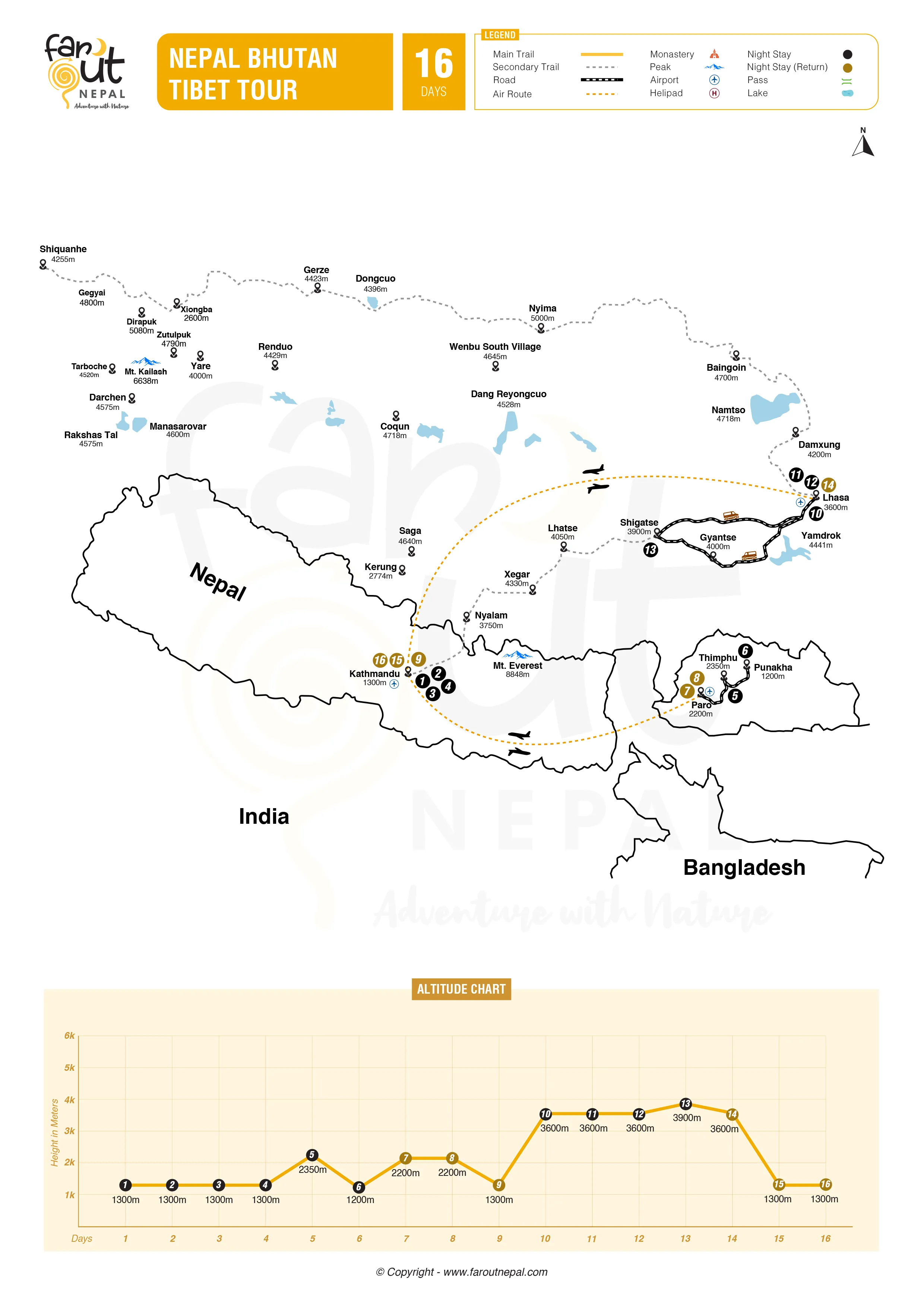
Trip map of Nepal Bhutan Tibet Tour
Trip Information
Duration & Overview of the Trip
The Nepal Bhutan Tibet Tour is a 16-day Himalayan cultural journey combining the spiritual heritage of Nepal, the peaceful Buddhist kingdom of Bhutan, and the high-altitude civilization of Tibet into one seamless multi-country expedition.
Unlike rushed multi-country itineraries, this route is paced strategically to allow travelers to experience each destination more deeply while gradually adapting to increasing Himalayan elevations before entering Tibet.
Breaking Down Your Trip Duration
| Destination | Duration (Buffer Days incl.) | Highlights |
| Nepal | 6 Nights / 7 Days | Kathmandu Valley heritage sites, Buddhist monasteries, spiritual experiences, and the visa processing period |
| Bhutan | 4 Nights / 5 Days | Thimphu, Punakha, Paro & Tiger’s Nest Monastery |
| Tibet | 5 Nights / 6 Days | Lhasa, Tibetan monasteries, Yamdrok Lake, Gyantse & Xigatse overland journey |
What Makes This Journey Unique
This Nepal Bhutan Tibet Tour is not simply a combination of three destinations. It is a connected Himalayan cultural experience that reveals how Buddhism, mountain geography, trade routes, monasteries, and spiritual traditions shaped the civilizations of the Himalayas over centuries.
By carefully structuring the journey in this sequence as Nepal → Bhutan → Tibet, travelers experience a natural progression through the Himalayan world rather than a disconnected series of destinations.
Who This Nepal Bhutan Tibet Tour Is Ideal For
The Nepal Bhutan Tibet Tour is designed for travelers seeking a deeper, culturally immersive Himalayan experience that goes beyond conventional sightseeing. It combines heritage exploration, spiritual discovery, and scenic mountain travel across Nepal, Bhutan, and Tibet.
This journey is best suited for travelers who value meaning, culture, and landscape-driven experiences over fast-paced or luxury-heavy itineraries.
This Tour Is Perfect For You If You Are Interested In:
- Himalayan culture, history, and civilizations
- Buddhist monasteries, rituals, and pilgrimage sites
- Multi-country cultural journeys in one itinerary
- Scenic landscapes, mountains, and photography
- UNESCO World Heritage Sites and ancient cities
- Slow-paced, meaningful travel experiences
- Spiritual or reflective travel journeys
Key highlights such as Taktsang Monastery and sacred sites in Kathmandu and Lhasa add depth to the overall experience.
This Tour May Not Be Ideal For Travelers Who Prefer:
- Fast-paced, city-hopping luxury vacations
- Minimal travel time between destinations
- Nightlife-focused or entertainment-heavy trips
- Fully modern infrastructure at all destinations
- Avoiding altitude or mountain travel conditions
This journey is designed to allow travelers to experience three distinct Himalayan worlds in a structured and meaningful way, without the rush of standard multi-country tours. If the traveler aligns with this style of exploration, the Nepal Bhutan Tibet Tour becomes one of the most rewarding cultural journeys in Asia.
Best Time to Visit Nepal, Bhutan & Tibet
The Nepal Bhutan Tibet Tour is best experienced during periods of stable weather, clear Himalayan visibility, and comfortable travel conditions across Nepal, Bhutan, and Tibet.
Due to the varying geography, from Kathmandu Valley to Bhutanese mountain passes and the high-altitude Tibetan Plateau, seasonal timing plays an important role in overall travel experience quality.
Spring (April – May): Best Overall Conditions
Spring is one of the most favorable times for this journey.
- Clear Himalayan mountain views
- Pleasant temperatures across all three countries
- Blooming rhododendrons in Bhutan
- Ideal conditions for sightseeing and photography
This is widely considered one of the most balanced seasons for cultural and scenic travel.
Autumn (Mid-September – October): Peak Travel Season
Autumn is the most popular and stable season for the Himalayan region.
- Crystal-clear mountain visibility
- Dry and stable weather conditions
- Excellent travel conditions in Kathmandu, Bhutan, and Tibet
- High-quality photography conditions
This is often regarded as the premium travel window for the entire itinerary.
Winter (November – February): Cold but Possible
Winter travel is possible but requires preparation.
- Cold temperatures, especially in Tibet
- Clear skies and strong visibility
- Fewer crowds at major sites
- Some higher-altitude areas may feel more challenging
Best suited for experienced Himalayan travelers.
Monsoon (June – August): Least Recommended
Monsoon season brings mixed travel conditions.
- Rainfall in Nepal and Bhutan
- Reduced mountain visibility
- Possible travel delays due to weather
- Tibet remains relatively drier compared to other regions
While travel is still possible, this period is generally less ideal for a multi-country Himalayan itinerary.
For the best overall experience across Nepal, Bhutan, and Tibet, the ideal travel windows are spring (April–May) and autumn (September–October), when weather conditions, visibility, and travel comfort align most effectively for a Himalayan multi-country journey.
Altitude & Acclimatization on the Nepal Bhutan Tibet Tour
The Nepal Bhutan Tibet Tour is designed as a culturally immersive Himalayan journey rather than a physically demanding expedition. However, because the itinerary eventually enters the Tibetan Plateau, travelers should understand the realities of high-altitude travel before joining the tour.
The highest elevation reached during the journey is approximately 4,750 meters while traveling through parts of Tibet.
Why This Itinerary Helps with Acclimatization
The journey begins in the lower elevations of Kathmandu before continuing into Bhutan, where travelers spend time between approximately 2,000 and 3,100 meters in places such as Thimphu, Punakha, and the Dochu-La Pass.
Only after several days in the Himalayas does the itinerary continue into Tibet, allowing the body more time to adapt before reaching higher elevations around Lhasa and beyond. This pacing makes the overall journey more manageable compared to entering Tibet immediately.
Understanding Altitude in Tibet
While most travelers adapt well with proper pacing and hydration, altitude affects everyone differently, regardless of age or fitness level.
Common mild symptoms may include headache, fatigue, mild dizziness, etc. These symptoms are relatively common during the first days in Tibet and often improve naturally as the body adjusts to the elevation. Learn more about the symptoms of altitude sickness →
How We Reduce Altitude Risk During the Journey
The itinerary is intentionally structured to support safer acclimatization through:
- Gradual elevation gain
- Acclimatization time in Lhasa
- Moderate pacing without rushed overland transitions
- Comfortable hotel stays
- Carefully planned sightseeing schedules
Travelers are also encouraged to:
- Drink plenty of water
- Avoid excessive alcohol consumption
- Walk slowly at higher elevations
- Rest properly upon arrival in Tibet
- Inform guides immediately if symptoms worsen
Who Should Consult a Doctor Before Joining?
Travelers with the following conditions should seek medical advice before booking:
- Heart conditions
- Lung or respiratory illnesses
- Severe blood pressure conditions
- Serious long-term medical issues
- Pregnancy-related travel concerns
Although the overall tour is considered easy to moderate in difficulty, Tibet’s high elevation requires responsible preparation and awareness. With proper pacing, acclimatization, and preparation, most travelers complete the Nepal Bhutan Tibet Tour comfortably while enjoying one of the world’s most fascinating high-altitude cultural journeys.
Accommodation & Comfort During the Nepal Bhutan Tibet Tour
Accommodation throughout the Nepal Bhutan Tibet Tour is carefully selected to provide comfort, convenience, and a smooth travel experience across three very different Himalayan destinations.
Because hotel standards, infrastructure, and tourism systems vary between Nepal, Bhutan, and Tibet, the accommodation experience also changes gradually throughout the journey.
The overall focus is on maintaining comfort, cleanliness, location quality, and reliable hospitality while preserving the authentic character of Himalayan travel.
Accommodation in Nepal
In Kathmandu, travelers stay in comfortable hotels located near cultural areas, restaurants, and major heritage sites. Options range from standard boutique properties to luxury hotels, depending on your preferred travel style and package category.
Most hotels typically include:
- Private attached bathrooms
- WiFi access
- Comfortable bedding
- Breakfast service
- Airport transfer support
Kathmandu offers the widest variety of accommodation standards during the overall journey.
Accommodation in Bhutan
Accommodation in Bhutan emphasizes traditional architecture, peaceful surroundings, and warm Bhutanese hospitality. Hotels in destinations such as Thimphu, Punakha, and Paro often combine modern comfort with local Himalayan design elements, including woodwork, traditional motifs, and scenic valley settings.
Depending on the selected category, travelers may enjoy:
- Traditional Bhutanese-style hotels
- Premium valley resorts
- Boutique cultural lodges
- Luxury Himalayan retreats
Bhutan generally offers some of the most peaceful accommodation experiences of the entire journey.
Accommodation in Tibet
Accommodation standards in Tibet are generally simpler compared to Nepal and Bhutan due to the remote high-altitude environment and limited tourism infrastructure outside major cities. In places such as Lhasa and Xigatse, carefully selected hotels provide comfortable stays suitable for acclimatization and overland travel.
Travelers should expect:
- Comfortable but simpler hotel standards
- Functional amenities rather than luxury-focused facilities
- Heating availability depends on the season
- Basic but reliable services in remote areas
The emphasis in Tibet is more on cultural access and expedition experience than on luxury infrastructure.
Hotel Categories & Customization
The Nepal Bhutan Tibet Tour can generally be customized with:
- Standard accommodation options
- Deluxe hotel upgrades
- Selected luxury property enhancements in major destinations
Luxury availability is highest in Nepal and Bhutan, while Tibet remains more limited due to regional conditions and permit-based tourism systems. The accommodation experience throughout this journey is designed to balance comfort, cultural atmosphere, and logistical practicality while supporting a smooth Himalayan travel experience across Nepal, Bhutan, and Tibet.
Transportation For The Nepal Bhutan Tibet Tour
The Nepal Bhutan Tibet Tour combines private overland transportation with some of the most spectacular mountain flights in the Himalayas, creating a journey that is both scenic and logistically seamless across three countries.
Because the expedition moves through remote Himalayan terrain, mountain valleys, and high-altitude plateau regions, transportation is an important part of the overall experience rather than simply a means of travel.
Scenic Himalayan Flights
This journey includes several remarkable flights across the Himalayan region, connecting Nepal, Bhutan, and Tibet.
Kathmandu to Paro Flight
The flight between Kathmandu and Paro is considered one of the most scenic mountain flights in the world.
On clear days, travelers may enjoy aerial views of Himalayan snow peaks, deep river valleys, and remote Himalayan settlements. The dramatic descent into Paro Valley is itself one of the highlights of the Bhutan experience.
Kathmandu to Lhasa Flight
The flight between Kathmandu and Lhasa offers a spectacular transition from Nepal into the Tibetan Plateau.
Weather permitting, travelers may witness Mount Everest, the Kanchenjunga range, Himalayan glacier systems, and Yamdrok Lake and Tibetan plateau landscapes. This route is widely regarded as one of Asia’s most visually impressive aviation experiences.
Private Ground Transportation
Throughout the journey, all overland travel is arranged using comfortable private transportation suitable for Himalayan road conditions.
Transportation includes:
- Airport transfers
- City sightseeing transportation
- Bhutan overland journeys
- Tibet Plateau road travel
- Scenic intercity drives
Vehicles are selected according to group size and road conditions to ensure safety and comfort throughout the expedition.
Overland Travel in Tibet
The Tibet section of the itinerary includes long scenic drives across the Tibetan Plateau between destinations, including Lhasa, Gyantse, and Xigatse.
These drives form an essential part of the experience, offering views of sacred lakes, mountain passes, Tibetan villages, glacier landscapes, and vast Himalayan plateau scenery. Travel times can be longer than typical city-based tours due to the remote terrain and altitude conditions.
Flight & Baggage Information
Mountain flights in the Himalayas are highly weather-dependent, and schedules may occasionally change due to operational or seasonal conditions.
Detailed baggage guidelines, domestic flight information, and final transportation arrangements are provided before departure to help travelers prepare comfortably for their journey.
Meals & Dining Experience
Meals across Nepal, Bhutan, and Tibet Tour are arranged to ensure comfort and convenience while reflecting the local food culture of each destination.
In Nepal, accommodation is generally on a bed & breakfast basis, with a wide range of restaurants available in Kathmandu offering Nepali, Asian, and international cuisine.
In Bhutan, the tour operates on a full-board basis (Breakfast, Lunch & Dinner), with meals served in hotels or approved restaurants featuring Bhutanese and continental dishes.
In Tibet, meals are typically on a bed & breakfast basis, with arranged meals during sightseeing and overland travel, offering simple Tibetan and Chinese-style cuisine.
Vegetarian options are generally available across all three countries with prior notice.
| Category | Information |
| Nepal | Breakfast basis with wide restaurant access |
| Bhutan | Full board (meals included in package) |
| Tibet | Breakfast basis with arranged meals during travel |
| Vegetarian Options | Widely available across all destinations |
| Food Variety | Highest in Nepal, moderate in Bhutan, basic in Tibet |
Expert Guides For the Nepal Bhutan Tibet Journey
The Nepal Bhutan Tibet Tour is not only a multi-country Himalayan journey but also a guided cultural experience designed to help travelers understand the deeper historical, spiritual, and civilizational context of the region.
Across Nepal, Bhutan, and Tibet, the journey is supported by experienced professional guides who ensure smooth logistics while also enriching the travel experience through cultural interpretation.
Guided Interpretation Across the Himalayas
In Kathmandu, guides provide insights into Nepal’s layered heritage, including Hindu-Buddhist coexistence, ancient city structures, and UNESCO-listed monuments.
In Bhutan, local guides help travelers understand Bhutan’s unique philosophy of Gross National Happiness, monastery traditions, and preserved Himalayan culture.
In Tibet, guiding focuses on Tibetan Buddhist history, monastic systems, pilgrimage practices, and the cultural significance of sites such as Lhasa and the surrounding regions.
This journey is designed to go beyond surface-level tourism; from a sightseeing tour into a structured cultural learning experience across three interconnected Himalayan civilizations.
Guide Expertise & Support
Depending on the section of the journey, travelers are assisted by:
- Local cultural experts in each country
- Licensed trekking and city guides
- Coordinated cross-border tour leadership for seamless transitions
This ensures both logistical efficiency and deeper cultural engagement throughout the expedition.
Visa & Permit Information
Travelling across Nepal, Bhutan, and Tibet requires separate visa and permit arrangements, as each destination follows its own entry regulations. This section outlines the key requirements and how they are managed for the Nepal Bhutan Tibet Tour.
Nepal Visa
Most travelers can obtain a visa for Nepal either on arrival at Tribhuvan International Airport or through an online application before travel.
Basic requirements include:
- Passport valid for at least 6 months
- Passport-sized photograph
- Applicable visa fee
Official application portal: Department of Immigration Nepal
Bhutan Visa
The Bhutan visa is processed in advance through a licensed tour operator after confirmation of the tour. People also need to pay the required SDF fee as part of supporting the Bhutan Tourism industry.
Requirements typically include:
- Passport copy
- Passport-size photograph
- Full tour payment
- Basic traveler details
The visa clearance is issued before travel and finalized upon arrival in Bhutan. Get more information here: Bhutan Visa and SDF. You can also check out the official application portal for Bhutan.
Tibet Travel Permit & China Group Visa
Entry into Tibet from Nepal follows a regulated group visa system. You can check out the detailed information here: About the Tibet Visa.
Key requirements include:
- Minimum group size of 4 travelers
- Mandatory travel booking with a licensed operator
- Passport submission in Kathmandu
- Processing time of approximately 4–7 working days
Two documents are required:
- Tibet Travel Permit
- China Group Visa (issued as a group document, not a passport stamp)
All travelers must enter and exit Tibet together as part of the same group itinerary.
Important Notes
- A Chinese visa issued outside Nepal is not valid for entry into Tibet from Nepal.
- Passport submission in Kathmandu is mandatory for processing.
- Travelers must remain in Kathmandu during the visa processing period.
- Tibet permits are strictly regulated and cannot be issued for independent travel.
Our team coordinates the complete visa and permit process after booking confirmation to ensure a smooth and compliant entry into all three destinations throughout the Nepal Bhutan Tibet Tour.
Health, Safety & Travel Insurance
The Nepal Bhutan Tibet Tour covers diverse terrain across Nepal, Bhutan, and Tibet, ranging from cultural city exploration to high-altitude Himalayan environments.
While the journey is designed to be comfortable and well-paced, responsible preparation is important due to altitude exposure and varying infrastructure conditions.
General Safety Overview
All three destinations are generally considered safe for travelers. The itinerary follows established tourist routes, with guided support and pre-arranged transportation throughout the journey. Standard precautions such as safeguarding personal belongings and following the guide instructions are recommended.
Altitude Considerations
The most important health factor on this tour is altitude, particularly in Tibet, where elevations can exceed 4,500 meters. You can learn more about what altitude sickness is here: What is AMS?
These symptoms are typically mild and temporary for most travelers, especially with gradual acclimatization included in the itinerary.
Health Recommendations
To ensure a comfortable journey:
- Stay well hydrated throughout the trip
- Avoid excessive physical exertion at high altitude
- Eat light, balanced meals
- Rest adequately upon arrival in higher elevations
- Inform your guide immediately if you feel unwell
Travelers with pre-existing medical conditions should take additional care during planning.
Travel Insurance
Comprehensive travel insurance is strongly recommended for all travelers.
Your insurance should ideally cover:
- Medical emergencies
- High-altitude travel
- Trip cancellations or delays
- Emergency evacuation
This ensures full protection throughout the multi-country journey.
Plan Your Himalayan Journey With Far Out Nepal
The Nepal Bhutan Tibet Tour is more than a multi-country journey. It is a carefully designed Himalayan expedition that connects three distinct worlds of culture, spirituality, and landscape into one seamless experience. From the heritage valleys of Nepal to the peaceful monasteries of Bhutan and the high-altitude spiritual plateau of Tibet, this journey offers a rare combination of depth, diversity, and meaning in a single itinerary.
With limited permit availability for Tibet and seasonal travel windows across the Himalayas, planning is essential to secure participation and ensure smooth visa coordination.
Seats on this route are limited due to Tibet permit regulations and seasonal travel constraints. We recommend early booking to secure your preferred departure date and ensure smooth visa processing. Our team will assist you with full trip planning, visa coordination, and customization based on your travel preferences.
Frequently Asked Questions
What is the Nepal Bhutan Tibet Tour?
The Nepal Bhutan Tibet Tour is a multi-country Himalayan journey that combines the cultural, spiritual, and scenic highlights of Nepal, Tibet, and Bhutan into a single guided itinerary.
Which destinations are covered in the Nepal Bhutan Tibet Tour?
The tour typically covers Kathmandu in Nepal, Lhasa in Tibet, and Paro, Thimphu, and Punakha in Bhutan, along with major monasteries, palaces, temples, and Himalayan landscapes.
How many days are needed for the Nepal Bhutan Tibet Tour?
Far Out’s Nepal Bhutan Tibet Tour generally requires 12 to 20 days, depending on itinerary pace, altitude acclimatization, and the number of destinations included.
What is included in the Nepal Bhutan Tibet tour package?
The Nepal Bhutan Tibet tour packages include accommodation, transportation, permits, sightseeing, licensed guides, internal flights, and cross-border travel arrangements.
Do travelers need permits for Tibet and Bhutan?
Yes, both Tibet and Bhutan require special travel permits and guided tour arrangements for international visitors, which are usually handled by the tour operator.
What is the best time to visit Nepal, Bhutan, and Tibet together?
The best time to visit Nepal, Bhutan, and Tibet is during spring (March–May) and autumn (September–November) when weather conditions are stable, and Himalayan visibility is clearer.
How much does a Nepal Bhutan Tibet Tour cost?
The Nepal Bhutan Tibet Tour typically costs between USD 4,000 and USD 9,000+ per person, depending on trip duration, accommodation standard, internal flights, and level of customization.
Is the Nepal Bhutan Tibet Tour cultural or spiritual?
The Nepal Bhutan Tibet Tour combines cultural, spiritual, and scenic experiences, including Buddhist monasteries, Himalayan heritage sites, sacred temples, and mountain landscapes.
What are the major highlights of the Nepal Bhutan Tibet Tour?
Major highlights include Kathmandu Valley UNESCO sites, Potala Palace in Lhasa, Jokhang Temple, Tiger’s Nest Monastery, Punakha Dzong, and Himalayan cultural landscapes.
Is a guided tour mandatory for Tibet and Bhutan?
Yes, guided tours are mandatory in Bhutan and required for most Tibet travel arrangements due to regional tourism regulations and permit systems.
What is the typical Nepal Bhutan Tibet itinerary?
A typical itinerary includes Kathmandu sightseeing, flights to Paro and Lhasa, cultural tours in Bhutan, monastery visits in Tibet, and guided experiences across all three Himalayan regions.
Is altitude sickness a concern during the Tibet portion of the tour?
Yes, altitude sickness can be a concern in Tibet, especially in Lhasa and higher Himalayan regions, so proper acclimatization and gradual travel pacing are important.
Can the Nepal Bhutan Tibet Tour be customized?
Yes, the tour can be customized with luxury hotels, spiritual retreats, private guides, helicopter experiences, and extended cultural or trekking extensions.
Is the Nepal Bhutan Tibet Tour suitable for first-time Himalayan travelers?
Yes, the tour is suitable for first-time Himalayan travelers because it combines guided cultural experiences with structured logistics across multiple destinations.
Are flights included in Nepal Bhutan Tibet tours?
Most Nepal Bhutan Tibet tours include regional flights between Kathmandu, Paro, and Lhasa, depending on the itinerary and package structure.
Reviews on Nepal Bhutan Tibet Tour
Special Savings and Discounts for Group Travelers!
-
1 -
1 person
US$ 4800
-
2 -
3 person
US$ 4100
-
4 -
5 person
US$ 3610
-
6 -
9 person
US$ 3315
-
10 over
9999
US$ 2990
US$ 4800