


Altitude Sickness (AMS) Symptoms: Early Signs, Severity Levels & When to Worry
Introduction
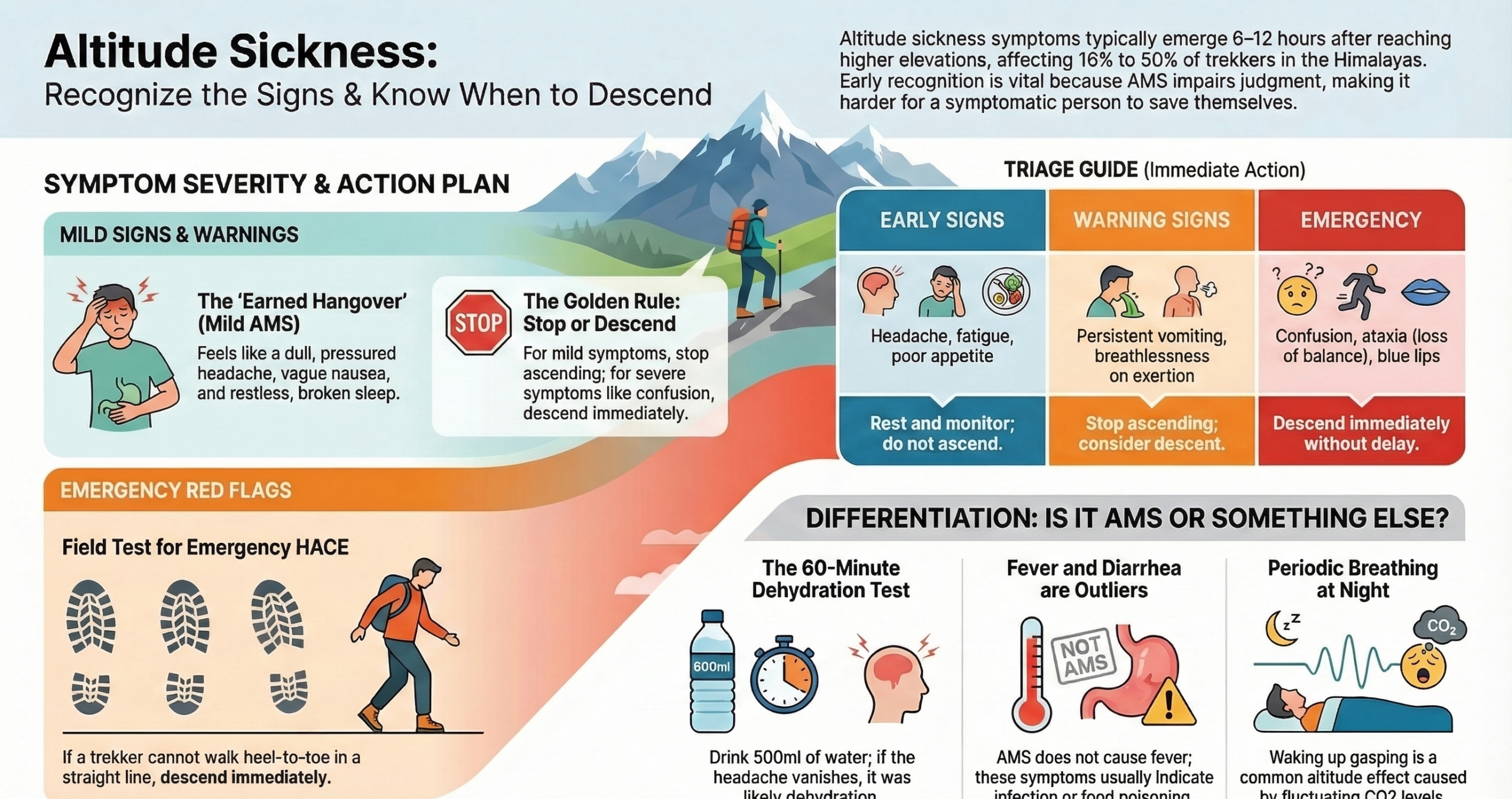
Altitude sickness symptoms usually begin to appear within 6–12 hours of reaching higher elevations. These symptoms typically range from mild headaches and fatigue to serious conditions affecting the lungs and brain. Studies in the Himalayas show AMS rates ranging from 16% to over 50%, depending on altitude and ascent speed.
This makes it one of the most common medical concerns for trekkers. Recognizing symptoms early and understanding what they actually mean is what keeps a great trek from becoming a medical emergency.
What Does Altitude Sickness Feel Like?
Most people expect altitude sickness to announce itself clearly. It rarely does and sneaks in quietly. The most honest description? It feels like a hangover you didn’t earn.
A dull, pressured headache that sits behind your eyes and wraps around your skull. A vague nausea that makes you want to vomit after smelling anything. A night of broken, restless sleep that leaves you more exhausted than when you went to bed.
What catches trekkers off guard is the subtlety. Initially, you feel off but not dramatically unwell. Many dismiss it as trail tiredness, a bad night’s sleep, or yesterday’s exertion. That dismissal is exactly where AMS gets dangerous.
The experience varies more than most expect. Some people feel genuinely terrible at mild AMS. Others feel only a little more tired. Fitness level doesn’t protect you, while experienced trekkers who lead the group on day one sometimes struggle most by day three. There is no reliable way to predict individual susceptibility in advance.
Early Signs of Altitude Sickness
The following symptoms typically appear first, often within hours of arriving at a new elevation:
- Headache: The defining symptom; throbbing or pressure-type, often worsening overnight
- Fatigue: Disproportionate tiredness that rest doesn’t fully relieve
- Loss of appetite: Food becomes unappealing, not just less enjoyable
- Mild dizziness: Lightheadedness, nausea (especially when standing or moving quickly)
- Sleep disturbance: Difficulty staying asleep, waking repeatedly, and feeling unrefreshed in the morning
A headache alone at altitude is classified as a high-altitude headache (HAH) and is extremely common. It becomes AMS when accompanied by at least one other symptom: nausea, fatigue, or dizziness. This combined symptom severity can reach a clinical threshold, which can be defined by the Lake Louise Scoring System.
If you wake up with a headache and no appetite after your first night at a new elevation, that combination deserves attention, not dismissal.
Altitude Sickness Symptoms by Severity
Mild Symptoms (Early AMS)
AMS is rare below 2,500m. Above 4,500m (which is the elevation of many popular Himalayan treks), more than half of the trekkers may be affected. Mild AMS is the most common presentation and, if managed correctly, is rarely dangerous.
- Headache that responds to ibuprofen or paracetamol
- Mild fatigue
- Reduced appetite
- Slight dizziness
- Disrupted sleep
At this stage, the right move is simple. Stop ascending. Rest at the same altitude. Most mild AMS resolves within 24–48 hours with acclimatization. The mistake people consistently make is pushing their ascent because they feel “only a little off.” That is how mild progresses to other stages.
Moderate Symptoms
Moderate AMS means your body is struggling to compensate. Symptoms intensify and begin interfering with normal functioning:
- Persistent headache that doesn’t fully respond to painkillers
- Nausea, possibly with vomiting
- Significant fatigue, where basic tasks feel effortful
- Breathlessness with mild exertion
- Reduced urine output
Do not ascend further. If symptoms don’t change (improve or worsen), even after 24 hours of rest at the same altitude, descending 300–500m is the right call. This is the stage at which ignoring symptoms creates a real risk.
Severe Symptoms (Emergency Warning Signs)
Severe AMS indicates progression toward HACE (High Altitude Cerebral Edema) or HAPE (High Altitude Pulmonary Edema). Both of these are life-threatening conditions and require immediate action.
HAPE is actually the more common cause of altitude-related death and can develop without preceding AMS symptoms in some cases. HACE, if untreated, can progress to coma and death within 12–24 hours due to brain herniation.
Descend immediately. Do not wait for morning.
- Breathlessness at complete rest
- Persistent dry cough, especially with pink or frothy sputum (HAPE)
- Confusion, disorientation, or unusual behavior
- Inability to walk a straight line (ataxia). A hallmark sign of HACE
- Extreme lethargy beyond normal exhaustion
- Blue lips or fingernails (cyanosis)
A useful field test for HACE: Ask the person to walk heel-to-toe in a straight line. If they can’t, even if they could before, descend immediately.
Specific AMS Symptoms Explained
Altitude Sickness Headache
The headache of AMS isn’t random. When oxygen levels drop, the brain triggers vasodilation, where the blood vessels widen in an attempt to push more oxygenated blood to the brain tissue. This increases intracranial pressure.
But the pain itself is generated through the trigeminovascular system. This is the same nerve pathway involved in migraines, which is why an AMS headache can feel remarkably similar to a migraine.
What makes it distinct from other headaches: It typically worsens overnight, peaks in the morning, and intensifies when bending forward or lying flat. Exertion makes it worse. It often doesn’t respond well to hydration alone, which is one of the key ways to differentiate it from a dehydration headache.
If ibuprofen isn’t meaningfully reducing it after a few hours, treat that as a signal, not a nuisance.
Nausea and Loss of Appetite
Hypoxia activates the sympathetic nervous system. This is the same stress-response system behind pre-adrenaline nausea. Simultaneously, the gut is deprioritized under low-oxygen conditions. Digestion slows. Food becomes unappealing.
In early AMS, this isn’t dramatic nausea, but a persistent, low-level queasiness. Many trekkers eat mechanically but find no enjoyment in food. Vomiting typically signals moderate-to-severe AMS, and when it appears, it matters beyond discomfort. Vomiting also accelerates dehydration and can delay acclimatization.
Dizziness and Fatigue
Dizziness at altitude stems from reduced oxygen reaching the vestibular system and brain. This is also compounded by the cardiovascular effort of compensating for hypoxia. It presents as lightheadedness, which is most noticeable when standing or changing positions quickly.
Fatigue runs deeper than just the tiredness after trekking. Muscles switch to less efficient anaerobic metabolism earlier than normal. Meanwhile, the body is working hard just to maintain basic function. There’s an increase in breathing rate, elevated heart rate, and heightened sympathetic activation. All of it burns energy. Fit, experienced trekkers are often the most surprised by how profound this fatigue feels.
Sleep Disturbances at Altitude
This is the most misunderstood AMS symptom, and the one most likely to be blamed on everything except the actual cause.
When you’re sleeping at an altitude, hypoxia triggers faster breathing (hyperpnea), which drops CO₂ levels. Low CO₂ signals the brain to temporarily stop breathing (apnea). Falling oxygen level then restarts the breathing drive, and the cycle repeats.
This is called periodic breathing, sometimes referred to as Cheyne-Stokes respiration at altitude. Each cycle lasts roughly 30 seconds to 2 minutes, though at altitude these cycles tend to be shorter and more frequent than in other clinical settings.
The result: Repeated micro-awakenings, often with a gasping or startled sensation. Vivid or unsettling dreams are common. You go to bed tired and wake up more exhausted, because you technically stopped breathing dozens of times overnight.
Many trekkers blame cold air, tent noise, or a new environment. If you’re consistently waking with a jolt at a new elevation, this is why.
Symptoms That Are Often Confused with Altitude Sickness
Knowing what altitude sickness is is just as important as knowing what it is. Once you’ve ruled out dehydration, food poisoning, or a common cold, what remains needs to be taken seriously.
Can Altitude Sickness Cause Fever?
No. Fever is not a symptom of AMS or HACE. If you have a fever above 38°C at altitude, think infection first, like viral illness, respiratory infection, or something requiring medical attention beyond altitude protocol.
The exception worth knowing: Fever can appear with HAPE, which is why HAPE is sometimes initially mistaken for pneumonia. But by that point, respiratory symptoms, including breathlessness at rest and a worsening cough, are dominant and hard to miss. A fever without those classic AMS markers points strongly away from altitude sickness.
Diarrhea at Altitude: AMS or Something Else?
Diarrhea is one of the most common medical complaints among trekkers in Nepal, but it is rarely caused by altitude. AMS only causes nausea and sometimes vomiting.
What actually causes trekker diarrhea in the Himalayas is far more mundane: contaminated water, unfamiliar food, traveler’s gut bacteria, including E. coli and Giardia. This is so prevalent in the first two weeks of a Nepal trip that many trekkers incorrectly attribute it to altitude when it needs an entirely different response of rehydration and possibly antibiotics, not descent.
Fever combined with diarrhea is almost certainly not AMS. Think food poisoning or infection.
AMS vs. Dehydration
This is the most practically useful distinction to understand, because dehydration and AMS frequently co-exist and share overlapping symptoms.
Where they overlap: headache, fatigue, nausea, dizziness.
Where they differ:
- Dehydration headache typically improves within 30–60 minutes of drinking water. AMS headache does not.
- Dehydration causes dry mouth, thirst, and dark urine. These are not typical AMS features.
- Altitude itself increases fluid loss through faster, drier breathing. Many trekkers arrive genuinely dehydrated without realizing it, which can worsen AMS symptoms.
A practical field approach: Drink 500ml of water and wait 45–60 minutes. If the headache eases meaningfully, dehydration was likely the cause. If it persists or worsens, treat it as AMS and act accordingly.
How AMS Symptoms Progress If Ignored
AMS follows a quick escalation when ascent continues despite symptoms.
Hours 6–12 after ascent: A dull headache begins, but is often dismissed as trail tiredness. Mild fatigue. Slight nausea. Easy to explain away.
Night 1: The headache intensifies when lying down. Sleep is fragmented by periodic breathing. Morning reveals worse symptoms than the evening before. This is a critical signal: if you feel worse after a night of rest, acclimatization is not happening.
24–48 hours with continued ascent: Headache becomes severe and unresponsive to medication. Vomiting. Profound fatigue. Breathlessness on minimal exertion. The body is no longer compensating.
Beyond this point: The transition to HACE or HAPE can happen within hours. Confusion appears. Coordination deteriorates. Breathing becomes labored at rest. This is a medical emergency with a narrow treatment window.
One critical and underappreciated factor:
AMS impairs judgment. The very condition requiring action makes it harder to recognize that you need to act. Guides, trek partners, and pre-agreed symptom plans matter here. You should not rely solely on self-assessment when symptomatic.
When to Be Concerned About Altitude Sickness Symptoms
Here’s a sobering finding from Nepal-based research: 63% of trekkers developed AMS symptoms despite 80% having prior knowledge of the condition.
Knowing about altitude sickness does not protect you from it. It also doesn’t guarantee you’ll recognize it in yourself.
Seek descent or emergency assistance when:
- Symptoms worsen after 24 hours of rest at the same altitude
- The headache becomes severe and doesn’t respond to ibuprofen
- Breathlessness occurs at rest, not just on the trail
- Coordination or balance deteriorates
- Confusion, unusual behavior, or extreme lethargy appear
- Any symptom from the severe category above is present
The golden rule of altitude: If in doubt, descend. Dropping even 300–500m can produce a dramatic improvement within hours. Altitude is the only reliable cure for AMS, and it works fast.
Do You Need Medication for These Symptoms?
Acetazolamide (sold under the brand name Diamox) is the most widely used medication for altitude sickness prevention and treatment. It works by inducing a mild metabolic shift that stimulates deeper, more frequent breathing, essentially accelerating what acclimatization does naturally over 3–5 days into roughly one.
It also directly reduces periodic breathing during sleep, which is why many trekkers on Diamox report significantly better rest at altitude. Importantly, it doesn’t mask symptoms, but supports the body’s actual adaptation process.
Whether you need it depends on your ascent profile, personal susceptibility, and trek itinerary. For dosage, timing, and a full breakdown of how to use it properly, see our complete altitude sickness medication guide.
Quick AMS Symptom Reference
| Category | Symptoms | Action |
| Early Signs | Headache, fatigue, poor appetite, mild dizziness, broken sleep | Rest, don’t ascend, monitor closely |
| Warning Signs | Persistent headache, nausea/vomiting, breathlessness on exertion | Stop ascending, consider descent |
| Emergency Signs | Breathlessness at rest, confusion, ataxia, pink/frothy cough | Descend immediately without any delay |
So, can we manage AMS symptoms?
Altitude sickness is manageable when you catch it early. The trekkers who get into serious trouble aren’t usually the ones who didn’t know the symptoms, but the ones who recognized them and kept climbing anyway.
Understand what your body is telling you. Know what AMS is and what isn’t. And when symptoms don’t resolve with rest, descend first and investigate later.
For a complete overview of causes, risk factors, and prevention strategies, see our complete altitude sickness overview guide.
Related Blogs
 February 27, 2026