


Classic Everest Base Camp vs. Gokyo Lakes Trek: Which Route Should You Choose?
Introduction: EBC vs. Gokyo Lakes
Let’s be honest. If you’ve started searching up “EBC vs Gokyo,” you’re not looking for a casual trekking experience. You’re already deep in the trekking rabbit hole, probably with seven tabs open and hastily comparing trekking companies & packages.
We get it. This is one of the most exciting, yet also one of the most confusing, decisions you’ll make. Both routes are genuinely spectacular. Both routes also start at Lukla, and both put you in the shadow of the world’s highest peaks. The difference is what happens in between.
At Far Out Nepal, we’ve guided trekkers on both routes for over 25 years. We’ve seen first-timers moved to tears at Kala Patthar. We’ve watched photographers lose their minds completely at Gokyo Ri. And we’ve guided the combined circuit with trekkers who refused to choose, and never regretted it.
EBC or Gokyo: Two Routes, Two Completely Different Journeys
Before the comparison tables and altitude numbers, here’s the summary of each:
Classic EBC = The iconic route, which is a well-established and world-renowned pilgrimage. You will be face-to-face with the world’s highest peak, which is an euphoric experience in itself.
EBC via the Gokyo Circuit = The full picture. Sacred lakes, Nepal’s longest glacier, a 360° panorama of four eight-thousand-foot peaks, and a circuit route that never repeats a single step.
Now let’s go deeper.
The Classic Everest Base Camp Trek (14-17 Days)
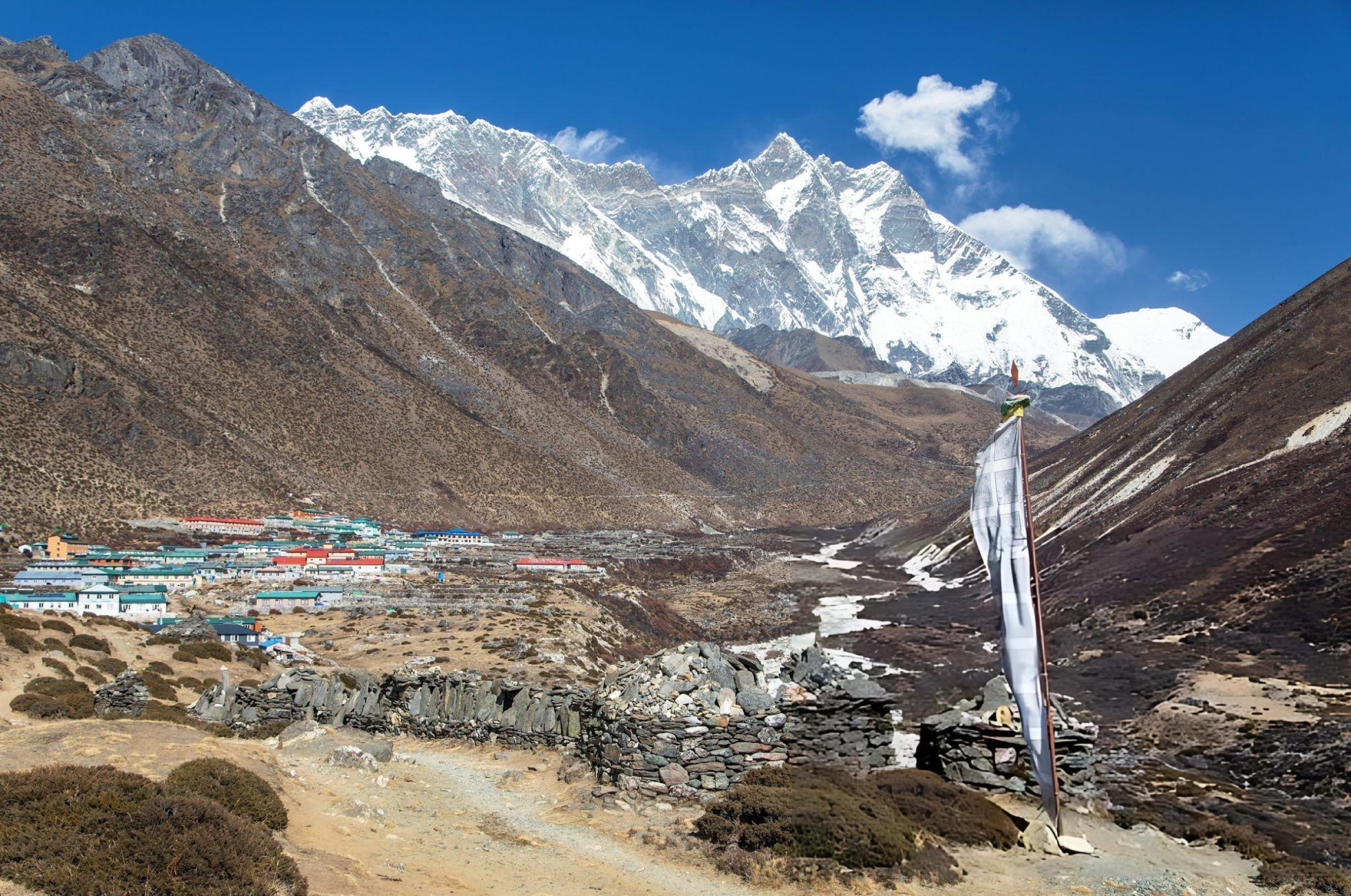
The Classic EBC Trek welcomes over 40,000 trekkers every year to the Khumbu region, and the numbers don’t lie.
This is one of the world’s great trekking routes. Starting with a flight into Lukla (2,860 m), you follow the Dudh Koshi River through a string of legendary Sherpa villages: Phakding, Namche Bazaar, Phortse, Dingboche, etc., before arriving at Gorakshep and stepping onto the moraine of Everest Base Camp (5,340 m / 17,500 ft).
Our 17-day Classic EBC Trek covers approximately 130–140 km round trip, with two planned acclimatisation stops built in (Namche Bazaar and Dingboche). The summit moment (and yes, it feels like a summit) is Kala Patthar at 5,545 m / 18,192 ft, where Everest’s south face fills your entire field of vision roughly 9 km away.
One thing we are honest about that most agencies won’t tell you: the return trip retraces the same path. Same trail, same teahouses, same ridgelines, but in reverse. For some trekkers, that’s a meditative experience. For those seeking novelty, it’s a compelling reason to consider the Gokyo circuit. Worth knowing before you commit.
→ Ready to see the full day-by-day breakdown? View the Classic EBC Trek map here.

The Gokyo Lakes Route (18-20 Days)

This route shares the trail with the classic as far as Namche Bazaar, then turns northwest into the quieter, less-travelled Gokyo Valley. Instead of heading toward Lobuche, you trek through Dole and Machhermo before arriving at Gokyo village. Our 20-day EBC via Gokyo trek is a genuine circuit, without backtracking, no repeated terrain, and new scenery every single day.
The village sits beside one of the most extraordinary landscapes in the Himalayas: a series of six turquoise glacial lakes, each shimmering at over 4,700 m, fed by the Ngozumpa Glacier (Himalaya’s longest glacier), stretching between 4,700 m and 6,000 m.
From Gokyo, you ascend Gokyo Ri (5,357 m), cross the dramatic Cho La Pass (5,420 m), and rejoin the classic EBC trail for the final push to Gorakshep, Base Camp (5,340 m), and Kala Patthar (5,645 m) on this route.
And about those lakes. The Gokyo Lakes aren’t just beautiful, they’re a Ramsar Wetland Site (No. 1692, designated in 2007), making them internationally recognised for their ecological significance. They are also sacred to both Hindus and Buddhists, with Sherpa communities honouring them for generations. Pilgrims still travel here for the annual Janai Purnima festival. You’re not just passing through a scenic valley. You’re walking through a living sacred landscape.
→ Curious about the full 20-day circuit? Explore the EBC via the Gokyo Lakes map here.

EBC or Gokyo: The Numbers That Matter
| Factor | Classic EBC | Everest Gokyo Circuit |
| Duration | 14-17 Days | 18-20 Days |
| Distance | ~130–140 km | ~160–175 km |
| Max Altitude | 5,545 m / 18,192 ft | 5,645 m / 18,520 ft |
| Grading | Difficult | Difficult |
| Crowds | High (40,000+ trekkers/year) | Moderate and noticeably quieter |
| Scenic Diversity | Mountains, glaciers, monasteries | Lakes, glaciers, passes, four 8,000m peaks |
| High Pass | None | Cho La Pass (5,420 m) |
| Glacier Walking | Limited | Extensive (Ngozumpa Glacier) |
| Route Type | Out-and-back | Full circuit without any repeated terrain |
| Group Size | 1–10 people | 2–10 people |
| Best Season | March–May / Oct–Nov | Mid-March–April / Mid-Oct–Nov |
| Best For | First-timers, bucket-list trekkers | Experienced trekkers, photographers, adventurers |
Route Differences Between Classic EBC vs. Gokyo Lakes Trek
Both treks start identically. Here’s where they diverge and how they eventually reunite:
| S.N. | Classic Everest Base Camp Trek Route | Gokyo Lakes and Cho La Pass Route |
| 1 | Arrive Kathmandu | Arrive Kathmandu |
| 2 | Drive → Ramechhap, fly → Lukla, trek → Phakding | Drive → Ramechhap, fly → Lukla, trek → Phakding |
| 3 | Phakding → Namche Bazaar (3,450 m) | Phakding → Namche Bazaar (3,450 m) |
| 4 | Namche acclimatisation | Namche acclimatisation |
| 5 | Namche → Tengboche (3,860 m) | Routes split: Namche → Dole (4,200 m) |
| 6 | Tengboche → Dingboche (4,360 m) | Dole → Machhermo (4,470 m) |
| 7 | Dingboche acclimatisation | Machhermo → Gokyo Lakes (4,790 m) |
| 8 | Dingboche → Lobuche (4,940 m) | Gokyo acclimatisation + Gokyo Ri ascent (5,357 m) |
| 9 | Lobuche → Gorakshep → EBC (5,340 m) | Gokyo → Thangnak (Cho La prep) |
| 10 | Kala Patthar → Pheriche | Cho La Pass crossing (5,420 m) → Dzongla |
| 11 | Pheriche → Namche | Dzongla → Lobuche (4,940 m) |
| 12 | Namche → Lukla | Lobuche → Gorakshep → EBC (5,340 m) |
| 13 | Fly → Ramechhap → Kathmandu | Gorakshep → Kala Patthar (5,645 m) → Pheriche |
| 15 | — | Descent → Namche → Lukla |
| 16 | — | Fly → Ramechhap → Kathmandu |
EBC or Gokyo: What Are You Actually Going to See?
Even if the region may be the same, what you’ll be seeing would be comparatively unique. While both routes are identical up to a certain point, they differ vastly in what they offer to trekkers, particularly in their destinations.
Classic EBC: Intimate, Epic, and Unforgettable
The classic route’s scenery doesn’t hit you all at once. It builds. Rhododendron forests give way to the magnificent Tengboche Monastery (3,860 m) with Ama Dablam (6,856 m) rising impossibly behind it. The trail passes through Phortse village, offering sweeping views of Kusum Kanguru (6,367 m), Thamserku (6,623 m), and Pumori (7,165 m), and gradually strips the landscape down to its raw glacial bones as you approach the Khumbu region.
Then comes Kala Patthar at sunrise.
Standing at 5,545 m, with Everest’s south face roughly 9 km in front of you. Nuptse, Lhotse, and the churning Khumbu Icefall are all visible as well. This is the kind of moment that rewires something in your brain permanently. This is what 40,000 people come for every year. And it delivers.
The Gokyo Circuit: The View That Changes Everything
Here’s the thing about Gokyo Ri. At 5,357 m, it is technically lower than Kala Patthar, but somehow offers what many experienced trekkers, Himalayan guides, and mountaineers describe as the better overall view of Everest.
Why? Because from Gokyo Ri, you see these eight-thousanders simultaneously: Cho Oyu (8,201 m), Mt. Everest (8,848 m), Lhotse (8,516 m), and Makalu (8,481 m). Let’s not forget Cholatse and Taboche, with the turquoise Gokyo Lakes shimmering directly below you and the Ngozumpa Glacier filling the valley between.
Kala Patthar puts you closer to Everest. Gokyo Ri shows you why Everest is the highest mountain in the world.
Comparing Difficulty and Altitude Between EBC & Gokyo
Both treks are graded “Difficult” by Far Out Nepal. Neither requires technical mountaineering skills, but both demand solid fitness, genuine respect for altitude, and a commitment to proper acclimatisation. This is not a weekend hike with a dramatic backdrop. It’s a multi-week high-altitude expedition.
On the Classic EBC, the challenge is sustained altitude accumulation across consecutive days above 4,000 m. The trail is well-established and well-marked, with teahouses spaced at regular intervals. Expect 5–7 hours of walking per day across steep trails, high ridges, and rugged Khumbu terrain. The two planned acclimatisation stops are non-negotiable and built into our itinerary.
On the EBC via Gokyo, the Cho La Pass (5,420 m) is the variable that changes everything. This is a steep, icy crossing with potential glacier walking with crampons. It is not technically difficult, but it demands strong fitness, proper acclimatisation, and ideally some prior high-altitude experience.
It also imposes a seasonal constraint: the Cho La Pass is generally unsafe between mid-December and mid-February due to the accumulation of snow and ice. That’s why our Gokyo trek’s best windows are mid-March to April and mid-October to November.
One counterintuitive advantage of the Gokyo route: the altitude profile through the Gokyo Valley is actually gentler in the early days. Trekking through Dole and Machhermo before reaching the lakes means more cumulative time above 4,000 m, building your altitude resilience before the Cho La and the final push to Kala Patthar.
💡 From Our Sherpa Guides: Never skip your acclimatisation days. Not even if you feel fine; altitude sickness doesn’t always announce itself early.
EBC or Gokyo: Who Should Choose Which Trek?
| Trekker Type | Best Choice | The Honest Reason |
| First-time Himalayan trekker | Classic EBC | Well-marked trail, dense teahouse network, simpler logistics |
| Experienced trekker wanting variety | EBC via Gokyo | True circuit, diverse terrain, the Cho La challenge |
| Photographer/content creator | EBC via Gokyo | Gokyo Ri’s lake-glacier-peak panorama is unmatched anywhere |
| Bucket-list / Everest-obsessed traveller | Classic EBC | Maximum time at Base Camp, closest proximity to Everest |
| Solo trekker craving solitude | EBC via Gokyo | Gokyo Valley trails are dramatically, blissfully quieter |
| Repeat Himalayan trekker | EBC via Gokyo | You’ve done EBC. Gokyo adds entirely new terrain and perspective |
| Short on time (under 18 days) | Classic EBC | The Gokyo circuit requires a minimum of 20 days with us |
Can’t Choose Between EBC or Gokyo? You Don’t Have To.
Here’s the thing nobody tells you at the start of your research: the combined route exists precisely for people who refuse to settle.
The EBC Trek via Gokyo Lakes and Cho La Pass is the most complete trekking experience the Khumbu region offers. In 20 days, you get the sacred Gokyo Lakes, a sunrise on Gokyo Ri with four eight-thousanders in view, the drama of crossing Cho La at 5,420 m, Everest Base Camp (5,340 m), and Kala Patthar (5,645 m), with zero repeated trail. Every single day is new ground, and it’s the route we recommend to any trekker who has the time and the fitness for it.
EBC or Gokyo: Which is better for photography?
Gokyo, without much debate. The combination of turquoise lakes at 4,700–5,000 m, the Ngozumpa Glacier, Gokyo Ri’s multi-peak panorama, and the visual drama of the Cho La crossing provide photographers with a range of shots that the Classic EBC cannot match. Kala Patthar at sunrise is iconic, but Gokyo offers more depth, foreground, and variety across more shooting days.
So, Which One Should You Choose: EBC or Gokyo?
If you have 17 days or this is your first Himalayan trek, the Classic EBC is the ideal route. It is iconic for a reason. Standing at Kala Patthar with Everest in your face is one of those experiences that permanently divides your life into before and after.
If you have 20 days, some altitude under your boots, and you want a trek that keeps surprising you with sacred lakes, glaciers, four eight-thousanders in one place, a high-pass crossing, and zero repeated terrain, the EBC via Gokyo is the answer.
And if you’re sitting there thinking, “I want all of it.“ Well, that’s exactly the right instinct. The combined route was built for you.
Plan your Classic EBC Trek with Far Out Nepal →
Explore the EBC via the Gokyo Lakes circuit with Far Out →