

Travelling Nepal in Monsoon: Be The Traveler Who Arrives When Everyone Leaves
Introduction to Monsoon Travelling In Nepal
Every year, thousands of travelers cross Nepal off their list come June. Rain, they say. Bad visibility. Leeches. Here’s what they’re giving away to the handful of people who know better.
The Honest Outlook of Monsoon
Nepal’s monsoon season runs from mid-June through the end of September, occasionally extending into mid-October. The heaviest rain falls across the southern Terai plains and the mid-hills. Temperatures climb as the hills reach 30–35°C, and the Terai can push past 40°C with humidity, making it feel like you’re standing inside a cloud.
Rainfall during the monsoon season can vary greatly. Some days experience continuous rain for several hours with short breaks in between, while other days remain dry but hot and humid. In recent years, changing climate patterns have made the weather increasingly unpredictable, causing the monsoon to arrive earlier or later than expected.
The season is marked by high humidity, overflowing rivers, floods, and occasional landslides that can disrupt road and flight connectivity in different parts of the country. Despite these challenges, monsoon travel in Nepal offers a completely different perspective of the Himalayas, with peaceful landscapes, lush green hills, dramatic clouds, fewer tourists, and vibrant local festivals.
Is Monsoon a Good Time to Travel in Nepal?
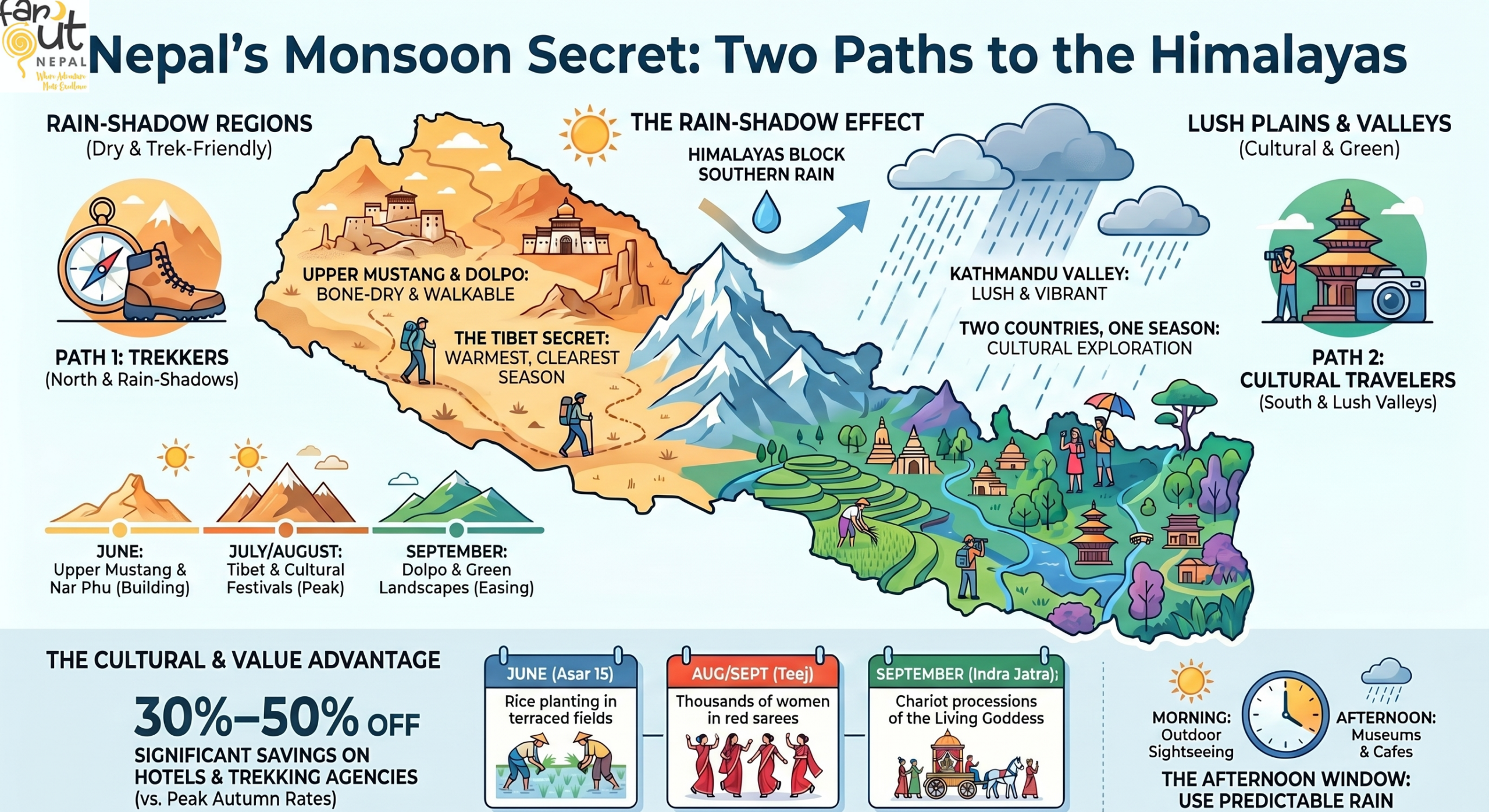
For trekking and mountain adventures, the monsoon is generally not considered the ideal season. Most popular trekking routes become slippery and challenging due to rain, leeches, landslides, and poor visibility of the Himalayan peaks. If you fly into Lukla chasing Everest Base Camp, the monsoon will beat you. But Nepal is not one weather pattern, but at least four, running simultaneously.
However, certain rain shadow regions in the Himalayas still offer excellent travel experiences during this time. Reaching these destinations may sometimes be affected by flight delays or road conditions, but the landscape remains spectacular.
For travelers interested in cultural experiences, Kathmandu Valley can still be enjoyable during the monsoon. Exploring ancient temples, heritage sites, arts, crafts, and local cuisine in Kathmandu can be rewarding, especially with fewer crowds.
Two Types of Travelers. Two Completely Different Trips.
The reality is that a trekker’s monsoon Nepal and a cultural traveler’s monsoon Nepal are almost different countries.
The Trekker: Rain-shadow trekking in Upper Mustang, Dolpo, Nar Phu. Dry trails, zero crowds, dramatic landscapes.
The Culture Traveler: Kathmandu’s UNESCO sites, monsoon festivals, Lumbini, Pokhara. These are all alive, but feel quieter than usual.
If you’re traveling with family, booking a cultural heritage trip, or simply don’t want to trek, the monsoon is entirely workable and frankly underrated. Don’t let anyone talk you out of it.
For Trekkers: Rain Shadow Trekking is Nepal’s Dry-Season Secret
The Himalayas don’t just block the sun. They block the monsoon itself, creating an entirely different climate on their northern flanks. These are the destinations that stay dry while the rest of Nepal is under cloud cover.
Upper Mustang
Best months: May · Jun · Sep
Nepal’s “Forbidden Kingdom” sits in the rain shadow of the Annapurna and Dhaulagiri ranges, receiving almost no monsoon rainfall. The landscape shifts from Nepal’s green hills to a Tibetan desert of deep canyons, ochre cliffs, ancient cave monasteries, and the walled city of Lo Manthang (3,840m).
During the monsoon, the winds that torment Upper Mustang in spring finally calm down, making trails significantly easier to walk. July and August are manageable within the region itself, even if travel disruptions in lower regions can complicate access. May, June, and September are actually the most reliable windows.
Practical note: Upper Mustang requires a special Restricted Area Permit. Flights to Jomsom can be affected by monsoon weather, so plan ahead. The jeep road from Pokhara is an alternative if flights are canceled.
Upper Dolpo
Best months: Jun · Sep
Upper Dolpo is the most remote of Nepal’s rain-shadow regions. It is a restricted, high-altitude wilderness in the far west containing Shey Phoksundo Lake, Shey Gompa monastery, and villages that have maintained Tibetan Buddhist traditions for centuries. Early June and September are the recommended windows. Mid-July through August can create access difficulties through lower regions, though the region itself stays dry.
Practical note: Permit-required, remote, higher budget than most Nepal treks. Travel with an experienced licensed guide. This is not a casual weekend trek.
Nar Phu Valley
Best months: Jun · Jul · Aug · Sep
A hidden corner of the Annapurna region that falls squarely in the rain shadow. The monsoon season here delivers a rare combination: dry trails, spectacular Himalayan scenery, ancient culture, and almost complete solitude. Connects to the Annapurna Circuit as a natural add-on.
Practical note: Requires a Nar Phu restricted area permit on top of the standard ACAP permit.
Ghorepani/Poon Hill
Best months: Jun · Jul · Aug · Sep
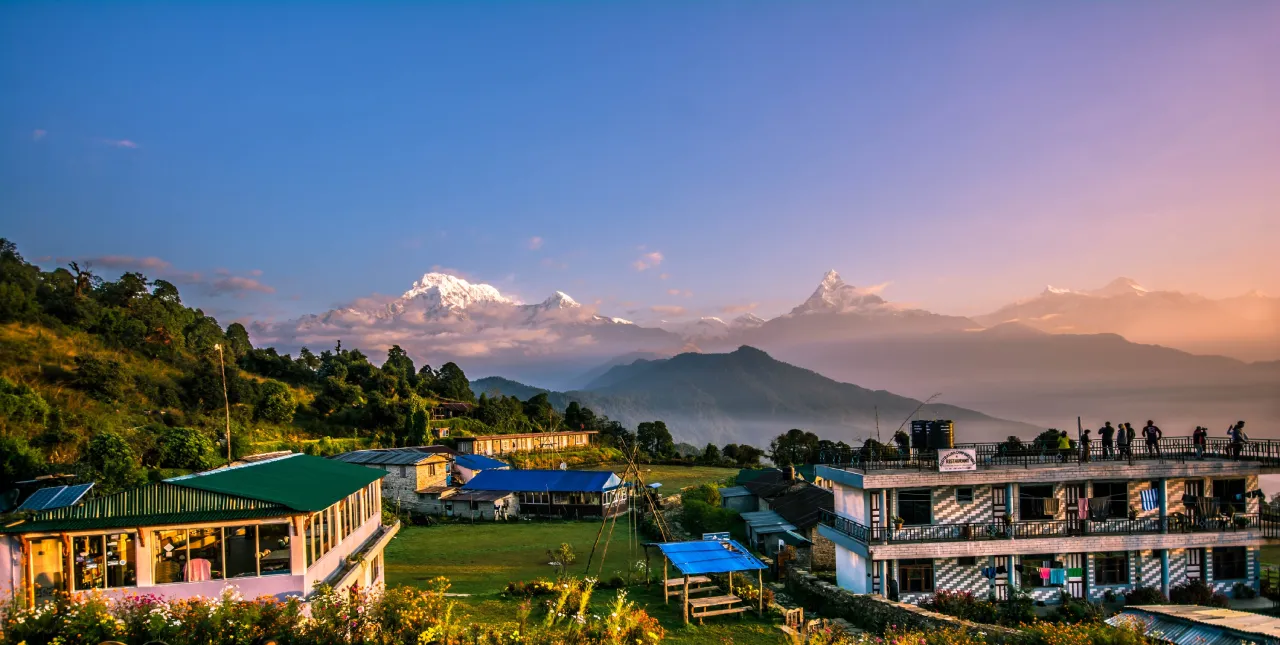
Not a rain-shadow destination, but Nepal’s most accessible short trek works during monsoon because of its wide, well-maintained stone paths and lower altitude. The forests around Ghorepani come alive with intensely green surroundings and birdsongs. The sunrise from Poon Hill over Annapurna and Dhaulagiri can be spectacular in the morning window before cloud cover builds.
Practical note: Start early every morning for the best visibility. Afternoons are reliably cloudy. Leech gaiters and trekking poles are non-negotiable on wet sections.
For Culture Travelers: Quieter Side of Nepal with Heritage Sites & No Crowds
Not every trip to Nepal is a trek. Monsoon is genuinely one of the best times to explore Nepal’s cultural and historical depth. You also get hotel discounts, empty UNESCO sites, and local festivals that only happen in the rainy season.
Kathmandu Valley
Best months: All monsoon months
Seven UNESCO World Heritage Sites within a single valley: Pashupatinath, Boudhanath, Swayambhunath, Bhaktapur Durbar Square, Patan Durbar Square, Kathmandu Durbar Square, and Changunarayan. You can visit all these without the spring and autumn tour groups.
The monsoon also brings Nepal’s most important festivals, all centered here.
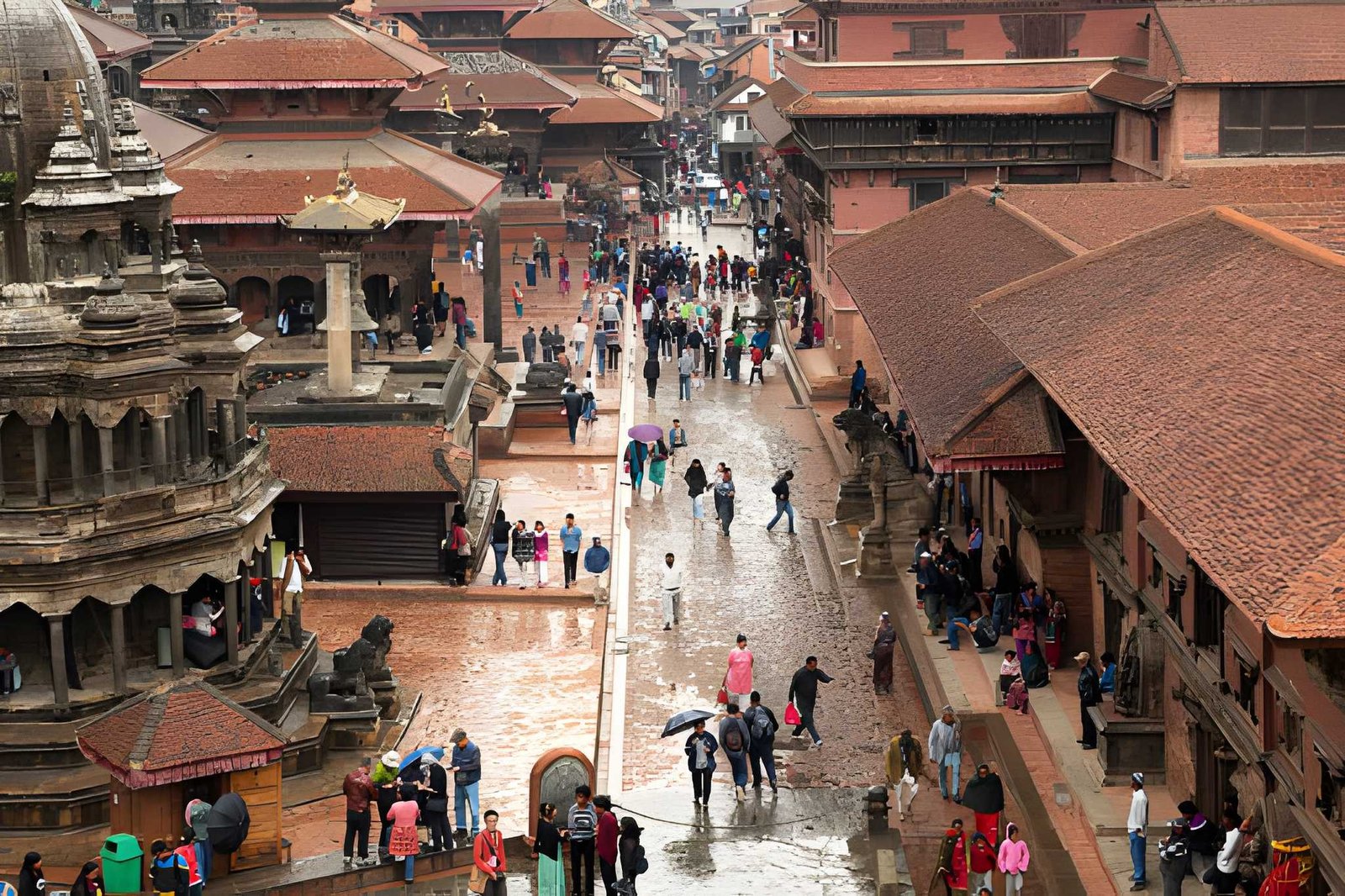
Practical note: Plan your outdoor sightseeing for mornings. Many temple courtyards are best explored in light rain, as you can see tiny details as the stone paths darken, and the marigold offerings glow. In the afternoons, you can visit the museums, Thamel, cooking classes, and local restaurants.
Lumbini
Best months: All monsoon months
You can also visit the birthplace of Siddhartha Gautama, or the titular Buddha. Monsoon rain turns Lumbini’s gardens intensely green. The Sacred Garden, Maya Devi Temple, Ashoka Pillar, and the ring of international monasteries are all quieter, more contemplative in the off-season.
Practical note: Lumbini pairs well with Chitwan National Park as a combined south Nepal circuit during the monsoon.
Pokhara
Best months: Jun · Sep · Oct
During monsoon, Phewa Lake fills to its edges, waterfalls cascade down the hillsides, and the lakefront café culture slows to a pace where you can just sit and watch the mist move across the Annapurna range. The rare clear break of Machhapuchhre suddenly appearing through parting clouds is something April crowds rarely witness with the same impact.
Practical note: July and August see the heaviest rain in Pokhara. June and September are more balanced. Use it as a rest stop or transit hub, not a trekking base, in the peak monsoon.
The Uncommon Monsoon Combination of Nepal + Tibet, No One is Talking About
While Nepal’s valleys fill with cloud and rain, just over the Himalayan barrier, Tibet sits in dry, clear, high-altitude air. This isn’t a coincidence, but geography, and it’s the best-kept secret of monsoon travel in this region.
The monsoon originates in the Bay of Bengal and moves northwest across South Asia. When it hits the Himalayan wall (the highest mountain barrier on Earth), it dumps its moisture on Nepal’s southern slopes and valleys. By the time the air crosses into Tibet, it has lost almost all its water content. The Tibetan Plateau receives less than 300mm of rain annually. During Nepal’s peak monsoon months, Tibet is entering its warmest, most accessible period.
Tibet in July–August: warmest temperatures, clear skies, high passes accessible, Lhasa at its most vibrant.
Nepal in July–August: rain-shadow trekking, festival season, green landscapes, off-season hotel pricing.
Practical itinerary: 3–4 days Kathmandu → overland or fly into Lhasa → Potala Palace, monasteries, high plateau.
The Months of Monsoon: When To Go, Exactly
June (Rain building): Good to go Upper Mustang, Nar Phu, Kathmandu Valley, Lumbini. Early access to rain-shadow routes before the peak monsoon.
July (Peak rain): Choose the Tibet combo, Kathmandu cultural tours, Upper Mustang interior. Festival season begins. Access roads in lower Nepal can flood.
August (Peak rain): Choose carefully. Tibet is excellent. Gai Jatra festival in Kathmandu. Upper Mustang interior. Avoid Dolpo access as road conditions are worse this month.
September (Rain easing): Good to go Upper Mustang, Dolpo, Nar Phu, Ghorepani all viable. Indra Jatra in Kathmandu. Landscapes at their greenest peak.
October (Tail end): Excellent window. Monsoon officially ends. Skies clear rapidly. Crowds and prices begin rising as the peak autumn season opens.
Monsoon Festivals: The Cultural Calendar Nobody Mentions
The monsoon season is Nepal’s most spiritually active period. These festivals don’t appear in most travel blogs because most travel blogs are written for trekkers. They’re a compelling reason to visit in their own right.
Asar 15: National Paddy Day
When: June 15 (approx.)
Where: Nationwide, especially vivid in Kathmandu Valley and hill districts
The official start of Nepal’s rice planting season. Farmers plant in waterlogged terraced fields to the sound of folk songs; in cities, people wade into the paddies together. It’s a celebration of agricultural identity, and one of the most photogenic days in the Nepalese calendar.
Janai Purnima: Sacred Thread Festival
When: Full moon of Shrawan (July–August)
Where: Pashupatinath, Gosaikunda, temples nationwide
Hindu men of the Brahmin and Chhetri castes change their sacred threads in a ritual renewal of spiritual commitment. Brahmin priests tie yellow threads around the wrists of worshippers as a symbol of protection. The festival also draws pilgrims to Gosaikunda Lake at 4,380m for ritual bathing. Kwati, a soup of nine varieties of sprouted beans, is the traditional food of the day.
Gai Jatra: The Cow Festival
When: Day after Janai Purnima (July–August)
Where: Kathmandu, Bhaktapur, Patan
Families who have lost a member in the past year lead a cow through the streets or a child dressed as one, as a symbolic guide for the departed soul. Gai Jatra evolved into a day of comedy, political satire, costumes, and street theater. To witness it is to understand something essential about how Nepal holds loss.
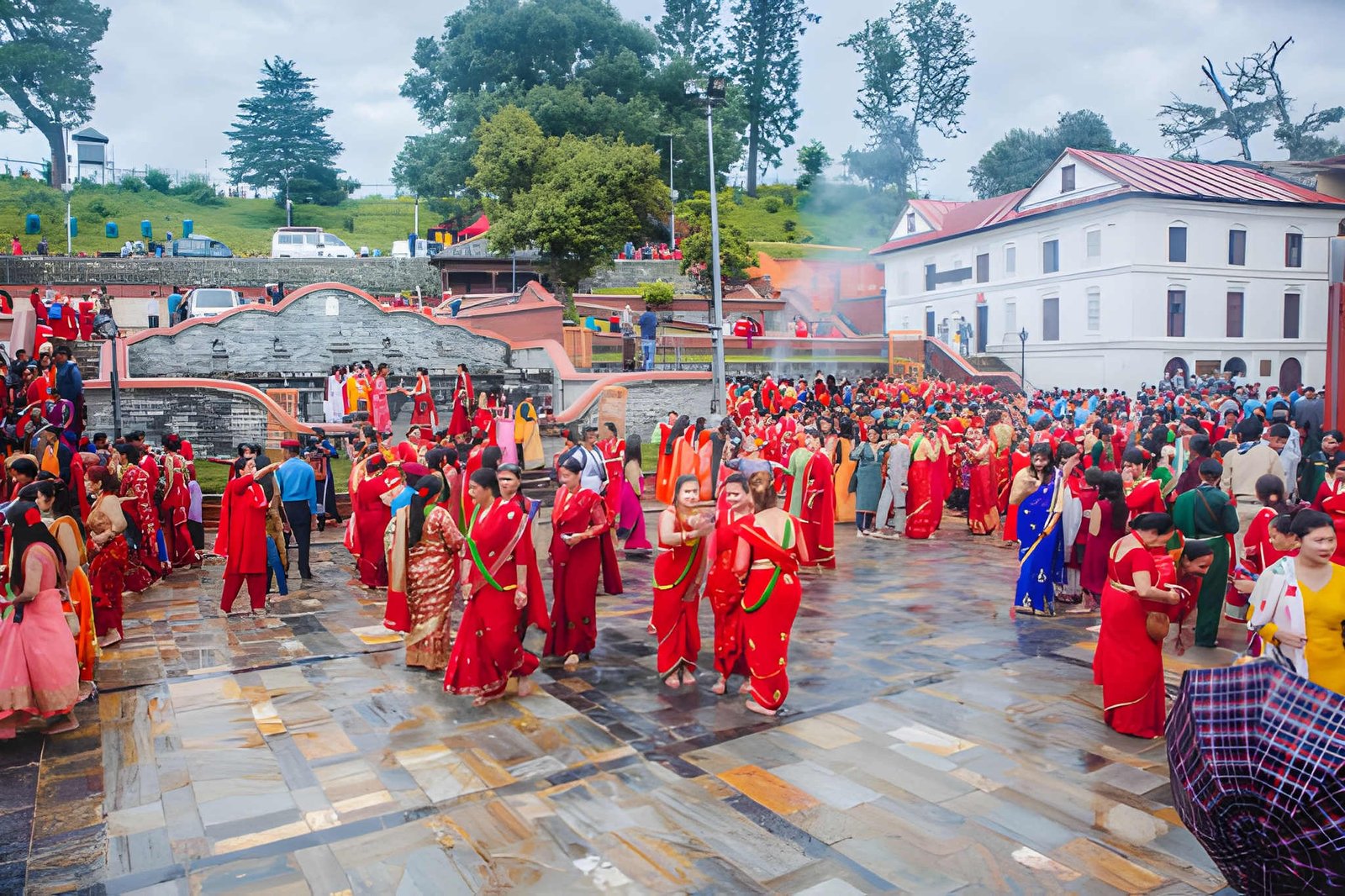
Teej: Women’s Festival
When: August–September
Where: Pashupatinath, Kathmandu; temple courtyards nationwide
A three-day festival dedicated to Goddess Parvati. Women dress in red sarees, gather at temples to pray and sing, observe a day-long fast, and celebrate with dancing that fills the streets. Pashupatinath becomes a sea of red on the main day. One of the most visually extraordinary events in the Nepalese calendar.
Indra Jatra: End of the Monsoon
When: September (8 days)
Where: Kathmandu Durbar Square
An eight-day celebration marking the close of the monsoon. It’s dedicated to Indra, the Hindu god of rain, and features a 36-foot ceremonial pole. There is also a chariot procession of the living goddess Kumari through the old city, masked dances, and the ritual drinking of rice liquor from the Swet Bhairab deity. One of the most spectacular festivals in all of Nepal.
Practical Essentials: What You Need to Know Before You Go
Time your day around the rain.
Sightseeing and trekking in the morning. Museums, restaurants, and cultural sites in the afternoon. The 2–4 hour afternoon rain window is predictable enough to plan around.
Build flight buffer days.
Domestic flights to mountain airstrips (Jomsom, Lukla, Juphal) are routinely delayed or cancelled in monsoon weather. Never connect a mountain flight to an international departure without at least two buffer days in Kathmandu.
Get proper travel insurance.
Medical evacuation insurance is non-negotiable in Nepal’s mountains. Helicopter rescue costs can run into the thousands. Get it before you arrive.
Use a licensed guide.
In monsoon conditions, a licensed local guide is a safety asset, not a luxury. They monitor trail conditions, know landslide risks, and can redirect when situations change. TAAN-registered agencies are the reliable standard, like Far Out Nepal.
Negotiate your rates.
Hotels, trekking agencies, and transport providers are in off-season mode. Discounts of 30–50% vs peak season are standard.
Stay informed on trail conditions.
Check with TAAN and local operators before each leg of a trek. Landslide conditions can shift within 24 hours.
Gear checklist:
- Waterproof jacket (not water-resistant, but waterproof)
- Waterproof trekking boots with ankle support
- Leech gaiters and leech-repellent salt
- Quick-dry clothing (no cotton)
- Trekking poles as they’re essential on wet slopes
- Dry bags for electronics, documents, and cash
- Backpack rain cover
- DEET-based insect repellent
- Extra socks (wool or synthetic, never cotton)
- Basic first aid: ibuprofen, stomach meds, blister kit
- Water purification tablets or a filter
- Lightweight down or fleece for evenings at altitude
Most gear is available cheaply in Kathmandu’s Thamel district. For boots and rain jackets, bring your own tested equipment.
The travelers who’ve been coming to Nepal during the monsoon for years have learned something simple: the season isn’t a problem to be managed. It’s a filter. It removes the tour buses, the overcrowded viewpoints, and the traveler who needs constant sunshine to have a good time. What’s left is Nepal in an unhurried, lush, and honest form.
June through October. The shoulder months, especially. Go when everyone leaves. That’s when Nepal belongs to you. So, book your Nepali Monsoon Trip the best way with Far Out Nepal →