


Annapurna Base Camp Trek

Annapurna Base Camp Trek

Annapurna Base Camp Trek

Annapurna Base Camp Trek

Annapurna Base Camp Trek
Annapurna Base Camp Trek - 13 Days

Activity
Sightseeing & Trekking
Duration
13 Days
Grading
Moderate
Max Altitude:
4,100m. / 13,451ft.
Best Season
Mar- May/ Oct- Nov
Style of Trip
Tea House Trek (Lodge)
Group Size
2-10 People
Accommodation
Hotel & Lodge
Meals
Breakfast, Lunch, Dinner
Why Choose the Annapurna Base Camp Trek?
The Annapurna Base Camp (ABC) Trek stands out as one of Nepal’s outstanding medium grade trek, which provides a complete Himalayan experience. It is well-known for its accessibility, diverse landscapes, and close-up mountain views in a relatively short timeframe. Whether you’re trekking for the scenery, culture, or personal challenge, ABC delivers exceptional value on every level.
- Moderate difficulty, high reward: This is a well-balanced trek having moderate difficulties and fewer altitude challenges, making it ideal for fit beginners and experienced trekkers alike.
- No domestic flights required: Starting from Pokhara means fewer logistical risks, helping you avoid delays and enjoy a smoother, more reliable travel experience.
- Incredible landscape diversity: In just days, the trail transitions from terraced farmlands and rhododendron forests to alpine valleys and glacial grounds near base camp.
- Authentic cultural immersion: Travel through traditional Gurung and Magar villages, such as Ghandruk, where warm hospitality and local lifestyles add a cultural touch to the mountains.
- Rich Himalayan biodiversity: Walk through the Annapurna Conservation Area, home to wildlife such as the Himalayan tahr and vibrant seasonal flora, particularly during the spring.
- Iconic Poon Hill viewpoint: Witness one of Nepal’s most famous sunrises, with panoramic views over the Annapurna and Dhaulagiri ranges.
- Close-up Himalayan giants: Experience rare proximity to towering peaks like Annapurna I (8,091m) and Machapuchare, without the need for extreme altitude trekking.
- The Annapurna Sanctuary finale: End your journey in a natural amphitheater of snow-covered peaks at 4,130m, one of the most gorgeous base camp settings in Nepal.
Trip Introduction
Overview of the Annapurna Base Camp Trek
The Annapurna Base Camp (ABC) Trek is one of Nepal’s most iconic Himalayan journeys, offering a rare combination of accessibility, cultural richness, and dramatic mountain scenery. First opened to trekkers in 1949, it remains a top choice for those seeking a rewarding adventure without the extremes of high-altitude expeditions.
Ideal for beginners with good fitness as well as seasoned trekkers, it delivers breathtaking views without the extremes of high-altitude expeditions. The trek takes you through a spectacular mix of landscapes: from lush terraced farmlands and traditional villages to alpine forests and glacial valleys.
The sense of awe, accomplishment, and connection to both nature and local culture make the ABC trek an experience you’ll never forget. Every step brings a new view, a new village, and a new story, blending adventure, scenery, and culture seamlessly.
Quick Details: Annapurna Base Camp Trek
- Location: Nepal, in the north region of Pokhara
- Distance: ~110 km (round trip, depending on route)
- Difficulty: Moderate. Suitable for beginners with good fitness and experienced trekkers
- Cost: $700–$1,500 (includes guide, permits, and accommodation options; budget to mid-range)
- Best Time to Trek: It can start from March and end around May, then in the fall from mid-October till mid-December
- Trail Type: Well-marked trekking paths with suspension bridges, forests, villages, and alpine terrain
Annapurna Base Camp Trek Itinerary Summary (13 Days)
- Day 1–2: Arrival in Kathmandu + cultural sightseeing tour
- Day 3–4: Fly to Pokhara → trek through Ulleri to Ghorepani
- Day 5: Sunrise hike to Poon Hill → trek to Tadapani
- Day 6–7: Trek through Chhomrong and bamboo forests to Deorali
- Day 8–9: Reach Machhapuchhare Base Camp → Annapurna Base Camp (4,130m)
- Day 10–11: Descend via Sinuwa and Ghandruk → drive to Pokhara
- Day 12–13: Return to Kathmandu → departure
Cost for the Annapurna Base Camp Trek
Knowing the cost upfront helps you budget wisely and pick the experience that fits your style. We will ensure that all expenses, including permits, accommodation, meals, and transportation, are covered. This is also based on the current 2026 trekking packages’ trend from other reputable Nepali operators, average international traveler expectations, and standard inclusions.
Average Cost for International Travelers (USD)
| Package | Accommodation | Meals | Guide | Transport | Permits & Extras | Estimated Cost (USD) |
| Premium | 5-star in Kathmandu, 4-star in Pokhara, attached bathrooms along the trek, where available | Breakfast, lunch, dinner + afternoon tea and light snacks | Senior trekking guide | Private 4WD (4 participants) | Hot water bag from 4,000m, duffel & sleeping bag, ACAP & TIMS permits | $1,400–$1,500+ |
| Standard | 4-star in Kathmandu and Pokhara, with attached bathrooms where available | Breakfast, lunch, dinner | Senior/Junior trekking guide | Private 4WD (4 participants) | ACAP & TIMS permits | $1,000–$1,300 |
| Economic / Budget | Non-star accommodation in Kathmandu, basic lodges along the trek (shared bathrooms) | Set-menu breakfast, lunch, dinner | Junior trekking guide | Shared transport | ACAP & TIMS permits | $700–$900 |
Cost Breakdown
- Permits: $30–$50 (ACAP and TIMS)
- Guide/Porter: $15–$25/day for a guide; $10–$15/day for a porter
- Accommodation: $5–$20/night for budget; $20–$40/night mid-range; premium depends on package
- Food: $5–$15 per meal along the trail; premium packages include full menu + snacks
- Transport: $10–$40 for flights or local transfers; private vehicle included in standard/premium
Things to Consider for Annapurna Base Camp Trek
Before you set out on the Annapurna Base Camp trek, it’s important to be aware of a few key factors that can affect your experience:
- Trail Disruptions: Some sections of the trail are impacted by ongoing road and construction work. While most jeep trails are avoided, a few stretches are unavoidable.
- Seasonal Crowds: The peak trekking months (April, October–December) bring heavy traffic to the trails. Expect busy tea houses and popular viewpoints during these periods.
- Limited Lodging: High-altitude villages within the Annapurna Conservation Area have limited accommodation. During peak season, shared rooms with 3–4 people are common.
- Weather Dependency: Weather in the Himalayas can change rapidly, even during ideal trekking seasons. Be prepared for sudden temperature drops or rain.
- Winter Challenges: Snow, ice, and potential avalanches can make certain trail sections impassable during early spring and winter months. Proper gear and local guidance are essential.
Detail itinerary of Annapurna Base Camp Trek
Day 01: Arrival in Kathmandu
Upon arrival at Tribhuvan International Airport, you’ll be warmly greeted by our Far Out representative and escorted to your hotel in Kathmandu. After check-in, a short trip briefing will be conducted, including a review of your personal trekking gear by our experts to ensure everything is ready for the adventure ahead.
The afternoon and evening are free for you to relax, explore the city, or enjoy local cuisine before the trek officially begins.

Activity: Arrival Transfer : Approx 30 minutes

Location: Kathmandu

Max. Altitude: 1,300m/4,265ft.

Accommodation: Hotel

Meal: NA
Day 02: Kathmandu: Sightseeing Tour in and Around the Valley
After breakfast, get ready for our guided Kathmandu day tour. Your city guide will pick you up and take you first to Swayambunath Stupa or “The Monkey Temple,” perched atop a hill on the western edge of Kathmandu Valley. This iconic Buddhist site is where Nepal was born; it is over 2000 years old and offers panoramic views of the valley below.
Next, visit Patan, also known as the City of Fine Arts, located 7 km southeast of Kathmandu. Explore its enchanting palaces, artistic courtyards, and pagoda-style temples, many of which date back to the 15th–17th centuries and reflect a rich blend of Hindu and Buddhist heritage.
This Kathmandu day tour not only immerses you in Nepal’s cultural and religious history but also serves as an excellent introduction before your trek begins.
Activity: Sightseeing Tour : 04 hours
Location: Kathmandu
Max. Altitude: 1,300m/4,265ft.
Accommodation: Hotel
Meal: Breakfast
Day 03: Fly to Pokhara | Drive and Trek to Ulleri
In the early morning after breakfast, you will head to the airport around 6:30 AM for a 25-minute flight to Pokhara (827m). After arriving, you will collect your baggage and be driven approximately 2 hours to the trek starting point, Tirkhedunga. The route passes through Nayapul and Birethanti, with terraced farms lining the Bhurungdi Khola. Some stretches are off-road, adding a touch of adventure before you reach Tirkhedunga.
After a short rest and arranging your luggage for porters, the trek begins. You will cross the Bhurungdi Khola, then ascend the famous stone staircase of Ulleri, consisting of roughly 3,300 steps. Along the way, you can enjoy intermittent views of Annapurna South (7,219 m) and Hiunchuli Mountain, giving you your first real taste of the stunning Himalayan scenery.
Overnight stay will be in Ulleri, a traditional Magar village offering a cozy introduction to high-altitude trekking accommodations.
Activity: Flight : 25 minutes + Drive 3 hours + Trek 4 hours
Location: Ulleri
Max. Altitude: 2,080m/6,824ft.
Accommodation: Lodge
Meal: Breakfast, Lunch, Dinner
Day 04: Trek to Ghorepani
After breakfast, you will begin a gentle climb through pastures and cultivated fields, eventually entering a deep forest leading to Banthanti. The trail continues through magnificent oak and rhododendron forests, crossing two sparkling streams before reaching Nangathanti (2,450 m).
From here, you will trek for about an hour to Ghorepani, a charming village with breathtaking panoramic views of Dhaulagiri I, Tukuche, Nilgiri, and Annapurna I. For an even higher vantage point, we will have a short 10-minute walk to Upper Ghorepani (2,870 m). Here you will also have access to more lodges, an internet café, and a police post.
In spring, the hillsides below are adorned with vibrant rhododendron blooms, Nepal’s national flower, adding bursts of color to your Himalayan scenery.
Activity: Trekking : Approx. 4 hours
Location: Ghorepani
Max. Altitude: 2,870m/9,416ft.
Accommodation: Lodge
Meal: Breakfast, Lunch, Dinner
Day 05: Trek to Tadapani via Poon Hill
We will start the day with an early morning climb to Poon Hill (3,193 m), which is about an hour away from Ghorepani. If the weather is clear, this vantage point offers a breathtaking sunrise over the snow-capped Himalayas, including:
- Dhaulagiri I (8,167 m)
- Tukuche (6,920 m)
- Nilgiri (6,940 m)
- Annapurna South
- Annapurna I (8,091 m)
- Hiunchuli (6,441 m)
- Tarke Kang (7,193 m)
You can spend around an hour soaking in the views and clicking their pictures, before descending back to Ghorepani for breakfast.
After breakfast, we collect our bag then our journey continues to our next destination, Tadapani, for an overnight stay. The trail first descends to Banthanti (2,606 m) over approximately 2½ hours, then winds through lush rhododendron forests, with gentle ups and downs along the way.
Upon arrival in Tadapani, you can enjoy a peaceful overnight stay there. On clear days, the village offers stunning sunset views of the Himalayas, making it a perfect spot to relax and reflect on the trek so far.
Activity: Trekking : Approx. 07 hours
Location: Tadapani
Max. Altitude: 2,590m/8,497ft.
Accommodation: Lodge
Meal: Breakfast, Lunch, Dinner
Day 06: Trek to Sinuwa
Today’s trek spans roughly 7 hours. The trek begins with a downhill trail through rhododendron forests to the traditional Gurung village of Gurjung. In spring, the area bursts with vibrant rhododendron blooms, creating a spectacular, colorful landscape.
The trail then ascends along the west bank of the Modi Khola, offering intermittent views of Annapurna South, Hiunchuli, and Machhapuchhare. After passing the settlement of Chhomrong, the path descends to Chhomrong Khola. You will cross the river via a suspension bridge before slowly ascending along a rocky trail to Sinuwa, where you’ll spend the night.
This section combines lush forests, traditional villages, and iconic Himalayan vistas, making it a highlight of the Annapurna Base Camp journey.
Activity: Trekking: Approx. 07 hours
Location: Sinuwa
Max. Altitude: 2,340m/7,677ft.
Accommodation: Lodge
Meal: Breakfast, Lunch, Dinner
Day 07: Trek to Deorali
We will continue ascending through rhododendron forests adorned with orchids and ferns, offering a vibrant and fragrant landscape. The trail then descends steeply along slippery stone steps into a deep bamboo and rhododendron forest, passing through Bamboo and onward to Dovan.
From Dovan, the path begins a steady ascent, crossing streams, avalanche chutes, and dense forest before climbing a steep ravine to Hinko Cave. After navigating the remnants of a glacier and climbing over large boulders, you’ll reach Deorali (3,140 m) for an overnight stay.
The trail is very sensational, featuring lush green forests, cascading waterfalls, massive boulders, towering trees, diverse birdlife, and breathtaking mountain views, making it one of the most scenic days of the trek.
Activity: Trekking : Approx. 7 hours
Location: Deorali
Max. Altitude: 3,100m/10,171ft.
Accommodation: Lodge
Meal: Breakfast, Lunch, Dinner
Day 08: Trek to Machhapuchhare Base Camp (MBC)
Today’s trek is shorter in distance but higher in elevation, decreasing the stress on your legs while gaining altitude. After breakfast, we will follow a gentle trail through a wide valley, offering your first glimpses of the entrance to the Annapurna Sanctuary.
The path then ascends along the east side of the valley, passing through a mix of bamboo and birch forests. You will trek further across avalanche-prone trails and sparse birch groves until reaching Machhapuchhare Base Camp (MBC).
From here, you can enjoy fantastic panoramic views of the surrounding Himalayan peaks, making it one of the most memorable stops on the Annapurna Base Camp trek.
Activity: Trekking : Approx. 2 hours
Location: Macchapuchare Base Camp
Max. Altitude: 3,700m/12,139ft.
Accommodation: Lodge
Meal: Breakfast, Lunch, Dinner
Day 09: Trek to Annapurna Base Camp & Descend to Dovan
We will start the day early with a steep 2-hour climb to reach the Annapurna Base Camp (4,130 m). The trail winds along the lateral moraine above the glacier, then descends slightly toward the base of the ice.
At Annapurna Base Camp, you can enjoy incredible views of the southern face of Annapurna and the surrounding snow-capped peaks. A short walk takes you to a west-side viewpoint draped with colorful prayer flags, offering a truly breathtaking panorama over the glacier.
After soaking in the scenery, begin a gradual descent to Dovan for an overnight stay, retracing parts of the trail and enjoying the changing perspective of the Annapurna Sanctuary.
Activity: Trekking : Approx. 7 hours
Location: Dovan
Max. Altitude: 2,500m/8,202ft.
Accommodation: Lodge
Meal: Breakast, Lunch, Dinner
Day 10: Trek to Chhomrong
After enjoying one last stunning morning view of the mountains, you will begin your descent along the same trail. The path passes through Sinuwa Danda before continuing downward to Chhomrong, a picturesque village at the base of Hiunchuli.
We will stay in Chhomrong, which gives you a chance to rest and reflect on your trek while surrounded by the serene Himalayan landscape.
Activity: Trekking : Apprx. 5 hours
Location: Chummrung
Max. Altitude: 2,170m/7,119ft.
Accommodation: Lodge
Meal: Breakfast, Lunch, Dinner
Day 11: Trek to Ghandruk & Drive to Pokhara
The day begins by heading back to the main trail intersection before turning west through scenic fields and farmland. We will then descend sharply to Kimrung, cross a bridge, and ascend through the forest to reach the summit of Kumrong Danda (2,220 m). From here, a gentle descent leads you to the bridge trail that turns east toward Ghandruk (1,900 m), one of Nepal’s largest Gurung villages.
The majestic peaks of Annapurna South (7,219 m) and Hiunchuli (6,441 m) tower over the slate-roofed houses and terraced fields, providing a dramatic Himalayan backdrop perfect for photography.
After lunch and some time exploring the village, you will continue down to Kimchi, where a vehicle will take you back to Pokhara. The drive takes approximately 2½ hours, beginning on rough roads before transitioning to paved roads. You will then stay the night in Pokhara.
Activity: Trekking : Approx. 4 hours + 3 Hours drive
Location: Pokhara
Max. Altitude: 900m/2,953ft.
Accommodation: Hotel
Meal: Breakfast, Lunch
Day 12: Fly Back to Kathmandu
You can enjoy a leisurely morning in Pokhara: taking time to relax, explore the lakeside, or grab a final coffee with Himalayan views. Later, you can catch a short flight back to Kathmandu. After arriving, you’ll be transferred to your hotel for check-in and overnight stay, marking the conclusion of your Annapurna Base Camp adventure.
Activity: Free Day
Location: Pokhara
Max. Altitude: 900m/2,953ft.
Accommodation: Hotel
Meal: Breakfast
Day 13: Departure
After an unforgettable Annapurna Base Camp trek, it’s time to say goodbye to Nepal. Our team will transfer you to Tribhuvan International Airport for your onward journey home, carrying with you incredible memories of the Himalayas.
Activity: Airport transfers
Location: Kathmandu
Max. Altitude: 1,300m/4,265ft.
Accommodation: Hotel (Check In Before 12 Noon)
Meal: Breakfast
Departures Dates
Need assistance with booking your trip? Inquire Now
Inclusions in Annapurna Base Camp Trek
- 03 nights twin sharing accommodation in a 3 Star category of hotels on BB basis in Kathmandu
- Sightseeing tour in Kathmandu Valley with the support of local guide, private transportation, entrance fee
- 08 nights/09 days Annapurna Base Camp
- Support of Guide and a porter
- Simple accommodation (common bathroom/toilet) in a sharing basis during trekking
- Set Meals (Breakfast, Lunch and Dinner)
- Transportation from Airport (Pokhara) to Naya Pul and then back to Pokhara
- TIMS card (Permit)
- Conservation Park Ticket
- 1 night twin sharing accommodation in a 3 Star category on BB basis in Pokhara
- Arrival/departure transfers
- Duffel Bag
- Insurance for our staff
- Basic First Aid kit
Trip Excludes
- Nepali Visa
- Meals: Lunch and Dinner in Kathmandu
- Flight fare KTM/PKR/KTM
- Personal trekking gears
- Insurance covering accidental, medical, travel and helicopter rescue in case of emergency
- Extra expenses of personal nature, internet, phone etc.
- Any extra incurred in case of flight cancellation, medical problem, epidemics, political turmoil
- Anything not mentioned in the Includes Box
- Tips expected but not a mandatory
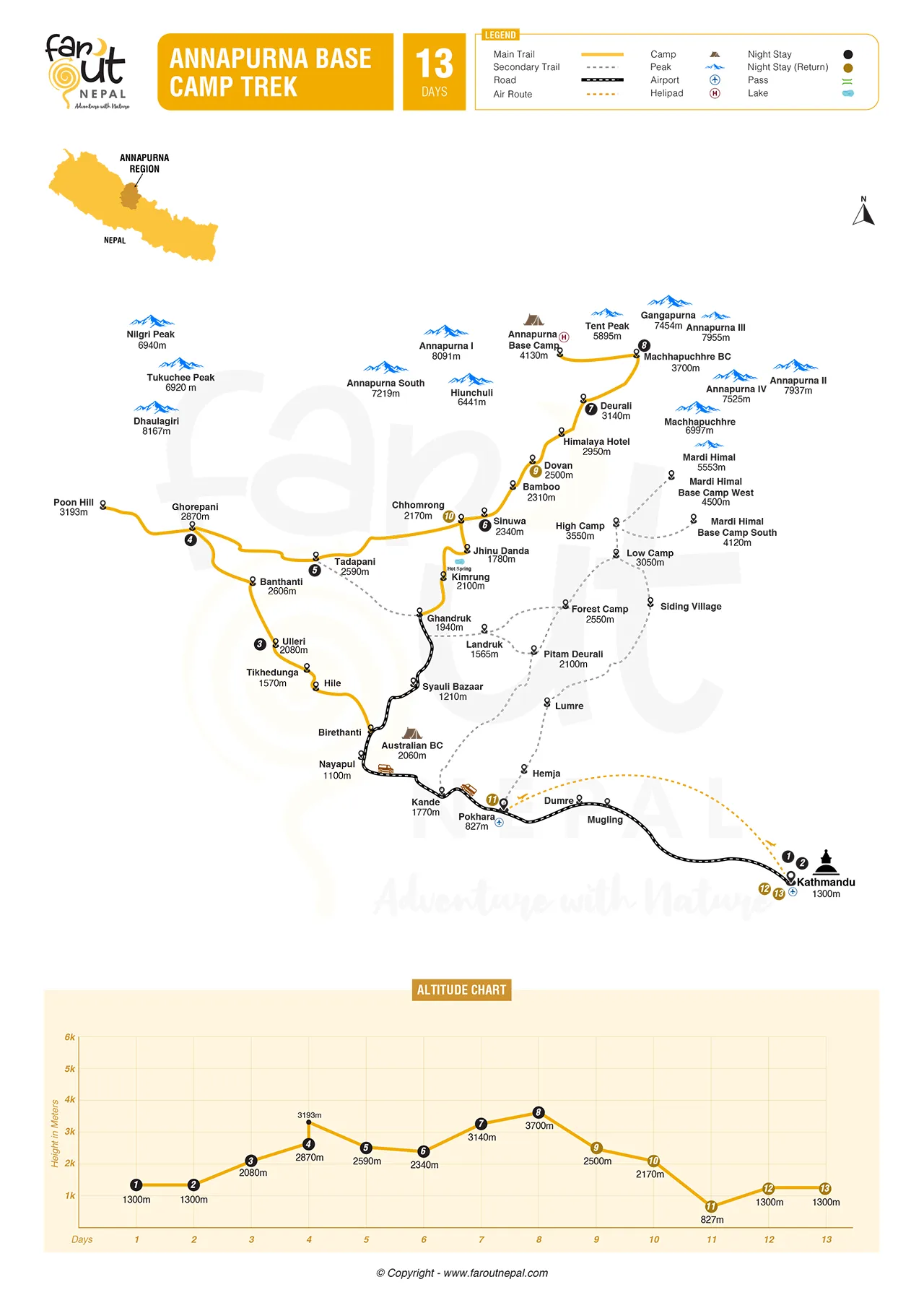
Trip map of Annapurna Base Camp Trek
Trip Information
Annapurna Base Camp Trek Duration
13 Days (9 Days Trek + 3 Nights in Kathmandu + 1 Night in Pokhara)
On average, you will be walking 5 to 7 hours per day, depending on the itinerary and pace. For shorter days, it’s usually 3–4 hours, with some acclimatization or high-altitude sections. During the longer days, the time can extend from 6 to 7+ hours, especially during the ascent and descent phases.
How Difficult is the Annapurna Base Camp Trek?
The Annapurna Base Camp (ABC) Trek is considered a moderate-level trek, making it achievable for beginners with good fitness while still rewarding for experienced hikers.
The trail includes frequent ascents and descents, stone staircases (like Ulleri’s 3,000+ steps), forest paths, and suspension bridges.
Trekkers gradually ascend to a maximum altitude of 4,130 meters (13,550 ft), with daily elevation gains of up to 600–700 meters and occasional steep descents exceeding 1,000 meters.
It doesn’t require technical climbing, but it does demand consistent walking, stamina, and mental resilience due to daily elevation changes and long trekking hours.
Who Should (and Should NOT) Do This Trek
This trek is ideal for:
- Beginners with a good fitness level and preparation
- Hikers looking for a non-technical Himalayan experience
- Travelers who want stunning mountain views without extreme altitude risk
This trek may NOT be suitable for:
- Those with limited fitness or no hiking experience
- Travelers uncomfortable with long walking days (5–7 hours)
- Individuals who are sensitive to altitude without proper acclimatization
Is the Annapurna Base Camp Trek Safe?
Yes, the ABC trek is considered safe and well-established, with clearly marked trails and regular tea house accommodations. However, like any Himalayan trek, it comes with risks such as altitude sickness, weather changes, and trail conditions.
With proper planning, a qualified guide, and gradual acclimatization, most trekkers complete the journey safely and successfully.
Altitude & AMS on the Annapurna Base Camp Trek
At 4,130 meters, altitude is a key factor to consider on the Annapurna Base Camp trek. While the risk of altitude sickness exists, a well-paced itinerary, including acclimatization stops like Ghorepani and Poon Hill (3,200m), significantly reduces the chances for most trekkers.
Common Symptoms of altitude sickness include headache, shortness of breath, difficulty sleeping, fatigue, and loss of appetite. If you experience symptoms, inform your guide immediately and avoid further ascent. The most effective response is to descend to a lower altitude.
How to Prevent Altitude Sickness
- Ascend gradually and follow a proper itinerary
- Stay well hydrated and eat regularly
- Walk at a steady, manageable pace
- Avoid smoking and alcohol at higher elevations
For a complete guide on symptoms, medication, and prevention, read our detailed article on altitude sickness during trekking.
Preparation for the Annapurna Base Camp Trek
Proper preparation is key to enjoying the Annapurna Base Camp trek safely and comfortably. With the right mindset and physical training, even first-time trekkers can complete this journey successfully.
Mental Preparation
- Assess if this trek aligns with your fitness level and expectations
- Get a basic health check-up, especially if you have pre-existing conditions
- Build mental resilience for long trekking days and changing conditions
- Stay patient and flexible, as weather and trail conditions can vary
Physical Preparation
Start training at least 3–4 months before your trek to build endurance and strength.
- Hiking: Walk 8–12 km regularly with a 5–15 kg backpack
- Stair Climbing: Practice uphill endurance by increasing intensity gradually
- Incline Training: Use a treadmill with a 10–15% incline for 45–60 minutes
- Cross Training: Activities like cycling, swimming, and jogging improve stamina
- Gear Practice: Break in your trekking boots to avoid blisters on the trail
Best Time to Trek the Annapurna Base Camp
Choosing the right season directly impacts your views, trail conditions, and overall experience on the Annapurna Base Camp trek.
- Autumn (Mid-October to Mid-December) – Best overall season
The fall season provides stable weather, crystal-clear skies, and the best mountain visibility. This is also considered the peak trekking season, so expect lively trails and full tea houses. - Spring (Mid-March to End of May) – Scenic and colorful
Spring brings comfortable temperatures with blooming rhododendrons across the hills. Slight haze and occasional rain may affect long-distance views. - Winter (January–February) – Quiet but cold
Winter observes fewer crowds and clear skies, but freezing temperatures and snow can make higher sections challenging. - Monsoon (June–September) – Not recommended
Heavy rainfall, leeches, landslides, and poor visibility make trekking difficult and less enjoyable.
Getting to the Annapurna Base Camp Trek
Getting to the trailhead is straightforward and adds to the overall adventure.
- Flight to Pokhara: A scenic 25–30 minute flight from Kathmandu, offering stunning Himalayan views
- Drive to Trailhead: From Pokhara, a 2–3 hour drive to Hille or Tirkhedhunga (depending on road access)
- Road Conditions: Some sections are rough/off-road with landslides’ potential during rain, but routes are improving each year
- Baggage Allowance: Typically up to 23 kg per person on domestic flights
Pro Tip: Starting from Pokhara saves time, reduces cost, and avoids unnecessary travel fatigue.
Annapurna Base Camp Trek Support Team
A strong support team can significantly improve your trekking experience, especially at higher altitudes.
- Guide:
- Government-licensed, English-speaking
- Experienced in navigation, altitude awareness, and emergency response
- Provides cultural insights and handles logistics
- Porters:
- One porter per two trekkers
- Carries up to 30 kg total (15 kg per person)
- Allows you to trek comfortably with just a daypack
Do You Need a Guide for the Annapurna Base Camp Trek?
Well, it’s not mandatory, but highly recommended.
You can Trek Without a Guide If:
- You have prior trekking experience
- You are confident navigating trails independently
- You’re comfortable managing logistics (permits, accommodation, route planning)
You should consider a Guide If:
- This is your first Himalayan trek
- You’re concerned about altitude sickness or safety
- You want a stress-free, well-organized experience
- You value local insights, culture, and smoother logistics
Why Most International Trekkers Choose a Guide
- Safety: Immediate support in case of altitude sickness or emergencies
- Navigation: Avoid wrong turns, especially in remote or changing trail sections
- Logistics: No need to worry about permits, rooms, or route planning
- Experience: Learn about local culture, villages, and mountains along the way
For most international travelers, hiring a guide (and optionally a porter) is the best choice. It transforms the trek from a logistical challenge into a fully immersive Himalayan experience, allowing you to focus on the journey rather than the details.
Accommodation on the Annapurna Base Camp Trek
Understanding what to expect on the trail helps you prepare better and trek more comfortably. While facilities are basic at higher altitudes, they are reliable and part of the authentic Himalayan experience.
Accommodation (Tea Houses & Lodges)
- Tea houses and lodges are available throughout the route, with better facilities at lower elevations.
- Attached bathrooms may be available in lower regions; higher up, expect shared toilets.
- During peak season, shared rooms (3–4 trekkers) are common
- Electricity and solar lighting are available, but may be limited at higher altitudes
- Extra charges apply for hot showers, WiFi, and device charging
- Lodges provide blankets and pillows, but bringing a sleeping bag is strongly recommended
Insight: Comfort decreases slightly with altitude, but the views and experience increase dramatically.
Food & Water
- Meals are simple, filling, and carb-focused (mix of Nepali, Indian, Chinese, and Western cuisines)
- Vegetarian options are widely available and safer at altitude
- Drink 2–3 liters of water daily
- Use filtered or purified water instead of bottled water
- Avoid raw salads and meat at higher altitudes to reduce the risk of stomach issues.
- Carry a reusable bottle with purification; it’s cheaper, safer, and eco-friendly.
What to Expect on the Annapurna Base Camp Trek
Trek Group Size
We recommend small group sizes (2–10 trekkers) to ensure a more personalized and enjoyable experience. Smaller groups allow for better pacing, flexibility, and closer interaction with your guide, especially on varied terrain and at higher altitudes.
What a Typical Trekking Day Looks Like
A typical day on the Annapurna Base Camp trek follows a steady, well-paced routine designed for both comfort and acclimatization:
- 6:00 AM: Wake-up call with tea or coffee
- Morning: Breakfast, pack up, and begin trekking by 7–8 AM
- Midday: Trek 3–4 hours → lunch at a lodge along the trail
- Afternoon: Continue trekking for another 2–3 hours
- Late Afternoon: Arrive at the lodge, rest or explore nearby areas
- Evening: Dinner served around 6–7 PM
- Night: Early rest (around 9 PM) to recover for the next day
Trekking Equipment for ABC
Weather in the Himalayas can change quickly, especially at higher elevations, so proper gear is essential for safety and comfort.
- A complete packing checklist will be provided after booking
- Most trekking gear can be rented or purchased in Kathmandu
- Focus on layered clothing, good trekking boots, and essentials
You don’t need to bring everything; many quality gear options are available locally. Check our guide on the gears required for trekking in Nepal.
Health, Safety & Practical Tips for ABC
Health & Medical
- Pre-trek check-up: See your doctor 6–8 weeks before departure and discuss vaccinations (hepatitis, typhoid, and routine immunizations).
- On the trek: Basic medical facilities exist in major towns, but remote areas have limited care. Serious emergencies may require evacuation.
- Food & water: Stick to bottled or boiled water and cooked meals to avoid waterborne illnesses.
First Aid
- Carry personal medications and prescriptions. Some medicines may be unavailable or restricted in Nepal.
- A small first aid kit with essentials like painkillers, bandages, and altitude sickness medication is highly recommended.
Electricity & Connectivity
- Most lodges offer electricity or solar charging, though outages are common. Bring a power bank or solar charger as backup.
- Mobile networks and Wi-Fi are generally available, but the signal can be patchy in remote areas.
Tip: Keeping things light and simple improves focus on the trek itself and avoids information overload for travelers.
Insurance, Visa & Permits for Annapurna Base Camp Trek
Trekking Insurance
Insurance is mandatory for the Annapurna Base Camp trek due to the high-altitude terrain and potential emergencies. At a minimum, your policy should cover:
- Emergency medical treatment and accidents
- Emergency helicopter evacuation
- Travel cancellations
- Theft or loss of property
Tip: Check out our dedicated Himalayan Trekking Insurance Guide for recommended providers and coverage details.
Nepal Visa Requirements
All international travelers need a visa to enter Nepal. You can obtain one on arrival at Tribhuvan International Airport or apply online in advance. You may also fill out the online visa application at immigration.gov.np before your arrival.
Requirements:
- Passport valid for at least 6 months
- One passport-size photo
- Visa fee in US dollars
Visa Fees:
- 15 Days – USD $30
- 30 Days – USD $50
- 90 Days – USD $125
For detailed steps and tips, see our Nepal Visa Guide.
Trekking Permits for Annapurna Base Camp
To trek ABC, you’ll need:
- TIMS Card (Trekking Information Management System)
- Annapurna Conservation Area Permit (ACAP)
Documents required:
- Passport scan
- Four passport-size photos
- Insurance details
- Emergency contact information
Pro Tip: We handle all permit arrangements for you, so you can focus on enjoying the trek safely.
Your ABC Adventure with Far Out Nepal Awaits
The Annapurna Base Camp trek is more than just a hike; it’s an immersion into Nepal’s natural beauty, culture, and Himalayan grandeur. From terraced villages and blooming rhododendrons to panoramic peaks like Annapurna I and Machhapuchhare, every step offers breathtaking views and unforgettable memories.
While the trail comes with challenges (weather, calamities, or political unrest), proper preparation, guidance, and a flexible mindset make this trek rewarding for both first-time trekkers and seasoned adventurers.
Ready to take the first step? Let us help you plan a safe, seamless, and inspiring Annapurna Base Camp journey. Book your trek today and experience the magic of the Himalayas like never before.
Reviews on Annapurna Base Camp Trek
Special Savings and Discounts for Group Travelers!
-
1 person
US$ 1800
-
2 -
3 person
US$ 1430
-
4 -
5 person
US$ 1295
-
6 -
9 person
US$ 1250
-
10 over
9999
US$ 1200
US$ 1800