


Central Tibet Tour

Central Tibet Tour

Central Tibet Tour

Central Tibet Tour

Central Tibet Tour
Central Tibet Tour - 08 Days

Activity
Tour
Duration
08 Days
Grading
Moderate
Max Altitude:
5,045m. / 16,552ft.
Best Season
April-June & September-October
Style of Trip
Spiritual, Cultural, Nature
Group Size
2-10 People
Accommodation
Hotel/Resort/Guest House
Meals
Breakfast
Why Central Tibet Tour ?
- Comprehensive 8-day Central Tibet Tour itinerary covering Tibet’s most significant spiritual, cultural, and natural landmarks.
- Visit Yarlung Valley, the mythical origin of Tibet
- Yamdrok Lake, one of Tibet’s holiest lakes
- Gyantse, a once-thriving trade town
- Xigatse, the seat of the Panchen Lama
- Lhasa, the spiritual and political heart of Tibet.
- Marvel at the iconic Potala Palace, meditate at Jokhang Temple, and immerse yourself in Tibetan monastic life and customs.
- Enjoy seamless travel arrangements, from permit processing to hotel stays and guided tours.
- Another technical benefit of Central Tibet tour is that this excursion begins at 3100 meters and lasts for two nights, giving your body time to adjust to the elevation before proceeding to further higher elevation.
Trip Introduction
Central Tibet Tour: Exploring the Heart and Soul of Tibet
Tibet, often referred to as the “Roof of the World,” boasts a rich cultural legacy spanning over 4,000 years. It is the birthplace of the Zang language, the ancient Bon religion, and Tibetan Buddhism. This high-altitude land is revered for its deeply spiritual traditions, where time-honored rituals such as sky burials, pilgrimage prostrations, and kora (circumambulation of sacred sites) remain an active part of everyday life.
With a unique blend of ancient Bon and Buddhist practices, Tibet is home to sacred monasteries, temples, and holy lakes—each echoing stories of faith, devotion, and enlightenment. Alongside its spiritual charm, Tibet offers an awe-inspiring natural canvas: from vast plateaus and mystical valleys to crystal-clear alpine lakes and towering snow-capped peaks.
Overview: Central Tibet Tour
The Central Tibet Tour is a curated 8-day itinerary focused on exploring the cultural and spiritual nucleus of Tibet. This central region, often regarded as the cradle of Tibetan civilization, is home to the most revered monasteries, vibrant towns, breathtaking landscapes, and legendary lakes.
Here, you’ll witness fluttering prayer flags atop high mountain passes, emerald, blue lakes that shimmer with divine energy, and humble villages where Tibetan hospitality meets centuries-old traditions. From ancient temples to panoramic Himalayan vistas, this journey offers a once-in-a-lifetime experience into Tibet’s sacred soul.
Whether you start your journey from Kathmandu or the Chinese mainland, we ensure all travel logistics—from Tibet Travel Permits to comfortable accommodation and expert local guides—are handled smoothly.
Tip: Central Tibet tour starting from Kathmandu offers a unique advantage. While waiting for your China visa and Tibet travel permit (which takes approximately 4 working days), you can explore Nepal’s spiritual sites, ancient palaces, and UNESCO heritage temples.
Highlights: Central Tibet Tour
Yarlung Valley – Birthplace of Tibetan Civilization
The Yarlung valley nestled in the fertile basin of southern Tibet is the birthplace of Tibetan civilization. Exploring Yarlung offers insight of Tibet’s earliest roots. It’s a region with history, myth, spirituality and breath-taking landscapes. Central Tibet tour will start by unfolding the birthplace of Tibetan civilization.
Key Attractions:
- Yumbulakhang Palace: The first Tibetan palace built by King Nyatri Tsenpo, said to have been constructed on the spot where the earliest Buddhist scriptures descended from the sky.
- Tradruk Monastery: Among Tibet’s oldest monasteries, dating back to the 7th century under King Songtsen Gampo. Famous for its pearl Thangka depicting Avalokiteshvara (Chenrezig), this sacred relic is a symbol of compassion. It is also among the twelve geomantic temples, Tradruk is the oldest significant one after the Jokhang.
- Chongye Valley & Burial Mounds: Final resting place of ancient Tibetan kings, this site preserves evidence of pre-Buddhist Bon culture, including unique burial traditions and sacrificial rites once performed by Bon priests.
- Samye Monastery:Built in the 8th century, Samye was the first Buddhist monastery in Tibet, designed as a mandala representing the universe. Influenced by the Indian University of Odantapuri, it blends Indian, Tibetan, and Chinese architectural elements and is a cornerstone of Tibetan Buddhist education and practice.
Lhasa – The Spiritual & Cultural Heart of Tibet
Lhasa the holy city of Tibet at an altitude of 3,656m has a history of over 13 centuries, it is regarded as the highest city in the world. It is the political, economic and spiritual center of Tibet. Central Tibet tour will take you to explore this beautiful city.
- Explore the world-famous Potala Palace, a UNESCO World Heritage Site and former residence of the Dalai Lama.
- Stroll through the bustling Barkhor Street, a lively marketplace where locals perform the sacred kora.
- Visit the revered Jokhang Temple, Tibet’s most sacred Buddhist site.
- Witness the famous monk debates at Sera Monastery and experience the monastic life at Drepung Monastery.
- Admire the breathtaking views of Karo La Glacier and the turquoise waters of Yamdrok Lake with snowy peaks at the backdrop.
- Enjoy an authentic Tibetan lunch with a local family.
Gyantse – Tibet’s Third Largest City and an Ancient Trading Center
Gyantse was once the third largest city of Tibet. It’s a historical, cultural city and ancient trade city of Tibet. It is located in the Nyang Chu valley, 260 km to the southwest of Lhasa and 90 km to the southeast of Shigatse.
- Ancient trade center
- Heroic City who baffled the British Troops
- Renowned monasteries Phalkor Chode, known for its architectural grandeur
- Ancient forts
- Famous for horse racing festivals.
- Beautiful villages enroute
Xigatse – Tibet’s Second-Largest City
Second largest city in Tibet and the capital of the Tsang province, Shigatse stands as a gateway to ancient traditions and modern connectivity. It is the traditional seat of Panchen Lama, one of the spiritual leaders in Tibet.
- Visit the Tashilhunpo Monastery, the seat of the Panchen Lama, Tibet’s second-highest spiritual figure.
- Discover local markets filled with Tibetan handicrafts, traditional art, and souvenirs.
Important Considerations: Central Tibet Tour
- While the Central Tibet Tour is an unforgettable journey, travelers must be prepared for the high-altitude environment. Much of the region lies above 3,100 meters, with some passes reaching up to 5,045 meters.
- Altitude sickness can affect even healthy individuals and typically occurs above 2,500 meters. Symptoms include headaches, nausea, and dizziness. Travelers with heart or lung conditions, or other long-term health concerns, should consult a physician before booking.
- Visa Note: Group travel is required to obtain the Tibet travel permit. A minimum of 4 participants is necessary for processing the group visa.
Conclusion: Central Tibet Tour Journey
Your 8-day journey through Central Tibet Tour has been a profound spiritual and cultural experience, marked by:
- Historic Monasteries: From Samye to Tashilhunpo, each monastery revealed layers of Tibetan Buddhist history, architecture, and monastic life.
- Iconic Landmarks: The Potala Palace and Jokhang Temple stand as timeless symbols of Tibetan identity and devotion.
- Natural Wonders: Scenic high passes, holy lakes like Yamdrok-tso, and glacier views added awe to the road journeys.
- Cultural Immersion: Wandering through old market streets of Gyantse and Lhasa offered authentic glimpses into Tibetan life.
- Philosophical Depth: The monastic debates at Sera Monastery provided a fascinating window into the intellectual traditions of Tibetan Buddhism.
Central Tibet tour not only connects you with sacred spaces and legendary sites but also left you with a deeper appreciation of Tibet’s resilient culture, timeless spirituality, and stunning natural beauty.
Let these memories stay with you long after you leave the “Roof of the World.”
Detail itinerary of Central Tibet Tour
Day 01: Fly to LHASA (3650m) – Drive to TSEDANG (3100m)
Central Tibet Tour starts with a panoramic mountain flight to Gonggar Airport which takes around one and half hour flight offering incredible aerial views of the Himalayas, including Kanchenjunga, Makalu, and Mount Everest, weather permitting.
Upon arrival at Gonggar Airport (Lhasa), finish your immigration formalities then meet your guide after a scenic 1.3-hour drive (120 km) takes you to Tsedang, a calm town in the Yarlung Valley. Rest of the day of Central Tibet Tour is reserved for acclimatization.

Activity: Flight 1.5 hours + 1.3 hours drive to Tsedang

Location: Tsedang

Max. Altitude: 3,100m/10,171ft.

Accommodation: Hotel
Day 02: Explore TSEDANG
Your Central Tibet tour begins with an unforgettable journey into the birthplace of Tibetan civilization, where history, spirituality, and legend come alive.
The day starts with a visit to Yumbulakhang Palace, a dramatic hilltop fortress overlooking the scenic Yarlung Valley. Known as the first palace in Tibet, it carries a mystical charm—locals believe it descended from heaven. The panoramic views and peaceful surroundings make it a truly special introduction to the region.
You then continue to Tradruk Monastery, one of Tibet’s oldest monasteries dating back to the 7th century. This sacred site predates many of Lhasa’s famous landmarks and is home to a rare pearl Thangka, offering a deep connection to early Tibetan Buddhism and spiritual heritage.
Later, explore the ancient Chongye Valley Tombs, where vast burial mounds of early Tibetan kings stand against a dramatic landscape. This site offers a glimpse into Tibet’s royal past and the fascinating pre-Buddhist Bon culture.
Return to Tsedang for an overnight stay, carrying with you the essence of Tibet’s rich history and timeless traditions.
Activity: Tour : approx. 6 hours
Location: Tsedang
Max. Altitude: 3,100m/10,171ft.
Accommodation: Hotel

Meal: Breakfast
Day 03: Drive to GYANTSE via YAMDROK LAKE
Next day of your Central Tibet tour takes you to Samye Monastery, the first monastery ever built in Tibet, dating back over 1,200 years. Located 40 km west of Tsedang, across the Tsangpo River, this sacred site marks the dawn of Tibetan Buddhism.
Then scenic drive continues as you ascend Khamba La Pass (4,794m), where you’ll pause to take in the spectacular views of Yamdrok-tso Lake and Nazin Kang Sa towering at 7,252m. Further, west cross Karo La Pass (5,045m), where massive glaciers seem to cascade right onto the road.
Central Tibet tour drives through picturesque Tibetan landscapes dotted with traditional villages before arriving at Gyantse, once Tibet’s third most important city. After check-in and a short rest, Central Tibet tour takes a leisurely walk through Gyantse Old Street, lined with quaint, traditional homes a unique sight reflecting authentic Tibetan life.
Activity: Approx. 7 hours drive
Location: Gyantse
Max. Altitude: 3,950m/12,959ft.
Accommodation: Hotel
Meal: Breakfast
Day 04: Drive to XIGATSE
Begin your morning with a visit to the 14th Century Palkor Choede Monastery, it brought together three different orders of Tibetan Buddhism in one place. The highlight is the impressive image of the Present Buddha inside the central shrine hall.
Within the monastery complex lies the Kumbum Stupa, the only Nepalese-style stupa in Tibet. Standing 34 meters high, its name means “100,000 images of Buddha,” and its exquisite murals and wall paintings date back to the time of its construction. From the top, enjoy a breathtaking view of the ancient town of Gyantse with the fortress looming in the background.
Later, Central Tibet tour program drives to Xigatse, Tibet’s second-largest city and the traditional capital of the Tsang region. After hotel check-in and some relaxation, stroll through the local market, absorbing the town’s vibrant atmosphere.
Activity: Tour + Drive = Approx. 7 hours
Location: Xigatse
Max. Altitude: 3,900m/12,795ft.
Accommodation: Hotel
Meal: Breakfast
Day 05: Drive to LHASA via Northern Route
This day Central Tibet Tour program takes you to the majestic Tashilhunpo Monastery, the seat of the Panchen Lama, who ranks second in Tibetan Buddhism after the Dalai Lama. Founded by the 1st Dalai Lama in 1447, it is one of Tibet’s four great Gelugpa monasteries and a center of Buddhist philosophy and Tantra.
After exploring the impressive Tashilhunpo monastery, Central Tibet tour drives you to Lhasa the heart and soul of Tibet via the scenic northern route, tracing the beautiful Brahmaputra River (Yarlung Tsangpo). The 250 km journey offers a feast of panoramic landscapes and river valleys.
Activity: Tour + Drive : Approx. 8 hours
Location: Lhasa
Max. Altitude: 3,650m/11,975ft.
Accommodation: Hotel
Meal: Breakfast
Day 06: Explore LHASA : POTALA PALACE, JOKHANG MONASTERY AND BHARKHOR STREET
Today’s Central Tibet tour immerses you in the timeless beauty and spiritual energy of Lhasa, the sacred heart of Tibetan culture and Buddhism.
Start your journey with a visit to the legendary Potala Palace, an architectural masterpiece and former winter residence of the Dalai Lamas. Built in the 7th century by Songtsen Gampo, this UNESCO World Heritage Site stands majestically above the city, housing over a thousand rooms filled with ancient murals, golden stupas, chapels, and sacred relics. It’s a must-visit highlight for anyone exploring Tibet.
Next, explore the revered Jokhang Temple, the most sacred temple in Tibet. Dating back to 647 AD, it attracts devoted pilgrims from across the region, creating a powerful spiritual atmosphere that offers a deep insight into Tibetan Buddhist traditions.
End your day with a walk around Barkhor Street, a historic pilgrimage circuit turned vibrant marketplace. Here, the rhythm of spinning prayer wheels, the aroma of incense, and the colorful local stalls create an authentic cultural experience—perfect for soaking in the essence of old Lhasa.
Return to your hotel, carrying memories of a day rich in history, spirituality, and cultural discovery.
Activity: Tour : Approx. 6 hours
Location: Lhasa
Max. Altitude: 3,650m/11,975ft.
Accommodation: Hotel
Meal: Breakfast
Day 07: Explore LHASA : DREPUNG and SERA MONASTERIES
Today’s Central Tibet tour takes you on an inspiring journey into the heart of Tibetan Buddhism, exploring two of the most iconic Gelug monasteries near Lhasa.
Start your morning at Drepung Monastery, once Tibet’s largest monastic institution, home to over 10,000 monks. Today, it still exudes spiritual power, offering visitors a fascinating maze of ancient halls, narrow alleys, and serene courtyards. Walking through Drepung provides a deep sense of Tibetan monastic life and history.
In the afternoon, visit Sera Monastery, one of the best-preserved Gelugpa monasteries in Tibet, founded in 1419. Sera is famous for its lively monk debates—here, you can witness monks engaging in animated philosophical discussions, using dramatic gestures and rhythmic claps. This unique tradition offers a rare and unforgettable glimpse into Buddhist scholarship and everyday monastic life.
Return to your Lhasa hotel enriched by a day filled with spirituality, history, and authentic Tibetan culture, making it a must-experience highlight of any Central Tibet tour.
Note: Debates typically occur Monday to Friday at 3:00 PM. However, schedules may vary due to rituals, holidays, or weather conditions.
Activity: Tour : Approx. 7 hours
Location: Lhasa
Max. Altitude: 3,650m/11,975ft.
Accommodation: Hotel
Meal: Breakfast
Day 08: DEPARTURE
This day we conclude our Tibet Central Tibet tours with beautiful memories of amazing Tibet. Accordingly, to our flight schedule drive to the airport for your onward destination.
Activity: Airport transfer: Approx. 01 hour
Location: Lhasa
Max. Altitude: 3,650m/11,975ft.
Accommodation: Hotel (Check Out Before 12 Noon)
Meal: Breakfast
Need assistance with booking your trip? Inquire Now
Inclusions in Central Tibet Tour
- 02 nights’ accommodation at Tsedang on BB basis
- 01-night twin accommodation at Gyantse on BB basis
- 01-night accommodation at Xigatse on BB
- 03 nights’ accommodation at Lhasa on BB
- Sightseeing tours as stated in the program
- Local English-speaking guide
- Private Transportation during tours and travel
- Entrance fee during the sightseeing tour
- Arrival/Departure transfers
Trip Excludes
- China Visa Fee
- Tibet Special permit
- Lunch and dinner
- Flight tickets
- Travel Insurance
- Expenses of personal nature.
- Any extra cost incurred in case of political turmoil, flight cancellation, natural disaster, epidemics etc
- Anything not mentioned in our include box.
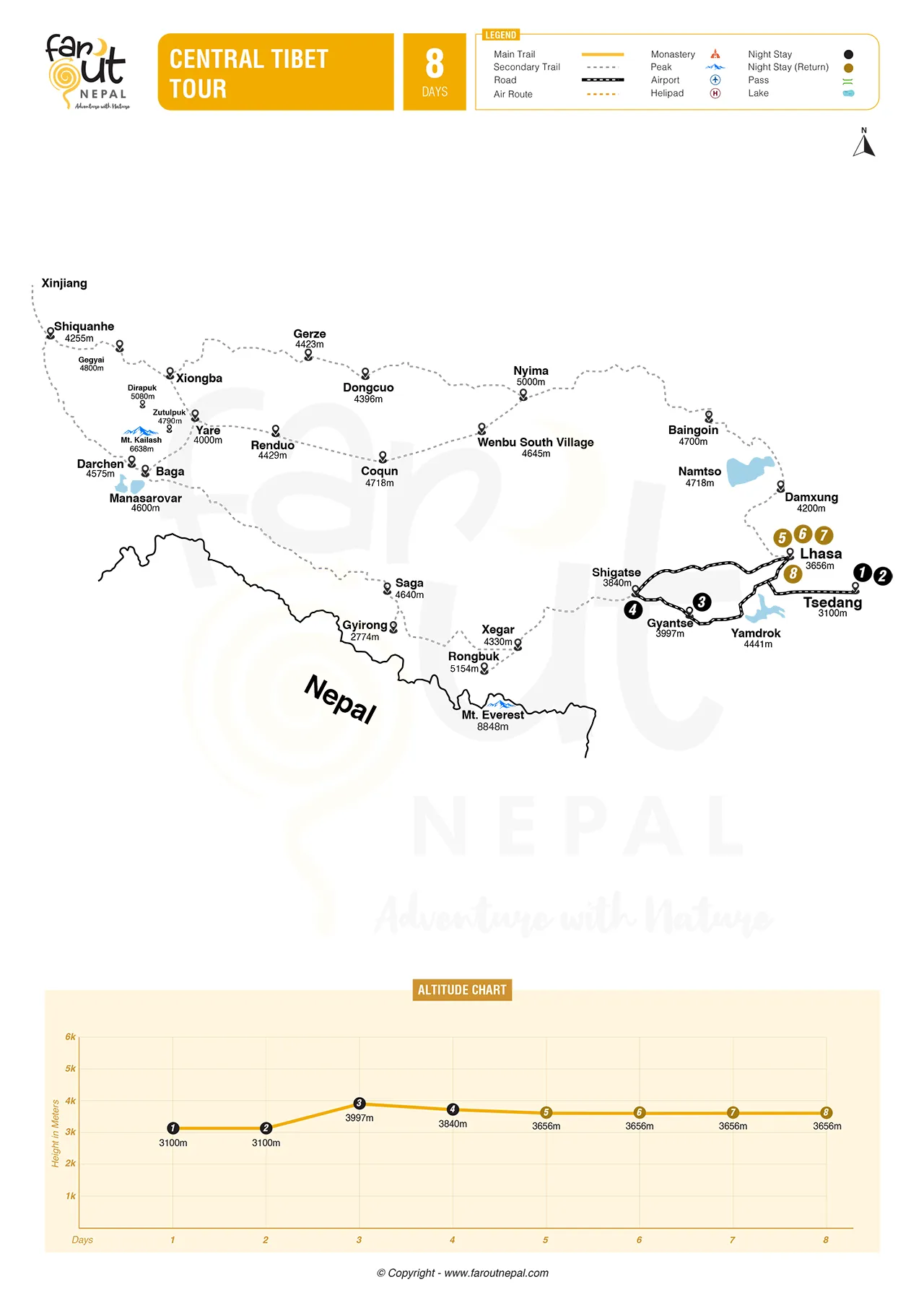
Trip map of Central Tibet Tour
Trip Information
Duration: 08 Days
The Central Tibet Tour spans 7 nights and 8 days, with 2 nights in Tsedang, 1 night in Gyantse, 01 night in Xigatse and 3 nights in Lhasa.
NB: If you’re traveling from Kathmandu, you will need to allow around 4 working days to secure your Tibet visa. Therefore, combining your trip with a visit to Kathmandu is an excellent choice for those looking to explore both Nepal and Tibet.
Visa Requirements: Central Tibet Tour
This journey is to Tibet Autonomous region of China requiring both a Chinese visa and a Tibet Travel Permit. The process differs based on whether you’re entering Tibet from Nepal or China. If you are traveling from Kathmandu, please note that a Chinese visa issued in any other country will not be valid for entry into Tibet. Instead, a group visa will be issued for all travelers entering Tibet from Nepal.
Visa Procedure for Tibet from Kathmandu:
Step 1:
You must book a tour package with a local travel agent in Kathmandu. The minimum group size for obtaining a group visa is 4 participants.
Step 2:
After booking, send a scanned copy of your passport and make the payment. Once received, the agent will begin the process of obtaining your Tibet Travel Permit, which takes around 1 week to process.
Step 3:
Once the Tibet Travel Permit is obtained, the next step is to submit a China visa application to the Chinese Embassy in Kathmandu. You will need to be physically present in Kathmandu for this process as the embassy requires the original passport.
Step 4:
The China visa takes about 4 working days to be issued. It will be a group visa, not stamped in your passport, but rather in a separate sheet listing the names of all group members. All travelers in the group must enter and exit China at the same time.
Important: A visa issued from any other country will not be valid for Tibet travel if entering from Nepal.
Free Visa:
Recently China has implemented unilateral visa-free policies for passport holders of around 74 countries. Under the current regulations (as of 2025), citizens of these countries can enter China for tourism, business, or transit purposes without applying for a visa for stays ranging from 15 to 30 days, depending on the bilateral agreement with China.
But as Tibet is a special administrative region of China, Tibet Travel Permit is still required even if you enter China without a visa.
Ideal Time to Travel for Central Tibet Tour:
The best time to travel to Tibet is between April to June and September to October, offering pleasant weather and beautiful scenery. During these months, temperatures hover around 10-20°C. However, due to the high altitude, it can get chilly at night, so be prepared with warm clothing.
These months also offer affordable travel costs and less crowded conditions, making it the ideal period for travelers seeking both comfort and a great experience.
Seasons in Tibet:
- April to June: Mild temperatures, clear skies, and vibrant landscapes.
- September to October: Pleasant temperatures and fewer tourists.
- October to April: Cold temperatures requiring heavier clothing, especially for night-time in high-altitude regions.
Accommodation During Central Tibet Tour:
Accommodation options in Lhasa have improved significantly in recent years, with many tourist-class hotels now offering comfortable stays. However, in smaller towns along the tour route, the facilities may be more basic, but you will always have the best available accommodation for each location.
Clothing and Accessories for Central Tibet Tour:
Given the high-altitude nature of Tibet, dressing appropriately is crucial to your comfort during the trip. Layered clothing is recommended to adapt to varying temperatures throughout the day.
- Recommended Clothing:
- Light layers: shirts, sweaters, jackets, and cotton inner wear.
- Warm clothing (October to April): woolen jackets, down feather coats, and boots.
- Comfortable walking shoes and sun protection accessories such as a hat and sunglasses.
- A warm jacket is essential, even during the day.
- Additional Accessories:
- Water bottle and purification tablets.
- Chapstick and sunscreen (Tibetan sun can be harsh).
- Utility knife, flashlight, bandana or dust mask, and first-aid kit.
- Medications for common cold, headache, fever, stomach issues, and Diamox (for altitude sickness).
Health Precautions and Vaccinations
While traveling in Tibet, altitude sickness is the primary health concern due to Tibet’s average altitude of over 3600 meters. It’s essential to take precautions such as drinking plenty of fluids, acclimatizing in Lhasa, and avoiding strenuous activities in the first few days.
Vaccinations:
- Hepatitis A and Typhoid fever are commonly recommended.
- Malaria prophylaxis is suggested for the southeastern part of Tibet.
- Bring water purification tablets and avoid drinking untreated water.
It’s advisable to see a health professional 4-6 weeks before traveling to ensure you’re in good health, and to discuss any pre-existing conditions that may affect your trip.
Altitude Sickness: What You Need to Know
Central Tibet tour takes you to an elevation of around 3,900 m and little bit more while crossing some of the passes enroute, so some travelers can be at risk for altitude sickness. Symptoms can range from headaches and dizziness to nausea and difficulty breathing. Our program starting from Tsedang which is at an elevation of 3,100 m offers some space for your body to acclimatization.
Prevention:
- Gradual Acclimatization: Spend a few days in Lhasa before traveling to higher altitudes.
- Drink plenty of fluids to stay hydrated and avoid altitude sickness.
- Move slowly and avoid overexertion.
Symptoms of Altitude Sickness:
- Headache, nausea, dizziness, and loss of appetite.
- Fatigue and sleeping difficulties.
- Breathing problems and overall unsteadiness.
If symptoms persist, the only remedy is to descend to a lower elevation as soon as possible. Always listen to your body.
Travel Insurance for Central Tibet Tour:
Given the high-altitude nature of Tibet, it is highly recommended to have travel insurance that covers medical emergencies, accidents, and helicopter rescues if needed. It should also cover evacuations, tour cancellations, and any unexpected travel disruptions.
Flight Information: Central Tibet Tour
The Kathmandu/Lhasa/Kathmandu flight once operated daily, but now it runs only three times a week i.e. Mon, Wed & Fri. With fewer flights available, it is essential to book your flight in advance to secure a seat. The flight offers breathtaking views of the Himalayas, including Mount Everest.
Is it Safe to Travel to Tibet?
One of the most common concerns among travelers is whether Tibet is a safe destination. The answer is a resounding YES! Tibet is as safe as other popular tourist destinations in mainland China, with no significant security issues for visitors. However, travelers should be mindful of the high altitude and unpredictable plateau climate. Central Tibet Tour does not involve any trekking it is a spiritual, cultural tour done in a comfortable vehicle and staying overnight at the hotels.
In this guide, we address key safety concerns and provide expert tips to ensure a secure and enjoyable journey in Tibet.
Tibetan Cuisine: What to Expect:
Tibetan food primarily consists of barley, meat, and dairy products. The staple foods include:
- Yak butter – Refined from cattle and goat milk, widely used in Tibetan tea.
- Tsampa – Roasted barley flour mixed with tea, butter, curds, and sugar for flavor.
- Tubo – A traditional gruel made from dried meat, tsampa, and wheat flour.
Due to Tibet’s high altitude (above 4,000m), vegetables are scarce, leading to a diet rich in meat. In winter, beef and mutton are preserved by air-drying and consumed raw or barbecued.
In Lhasa, travelers will find numerous restaurants serving Tibetan, Indian, Nepali, and Western cuisine. Momos, steamed or fried dumplings stuffed with meat or vegetables, are a popular delicacy. Chinese food is widely available in Tibet’s major towns.
Food Safety Tips in Tibet:
- Always eat at restaurants frequented by locals for better hygiene standards.
- Ensure your food is thoroughly cooked and served hot to eliminate bacteria.
- Avoid raw foods and items that may have come into contact with unfiltered water.
Duty-Free Allowance for Tibet
Travelers can bring the following items into Tibet:
- 400 cigarettes, 100 cigars, and 500g of tobacco
- 1.5 liters of alcoholic beverages (12% alcohol content or more)
- Personal articles up to ¥5,000 (USD $50) for Chinese residents
- Personal articles up to ¥2,000 (USD $20) for non-residents
Prohibited Items:
Arms, ammunition, narcotics, fruit, animals, animal products, and politically sensitive materials (e.g., publications on Tibetan independence or the Dalai Lama). Chinese customs may inspect and seize restricted content upon entry.
Currency and Payment in Tibet
The official currency in Tibet is the Chinese Yuan (CNY). Foreign currency exchange is available at the Bank of China branches in Lhasa, Shigatse, and Zhangmu. Many hotels also offer exchange services.
Payment Methods:
- ATMs: Available in Lhasa and Shigatse
- Credit Cards: Accepted in major hotels, shops, and restaurants
- Cash: Small denominations are recommended for local purchases
- Traveler’s Cheques: Not recommended due to high fees and limited exchange availability
Travel Costs in Tibet:
Since all foreign visitors must be part of an organized tour, tour packages (including accommodation, transport, and travel permits) form the bulk of travel expenses.
- Dining costs: International restaurants cost around USD $15-20 per meal. Local Tibetan and Nepali eateries offer meals for as low as USD $6.
Electricity & Plugs in Tibet
- Standard Voltage: 220V, 50Hz AC
- Plug Types: European two-round pins or American two-flat pins
- Recommendation: Carry a universal travel adapter and a voltage converter for U.S. appliances
Internet & WiFi in Tibet:
WiFi is available in hotels and cafes in Lhasa, but connections are generally slow and unreliable. Additionally, internet access is monitored, and many sites (e.g., social media platforms) are blocked.
Tibet Time Zone
Tibet follows China Standard Time (CST), which is GMT+8. Daylight Saving Time is not observed.
Final Thoughts: Central Tibet Tours
This Tibet tour blends spirituality, breathtaking landscapes, and immersive cultural experiences. From sacred monasteries and UNESCO heritage sites to high-altitude lakes and scenic drives, every moment in Tibet is a step into an ancient and mystical world.
Book your Tibet adventure today and embark on a journey of a lifetime!
Reviews on Central Tibet Tour
Special Savings and Discounts for Group Travelers!
-
4 -
5 person
US$ 1,750
-
6 -
9 person
US$ 1,700
-
10 over
9999
US$ 1,675
US$