


Manaslu Circuit Trek

Manaslu Circuit Trek

Manaslu Circuit Trek

Manaslu Circuit Trek

Manaslu Circuit Trek
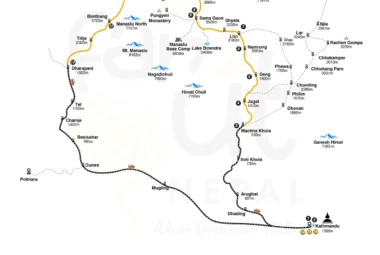
Manaslu Circuit Trek - 16 Days

Activity
Trekking
Duration
16 Days
Grading
Difficult
Max Altitude:
5,106m. / 16,752ft.
Best Season
Mid Oct-Nov
Style of Trip
Lodge Trekking
Group Size
2-10 People
Accommodation
Kathmandu : Hotel / Trek : Simple Mountain Lodges
Meals
Breakfast, Lunch, Dinner
Why Choose the Manaslu Circuit Trek?
If you’re looking for a perfect trek in Nepal that has less crowd and bit remote, the Manaslu Circuit stands in an underrated league of its own. It blends dramatic landscapes, deep cultural immersion, and far fewer crowds into one unforgettable journey. This makes it one of the most rewarding alternatives to Everest or Annapurna.
- A Peaceful, Crowd-Free Trail: Unlike the busy EBC or Annapurna routes, this trail is perfect for those seeking solitude or peaceful exploration in the Himalayas. Walk through the serene valleys and remote villages without encountering much hustle and bustle.
- Remote & Authentically Untouched: The Manaslu region retains its offbeat, secluded character, since it’s only recently opened to teahouse trekking. The experience still feels close to what early explorers encountered: raw, immersive, and deeply authentic.
- No Flights Required: Skip the uncertainty of mountain flights. The trek can be approached with a drive of around 8 hours from Kathmandu, making logistics simpler.
- Incredible Landscape Diversity: In just a couple of weeks, pass through subtropical forests, river gorges, terraced farmlands, hillside villages, alpine meadows, and glacial valleys.
- A True Adventure Trek: The crossing of Larke La Pass (5,106m) is challenging but rewarding. This adds a real sense of achievement to the experience.
- Jaw-Dropping Mountain Views: The trek circles Mount Manaslu (8,163m), the world’s eighth-highest peak, offering close-up views of Himlung Himal, Ngadi Chuli, and the Ganesh Himal range.
- Deep Cultural Immersion: The trail winds through traditional villages inhabited by Gurung, Tamang, and Tibetan-influenced communities, where they still practice ancient customs and follow local lifestyles.
- Strong Spiritual Presence: Along the route, explore ancient monasteries, Mani walls, colorful prayer flags, and prayer wheels. These elements reflect the region’s deep-rooted Buddhist heritage, adding a spiritual dimension to the trek.
- Rich Biodiversity & Wildlife: The Manaslu Conservation Area is a protected ecosystem, home to rare Himalayan wildlife such as the Snow leopard (rare), Red panda, Himalayan tahr, etc. Combined with diverse flora, this makes the trek a true nature experience.
- The Manaslu Circuit Trek is ideal for trekkers seeking fewer crowds, a richer cultural experience, and a more authentic Himalayan adventure, without compromising on scenery or challenge.
Trip Introduction
Overview of the Manaslu Circuit Trek
The Manaslu Circuit Trek is a rewarding 12 to 16-day journey through the remote west-central Nepal, circling the eighth-highest mountain in the world, Mount Manaslu (8,163m). Known for its raw beauty and limited crowds, this trek offers some of the most dramatic mountain scenery with a deep cultural experience in Nepal.
While the route does offer an unforgettable mountain adventure, it also takes you through a hidden world of the ethnic population inhabiting these valleys. You’ll walk past traditional villages where Gurung and Tibetan-influenced communities continue to live on for generations, while preserving their customs, architecture, and way of life. You’ll encounter a blend of Hindu and Tibetan Buddhist traditions, with monasteries, mani walls, and prayer flags woven into everyday life along the trail.
The landscape changes rapidly as you gain altitude. The trail begins in huge green forests and terraced farmland, gradually leading into alpine valleys and glacial moraines.
Although the Manaslu Circuit Trek has grown in popularity as an alternative to the Annapurna Circuit, it remains a restricted and less-traveled route. This keeps the experience quieter, more authentic, and closer to the true spirit of trekking in Nepal.
Widely regarded as one of the best treks in Nepal, the Manaslu Circuit is ideal for those seeking a challenging, culturally immersive, and off-the-beaten-path Himalayan adventure.
Manaslu Circuit Trek: Quick Details
Location: Nepal, in the remote Manaslu region (west-central Himalayas)
Distance: ~160–180 km (varies by route and side trips)
Difficulty: Moderate to challenging. Best suited for trekkers with good fitness and some high-altitude experience
Cost: $1,100–$2,700 (includes permits, guide, accommodation, and transport; varies by group size and service level)
Best Time to Trek: Spring (March to May) and Autumn (Mid-October to November) for stable weather and clear views
Trail Type: A bit remote trekking route with rugged trails, suspension bridges, alpine terrain, and high mountain passes
Permits Required: Restricted Area Permit (RAP), Manaslu Conservation Area Permit (MCAP), Annapurna Conservation Area Permit (ACAP)
Guide Requirement: Mandatory. Solo trekking is not allowed in the Manaslu region.
Group Join Available: Yes, with fixed departures and shared costs
Start planning your Manaslu Circuit Trek today or join a group departure for the best value.
Manaslu Circuit Trek Itinerary (13–16 Days)
The route follows the Budhi Gandaki River through deep gorges and traditional villages before opening into the high Himalayan landscapes of the Nubri Valley, eventually crossing the iconic Larke La Pass and linking with the Annapurna region.
Day 1–2: Arrival in Kathmandu → trek preparation and permits
Day 3: Drive from Kathmandu to Machha Khola (approx. 8–9 hours)
Day 4: Start trek from Machha Khola to Jagat along the Budhi Gandaki River
Day 5–7: Trek via Deng, Namrung, and Lho → enter the Nubri Valley
Day 8–9: Acclimatization and exploration around Samagaun (near Manaslu Base Camp)
Day 10: Trek to Samdo → gradual altitude gain
Day 11: Trek to Dharamsala (Larke Phedi), base of the pass
Day 12: Cross Larke La Pass (5,106m) → descend to Bimthang
Day 13: Trek through alpine forests to Tilje → join the Annapurna trail
Day 14: Drive back to Kathmandu via Besisahar
Manaslu Circuit Trek Packages & Cost
Knowing the costs upfront helps you budget wisely and choose a package that fits your style. The Manaslu Circuit Trek is a restricted-area trek, so a licensed guide is mandatory, and permits add to the overall cost. All our packages include permits, guide services, meals, accommodation, and transportation.
| Package (2026) | Accommodation | Meals | Guide | Transport | Extras | Estimated Cost (USD) |
| Premium | 5-star in Kathmandu; attached bathrooms along the trek, where available | Breakfast, lunch, dinner + afternoon tea and snacks | Senior licensed trekking guide | Private 4WD (4 participants) | Hot water bag from 4,000 m | $1,500–$1,900+ |
| Standard | 4-star in Kathmandu; attached bathrooms where available | Breakfast, lunch, dinner | Senior/Junior licensed trekking guide | Private 4WD (4 participants) | None | $1,100–$1,500 |
| Budget/Group Join | Non-star hotels in Kathmandu; basic teahouse rooms along the trek | Set-menu for breakfast, lunch, dinner | Junior licensed trekking guide | Shared vehicle transport | None | $900–$1,200 |
Cost Breakdown
- Permits: Manaslu Restricted Area Permit + Conservation Area Permit + Annapurna Conservation Area Permit (~$140–$180)
- Guide & Porter: $30–35/day for guide; $20–25/day for porter (optional)
- Accommodation & Meals: Included in packages; independent travelers ~$25–35/day for food
- Transport: Private jeep to trailhead and back ~$180–280 per vehicle (shared)
- Extras: Hot showers, charging, Wi-Fi ($3–8/day), tips for guides/porters
Challenges and Considerations for Manaslu Circuit Trek
The Manaslu Circuit Trek is breathtaking, but it demands preparation and awareness. Trekkers should understand the key challenges to stay safe and enjoy the journey.
- High-Altitude Risks: The trek reaches Larkya La Pass at 5,100 m, which can trigger altitude sickness as low as 2,500 m. Severe cases require immediate evacuation, sometimes by helicopter.
- Limited Medical Facilities: Medical support along the trail is minimal. Trekkers should carry a comprehensive first-aid kit, know basic altitude sickness management, and prioritize acclimatization at proper intervals.
- Road and Trail Conditions: The drive from Kathmandu to the trailhead is long and rugged, often affected by road construction or traffic. The trekking path is steep, rocky, and occasionally perched on cliffs, requiring caution and sure-footedness.
- Weather Dependency: Himalayan weather is unpredictable. Even in spring or autumn, sudden snow, heavy rain, or high winds can close passes or make trails hazardous, sometimes forcing retracing of steps.
- Seasonal Considerations: The best seasons for trekking are spring (March–May) and autumn (Mid-October–November) for clear skies and stable conditions. However, occasional poor weather may obscure views or slow progress.
Detail itinerary of Manaslu Circuit Trek
Day 01: Arrive in Kathmandu
After arriving at Tribhuvan International Airport, you will be warmly welcomed by our representative and escorted to your hotel. After checking in, a Manaslu Circuit Trek briefing session will be arranged.
During the briefing, our experts will review your trekking gear and provide essential guidance for the journey ahead. We will also collect your passport to process the special Manaslu Restricted Area Permit.
The rest of the afternoon and evening is free for you to relax, explore the city, or prepare for the trek.

Activity: Arrival Transfer : Approx. 30 minutes

Location: Kathmandu

Max. Altitude: 1,300m/4,265ft.

Accommodation: Hotel

Meal: NA
Day 02: Kathmandu: Preparation & City Tour
After breakfast, the morning is dedicated to preparing for your trek. Our team will assist with final gear checks, packing, and permit formalities for the Manaslu Circuit Trek.
Later, you can enjoy a guided sightseeing tour of Kathmandu’s cultural gems. First, you’ll visit Swayambunath Stupa, perched atop a hill on the western edge of the valley. Known as the “Monkey Temple,” this 2,000-year-old Buddhist Chaitya is one of the most iconic and spiritual landmarks in Nepal.
Next, we’ll explore Patan: the City of Fine Arts, located 7 km southeast of Kathmandu. You can stroll through ancient Malla courtyards, palaces, and pagoda temples, marveling at monuments dating from the 15th to 17th centuries. This city beautifully blends Hindu and Buddhist heritage, offering a rich cultural experience before your trek begins.
By the end of the day, all trekking permits will be finalized, ensuring you are ready for the journey ahead.
Activity: Tour : Approx. 5 hours
Location: Kathmandu
Max. Altitude: 1,300m/4,265ft.
Accommodation: Hotel
Meal: Breakfast
Day 03: Drive to Machha Khola: Gateway to the Manaslu Circuit Trek
Early in the morning, we depart from Kathmandu and head toward Machha Khola, the starting point of the Manaslu Circuit Trek. The journey takes approximately 7–8 hours. The route starts on smooth, paved roads before turning onto rugged mountain tracks with twists, turns, and occasional landslide-prone sections.
As we ascend, we catch glimpses of the majestic Annapurna, Manaslu, Ganesh Himal, and Langtang peaks (if the weather allows). Below, the valley unfolds in a tapestry of green hills, terraced fields, and winding rivers, offering a gentle introduction to the Himalayas.
Along the way, you will cross swinging suspension bridges, trek through dense Sal forests, admire cascading waterfalls, and witness the daily life of Gurung villages tucked into the hillsides.
By evening, we arrive at Machha Khola, a peaceful riverside village, where we rest and prepare for the trek ahead.
Activity: Drive: Approx. 07 hours
Location: Machhakhola
Max. Altitude: 2,835m/9,301ft.
Accommodation: Lodge
Meal: Breakfast, Lunch, Dinner
Day 04: Trek to Jagat
After breakfast, the trek begins toward Jagat, our next overnight stop. The trail follows a mix of ups and downs, crossing the Tharo Khola to reach the small village of Kholabensi. Along the way, you may notice hot springs at Tatopani, a soothing sight for trekkers.
The path then climbs steeply over a ridge and crosses the Budhi Gandaki River on a suspension bridge. From here, a well-constructed stone staircase leads to the village of Doban, an ideal spot for a lunch break.
After lunch, the trail continues on a rugged, rocky ascent to the top of another ridge. A short descent brings you to Buri Gandaki, where you cross another suspension bridge before climbing more stone steps to Tharo Bharyang.
Finally, the trail crosses to the west bank of the Buri Gandaki River and climbs gently to Jagat, a compact village that serves as our rest stop for the night.
Activity: Trekking : Approx. 7 hours
Location: Jagat
Max. Altitude: 1,410m/4,626ft.
Accommodation: Lodge
Meal: Breakfast, Lunch, Dinner
Day 05: Trek to Deng
After completing the permit checks at Jagat, we continue deeper into the Manaslu region. The trail first climbs over a rocky ridge toward Salleri and Sirdibas. We will then cross a long suspension bridge and ascend to Philim, a picturesque Gurung village surrounded by terraced fields of corn and millet.
From Philim, the trail leads to Chisopani, where we stop for lunch. After the break, the path turns north along a relatively level stretch before entering a steep, uninhabited gorge.
The trail then descends onto grassy slopes, crossing the Budhi Gandaki River multiple times as it meanders between the western and eastern banks. As the valley opens, trekkers pass through a serene bamboo forest before reaching Deng Khola. A final river crossing brings us to the charming village of Deng, where we rest for the night.
Activity: Trekking : Approx. 7 hours
Location: Deng
Max. Altitude: 1,800m/5,906ft.
Accommodation: Lodge
Meal: Breakfast, Lunch, Dinner
Day 06: Trek to Namrung
After breakfast, the trek begins with a 30-minute descent to the river, followed by a steep climb to Rana (1,980 m). From there, the trail continues to Bihi, navigating a gently undulating path. We will then ascend to Ghap, a village with strong Tibetan cultural influences.
The trail then climbs higher into the alpine forests of pine and juniper, offering stunning views of snow-capped peaks along the way. As we approach Namrung, you will cross a river and make a final steep ascent. We will finally reach this charming village, renowned for its breathtaking vistas of Siring and Ganesh Himal.
Namrung serves as an ideal rest stop, providing both cultural insight and spectacular mountain scenery before continuing the trek.
Activity: Trekking : Approx. 5 hours
Location: Namrung
Max. Altitude: 2,660m/8,727ft.
Accommodation: Lodge
Meal: Breakfast, Lunch, Dinner
Day 07: Trek to Lho
Today’s trek will be shorter and more relaxed. This will allow you to explore the Upper Nupri Valley, a region rich in Tibetan culture. Along the trail, we will pass through mani walls, barley fields, and traditional villages such as Barsam (2,800 m) and Lihi (2,900 m).
From Lihi, the trail ascends gently, offering spectacular views of Manaslu North (7,157 m) and Naike Peak (5,515 m).
We’ll arrive at the village of Lho, home to a large Gompa, a stone archway, a Tibetan chorten, and an impressive mani wall. The viewpoint above Lho provides panoramic vistas of Manaslu North and Naike Peak, making it a perfect spot for photography and reflection.
Activity: Trekking : Approx. 04 hours
Location: Lho
Max. Altitude: 3,180m/10,433ft.
Accommodation: Lodge
Meal: Breakfast, Lunch, Dinner
Day 08: Trek to Samagaon
Today’s trek from Lho to Samagaon is relatively short, allowing you to enjoy the surrounding forests and cross small streams along the way.
We’ll pass through the village of Shyaula, with its breathtaking views of Mt. Phungi, Manaslu, and Himal Chuli. After crossing the Punggen Glacier outflow and trekking beside a mountain stream, you’ll arrive at Samagaon, a charming village with stunning vistas of Mt. Manaslu, offering a perfect spot to rest and soak in the high Himalayan scenery.
Activity: Trekking : Approx. 4 hours
Location: Sama Gaon
Max. Altitude: 3,520m/11,549ft.
Accommodation: Lodge
Meal: Breakfast, Lunch, Dinner
Day 09: Acclimatization Day in Samagaon
Today is an important acclimatization day on the Manaslu Circuit Trek. This will give your body time to adjust to the high altitude.
You have the option for a side excursion, depending on your health and energy levels. You can visit the historic Pungyen Gompa, a serene Buddhist monastery, or undertake a trek to Manaslu Base Camp for close-up views of the mighty Mt. Manaslu and its surrounding glaciers.
This day is all about rest, gentle exploration, and altitude adjustment, ensuring you are well-prepared for the challenging trails ahead.
Activity: Acclimatization Day : Side trips approx. 5 hrs
Location: Sama Gaon
Max. Altitude: 3,520m/11,549ft.
Accommodation: Lodge
Meal: Breakfast, Lunch, Dinner
Day 10: Trek to Samdo
Today’s trail follows the Budhi Gandaki River as it gradually turns north. Along the way, you’ll take the route toward Larkya La Pass, while avoiding the side trail that leads to Manaslu Base Camp. The path passes several mani walls, and the valley begins to open up into a wider alpine landscape.
The trek starts relatively easy and gradually until Kermo Kharka, after which the trail becomes more rugged while climbing towards a ridge. From here, you descend slightly, cross the Budhi Gandaki River on a wooden bridge, and begin a steep ascent to higher ground.
As you approach Samdo, you pass through a traditional kani (stone gateway) before reaching this remote highland village. Samdo offers a strong sense of Tibetan culture and serves as an important stop before heading toward higher altitudes.
Activity: Trekking : Approx. 3 hours
Location: Samdo
Max. Altitude: 3,860m/12,664ft.
Accommodation: Lodge
Meal: Breakfast, Lunch, Dinner
Day 11: Trek to Dharamsala (Larkya Phedi)
Today’s trek leads to Dharamsala (Larkya Phedi), the base camp for crossing Larkya La Pass (5,106 m). Located at around 4,480 m, this is the final stop before the most challenging day of the trek.
The trail begins with a gentle descent, passing open fields, a large mani wall, and a traditional stone archway. You then descend to the river and cross it via a wooden bridge. We will then continue along a gradual climb through tundra and juniper landscapes, with views of the massive Larkya Glacier.
As the altitude increases, the trail becomes steeper and more rugged, climbing along a ridge that offers stunning Himalayan views. The path then winds through a narrow gorge before contouring toward a solitary stone lodge, where you will spend the night.
This is a crucial day to rest, hydrate, and prepare for the high pass crossing ahead.
Activity: Trekking : Approx. 4 hours
Location: Dharamsala
Max. Altitude: 4,480m/14,698ft.
Accommodation: Lodge
Meal: Breakfast, Lunch, Dinner
Day 12: Trek to Bimthang via Larkya La Pass (5,106 m)
Today is the longest and most challenging day of the Manaslu Circuit Trek, as you will cross the spectacular Larkya La Pass, the highest point of the journey.
You begin early in the morning, climbing gradually above Dharamsala before traversing the northern side of the Larkya Glacier. Along the way, you can enjoy incredible views of Cho Danda and Larkya Peak as the landscape becomes more rugged and dramatic.
The trail then crosses rocky moraine and boulder fields, climbing steadily across ridgelines until you reach the summit of Larkya La Pass. From the top, you are rewarded with breathtaking panoramic views of Himalayan giants, including Himlung Himal, Cheo Peak, Kangguru, and Annapurna II.
Due to strong winds and cold temperatures, the stop at the pass is usually brief. The descent begins steeply across snow-covered trails, requiring careful footing.
As you lose altitude, the trail becomes easier, passing through grassy moraines and wide alpine meadows. Eventually, you reach Bimthang, a beautiful valley surrounded by peaks, where you rest after one of the most rewarding days of the trek.
Activity: Trekking : Approx. 8 hours
Location: Bimtang
Max. Altitude: 3,720m/12,205ft.
Accommodation: Lodge
Meal: Breakfast, Lunch, Dinner
Day 13: Trek to Dharapani
After the high-altitude adventure of the previous day, today’s trek is a gradual descent into greener landscapes. The trail leads down to the Dudh Khola, passing through pine and rhododendron forests before reaching the village of Gho.
As you descend further, you can enjoy views of Lamjung Peak rising above the Marsyangdi Valley. The trail continues through the traditional villages of Tilje and Thonje, offering glimpses of local life along the way.
Beyond Thonje, we will descend to cross the Marsyangdi River, followed by a steady climb up stone steps to reach Dharapani (1,963 m), a lively village on the Annapurna Circuit.
This marks the completion of the trekking portion, and we will spend the night here, reflecting on the incredible journey around Manaslu.
Activity: Trekking : Approx. 7 hours
Location: Dharapani
Max. Altitude: 1,920m/6,299ft.
Accommodation: Lodge
Meal: Breakfast, Lunch, Dinner
Day 14: Drive to Kathmandu
After completing the trek, we will return to Kathmandu with a scenic drive. From Dharapani, we travel along the Marsyangdi Valley by local jeep, following rugged mountain roads to Besisahar, where the paved road begins.
From here, you will switch to a more comfortable vehicle and continue the drive toward Kathmandu. The route winds through hills and river valleys, following the Marsyangdi River until it meets the Trisuli River along the highway.
By late afternoon, you will arrive in Kathmandu and check into your hotel. The evening is free to relax, celebrate the completion of the trek, or explore the city one last time.
Activity: Drive : Approx. 8 hours
Location: Kathmandu
Max. Altitude: 1,300m/4,265ft.
Accommodation: Hotel
Meal: Breakfast, Lunch
Day 15: Backup/Contingency Day
This day is reserved as a backup day in case of any delays during the Manaslu Circuit Trek. Unpredictable factors such as weather conditions, trail challenges, or high-altitude adjustments may sometimes require flexibility in the itinerary.
If everything goes as planned, this day can be used to relax in Kathmandu, explore the city more, or simply unwind after the trek.
Activity: Back Up Day
Location: Kathmandu
Max. Altitude: 1,300m/4,265ft.
Accommodation: Hotel
Meal: Breakfast
Day 16: Departure
Your Manaslu Circuit Trek comes to an end today. Based on your flight schedule, our team will transfer you to Tribhuvan International Airport for your departure.
We hope you leave with unforgettable memories of the Himalayas and an incredible trekking experience in Nepal.
Activity: Departure Transfer
Location: Kathmandu
Max. Altitude: 1,300m/4,265ft.
Accommodation: Hotel (Check out before 12 Noon)
Meal: Breakfast
Departures Dates
Need assistance with booking your trip? Inquire Now
Inclusions in Manaslu Circuit Trek
- 04 nights twin sharing accommodation on BB basis in a 3-star class hotel
- 01-day sightseeing tour of Swayambunath, Bhaktapur and Pashupatinath with local English-speaking guide, private transportation and entrance fee during the sightseeing tour.
- 11 nights/12 days Manaslu Trek
- Support of Crew & porter
- Simple accommodation on twin sharing basis
- Meals: Set Breakfast, Lunch, Dinner
- TIM’s Card
- Conservation Park Fee
- Special Permit
- Transportation KTM/MACHHAKHOLA/DHARAPANI/KATHMANDU
- All arrival/departure transfers
- Insurance of staff and porters
- Waterproof duffle bag
Trip Excludes
- Nepal Visa
- Meals during your stay in Kathmandu (Lunch & Dinner)
- Shower, internet, mobile charging
- Your personal gears for the trip i.e. sleeping bags, trekking gears, personal medicines etc
- Insurance – as this is an adventure trip it is important to have an insurance coverage for health, life, accidents and helicopter rescue in case of emergency evacuation.
- Any extra cost incurred in case of delay or cancellation of flight, any political turmoil, natural disaster
- Entrance fee for visiting monasteries etc
- Anything not included in our include box
Trip map of Manaslu Circuit Trek
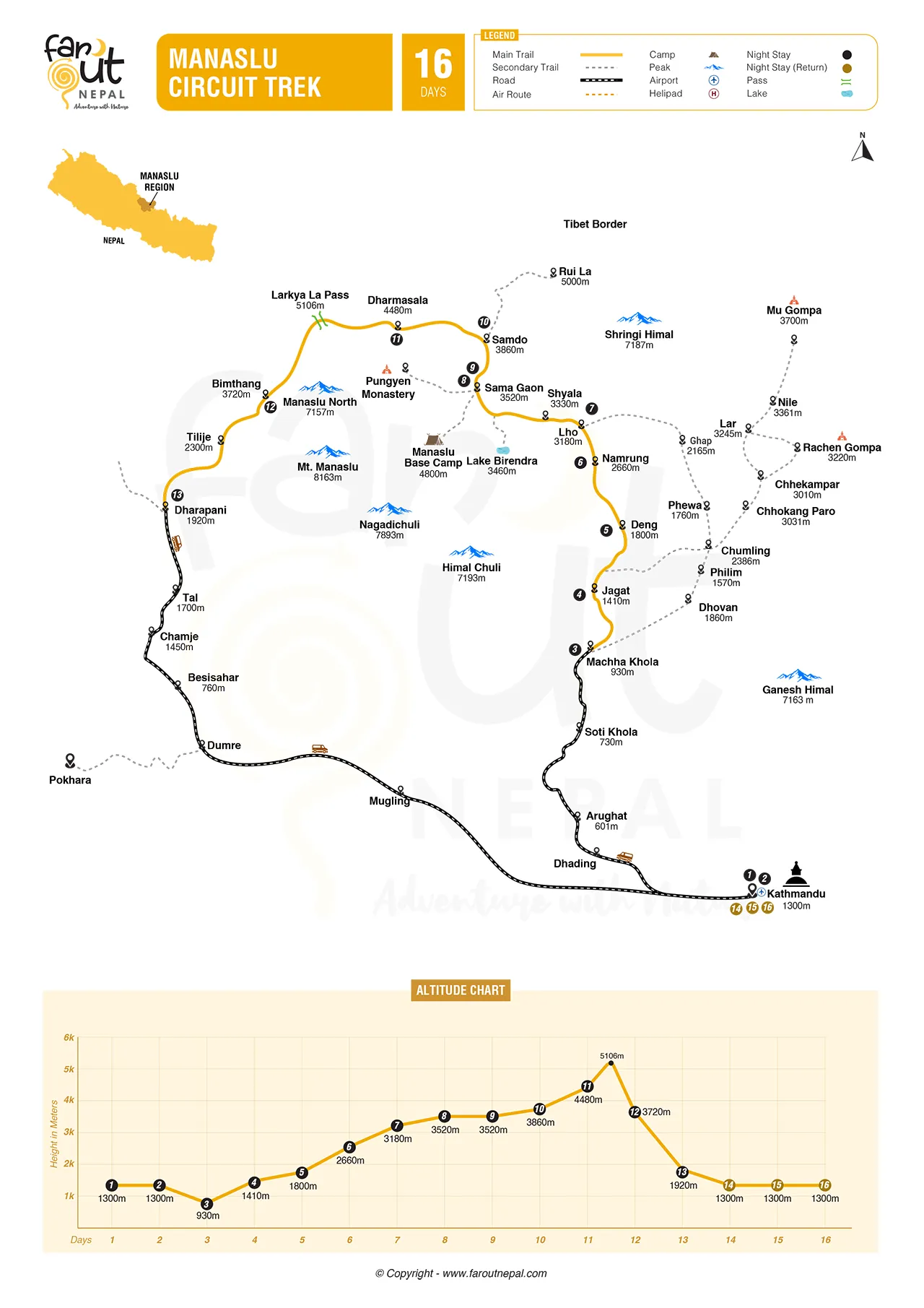
Information about Manaslu Circuit Trek
Manaslu Circuit Trek Duration & Difficulty
Planning is key to enjoying the Manaslu Circuit Trek safely and comfortably. Here’s what you need to know before you go.
Duration: 16 Days
The complete itinerary spans 16 days, including:
- 11 nights/12 days of trekking and driving along the Manaslu Circuit
- 4 nights in Kathmandu for arrival, preparation, permits, sightseeing, and 1 backup day for flexibility in case of delays
You should expect to walk 3–8 hours per day on average, depending on terrain and altitude as well.
Difficulty Level: Demanding
The Manaslu Circuit Trek is considered a demanding high-altitude trek. Daily trekking involves 3–8 hours of walking. Trekkers should prepare for steep ascents, descents, and rugged terrain. Crossing Larkya La Pass (5,106 m) is physically challenging, while weather conditions can change rapidly
The biggest challenge is altitude. As you ascend, oxygen levels decrease, making breathing harder and increasing the risk of Altitude Sickness (AMS).
Who Can Undertake The Manaslu Trek?
This trek is best suited for:
- Trekkers with good fitness and stamina
- Those with previous hiking or high-altitude experience
- Adventurers seeking a remote and less crowded Himalayan route
Motivated beginners can also complete it, provided they train properly. They should also follow a well-paced itinerary and allow sufficient time for acclimatization.
This trek is not recommended for:
- Individuals with serious medical conditions (heart, respiratory issues)
- Pregnant travelers
- Those unprepared for long, physically demanding days
Preparation for Manaslu Circuit Trek
With the right mindset and training, even motivated beginners can successfully take on this demanding high-altitude trek, like the Manaslu Circuit. You just need to be well-prepared for the risks that may come with the trek.
Physical Preparation
Start training at least 3–4 months before your trek to build endurance and strength.
- Hiking: Walk 8–12 km regularly with a 5–15 kg backpack
- Stair Climbing: Build leg strength with gradual intensity increases
- Incline Training: Use a treadmill with a 10–15% incline for 45–60 minutes
- Cross Training: Activities like cycling, swimming, or jogging improve stamina
- Gear Practice: Break in your trekking boots to avoid blisters
Mental Preparation
- Assess whether this trek matches your fitness level and expectations
- Build mental resilience for long trekking days and changing weather
- Stay patient and flexible, as delays and adjustments are common in the Himalayas
- Be prepared for remote conditions and basic accommodation
You don’t need to be an athlete, but you do need to be consistent. A well-prepared trekker enjoys the journey far more than one relying on luck.
Altitude Sickness on Manaslu Circuit Trek
The Manaslu Circuit Trek reaches altitudes above 5,100 m at Larkya La Pass, making altitude sickness (AMS) one of the most important risks to understand. Altitude-related issues can begin from 2,500 m, as oxygen levels decrease and the body struggles to adapt. If not managed properly, AMS can escalate quickly and become serious or even life-threatening.
Common symptoms of altitude sickness include headache, nausea, shortness of breath, fatigue, etc. If you experience any of these symptoms, do not ignore them. If you want to learn more about AMS symptoms, you can check our detailed blog on the symptoms of altitude sickness.
If you experience these symptoms
- Stop ascending immediately
- Inform your guide without delay
- Descend to a lower altitude (most effective treatment)
Descent is the only reliable solution for worsening symptoms.
Altitude Preparation
- Understand the risks of altitude sickness (AMS) above 2,500 m
- Follow a gradual ascent and proper acclimatization schedule
- Proper hydration is key to preventing altitude sickness and maintaining energy levels.
- Never ignore early symptoms
With a well-paced itinerary, proper acclimatization, and an experienced guide, most trekkers complete the Manaslu Circuit safely. Awareness and early action are key.
Best Seasons for Manaslu Circuit Trek
Choosing the right season is key to getting the best experience on the Manaslu Circuit Trek, especially due to its remote terrain and high-altitude conditions. For the best balance of clear views, safety, and trail conditions, plan your trek during October–November and March–April. These seasons offer the most reliable weather for crossing Larkya La Pass.
Autumn (Mid-October to Mid-December) – Best Overall
- Clear skies and excellent mountain visibility
- Stable weather and ideal trekking conditions
- Peak season with lively trails
Spring (Mid-March to Late April) – Scenic & Colorful
- Blooming rhododendron forests
- Pleasant temperatures for trekking
- Occasional haze or light rain possible
Monsoon (June to September) – Not Recommended
- Heavy rainfall, landslides, and leeches
- Poor visibility and slippery trails
Winter (December to February) – Cold & Challenging
- Fewer trekkers and quiet trails
- Extreme cold and possible snow at Larkya La Pass
Group Size & Trekking Support For Manaslu
We keep our group sizes small (2–10 trekkers) to ensure a more personalized, flexible, and safe trekking experience on the Manaslu Circuit.
We also suggest a mandatory guide & porter for the Manaslu Circuit due to its remote nature. This allows you to focus on the journey rather than the details.
Guide Support
- Government-licensed, English-speaking trekking guide
- Trained in first aid and altitude awareness
- Handles navigation, logistics, and safety throughout the trek
Porter Support
- 1 porter for every 2 trekkers
- Carries up to 30 kg total (15 kg per person)
- Allows you to trek comfortably with just a light daypack
Trekking Equipment for Manaslu Trek
Proper gear is critical for comfort and safety on a high-altitude trek like Manaslu. Essential Gear Checklist includes:
- Sturdy trekking boots (well broken-in)
- Four-season sleeping bag (-10°C to -15°C)
- Waterproof jacket and trousers
- Insulated layers (fleece/down jacket), etc.
A complete packing list will be provided after booking, and most gear can be rented or purchased in Kathmandu. You can also check our guide on the required gear for trekking.
Baggage & Luggage Management
Your main luggage is handled by our porter team, so you can trek with ease.
During the Trek
- Carry a daypack with essentials:
- Water, snacks
- Sunscreen, camera
- Spare layer and personal medication
Before the Trek
- We provide a duffel bag for your trekking gear
- Store extra luggage (non-trekking items) at your hotel in Kathmandu free of charge
- Use a small lockable bag for valuables and travel clothes
Traveling light significantly improves your trekking comfort and performance.
Access & Transportation
Reaching the Manaslu region is part of the adventure. Unlike Everest treks, no domestic flights are required, making this route more reliable and cost-effective.
Road Access
- Drive from Kathmandu to Machha Khola (trailhead)
- Duration: 8–10 hours
- Transport: Private 4WD vehicle
Road Conditions
- A combination of paved highways and rugged mountain roads
- Scenic journey through rivers, terraced fields, and hillside villages
- Risk of land and mudslides.
Accommodation on Manaslu Circuit Trek
Understanding what to expect on the trail helps you prepare better and enjoy the Manaslu Circuit Trek comfortably. Facilities are basic but reliable, especially considering the remote Himalayan setting. But this is part of what makes the Manaslu Circuit a true off-the-beaten-path adventure.
Accommodation (Tea Houses & Lodges)
- Stay in basic mountain lodges (teahouses) on a twin-sharing basis.
- Lodges that utilize sustainable energy sources such as kerosene, solar, or cow dung are prioritized.
- Shared bathrooms are common, especially at higher altitudes
- At Dharamsala, rooms may be shared with more than two trekkers due to limited availability.
- Some villages offer attached bathrooms, but availability is limited.
- Lodges provide blankets, but carrying a sleeping bag is highly recommended.
- Meals are carb-rich and energy-focused for trekking. A mix of Nepali, Indian, Chinese, and limited Western cuisine with veg options.
- Hot showers will be available in the trekking regions, but come at an extra cost.
Comfort is simple, but the authentic mountain experience is unmatched.
Hydration Tips
- Drink 2–3 liters of water daily
- Use water purification tablets or filters
- Avoid relying on bottled water (costly and environmentally harmful)
Typical Day on the Manaslu Circuit Trek
A typical day on the Manaslu Circuit Trek follows a steady routine designed for acclimatization, comfort, and consistent progress in high-altitude conditions.
Daily Trekking Routine
- Morning:
- Wake-up call with tea or coffee at 06:00 AM
- Freshen up, pack your gear, and enjoy breakfast at the lodge
- Start trekking
- Midday:
- Trek for 3–4 hours
- Stop for lunch at a scenic teahouse along the trail
- Afternoon:
- Continue trekking for another 3–4 hours
- Gradual pace to maintain energy and acclimatization
- Late Afternoon:
- Arrive at the day’s destination
- Rest, explore the village, or relax
- Evening:
- Dinner served at the lodge (choose from the menu)
- Briefing for the next day’s trek
- Night:
- Early rest (around 8:30–9:00 PM)
What to Expect Each Day
- Walking time: between 3 and 8 hours per day
- Terrain: Mix of forests, villages, river valleys, and alpine landscapes
- Accommodation: Simple teahouses with basic facilities
- Atmosphere: Quiet, remote, and deeply immersive
The routine may feel simple, but it’s carefully designed to help your body adapt to altitude while maximizing the trekking experience.
Manaslu Circuit Trekking Infrastructure
Preparing for the Manaslu Circuit Trek goes beyond packing. It’s about ensuring your health, safety, and connectivity in a remote Himalayan environment.
Pre-Departure Health Checklist
Start preparing at least 6–8 weeks before your trek:
- Schedule a health check-up with your doctor or travel clinic
- Discuss your itinerary and confirm recommended vaccinations
- Avoid raw or undercooked food
- Take mosquito precautions at lower elevations
- Familiarize yourself with emergency procedures in Nepal
First Aid & Medical Preparedness
- Carry your own medications and prescriptions
- Some medicines may be unavailable or restricted in Nepal
- Include essentials: pain relief, altitude medication, bandages, antiseptic
In remote regions like Manaslu, self-preparedness is essential.
Electricity & Charging
- Most teahouses offer electricity or solar power
- Charging may cost extra, especially at higher altitudes
- Bring a power bank or solar charger as backup
Internet & Communication
- Wi-Fi is available in many lodges (paid, limited speed)
- The Internet becomes unreliable at higher altitudes
Mobile Network
- Nepal Telecom (NTC): Better coverage in remote areas
- Ncell: Works well in lower regions
- Buying a local SIM card with a data package is recommended for basic connectivity.
Insurance, Visa & Trekking Permits for Manaslu
Proper documentation and insurance are essential for a safe and hassle-free Manaslu Circuit Trek.
Travel Insurance (Mandatory)
Travel insurance is required for trekking in the Himalayas. Your policy should cover:
- Emergency medical treatment
- Accidents and injuries
- Helicopter evacuation for high-altitude emergencies
- Trip cancellations or delays
- Theft or loss of belongings
You can learn the types of insurance that are best for treks like Manaslu from our insurance page.
Nepal Visa Requirements
All international travelers must obtain a Nepal visa, either on arrival at Tribhuvan International Airport (Kathmandu) or via a Nepalese embassy.
Visa Fees:
- 15 days – USD 30
- 30 days – USD 50
- 90 days – USD 120
You can check the requirements on our Nepali Visa page.
Tip: Keep a digital and physical copy of your passport and visa for backup.
Manaslu Trekking Permits
To enter the Manaslu region, you will need:
- Restricted Area Trekking Permit (RAP)
- Conservation Park Permit (MCAP/ACAP)
Documents required for permit processing:
- Passport scan
- Passport-size photo
- Original passport for at least one day in Kathmandu
Far Out Nepal can also handle all permit arrangements, save time, and reduce stress before the trek.
Time and Length for working out the permit:
- We suggest you obtain the online e-visa earlier from your hometown and send us a copy of the visa so that we can obtain the permit before your arrival.
- An electronic visa(e-visa) is an online system that affirms the eligibility of a foreign national to travel to Nepal under its immigration laws. Log on to Nepali-Port-Online-Services for details.
- If you are planning to get the visa upon arrival in Kathmandu, then you can keep a gap of two days in Kathmandu for obtaining the trek permit before your trek. These days should be the working days. Saturday is an official holiday in Nepal.
Join a Group Manaslu Circuit Trek
Looking to experience the Manaslu Circuit Trek with like-minded adventurers? Joining a group trek is not only fun but also cost-effective.
Why Consider a Group Trek:
- Fixed Departure Dates: Join scheduled treks and enjoy a hassle-free itinerary.
- Cost Advantage: Share guide, porter, and transportation costs with other trekkers.
- Social Experience: Make new friends, share stories, and enjoy camaraderie along the trail.
- Stress-Free Logistics: Group treks include all permits, accommodations, and meals organized for you.
Even if you’re a solo traveler, a group trek allows you to experience the region safely while keeping costs lower.
Why Book With Far Out
Choosing the right trekking agency makes all the difference in the Manaslu Circuit Trek experience.
Here’s why trekkers trust us:
- Local Expertise: Our team lives and works in the region. Get exclusive insider knowledge for safe, scenic, and authentic trekking.
- Certified Guides: All guides are government-licensed, trained in first aid, and experienced with high-altitude trekking.
- Years of Experience: Over a decade of organizing Himalayan treks, ensuring smooth logistics and unforgettable experiences.
Ready to Trek Manaslu with Far Out? Take Action Now!
Your Manaslu Circuit adventure is just a step away. Reach out to us through the inquiry forms and WhatsApp. You can even customize your trek with a date or any other requests.
So, don’t wait. Join a group trek or plan your private adventure today and experience the magic of the Manaslu Circuit!
Reviews on Manaslu Circuit Trek
Special Savings and Discounts for Group Travelers!
-
1 -
person
US$ 1840
-
2 -
3 person
US$ 1550
-
4 -
5 person
US$ 1420
-
6 -
9 person
US$ 1350
-
10 over
9999
US$ 1300
US$ 1840