

Upper Dolpo Trek

Upper Dolpo Trek

Upper Dolpo Trek

Upper Dolpo Trek

Upper Dolpo Trek
Upper Dolpo Trek - 24 Days

Activity
Trek
Duration
24 Days
Grading
Challenging
Max Altitude:
5,345m. / 17,536ft.
Best Season
May-June & Sept-Early October
Style of Trip
Camping Full Organized Trek
Group Size
2 - 10 People
Accommodation
Hotel and Camping
Meals
Breakfast, Lunch, Dinner
Why Trek Upper Dolpo?
The Upper Dolpo Trek is one of Nepal’s most extraordinary wilderness journeys. Located in the far northwest of Nepal, Upper Dolpo offers an adventure through high mountain passes, isolated villages, and sacred monasteries that few trekkers ever experience.
- Remote Himalayan Wilderness: Experience one of Nepal’s most isolated regions, where raw landscapes, deep valleys, and high-altitude plateaus remain untouched.
- Visit the Stunning Shey Phoksundo Lake: Marvel at the sacred and surreal turquoise waters of this iconic lake, dramatically set beneath cliffs.
- Spiritual and Cultural Depth: Walk through traditional villages where life follows centuries-old customs, and visit spiritual landmarks like Shey Gompa.
- Journey Through Shey Phoksundo National Park: Trek across Nepal’s largest national park, a protected wilderness rich in breathtaking and dramatic Himalayan scenery.
- Rare Wildlife Encounters: Keep an eye out for blue sheep, Himalayan wolves, and even the elusive snow leopard in this pristine and undisturbed habitat.
- Cross High Himalayan Passes: Conquer multiple high passes above 5,000 meters, offering sweeping views of remote mountain ranges and a true sense of expedition adventure.
- Authentic Off-the-Beaten-Path Experience: Unlike Everest or Annapurna, Upper Dolpo sees very few trekkers, giving you a rare sense of solitude and exploration.
- Explore Ancient Tibetan Buddhist Culture: Experience a unique blend of Buddhist and Bon traditions, reflected in monasteries, chortens, and sacred rituals.
- A True Adventure for Experienced Trekkers: With its remoteness, altitude, and camping requirements, the Upper Dolpo Trek offers a rewarding challenge for those seeking a serious Himalayan expedition.
Trip Introduction
Introduction: Upper Dolpo Trek
The Upper Dolpo Trek is one of Nepal’s most remote and extraordinary trekking adventures. The trek takes you deep into a hidden region where ancient Tibetan culture and untouched landscapes still thrive. Located in the far northwestern corner of Nepal, Dolpo offers a rare opportunity to explore an untouched paradise that remains relatively unexplored by mainstream tourism or development.
This high-altitude trek leads through the dramatic wilderness of Shey Phoksundo National Park. You will be trekking across rugged terrain, deep valleys, and windswept plateaus near the Tibetan border. Along the way, trekkers also encounter traditional villages, centuries-old monasteries, and sacred landmarks such as Shey Phoksundo Lake and Shey Gompa (which hold deep spiritual significance for local communities).
Overview: Upper Dolpo Trek
The Upper Dolpo Trek is a long-duration, high-altitude camping trek in the remote trans-Himalayan region of western Nepal. Known for its isolation but cultural richness, this journey combines challenging mountain terrain with deep cultural immersion. So, the trek can be considered as one of the most unique trekking experiences in Nepal.
Unlike popular trekking routes, Upper Dolpo requires careful planning, special permits, and a fully supported expedition team. The trek typically spans over three weeks, crossing multiple high passes and remote settlements while offering unparalleled access to pristine Himalayan landscapes.
Quick Facts: Upper Dolpo Trek
| Trek Facts | Details |
| Duration | 22-24 Days |
| Maximum Altitude | ~5,380 meters (Kang La Pass) |
| Trek Difficulty | Strenuous / Challenging |
| Accommodation/Trekking Style | Fully supported camping trek |
| Region | Dolpo (Western Nepal) |
| Best Season | May-June & Sep–Nov |
| Permits Required | Restricted Area Permit + National Park Permit |
| Group Type | Private / Small Group |
Upper Dolpo Trek Route Overview
The journey begins with a flight from Kathmandu to Nepalgunj, followed by a dramatic mountain flight to Juphal. From here, the trail quickly leaves behind any signs of modern infrastructure, entering an isolated landscape that defines the Dolpo experience.
The route at a glance:
Kathmandu → Nepalgunj → Juphal (Trek Start) → Dunai → Chhepka → Ringmo → Shey Phoksundo Lake → Shey Gompa → Kang La Pass → Saldang → Dho Tarap → Tarap Valley → Juphal → Nepalgunj → Kathmandu
The Upper Dolpo Trek can be understood in distinct phases, each offering a different landscape, cultural experience, and level of difficulty.
- Phase 1: Entering Dolpo (Juphal → Dunai → Chhepka → Ringmo)
This initial section follows river valleys and forests as you gradually enter the Dolpo region. The trail is relatively moderate, allowing your body to adjust as you pass through small settlements and ascend to Shey Phoksundo Lake. - Phase 2: Sacred & High-Altitude Core (Ringmo → Shey Gompa → Kang La Pass)
This is the spiritual and physical heart of the trek. You explore Shey Gompa and cross high passes like Kang La. Expect thinner air, harsher terrain, and some of the most dramatic scenery of the journey. - Phase 3: Remote Upper Dolpo Plateau (Saldang Region)
After crossing into Upper Dolpo, the landscape opens into a vast, dry plateau with strong Tibetan influence. Villages like Saldang showcase traditional lifestyles and deep cultural isolation. - Phase 4: Descent via Tarap Valley (Dho Tarap → Tarap → Juphal)
The final phase gradually descends through wide valleys and culturally rich villages like Dho Tarap. The terrain becomes greener and more forgiving as you return toward Juphal.
Rather than reaching a destination, this trek is about traversing one of Nepal’s last untouched frontiers, where each section of the trail reveals a new layer of landscape, culture, and isolation.
Trekking Experience in Upper Dolpo
The trekking experience in Upper Dolpo is best described as a true wilderness expedition. It is known to offer a rare combination of physical challenge, isolation, and cultural immersion. This journey is not defined by comfort, but by the depth of experience it delivers.
- Physically demanding terrain
The trek involves long walking days (often 6–8 hours), across rugged and sometimes exposed trails at high altitude. Endurance and prior trekking experience are highly recommended. - Complete immersion in nature
With limited settlements along the route, trekkers spend extended periods surrounded by untouched landscapes, enhancing the sense of remoteness and exploration. - Expedition-style support system
A team of guides, cooks, and porters ensures safety and comfort, managing logistics such as meals, camping setup, and navigation. - Trekkers should also know that due to the lack of teahouses, the trek is entirely camping-based, requiring a support crew and careful logistical planning throughout the journey.
For those prepared for the challenge, this trek offers something increasingly rare in modern travel: a genuine sense of exploration, where the journey feels raw, personal, and deeply rewarding.
Culture of Dolpo: A Living Tibetan Heritage
Upper Dolpo is also a cultural stronghold, preserving traditions that have remained largely unchanged for centuries. Its isolation has allowed a unique Himalayan identity to thrive, deeply rooted in Tibetan heritage.
- Preserved Tibetan traditions
The region’s culture closely mirrors that of Tibet, with traditional architecture, clothing, and daily practices still widely maintained. - Deep-rooted spiritual practices
Both Tibetan Buddhism and the ancient Bon religion are practiced here, influencing every aspect of village life, from seasonal festivals and rituals to daily activities. - Unique social systems and lifestyle
In some areas, practices like polyandry still exist, reflecting adaptations to the harsh environment and limited resources. - Historic trans-Himalayan trade
Dolpo has long been part of ancient trade routes, where locals exchanged salt, wool, and grains with Tibet, a tradition that continues in limited forms to this day.
Shey Gompa & Spiritual Significance
Shey Gompa is one of the most spiritually significant landmarks in Upper Dolpo. Its remote location and historical importance make it a place of both cultural and religious reverence.
Founded in 1220 AD, Shey Gompa has served as a center of religious learning and spiritual practice for centuries. It is situated at the base of Shey Rinpoche (Crystal Mountain), and the monastery is part of a revered pilgrimage circuit.
Pilgrims gather periodically to perform a sacred circumambulation (kora) around the mountain, a practice comparable to rituals at Mount Kailash. Within the monastery, ancient thangkas, statues, and manuscripts are housed, reflecting the region’s profound spiritual heritage.
Hidden Beauty of Upper Dolpo: Nature & Wildlife
The Upper Dolpo Trek passes through Shey Phoksundo National Park. This region is a vast and ecologically significant region that showcases some of the least disturbed landscapes of Nepal.
- The largest national park in Nepal
The park encompasses a diverse range of ecosystems, from dense forests to high-altitude desert terrain, all shaped by extreme climatic conditions. - Iconic Shey Phoksundo Lake
The stunning Shey Phoksundo Lake is renowned for its deep turquoise color and tranquil surroundings, making it one of the visual highlights of the trek. - Rare and elusive wildlife
The region supports species such as the snow leopard and Himalayan blue sheep, reflecting its ecological importance and conservation value. - Rich medicinal plant diversity
Local communities rely on a wide range of herbs and plants for traditional medicine, adding another layer of ecological significance.
Challenges of Upper Dolpo Trek
The Upper Dolpo Trek is as demanding logistically as it is physically. So, it requires careful preparation, flexibility, and a realistic understanding of the conditions.
- Weather-dependent flights to Juphal
Flights are often delayed due to unpredictable mountain weather, which can affect travel plans and require buffer days. - Extreme remoteness and limited facilities
The lack of infrastructure results in limited access to medical care, communication, and basic services throughout much of the trek, with the alternative being helicopter access. - High altitude and acclimatization needs
With elevations exceeding 5,000 meters, altitude sickness is a significant risk, making proper acclimatization essential. - Camping-based trekking conditions
The absence of teahouses requires a fully supported camping setup, with all logistics managed by the trekking team.
While these challenges are considerable, they are also what make the journey so rewarding. For well-prepared trekkers, Upper Dolpo offers a level of authenticity and adventure that few destinations in Nepal can match.
Detail itinerary of Upper Dolpo Trek
Day 01: Arrival in Kathmandu
After you arrive in Kathmandu, you will be transferred to your hotel for check-in and a brief rest. Our team will meet you to collect the necessary documents and provide a short orientation about the journey ahead. This is also the time to review your gear and get an overview of what to expect during the high-altitude expedition.

Activity: Airport transfer: 30min

Location: Kathmandu

Max. Altitude: 1,300m/4,265ft.

Accommodation: Hotel (Check In After 1400 Hrs)

Meal: NA
Day 02: Kathmandu: Trek Preparation & Permits
Your second day in Kathmandu is dedicated to preparing for the Upper Dolpo Trek. You can use this time to purchase any last-minute trekking gear or essentials and ensure your equipment is ready for high-altitude conditions. Meanwhile, the trekking team will work on securing the required permits, so everything is set before your journey begins.
Activity: Preparation, Permit Work
Location: Kathmandu
Max. Altitude: 1,300m/4,265ft.
Accommodation: Hotel
Meal: Breakfast
Day 03: Fly to Nepalgunj
After a relaxed morning in Kathmandu, you will be transferred to the domestic airport for your afternoon flight to Nepalgunj (located in western Nepal). The flight takes approximately 45 minutes. This flight is also positioned in such a way for the early morning connection to Juphal, which is considered the gateway to Upper Dolpo. Nepalgunj also provides an opportunity to rest and prepare for the remote journey ahead.
Activity: 45min Flight
Location: Nepalgunj
Max. Altitude: 150m/492ft.
Accommodation: Hotel
Meal: Breakfast
Day 04: Flight to Juphal and Trek to Kagni
In the early morning, you will be transferred to the airport for a scenic flight to Juphal (2,320 m / 7,610 ft). The flight takes over the central Himalayas with stunning views of Manaslu, Annapurna, and Dhaulagiri peaks. After arriving, you will meet the remaining trekking staff, pack the gear, and begin the adventure into Upper Dolpo.
The trek to Kagni (2,260 m) follows the Thuli Bheri River, initially descending before gradually climbing to the village. Kagni offers your first experience of Dolpo’s rugged terrain and a peaceful overnight stay in a traditional setting.
Activity: 4 hrs walk
Location: Kagni
Max. Altitude: 2,260m/7,415ft.
Accommodation: Camp
Meal: Breakfast, Lunch, Dinner
Day 05: Trek to Renje
The trek continues as we gradually ascend toward Renje, passing through small, traditional villages such as Shyagda, Rahagaon, and Chhepka along the Suli Gad and Phoksundo Rivers.
On clear days, trekkers are rewarded with spectacular views of Kagmara Peak rising in the distance. Renje offers a scenic first night as we will camp immersed fully in the remote Upper Dolpo wilderness.
Activity: 6hrs. walk
Location: Renje
Max. Altitude: 3,010m/9,875ft.
Accommodation: Tented Camp
Meal: Breakfast, Lunch, Dinner
Day 06: Trek to Phoksundo Lake
From Renje, the trail winds through traditional villages like Sanduwa, Bagral, Chunuwar, and Polam as you make your way toward Ringmo.
A short hike up a hilltop rewards you with a breathtaking panoramic view of Phoksundo Lake and Phoksundo Jharana, one of Nepal’s tallest waterfalls. The path descends through birch forests to the charming Ringmo Village, famous for its mud-plastered chortens, before reaching the serene Phoksundo Lake for your overnight stay.
Phoksundo Lake is a mysterious natural wonder. Measuring 4.8 km long, 1.8 km wide, and 650 m deep, it is the deepest lake in Nepal. Its vivid turquoise waters, reminiscent of Tibetan gemstones, are strikingly clear due to the absence of aquatic life, creating a surreal and tranquil setting.
Activity: 5 hrs. walk.
Location: Phoksumdo Lake
Max. Altitude: 3,650m/11,975ft.
Accommodation: Tented Camp
Meal: Breakfast, Lunch, Dinner
Day 07: Acclimatization at Phoksundo Lake
We have planned today to be a rest and acclimatization day, which will help your body adjust to higher altitudes. You can enjoy the tranquil beauty of Phoksundo Lake and take time to explore the ancient Tshowa Monastery, believed to be over 900 years old.
This peaceful day allows you to fully immerse yourself in the serene natural surroundings and rich cultural heritage of Upper Dolpo before continuing the trek to higher elevations.
Activity: Acclimatization Day
Location: Phoksumdo Lake
Max. Altitude: 3,650m/11,975ft.
Accommodation: Tented camp
Meal: Breakfast, Lunch, Dinner
Day 08: Trek to Forest Camp
The trek continues along the shores of Phoksundo Lake. You will be following a rocky trail suspended over wooden gangways, while getting an exhilarating glimpse into Upper Dolpo’s remote wilderness. As we reach the lake’s western edge, the path opens into lush meadows and the Phoksundo Khola floodplain.
You will also be blessed with towering views of Kanjiroba and Sonam Kang mountains, before finally arriving at Forest Camp for the night, surrounded by the tranquility of the high Himalayan landscape.
Activity: 5 hrs. walk
Location: Forest Camp
Max. Altitude: 3,630m/11,909ft.
Accommodation: Tented camp
Meal: Breakfast, Lunch, Dinner
Day 09: Trek to Ngongda La Base Camp
After breakfast, the trail ascends through a valley dotted with juniper and azalea before crossing a river via a small bridge. The path climbs a scree slope up to 4,490 m, then continues along a grassy ridge to a crest at 4,640 m. From here, the trail descends to Snowfields Camp, situated beside the river at the foot of the pass leading into Inner Dolpo.
This historic camp was famously mentioned by Peter Mathiessen in his book Snow Leopard, adding a literary connection to your adventure.
Activity: 6 hrs walk
Location: Ngongda La Base Camp
Max. Altitude: 4,640m/15,223ft.
Accommodation: Tented Camp
Meal: Breakfast, Lunch, Dinner
Day 10: Trek to Shey Gompa via Kang La Pass
The Upper Dolpo trek will take you on a challenging ascent to the revered Shey Gompa, situated near the sacred Crystal Mountain. You will begin the day with a climb to Kang La Pass at 5,380 m, where panoramic views of snow-capped peaks like Shey Shikkar and Kang Chunne await.
After soaking in the high-altitude vistas, the trail descends into the valley, leading you to Shey Gompa. This is a spiritually significant monastery visited by local pilgrims for its religious and cultural reverence. This section also combines both the physical challenge of the pass and a deep cultural experience.
Activity: 6 hrs walk
Location: Shey Gompa
Max. Altitude: 4,280m/14,042ft.
Accommodation: Tented Camp
Meal: Breakfast, Lunch, Dinner
Day 11: Explore Shey Gompa
Today is dedicated to exploring Shey Gompa, the spiritual heart of Upper Dolpo. You can wander through the ancient Bon Po monastery and learn about the region’s unique pre-Buddhist traditions that continue to shape local culture. You will also visit Tsa Kang Gompa, renowned for its vibrant thangkas and exquisite Buddhist paintings, offering a deeper understanding of Dolpo’s rich spiritual heritage.
Activity: Full Day : Approx. 5/6 hours
Location: Shey Gompa
Max. Altitude: 4,280m/14,042ft.
Accommodation: Tented Camp
Meal: Breakfast, Lunch, Dinner
Day 12: Trek To Namgung Gaon
The trek continues eastward, passing mani walls and small traditional villages as you ascend toward Saldang La at 5,200 m. From the pass, you can enjoy sweeping panoramic views of the Tibetan Mountains, Crystal Mountain, and Kanjiroba.
The trail then descends to Namgung Village, known for its Karma-pa monastery and ancient cave complexes, offering a fascinating glimpse into the region’s spiritual and cultural heritage.
Activity: 5 hrs. walk
Location: Namgung Gaon
Max. Altitude: 4,430m/14,534ft.
Accommodation: Tented Camp
Meal: Breakfast, Lunch, Dinner
Day 13: Trek to Saldang
Today’s trek will be relatively short, allowing you to enjoy the serene beauty of the surrounding landscapes. The trail winds through traditional Tibetan-style villages, offering stunning views of terraced fields and distant peaks.
Saldang, a prosperous village along an ancient trade route, showcases well-built houses and a rich cultural heritage. Historically a hub for trade with Tibet, the village retains its unique charm, making it one of the highlights of the Upper Dolpo trek.
Activity: 4 hrs. walk
Location: Saldang
Max. Altitude: 3,620m/11,877ft.
Accommodation: Tented Camp
Meal: Breakfast, Lunch, Dinner
Day 14: Trek to Rakyo
The trail today descends along the riverbed, passing terraced fields, stupas, chortens, and mani stone heaps. You’ll visit the Chaiba monastery before crossing Namdo Village, a thriving settlement of about 400 people with around sixty houses. The Namdo monastery near the river adds a spiritual touch to the landscape.
Continuing along high slopes beside the Nam Khong Khola, the trail passes Sugugaon and Chagaon villages, dotted with prayer flags and small gumba, before reaching our overnight camp at Rakyo.
Activity: 6 hrs walk
Location: Rakyo
Max. Altitude: 4,177m/13,704ft.
Accommodation: Tented Camp
Meal: Breakfast, Lunch, Dinner
Day 15: Trek to High Camp (Jyanta La Base)
The trek ascends gradually toward Jyanta La Pass High Camp, which can be a bit tiring due to its ascent. The trail follows the Nam Khong Khola, where you may spot caravans of laden yaks heading toward the Tibetan border.
After days following the same river, the route turns east toward the confluence of two small tributaries, then climbs steeply to reach the base of Jeng La (4,900 m/16,072 ft). The day ends at a scenic meadow, where you’ll camp overnight in tents.
Activity: 7 hrs. walk
Location: High Camp
Max. Altitude: 4,120m/13,517ft.
Accommodation: Tented Camp
Meal: Breakfast, Lunch, Dinner
Day 16: Trek to Tokyu (Crossing Jyanta La Pass)
Start on a steady gradient which goes up around 500m to the top of Jyanta La (5,220m) after we walk down to a vast, shallow alpine valley. Follow the east bank of the river until you reach a loose wall of terminal moraine. Cross the river to the western bank then walks through several mani walls and chorten as the valley widens. Then the final descent takes you to the village of Tokyu.
Activity: 7 hrs. walk
Location: Tokyu
Max. Altitude: 4,250m/13,944ft.
Accommodation: Tented Camp
Meal: Breakfast, Lunch, Dinner
Day 17: Trek To Dho Tarap
The trek to Dho Tarap is a scenic 2-hour walk through the upper Dolpo plateau. Dho Tarap is a cultural hub, with traditional Tibetan-style houses, colorful prayer flags, and a vibrant village atmosphere. You can explore monasteries such as Ribo Bumpa and Drakmar Dewa, and immerse yourself in local traditions with Tibetan dances, songs, and the warm hospitality of the villagers.
Activity: 2hrs. walk
Location: Dho Tarap
Max. Altitude: 4,080m/13,386ft.
Accommodation: Tented Camp
Meal: Breakfast, Lunch, Dinner
Day 18: Trek To Nawarpani
Today’s trek is a longer journey, following the Tarap Khola to the Mirububane Khola Dovan, then descending into Klang Khola. The trail winds through dry, rugged landscapes, offering sweeping views of the Upper Dolpo plateau. You will pass through traditional villages like Sisaul, Gyamghar, and Toltol before arriving at Nawarpani, where you’ll camp overnight amidst serene surroundings.
Activity: 7 hrs. walk
Location: Naworpani
Max. Altitude: 3,475m/11,401ft.
Accommodation: Tented Camp
Meal: Breakfast, Lunch, Dinner
Day 19: Trek To Lashicap
The trek continues along the Tarap Khola as the landscape gradually transitions the more you descend into greener terrain. Passing through Lamchaur, the trail leads down to Lahini Odar and the culturally significant Chhedhul Gompa. You will then eventually reach Lashicap as you continue along the same river, where you’ll settle in for an overnight stay surrounded by the peaceful valley scenery.
Activity: 6 hrs Trek
Location: Lashicap
Max. Altitude: 2,775m/9,104ft.
Accommodation: Tented Camp
Meal: Breakfast, Lunch, Dinner
Day 20: Trek To Dunai
Today marks the beginning of the final stretch of your Upper Dolpo trek as you head toward Dunai via Tarakot. The trail passes through lush forests above the Thuli Bheri River, gradually reintroducing greener landscapes after days in the high, arid terrain. You will continue on a long and physically demanding walk of around 8 hours after crossing a small stream along the way. We will then finally reach Dunai, the administrative center of the Dolpo region, for an overnight stay.
Activity: 8 hrs. walk
Location: Dunai
Max. Altitude: 2,850m/9,350ft.
Accommodation: Tented Camp
Meal: Breakfast, Lunch, Dinner
Day 21: Trek To Juphal
Today you will return to Juphal, the starting point of your Upper Dolpo trek. The walk from Dunai is relatively easy, following a gentle trail along the Thuli Bheri River. You will pass through terraced fields and small, charming villages, as the landscape gradually transitions back to more familiar terrain. It’s a rewarding final trekking day, marking the completion of your journey through the remote Dolpo region.
Activity: 3 hours walk
Location: Juphel
Max. Altitude: 2,500m/8,202ft.
Accommodation: Tented Camp
Meal: Breakfast, Lunch, Dinner
Day 22: Fly to Kathmandu via Nepalgunj
Your Upper Dolpo trek concludes with an early morning flight from Juphal to Kathmandu via Nepalgunj. You will be transferred to your hotel after you arrive in Kathmandu. You can relax and unwind after the long expedition, as this is a rest day. This means you’re free for independent activities, so you can either explore the city or simply rest and reflect on your journey.
Activity: 25 m + 25 m
Location: Kathmandu
Max. Altitude: 1,300m/4,265ft.
Accommodation: Hotel
Meal: Breakfast, Lunch, Dinner
Day 23: Free Day in Kathmandu
This day is reserved as a buffer in case of flight delays or unforeseen circumstances, which are common in remote regions like Dolpo. If everything goes as planned, you can spend the day exploring the cultural highlights of Kathmandu and shopping for souvenirs with our “Kathmandu Day Tour”, or simply relax at your hotel before your onward journey.
Location: Kathmandu
Max. Altitude: 1,400m/4,593ft.
Accommodation: Hotel
Meal: Breakfast
Day 24: Departure
Your Upper Dolpo trek comes to an end today as you prepare for your onward journey. You will be transferred to Tribhuvan International Airport for departure according to your flight schedule.
If time permits, you can enjoy a relaxed breakfast, explore a few last-minute sights, or shop for souvenirs before hotel check-out. Our team will ensure a smooth and timely transfer to the airport for your journey back home.
Remember that you will be leaving Nepal with unforgettable memories of remote Himalayan landscapes, rich Tibetan culture, and an extraordinary trekking adventure in the wild west of the country.
Activity: Airport Transfer : 30 minutes
Location: Kathmandu
Max. Altitude: 1,300m/4,265ft.
Accommodation: Hotel ( Check Out Before 12 Noon)
Meal: Breakfast
Departures Dates
Need assistance with booking your trip? Inquire Now
Inclusions in Upper Dolpo Trek
- 04 nights twin sharing accommodation in a medium class hotel in Kathmandu on BB basis.
- 01 day sightseeing tour with Local English speaking guide, entrance fee and private transportation.
- 01 night twin sharing accommodation in Nepalgunj on BB basis.
- 18 nights/19 days Upper Dolpo program
- Support of trekking crew
- Mules for luggage
- Two men tent, dinning tent, kitchen tent, toilet tent;
- Sleeping mattress
- Meals – Breakfast, Lunch and Dinner; kitchen utensils and hot water bag above 4000 m if required.
- Basic First Aid kit
- Duffel bag
- Gamo bag
- Satellite phone
- Insurance of the staff
- Arrival/departure transfers
Trip Excludes
- Nepali visa
- Special Trekking Permit fee US $ 500.- per person for 10 days in the Upper Dolpo and US $ 10 per person for Lower Dolpo.
- TIM’s card charge US $ 10.- net per person (Subject to change without any prior notice)
- Conservation permit US $ 34.- net per person (Subject to change without any prior notice)
- Airfare KTM/NEPALGUNJ/JUPHEL(DOLPO)/JOMSOM/KATHMANDU
- Personal trekking gears i.e. sleeping bag, clothes, shoes
- Personal medication
- Personal Insurance covering health, accident, loss of baggage, cancellation of tour in the last minute due to some personal reasons, helicopter rescue in case of emergency evacuation
- Any extra cost involved in case of natural disaster, flight cancellation, political turmoil, sickness and any other matters
- Expenses of personal nature i.e. internet, telephone call, laundry etc
- Meals i.e. Lunch and Dinner in Kathmandu and Nepalgunj
- Any other matter not mentioned in our include box
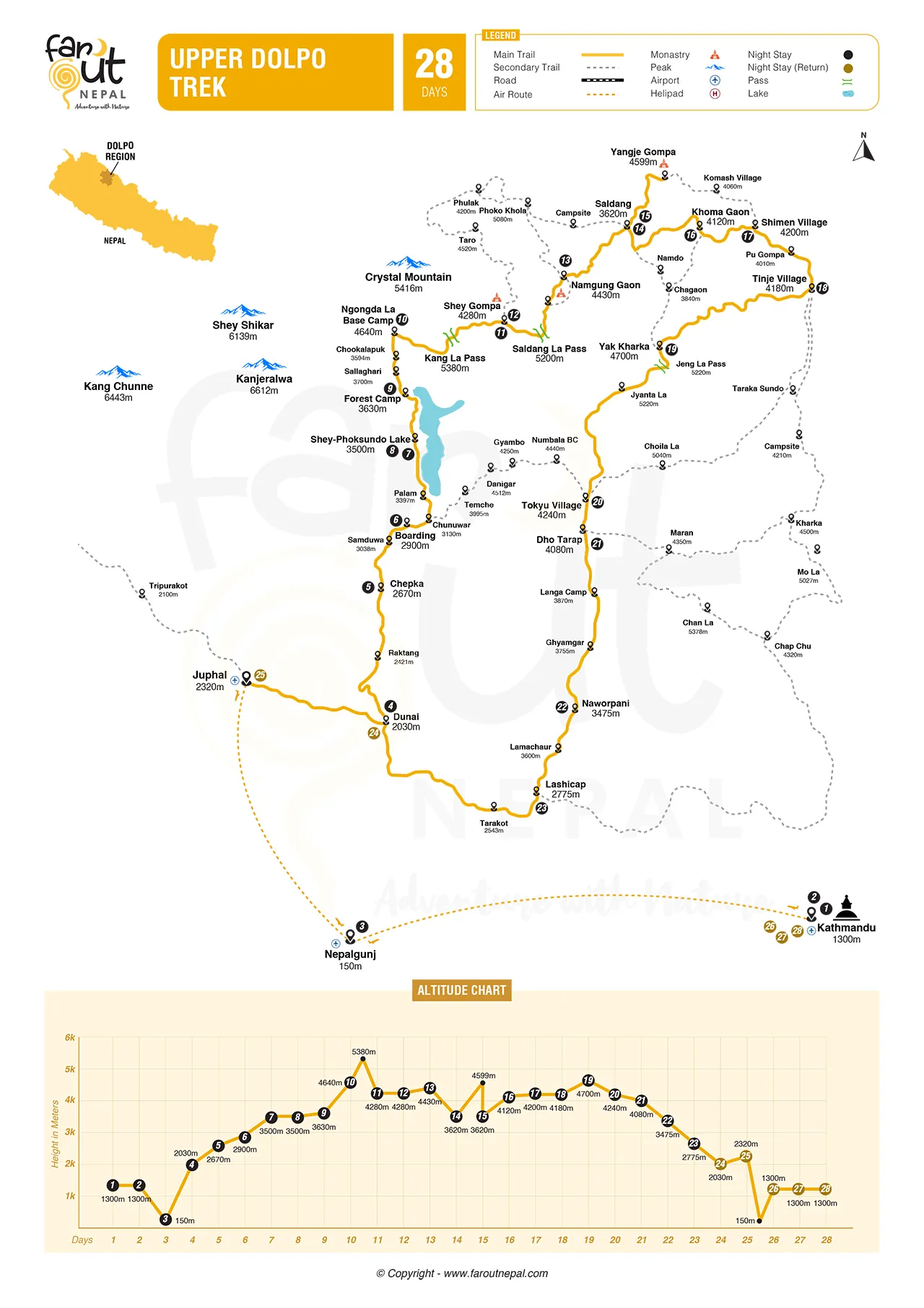
Trip map of Upper Dolpo Trek
Trip Information
Upper Dolpo Trek Facts
Duration: 24 Days in total (20 trekking days + travel, permits, and buffer time)
After completing the full itinerary, it’s clear that the Upper Dolpo Trek is not just a journey but a true high-altitude expedition. Spanning nearly four weeks, the route combines long trekking days, remote camping, and complex logistics across one of Nepal’s most isolated regions.
Reaching a maximum elevation of 5,380 meters at Kang La Pass, the trek requires strong physical fitness and prior experience at high altitudes. Daily walks of longer duration often involve crossing rugged terrain and high mountain passes.
This is a high-altitude trek that starts and ends in Juphal, accessible via flights from Kathmandu and Nepalgunj. With minimal infrastructure along the route, the experience is defined by raw landscapes, deep cultural encounters, and complete immersion in the wilderness of Dolpo.
Best Time to Trek Upper Dolpo
The Upper Dolpo region lies in the rain shadow of the Dhaulagiri range, resulting in a relatively dry climate compared to other parts of Nepal. The weather can still be unpredictable, so timing your trek carefully is essential for safety, accessibility, and the best experience of the landscapes and culture.
It is possible to trek there during the summer, as well as in the normal pre- and post-monsoon trekking seasons. Problems are likely to be encountered, however, in travelling to and from the region during the monsoon months.
Ideal Trekking Time:
- Mid-May to June (Between spring & summer): Moderate temperatures, clear skies, and blooming alpine flora make trekking highly enjoyable.
- September to Mid-October (Autumn): Stable weather, crisp air, and excellent visibility of the Himalayan peaks.
Other Considerations:
- Summer Monsoon (June to August): Possible, but travel to and from Dolpo can be challenging due to occasional rain and flooding.
- Winter (November to Early March): Extremely cold with heavy snow; many passes may be impassable, making it not recommended for most trekkers.
- Flight-Dependent Access: Weather can significantly impact flights to Juphal, so consider including buffer days for potential delays.
Choosing the right time to trek ensures safer trekking, better visibility of stunning landscapes, and smoother travel logistics throughout this remote Himalayan region.
Difficulty of Upper Dolpo Trek
The Upper Dolpo Trek is a physically demanding high-altitude expedition in one of Nepal’s most remote regions. Trekkers face long days of walking (typically 6–8 hours) with steep ascents, rugged trails, and multiple high passes above 5,000 meters. The region’s isolation means limited access to medical facilities, teahouses, or emergency support, making preparation and self-reliance essential.
This trek is ideal for:
- Experienced trekkers who are accustomed to high-altitude environments.
- Adventurers seeking solitude, raw Himalayan landscapes, and cultural immersion.
- Those who are mentally and physically prepared for multi-week camping expeditions in remote terrain.
Travel & Logistics for Upper Dolpo Trek
Reaching Upper Dolpo requires careful planning, as the region is remote and access is limited. Most travellers combine domestic flights with trekking to reach the trailhead efficiently.
Access Points & Travel Options:
- Flight to Juphal: The fastest and most common option. Flights are weather-dependent, so flexibility is important.
- Road Journey: 4×4 vehicles can reach Juphal from Nepalgunj in approximately 15 hours.
- Alternative Trek Approach: For those with extra time and stamina, it is possible to trek into Dolpo from Beni or Jomsom over multiple days.
Baggage & Weight Allowances:
- Trekkers are allowed 15 kg of main luggage, typically carried by mules, so you only need a small daypack for essentials like water, camera, sunscreen, jacket, and medications.
- Domestic Flight Allowances:
- Small aircraft (Juphal/Jomsom): 10 kg of checked baggage + 5 kg of carry-on; an additional 5 kg can be booked as cargo.
- Larger aircraft (Kathmandu → Nepalgunj/Pokhara): 20 kg checked baggage.
This combination of careful planning, weight management, and understanding local transport options ensures a smoother journey to the remote Upper Dolpo region.
Preparation & Gear for Upper Dolpo Trek
The Upper Dolpo Trek is physically demanding and requires careful preparation, both mentally and physically. Trekkers should be ready for long walking days on rugged trails, high-altitude conditions, and fully camping-based logistics.
Mental & Physical Preparation:
- Fitness Training: Build stamina with daily hikes of 9–12 km, stair climbing, and aerobic exercises such as jogging, cycling, or swimming.
- Acclimatization Practice: If possible, train at higher altitudes to help your body adjust to lower oxygen levels.
- Mental Readiness: Prepare for isolation, unpredictable weather, and multi-day trekking with mindfulness, meditation, or visualization techniques.
Interested trekkers can check out our blog for tips on preparing for high-altitude treks, such as the Upper Dolpo Trek.
Gear Essentials:
- Clothing: Layered clothing system including thermal base layers, fleece mid-layers, waterproof outer shell, gloves, and hats.
- Footwear: Durable trekking boots, warm socks, and gaiters for snow or scree sections.
- Camping & Trekking Equipment: Sleeping bag (rated for -15°C), trekking poles, headlamp, and daypack for essentials.
- Personal Items: Water bottles or hydration system, sunscreen, sunglasses, camera, and toiletries.
Trekking Support:
- The trek is fully supported by experienced guides, cooks, and porters. Mules carry main baggage (up to 15 kg per person), leaving trekkers free to carry only a daypack.
- All camping equipment, including tents, kitchen facilities, dining areas, and toilet facilities, is provided.
Proper preparation ensures a safe, comfortable, and rewarding experience while exploring Upper Dolpo’s remote landscapes and Tibetan-influenced culture.
Upper Dolpo: Fully-Supported Camping Style Trek
Due to the remoteness of Upper Dolpo, this trek is fully supported in a camping style. Our team, consisting of Sherpas, supports and sets up comfortable camps each evening, including two-person tents, dining, kitchen, bath, and toilet facilities. Meals are freshly prepared by our cooks, allowing trekkers to focus on the journey. Our porters will also carry your gear, while you can carry only a small daypack with essentials like water, a camera, and warm clothing.
A typical day on the trek includes:
- Early morning wake-up: Tea or coffee served in your tent.
- Breakfast: Freshly prepared to fuel the day.
- Trekking sessions: Usually 6–8 hours per day, with breaks for snacks and lunch.
- Arrive at camp: Around 4 p.m., allowing time to rest or explore the surroundings.
- Dinner: A wholesome meal, including soup, main course (rice, chapati, & curry), and dessert, usually served by 6 p.m.
- Retire for the night: Rest and sleep in your tent to recover for the next day.
This style of trekking offers a true wilderness experience while maintaining a safe and organized support system throughout the journey.
Upper Dolpo: Altitude Challenges & Safety Tips
The Upper Dolpo Trek reaches altitudes of up to 5,380 meters, making altitude sickness a significant concern. Oxygen levels decrease as you ascend, which can cause symptoms like headaches, fatigue, shortness of breath, and rapid heartbeat. Proper acclimatization and awareness are crucial to ensure a safe and enjoyable trek.
Key Safety Tips:
- Acclimatize Properly: Take rest days at strategic points, especially at Phoksundo Lake and before major passes like Kang La and Jyanta La. Avoid ascending more than 500 meters per day above 3,000 meters.
- Pace Yourself: Walk at a steady, comfortable pace. Avoid overexertion.
- Stay Hydrated: Drink at least 3–4 litres of water daily; dehydration worsens altitude sickness.
- Medication & First Aid:
- Carry medications such as Diamox (for altitude sickness), painkillers, and anti-nausea tablets.
- Bring a personal first-aid kit with bandages, antiseptic, blister pads, and any prescription medicines.
- Avoid Smoking & Alcohol: These reduce oxygen absorption and can increase altitude sickness risks.
- Recognize Warning Signs: Severe symptoms (persistent headache, nausea, dizziness, shortness of breath) require immediate descent to lower altitudes.
- Emergency Preparedness: Guides carry a satellite phone for emergencies. Helicopter evacuation is possible but can be delayed due to weather conditions.
With these precautions, trekkers can minimize risks and enjoy the incredible landscapes and cultural richness of Upper Dolpo safely.
To learn more about AMS and its prevention during treks like Upper Dolpo, refer to our blog: AMS Overview, Causes, and Prevention.
Permits & Fees for Upper Dolpo Trek
Upper Dolpo is a restricted area, so trekking here requires special permits, as well as entry to Shey Phoksundo National Park. Permit processing begins in Kathmandu before the trek, and all travellers must provide passport copies and personal details.
Required Permits:
- Upper Dolpo Special Permit: USD 500 for the first 10 days, then USD 50 per day thereafter.
- Shey Phoksundo National Park Entry Fee: USD 24 per person.
- Lower Dolpo Permit (if visiting lower areas): USD 10 per person per week.
Important Notes:
- Permit processing cannot be done on Saturdays (government offices closed).
- Copies of the passport and personal details (including name, nationality, passport number, date of birth, sex, and profession) are required.
- Permits are essential and must be verified in Kathmandu before starting the trek.
Travel Insurance for Upper Dolpo Trek
Comprehensive travel insurance is mandatory for all trekkers in Upper Dolpo. The remote and high-altitude nature of this trek makes coverage essential.
- Should cover medical emergencies, including hospitalization and treatment for altitude sickness.
- Must include helicopter evacuation, as some areas are far from medical facilities.
- Trip cancellation and interruption coverage is strongly recommended due to weather-dependent flights.
- Ensure coverage for personal belongings, especially gear and electronics, during transit and camping.
- Carry a copy of your insurance policy and emergency contact numbers with you.
Upper Dolpo Infrastructure
Upper Dolpo is one of Nepal’s most remote regions, and as a result, infrastructure is limited. Trekkers should be prepared for minimal services.
- Electricity: Available only in some villages and monasteries via solar panels; charging devices are limited. Portable power banks and solar chargers are recommended.
- Communication: Mobile networks are often intermittent, with some areas experiencing no signal at all. Satellite phones or local SIMs with limited coverage can be used for emergencies.
- Banking & ATMs: There are no ATMs along the route; please carry sufficient Nepalese Rupees in cash.
- Internet: Very limited, mostly in larger villages; do not rely on connectivity for daily updates.
Trek the Upper Dolpo with Far Out
The Upper Dolpo Trek is one of Nepal’s last untouched Himalayan frontiers. The region offers trekkers a rare combination of high-altitude adventure, deep cultural immersion, and breathtaking landscapes. From the serene Phoksundo Lake to the ancient monasteries of Shey Gompa and the remote Tibetan-style villages, every day brings new experiences and challenges.
This trek is designed for experienced and prepared adventurers. It rewards those who embrace its remoteness with solitude, discovery, and a deep connection to the mountains and its culture. Proper preparation, awareness of altitude and weather conditions, and respect for the unique Dolpo environment ensure a safe and unforgettable journey into one of the world’s most extraordinary wilderness regions.
Ready to take on this epic adventure? Book your Upper Dolpo Trek with Far Out and let our expert team handle permits, logistics, and all the details, so you can fully immerse yourself in the pristine Himalayan landscapes and rich Tibetan culture. Your journey into one of Nepal’s most remote regions awaits.
Reviews on Upper Dolpo Trek
Special Savings and Discounts for Group Travelers!
-
1 -
person
US$ 5,100
-
2 -
3 person
US$ 4,575
-
4 -
5 person
US$ 4,420
-
6 -
9 person
US$ 4,285
-
10 over
9999
US$ 3,990
US$ 5