


Which Is the Hardest Pass on the Everest Three Passes Trek? (Kongma La vs Cho La vs Renjo La)
Introduction to The Everest Three Passes
If you’re searching for the Everest Three Passes Trek, this question is likely not idle curiosity. Underneath “which pass is hardest” is often a quieter one: am I actually capable of this? That’s a fair thing to wonder before committing weeks and serious money to a trek that crosses three passes above 5,300m.
Everyone agrees that the hardest pass is Kongma La due to the altitude or the distance. But altitude alone doesn’t explain why, and it definitely doesn’t tell you which pass will be hardest for you specifically. Difficulty here isn’t one-dimensional. It shows up as exhaustion on one pass, as nerve on another, and as sheer persistence on the third. This guide breaks down what actually makes each crossing hard, so you can prepare for the right thing instead of just bracing generally.
Which Everest Pass Is the Hardest?
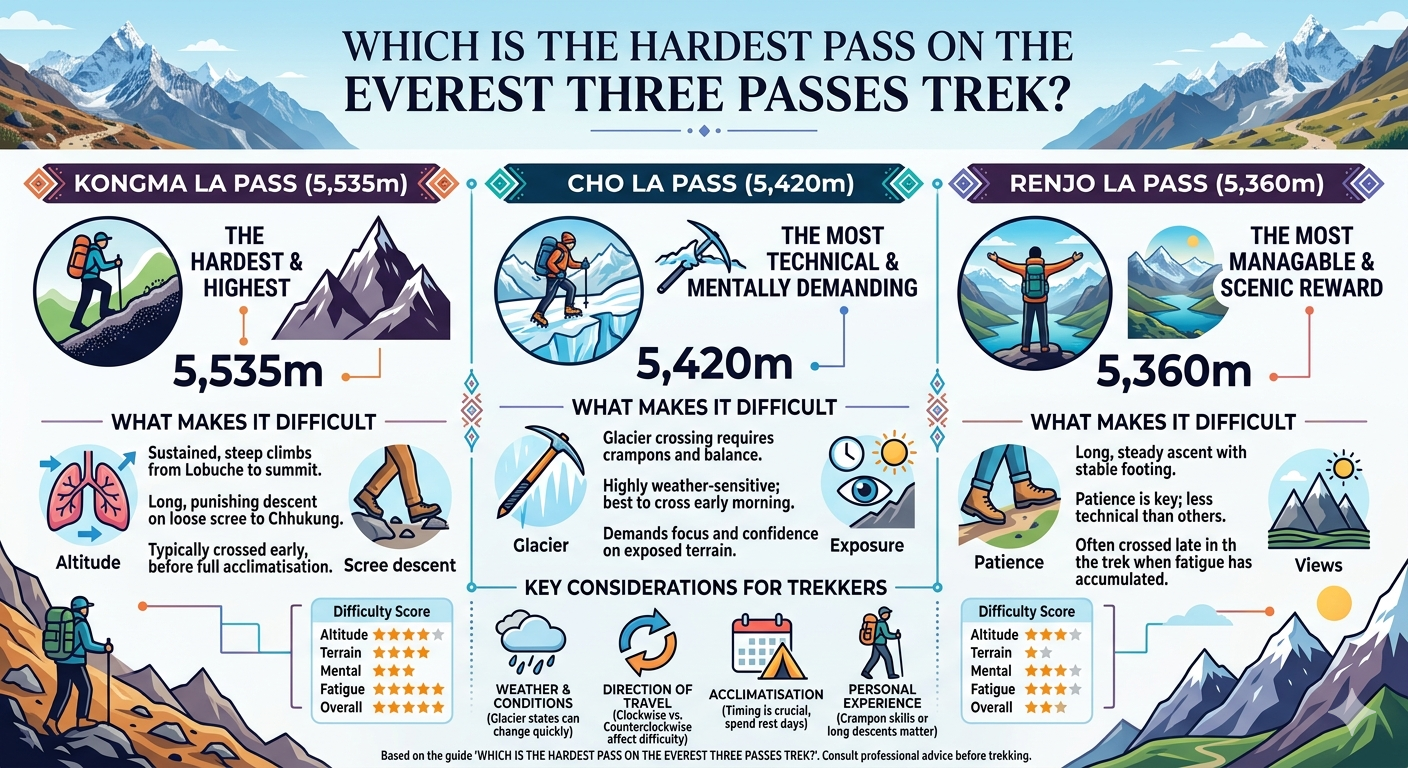
As stated above, Kongma La (5,535m) is generally the hardest pass on the Everest Three Passes Trek.
- Kongma La: the highest, longest, and most physically exhausting
- Cho La: most technical, most mentally demanding
- Renjo La: most manageable, best views
But “hardest” depends on what you personally struggle with.
How We Compared Kongma La, Cho La, and Renjo La
Most of the rankings of these passes are solely based on elevation. But that’s incomplete. A 100m difference in altitude matters less than when you cross a pass, or what’s the terrain like at that time, or even what kind of difficulty do you personally handle worst?
Two trekkers can cross the same pass on the same day and come away with completely different verdicts on how hard it was. This is because difficulty isn’t just a property of the mountain; it’s a product of the mountain meeting a specific person on a specific day.
We compared all three across four dimensions, weighted by how much each actually shapes the experience of crossing:
| Dimension | Weight | What It Measures |
| Altitude | 35% | Oxygen availability, summit elevation |
| Terrain | 25% | Surface type: rock, scree, or glacier |
| Mental & Exposure | 20% | Fear, exposure, and the consequence of a misstep |
| Fatigue & Acclimatisation | 20% | When the pass is crossed, cumulative tiredness |
Altitude
Every 100m above 5,000m costs you more than the last. Kongma La’s summit sits 175m above Renjo La’s. This may not sound dramatic on paper, but it is noticeably harder in your lungs when you’re crossing the pass.
Terrain
Loose scree drains you differently from glacier ice, which drains you differently from packed trail. Kongma La’s descent is scree. Cho La’s crossing is ice. Renjo La is mostly stable rock. It’s the same altitude range, but three different kinds of tiredness.
Mental & Exposure
Some difficulty is physical. Some is psychological. Standing on moving ice above a drop triggers a different kind of stress than a long, grinding climb, even if the climb burns more calories.
Fatigue & Acclimatisation
The same pass crossed on Day 5 and Day 12 of a trek can feel like two different mountains. Your body’s altitude tolerance improves substantially over the first ten days at elevation. Timing changes everything.
If you can score each pass against these four dimensions, and a clearer, more honest ranking emerges: one that explains why it’s hard, not just that it is.
Everest Three Passes at a Glance
| Pass | Elevation | Route | Typical Trek Day | Tests |
| Kongma La | 5,535m | Lobuche → Chhukung | Day 5–7 (clockwise) | Endurance |
| Cho La | 5,420m | Dzongla → Gokyo | Day 8–10 (clockwise) | Confidence |
| Renjo La | 5,360m | Gokyo → Lungden | Day 11–13 (clockwise) | Consistency |
All three sit within the wider Khumbu region, linking the Everest Base Camp trail with the Gokyo Lakes valley. Crossing all three in one trip is what defines the Three Passes Trek. There’s no shortcut around any of them if you’re doing the full loop.
Kongma La Pass: Why It’s Usually Considered the Hardest
- Elevation: 5,535m
- Route: Lobuche → Chhukung
- Tests: Endurance
If you’ve never wondered whether your legs will simply give out partway through a day, Kongma La is where you’ll find out.
What Makes Kongma Difficult
From Lobuche (4,940m), the ascent gains roughly 600 vertical metres with almost no flat recovery sections. It’s sustained, grinding, and long before you even reach the summit. The descent toward Chhukung is where most people actually struggle. This descent is a long stretch of loose scree that punishes already-tired knees and demands constant attention. There’s no coasting down. Every step requires a small decision.
This is also the pass most often crossed early in the standard clockwise itinerary, typically Day 5–7, when your body hasn’t finished adapting to altitude. That timing disadvantage is a real part of why it earns its reputation. The difficulty isn’t only the mountain, it’s the mountain arriving before you’re ready for it.
Who Struggles Most Here
If long, sustained physical effort wears you down faster than fear does, Kongma La will be your hardest day. Trekkers without prior experience above 5,000m, or anyone who hasn’t trained for sustained descents, tend to find this the most punishing of the three. It’s not because of any single moment, but because of how long the difficulty lasts.
When Kongma Feels Easier
Cross it later in your itinerary, like after eight or more days at altitude, and Kongma La becomes noticeably more manageable. Trekkers doing the route counterclockwise, who reach Kongma La after Renjo La and Cho La, consistently report an easier experience here, even though nothing about the mountain has changed.
Difficulty Score
| Category | Score |
| Altitude | ★★★★★ |
| Terrain | ★★★★ |
| Mental & Exposure | ★★★ |
| Fatigue impact | ★★★★★ |
| Overall | ★★★★★ |
Cho La Pass: Why It Feels More Technical Than Kongma
- Elevation: 5,420m
- Route: Dzongla → Gokyo
- Tests: Confidence
If exposure unsettles you more than exhaustion does, this is the pass that will quietly get under your skin.
Glacier and Footing
Cho La’s defining feature is its glacier crossing. It’s a section of ice that demands balance, caution, and usually crampons. It isn’t long, but it concentrates risk into a short stretch in a way that nothing else on the trek does. Every foot placement matters here. That’s a different kind of tiring than a long climb, that is mentally draining rather than physically draining, and it lingers in a way pure fatigue doesn’t.
Weather Sensitivity
Cho La is the most condition-dependent of the three passes. Crossing early in the morning (ideally before 7 am) means firmer, more predictable ice. Cross later in the day, after the sun has softened the surface, and the same pass becomes meaningfully harder and riskier. Season matters too: October and November typically offer more stable conditions than the unsettled snow sometimes left over from the monsoon season.
Who Finds Cho La Hardest
If you’ve never crossed exposed terrain or worked with crampons, the glacier section can be the most intimidating moment of the entire trek, regardless of your fitness level. Strong, fit trekkers with no prior exposure experience sometimes find Cho La harder than Kongma La, even though it sits 115m lower. Confidence under uncertainty matters more here than raw stamina.
Difficulty Score
| Category | Score |
| Altitude | ★★★★ |
| Terrain | ★★★★★ |
| Mental & Exposure | ★★★★★ |
| Fatigue impact | ★★★ |
| Overall | ★★★★ |
Renjo La Pass: The Most Balanced of the Three
- Elevation: 5,360m
- Route: Gokyo → Lungden
- Tests: Consistency
If you can keep putting one foot in front of the other for hours without losing focus, Renjo La rewards you generously.
Why Renjo Feels Smoother
There’s no glacier here, no major scree field, nothing technical to navigate. What Renjo La asks for instead is patience. It involves a long, steady ascent from Gokyo that gains elevation gradually rather than punishing you in short bursts. The terrain is stable underfoot. The challenge is less about any single obstacle and more about sustaining effort, breath after breath, at altitude.
When Renjo Becomes Difficult
By the time most trekkers reach Renjo La, typically the final pass on a clockwise loop, fatigue has already accumulated from two prior crossings. The pass itself is the most forgiving of the three, but it’s rarely crossed by fresh legs. Consistency, not difficulty, is what gets tested here: can you keep going at the same pace after everything that’s come before?
Who Enjoys Renjo Most
Trekkers who find altitude tiring but not frightening, and who prefer a pass that rewards patience over technical skill, tend to enjoy Renjo La the most. It’s also the strongest confidence-builder if crossed first. For trekkers attempting the route counterclockwise, Renjo La is a manageable introduction to what a 5,000m+ pass actually feels like.
Scenic Value
It’s worth noting Renjo La isn’t just the easiest of the three, but arguably the most beautiful. From the summit, Everest, Lhotse, and Makalu line the horizon, with the Gokyo Lakes glittering below. The reward at the top is real, and it tends to make the long ascent feel worthwhile in a way the other two passes don’t quite match.
Difficulty Score
| Category | Score |
| Altitude | ★★★★ |
| Terrain | ★★ |
| Mental & Exposure | ★★★ |
| Fatigue impact | ★★★★ |
| Overall | ★★★ |
Kongma La vs Cho La vs Renjo La: Side-by-Side Comparison
| Category | Kongma La | Cho La | Renjo La |
| Altitude | ★★★★★ | ★★★★ | ★★★★ |
| Technicality | ★★★ | ★★★★★ | ★★ |
| Mental demand | ★★★★★ | ★★★★ | ★★★ |
| Descent difficulty | ★★★★★ | ★★★★ | ★★★ |
| Scenic reward | ★★★★ | ★★★★ | ★★★★★ |
| Overall difficulty | ★★★★★ | ★★★★ | ★★★ |
The pattern is clear once you see it side by side: Kongma La wins on sheer physical demand, Cho La wins on technical and mental intensity, and Renjo La wins on consistency and reward. None of them is easy. They’re just hard in different currencies.
If you’re planning the full circuit rather than a single pass, our Everest Three Passes Trek itinerary breaks down the complete route day by day, including acclimatisation scheduling around all three crossings.
Why Trekkers Disagree on the Hardest Pass
Ask ten people who’ve completed the Three Passes which pass was hardest, and you won’t get one answer. Some will say Kongma La without hesitation. Others will insist Cho La’s glacier was the worst moment of the trip. A few will say Renjo La caught them off guard simply because it came last. That’s not inconsistency, but a difficulty that isn’t fixed. It shifts based on four things.
Weather
A clear, cold morning on Cho La is a different pass entirely from a warm, overcast afternoon crossing. Glacier conditions swing more with the weather than either of the other two passes.
Direction of Travel
Clockwise (Kongma La → Cho La → Renjo La) front-loads the hardest physical pass before you’re fully acclimatised. Counterclockwise reverses that. It eases in with Renjo La and saves Kongma La for when your body is most adapted, at the cost of facing it after two passes’ worth of accumulated fatigue.
Acclimatisation
Someone who’s spent extra rest days at altitude before starting will experience all three passes differently than someone moving through on a tighter schedule. Time at elevation is the single biggest variable nobody controls for in generic difficulty rankings.
Previous Trekking Experience
A trekker who’s used crampons before will find Cho La’s glacier far less intimidating than a first-timer. Someone who’s done long descents on loose rock will find Kongma La’s scree section routine rather than punishing. Your difficulty ranking is, in part, a reflection of what you’ve already done.
This is why a fixed “hardest pass” answer only tells part of the story. The framework above gives you the consensus. The honest answer is that your hardest pass depends on which of these four variables hits you hardest.
Which Everest Pass Should You Choose?
If you’re planning your preparation or trying to decide where to focus your training for the Khumbu region, here’s where the four dimensions point.
If you struggle with long endurance → Kongma La will test you most. Train with sustained climbs and long descents on loose or uneven terrain.
If you struggle with exposure or technical footing → Cho La will test you most. If you’ve never used crampons, consider a short practice session before the trek.
If you struggle with altitude anxiety generally → Kongma La’s elevation and timing make it the most likely to trigger it.
If you’re after the best reward-to-effort ratio → Renjo La delivers spectacular views without demanding technical skill. It can be a strong choice if you’re newer to high-altitude trekking.
If you’re doing the full loop (most trekkers are) → Prepare hardest for Kongma La, respect Cho La’s technical demands, and let Renjo La be the pass where you finally enjoy the view instead of just surviving it.
Final Verdict: Which Is the Hardest Pass on Everest?
Kongma La is the hardest pass on the Everest Three Passes Trek. The highest, longest, and most physically demanding, this pass is often crossed before trekkers are fully acclimatised.
Cho La is the most technical and mentally demanding, thanks to its glacier crossing and weather-sensitive conditions.
Renjo La is the most manageable, but at 5,360m, “manageable” is relative. Nothing on this trek is easy. Some of it just asks more from your legs, and some of it asks more from your nerves.