


Understanding the Risks of Climbing an 8,000er Like the Broad Peak
Introduction
Broad Peak carries a reputation among mountaineers as “K2’s easier neighbor.” It’s a mountain climbed as an acclimatization objective before or after an attempt on its far more famous companion, a few kilometers away in the Karakoram. That reputation isn’t bad, exactly.
Broad Peak is not considered one of the more technically demanding 8,000-meter peaks. However, technical grade and overall danger are two distinct measurements, and conflating them is where most misunderstandings about this mountain originate.
Answering the question: Broad Peak is dangerous because of what mountaineers call objective hazard, rather than being technically difficult to climb. The extreme altitude, avalanche-prone slopes, and volatile Karakoram weather, combined with a long, exposed summit ridge keeps climbers at extreme elevation far longer than most 8,000ers require. Its comparatively moderate technical grade has, historically, led some climbers to underestimate it.
Broad Peak at a Glance
- Elevation: 8,047 m / 26,400 ft (some sources cite 8,051 m; this article follows the figure recognized by the Alpine Club of Pakistan and American Alpine Club)
- Rank: 12th-highest mountain in the world
- Range: Karakoram
- Location: Gilgit-Baltistan, Pakistan, near the Baltoro Glacier and Concordia, adjacent to K2
- Classification: Eight-thousander
- First ascent: June 9, 1957. Hermann Buhl, Kurt Diemberger, Marcus Schmuck, and Fritz Wintersteller, climbing alpine-style without supplemental oxygen or high-altitude porters, were the first team to put every member of an expedition on top of an 8,000-meter peak (Guinness World Records)
How Difficult Is the Broad Peak to Climb?
Is Broad Peak easy to climb? No. But it is genuinely less technical than K2, and that comparison is where the confusion starts.
Technical difficulty describes the physical climbing itself, like how steep the terrain is, how much rock or ice work is required, and how much specialized skill is needed to move through them. By that narrow measure, Broad Peak’s standard route, up the western spur and along the summit ridge, compares favorably to routes on K2 or Nanga Parbat. There’s no equivalent of K2’s Bottleneck, no sustained vertical ice.
But technical difficulty is only one input into overall risk. Overall expedition difficulty and objective hazard are separate variables, and Broad Peak scores much higher on both.
An objective hazard is a danger that exists independent of a climber’s skill or preparation, like avalanche-prone slopes, unstable seracs, or sudden weather. No amount of technical ability removes it. On Broad Peak, the risk comes less from what a climber’s hands and feet have to do, and more from how long they’re exposed to hazards they can’t control, at an altitude that steadily degrades the judgment needed to manage them.
That gap between “less technical” and “less dangerous” is the reason experienced mountaineers still treat Broad Peak with real caution.
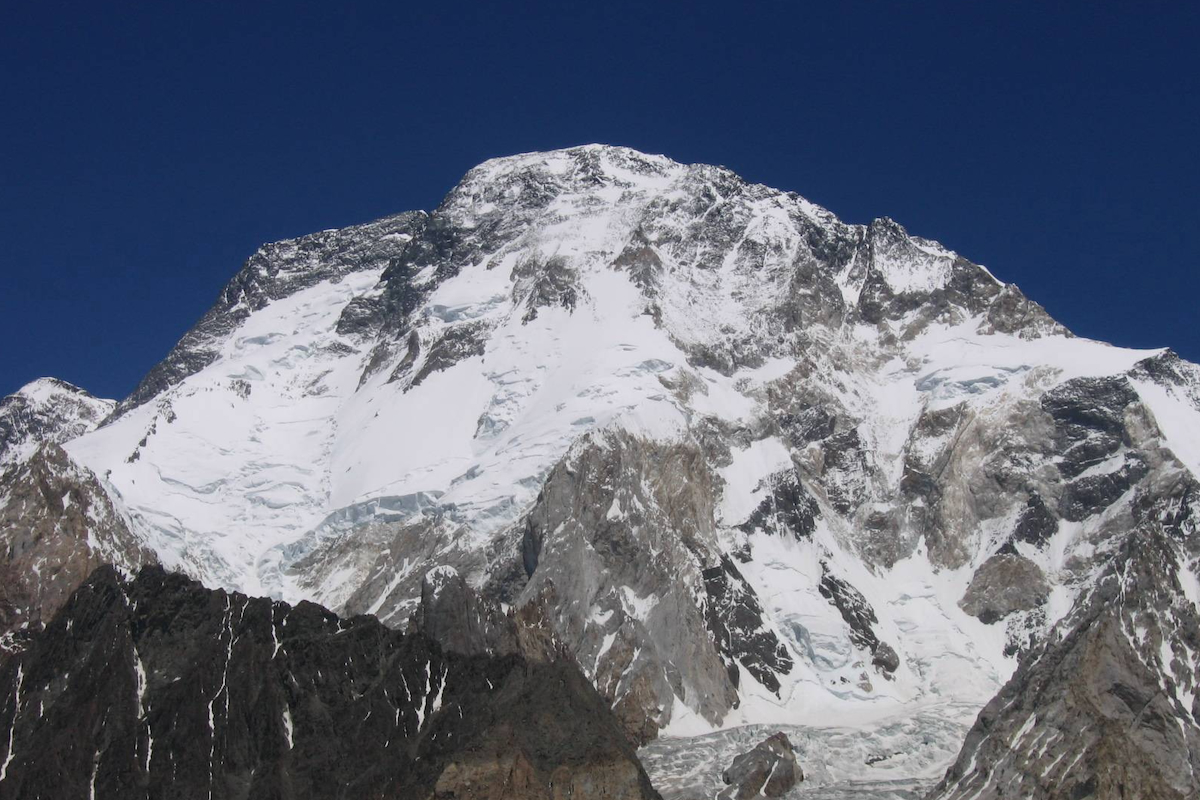
Why Is Broad Peak So Dangerous?
Several factors compound to push Broad Peak’s risk well above what its technical grade implies.
- Extreme altitude: Above 8,000 meters, climbers enter the death zone, where atmospheric oxygen sits at roughly a third of sea-level pressure. The physiological chain is well understood: reduced oxygen leads to hypoxia, hypoxia degrades coordination and judgment, and impaired judgment is what turns a manageable situation into an accident, like when decisions have to be made quickly, exhausted, at altitude.
- A long, exposed summit day: Broad Peak’s summit ridge is unusually long for an 8,000-meter peak. It also includes a fore-summit at roughly 8,030 m that climbers must cross before reaching the true summit. The extended time spent above 8,000 meters compounds cold exposure, fatigue, and the odds of a weather shift catching climbers still high on the mountain.
- Avalanche and objective hazard: Broad Peak’s upper slopes, particularly the terrain between Camp 2 and Camp 3, sit in the 30–45 degree range where slab avalanches release most readily. Fresh snowfall repeatedly loads this section with unstable snow. This isn’t an occasional, but an environmental feature of the route, and it accounts for the mountain’s worst accidents.
- Weather volatility and decision pressure: The Karakoram produces fast-moving, sometimes violent weather systems. Climbers typically commit to a summit push during a narrow weather window, often deciding under time pressure with imperfect forecasting. This pressure has historically pushed teams to move on marginal days.
- Remoteness and rescue limitations: Base Camp sits deep in the Karakoram, reachable only via a multi-day trek along the Baltoro Glacier. Rescue helicopters serving the region typically can’t fly above roughly 5,000 meters (close to Base Camp’s own altitude), which means an accident higher on the mountain often has to be met on foot before any air evacuation is possible.
| Hazard | Where it occurs the most | Why it’s dangerous |
| Altitude | Above 8,000 m | Hypoxia impairs judgment, coordination, and endurance |
| Avalanche | Snow-loaded slopes, ~6,600–6,800 m | Objective hazard, unrelated to climbing skill |
| Weather | Upper mountain, summit day | Sudden storms, whiteout, high winds |
| Long summit ridge | Fore-summit to true summit | Prolonged exposure, delayed descent |
| Exhaustion | Summit push and descent | Impairs decision-making when it matters most |
| Remoteness | Above Base Camp | Rescue is slow, altitude-limited, and weather-dependent |
How Have Climbers Died on Broad Peak?
Broad Peak’s accident history doesn’t reduce to a single cause. Deaths have historically resulted from several recurring patterns: avalanches on the loaded slopes near Camp 2 and Camp 3; falls on the exposed summit ridge and during descent; exhaustion and altitude illness following long summit pushes; and, in a smaller number of cases, climbers who went missing in poor visibility.
No one mechanism dominates the record, which is itself the point. It suggests Broad Peak’s danger is cumulative. It can be the product of altitude, terrain, and time spent exposed to both, rather than a single hazard that a climber can simply plan around.
What Is Broad Peak’s Fatality Rate?
Broad Peak’s fatality rate is often quoted as a single percentage, but that figure depends heavily on the dataset behind it. An older, widely cited estimate, which is based on ascent and death records through 2003, put the historical rate at roughly 7% (SummitPost). That number reflects a specific, dated population of climbers and shouldn’t be treated as a current or fixed statistic.
Fatality rates on 8,000-meter peaks shift as expedition volume, equipment, forecasting, and climbing practices change over time. They also depend on what’s counted in the denominator, like total summit attempts, successful ascents, or registered expeditions, all of which yield different numbers from the same underlying data. Any fatality-rate figure is only as useful as the methodology behind it.
Why Is the Descent So Dangerous?
Reaching the summit is usually treated as the climax of an expedition, but a disproportionate share of Broad Peak’s fatalities happen on the way down. The pattern is consistent across high-altitude mountaineering generally, and Broad Peak’s terrain makes it worse.
Climbers are at their most fatigued and dehydrated after a long summit push, judgment is more compromised by hypoxia than it was hours earlier, and Karakoram weather tends to deteriorate through the afternoon. Broad Peak’s long summit ridge extends this exposure as the distance between the true summit and the safety of the upper camps is greater than on many 8,000ers. This means that the climbers descend exhausted terrain at extreme altitude for longer than they would elsewhere.
Broad Peak Avalanches and Recent Accidents
Avalanche risk on Broad Peak is structural, not incidental. The slope between Camp 2 and Camp 3, at roughly 6,600–6,800 meters, is a recurring release zone. Fresh snowfall on this section has triggered accidents in multiple, largely separate climbing seasons.
You can learn about all the Broad Peak accidents here: []
July 2025: After weeks of dry conditions, two days of fresh snowfall triggered a slide on this same stretch of the mountain. Polish climber Waldemar Kowalewski was caught while descending from Camp 3, suffered a broken leg, and was stranded above Camp 2 for several days before a Sherpa-led rescue reached him (ExplorersWeb; Alan Arnette). He survived and was later evacuated by helicopter (TVP World), but the incident was a clear signal of how quickly this section of the mountain turns hazardous after snowfall.
July 2026. On July 30, an avalanche struck a group of ten climbers on the same slope, at roughly 6,600 meters (Wikipedia). Heavy snowfall in the preceding days had loaded the slope, and the group set out on one of the first clear days after the storm. It was the kind of decision every 8,000-meter expedition eventually faces, weighing a narrow weather window against snow that hasn’t yet stabilized (National Geographic). The slide swept all ten climbers down the mountain; by August 1, all ten were confirmed dead (Al Jazeera; ABC News), among them Nirmal Purja, one of the most recognized names in contemporary high-altitude mountaineering. It stands as one of the deadliest single accidents in the mountain’s climbing history.
Why is rescue so difficult here?
An avalanche at 6,600 meters doesn’t end the danger, but starts a second, harder problem. The same unstable slope often remains hazardous to search teams, and continued snowfall can make conditions worse before they improve.
With rescue helicopters typically unable to fly much above 5,000 meters in this region, injured or stranded climbers well above that altitude have historically had to wait for teams of Sherpas or fellow climbers to reach them on foot. This is a slow, physically demanding process in terrain that is itself avalanche-prone. This is also why accidents that would be manageable at lower elevations become drawn-out, multi-day operations on Broad Peak, a dynamic that shaped both the 2025 rescue and the far larger 2026 recovery effort.
How Many Climbers Have Successfully Summited Broad Peak?
The exact number of successful Broad Peak summits varies by source, largely because of a long-standing ambiguity between the mountain’s fore-summit and its true summit. The fore-summit sits at roughly 8,030 meters, about an hour’s climb short of the true 8,047 m summit across a long, exposed traverse. A meaningful number of climbers who reported summiting Broad Peak historically stopped at the fore-summit, whether by choice, exhaustion, or a misjudgment of the terrain still ahead.
This means published “total summits” figures deserve scrutiny: some databases count fore-summit ascents as full summits, others don’t, and the two produce materially different totals for what looks like the same statistic. Since 1957, successful ascents have risen steadily as commercial expeditions have made the mountain more accessible, but any precise current total should come from a transparent, up-to-date dataset rather than an older aggregate.
What Is the Broad Peak Climbing Route Like?
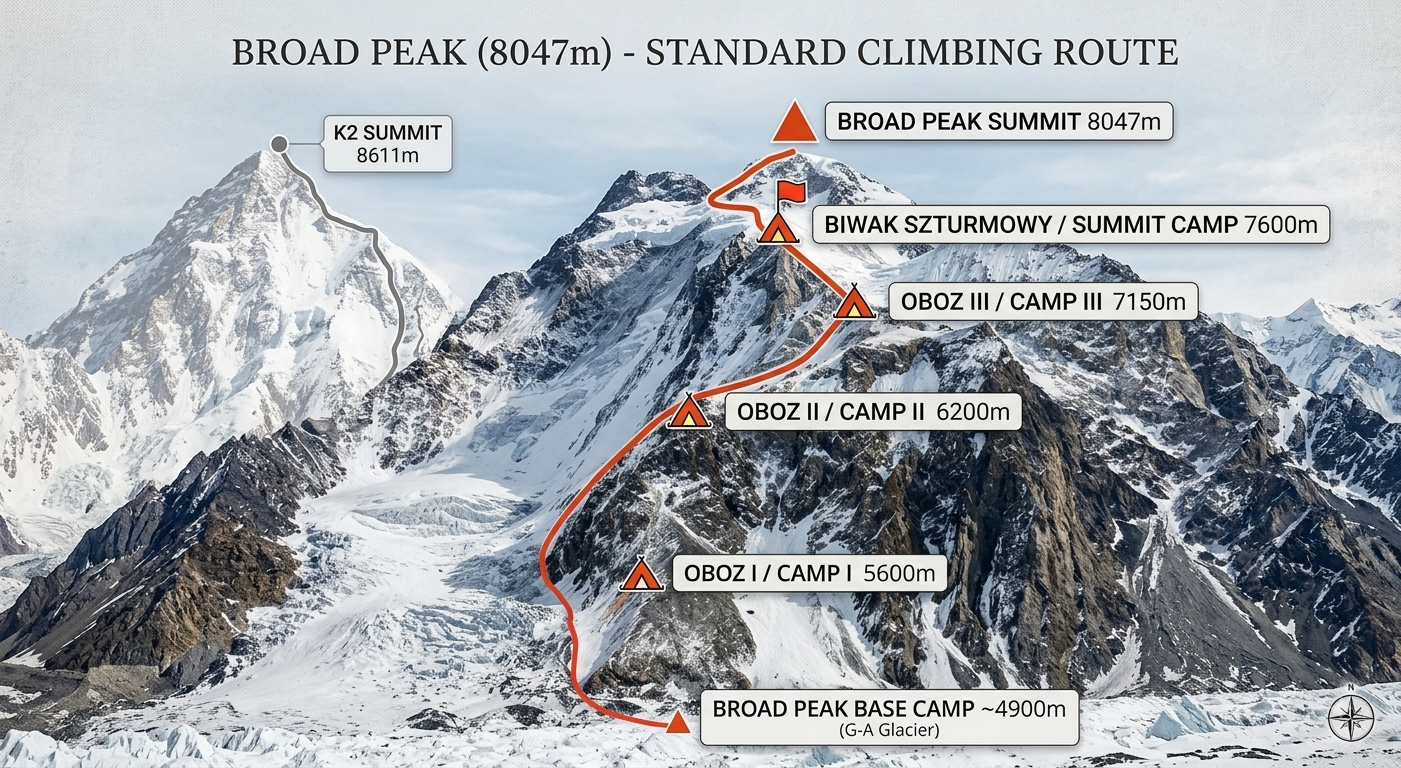
Broad Peak’s standard route follows the mountain’s western spur, climbed via a familiar high-altitude expedition structure:
- Approach: A multi-day trek along the Baltoro Glacier to Concordia and on to Broad Peak Base Camp, which is also shared with the approach to K2
- Base Camp to Camp III: Progressive acclimatization rotations up the western spur, gaining the ridge toward the upper mountain
- Upper mountain and summit ridge: A long, exposed ridge traverse passing the fore-summit before reaching the true summit
- Descent: Retracing the same line, typically the most physically depleted and highest-risk phase of the climb
The route’s technical sections are moderate by 8,000-meter standards. What makes summit day demanding isn’t the climbing, but the length of the upper ridge and the distance between the fore-summit and the true summit, which stretches an already long day well past what most climbers expect.
Can Broad Peak Be Climbed Without Supplemental Oxygen?
Yes. Broad Peak has been climbed without bottled oxygen since its first ascent in 1957, and it remains a common objective for climbers pursuing oxygen-free ascents of multiple 8,000ers. Doing so raises the physiological stakes: acclimatization becomes more critical, and the margin for error in decision-making narrows. (Even at far lower altitudes, proper acclimatization and prevention matter, as our guide to staying safe on high-altitude routes suggests.) What it does not do is change the mountain’s objective hazards. Supplemental oxygen mitigates the physiological effects of extreme altitude, but does nothing to reduce avalanche risk, serac fall, or weather exposure.
Nirmal Purja, one of the climbers who died in the 2026 avalanche, was attempting the climb without bottled oxygen as part of a long-standing pursuit of a no-O2 record across all 14 eight-thousanders (National Geographic; Wikipedia). Tragically, the accident itself was a function of terrain and snow conditions, unrelated to physiological preparedness or climbing style.
Broad Peak vs K2: Which Is More Dangerous?
Broad Peak and K2 sit close together in the Karakoram and are frequently climbed in the same season, which invites direct comparison — though the honest answer resists a simple ranking.
| Factor | Broad Peak | K2 |
| Elevation | 8,047 m | 8,611 m |
| Technical difficulty | Moderate for an 8,000er | Extreme |
| Major hazards | Avalanche, altitude, weather, exposure | Avalanche, serac, falls, altitude |
| Summit challenge | Long upper ridge, fore-summit traverse | Highly technical upper mountain, Bottleneck serac |
| Rescue difficulty | Severe | Severe |
- K2 is widely regarded as more technically demanding, with sustained steep climbing, the notorious Bottleneck traverse, and a narrower margin for error on the route itself.
- Broad Peak’s lower technical grade, though, doesn’t translate into lower overall risk. Its danger comes from a different source: extreme altitude sustained over a long summit day, avalanche-prone terrain, and weather that can shift with little warning.
The two mountains are dangerous in different ways rather than by different degrees. K2 asks more of a climber’s technical skill, Broad Peak asks more of their judgment, endurance, and the conditions they happen to encounter.
The Bottom Line
Broad Peak’s comparatively moderate technical reputation can obscure how serious its real risks are. Extreme altitude, a long and exposed summit ridge, avalanche-prone terrain, volatile weather, and limited rescue options combine to make it a genuinely dangerous 8,000-meter climb, regardless of where it sits on a technical difficulty scale. Understanding that difficulty and danger are not the same thing is the most important step toward understanding this mountain.
Sources & Further Reading
- 2026 Broad Peak Avalanche — Wikipedia
- How Nims Purja’s Broad Peak Climb Ended in Deadly Disaster — National Geographic
- Avalanche Kills Famed Climber Purja and Nine Others in Pakistan — Al Jazeera
- All 10 Climbers Swept Away in Avalanche in Pakistan Are Confirmed Dead — ABC News
- Avalanche on Broad Peak Injures, Strands Climber (2025) — ExplorersWeb
- K2 2025 Coverage: Injured Climber on Broad Peak — Alan Arnette
- Broad Peak — SummitPost
- First Ascent of Broad Peak — Guinness World Records
In Memory
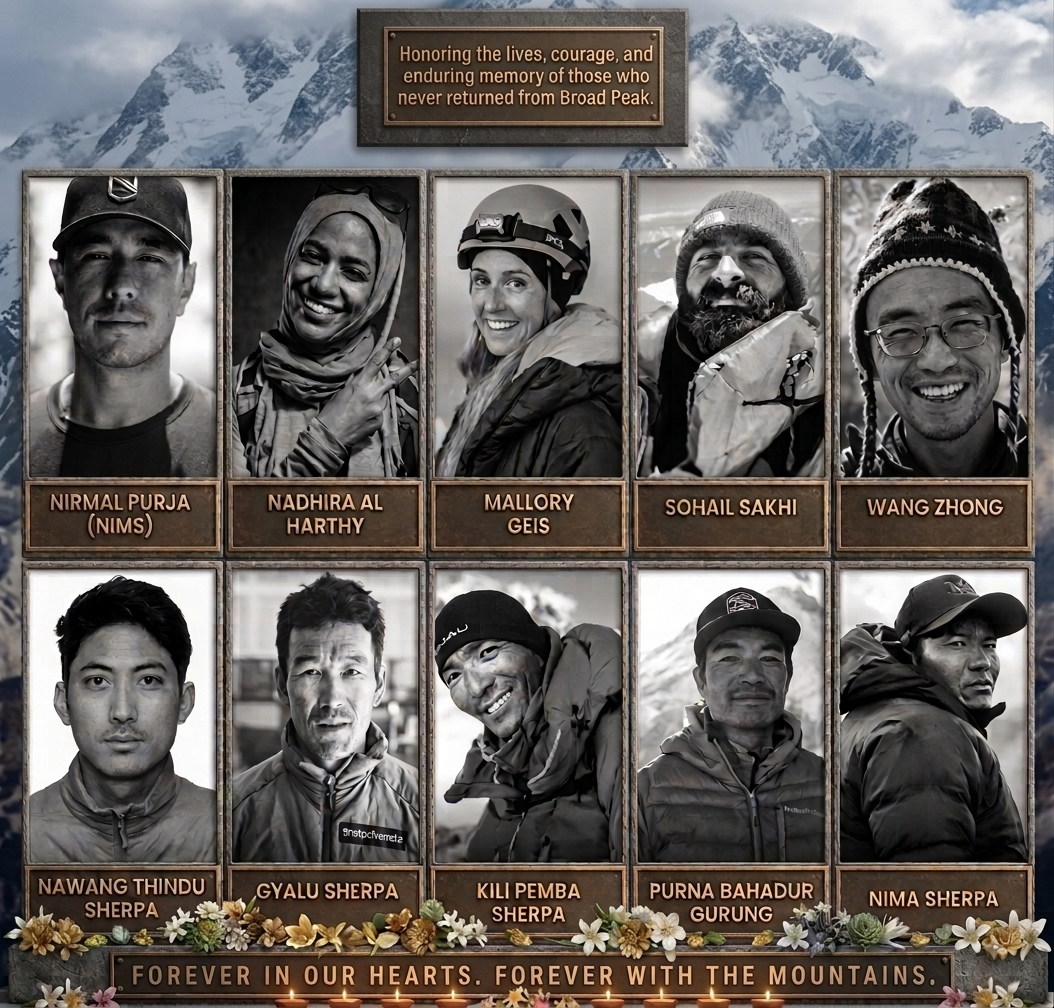
We remember with profound respect and deepest sympathy the ten climbers who lost their lives in the Broad Peak avalanche on July 30, 2026:
Nirmal Purja, Pur Bahadur Gurung, Kili Pemba Sherpa, Nima Sherpa, Nawang Thindu Sherpa, Gyalu Sherpa, Nadhira Ahmed Abdullah Al Harthy, Sohail Sakhi, Wang Zhong, and Mallory Geis.
They came to the mountains with courage, determination, and a deep passion for climbing. Their lives and their journeys touched not only those who knew them personally but also the wider mountaineering community, including us at Far Out Nepal.
Our thoughts are with their families, friends, teammates, and loved ones, who carry their memories beyond the mountain.
May their courage be remembered, their stories never forgotten, and may they rest in peace.