


Poon Hill Trek

Poon Hill Trek

Poon Hill Trek

Poon Hill Trek

Poon Hill Trek
Poon Hill Trek - 11 Days

Activity
Trekking & Tours
Duration
11 Days
Grading
Easy
Max Altitude:
3,200m. / 10,499ft.
Best Season
Mid Oct-Nov & Mid Mar-Apr
Style of Trip
Tea House Trek
Group Size
2-10 People
Accommodation
Hotel & Lodge
Meals
Breakfast, Lunch, Dinner
Why Poon Hill Trek ?
- Easy to medium trek – good even for novice trekkers
- Short – ideal for people having short time but yet want to have a taste of Himalayas
- No worries about altitude problems
- Great views of Sunrise and Sunset over the Himalayas from Poon Hill 3,200m
- Amazing views of the high Himalayas like Mt. Dhaulagiri Range, and Annapurna Range
- Experience the rural set up of Nepal
- Local Villages, terrace rice fields, rhododendron forest
Trip Introduction
Overview : POON HILL TREK
Poon Hill trek is one of the most well-liked short treks in Nepal. This trek may be approached from several directions and completed in different time frames by incorporating other beautiful trails. Poon Hill trek route lies north of Pokhara Valley just below the Annapurna Mountain (8,091 m) the 10th highest peak of the world.
Considered a simple hike in Nepal, it provides a relatively low-altitude, breathtaking perspective of the Central Himalayas. From Dhaulagiri (8,167m) and Tukuche (6920m) to Nilgiri (66,940m), Annapurna South, Annapurna I (8,091m), Hiunchuli (6,441m), and Tarke Kang (7,193m), Poon Hill (3,200m) provides the most amazing sunrise view over the Himalayas.
Dotted along the trail are beautiful local villages which provide the insights of the local people. You will also have the chance to tour the Gurung tribe’s museum and old village well preserved. Spring times are even more beautiful as the trails are covered with a vibrant rhododendron forest with breathtaking vistas of Annapurna and Dhaulagiri.
In six days, our Poon Hill trek program combines two well-known mountain viewing locations. Starting at the well-known Poon Hill viewpoint, which is 3,200 meters high, and continuing east past the village of Landruk, which is home to terraced rice fields, a rhododendron forest, and local farming, until arriving at Australian Camp. This is another great spot from where you will enjoy the breath-taking sweeping views of the Annapurna and Dhaulagiri Mountain ranges.
Poon Hill Trek: Highlights
- Striking views of the Central Himalayas Annapurna and Dhaulagiri Mountain ranges
- Mesmerizing views of the sunrise over the Himalayas from the Summit of Poon Hill (3,210m)
- Amazing Sunset views from Australian Camp (2,060m)
- Walk through nature beautiful rhododendron forest, bamboo groves, terraced rice fields, small streams and different species of birds
- Experience the peaceful, serene villages and the insights of locals
- Visit the Gurung Museum and old Gurung village well preserved.
POON HILL: Trek Routes
The trek route to Poon Hill with Australian Camp can be done from different directions. Ours is a usual route which starts from Hille village which is a drive of around 2 hrs from Pokhara. From there we walk to village of Tirkhedunga in an ascending order for lunch. Then we tackle toughest part by climbing the steep stone staircase believed to be around 3300 steps to a Magar village of Ulleri for an overnight stay. This section is the most challenging part in the entire trek route. After spending the night in Ulleri next day our destination is Ghorepani which is a gradual ascend order passing through local villages, rhododendron forest. Morning hike up to Poon Hill (3,200m) to get a mesmerizing view of the sunrise over the sunrise. This is around 01 hour hike up early morning for viewing sunrise with the snowy peaks turning into golden color. Then continue eastward towards Tadapani with some gentle up then descending gradually to Tadapani for an overnight stay. Morning view from can also be magnificent. From here we continue our trek on an easy trail to second largest Gurung Village of Ghandruk which provides excellent view of Annapurna South. Here you can also explore old village and museum of the Gurung tribe. Have lunch then descend down steeply in a stone staircase then a little bit of climb to Landruk for overnight stay. From Landruk our trek goes to Australian Camp through mix trail some part in a jeep trail where there is not much of traffic and other part in a proper trek trail. Australian Camp is another great viewpoint for the mountains – next morning we hope to get some fantastic panoramic of the Himalayas (Weather permitting). After walk to Kande and then drive to Pokhara.
POON HILL: Challenge to Consider
- Since whole of Annapurna region is on a road construction project so some section of the trek will be on the Jeep trail with not much traffic.
- During season time i.e. April you will encounter quite a lot of crowds on the trail
- Because of the busy season getting accommodation can be a problem so early booking is recommended.
- Weather can play foul as trekking in the Himalayas is mostly to see those gigantic snowy peaks. Even during the recommended season, the weather sometimes can go wrong making the trip without the view of the Himalayas.
Detail itinerary of Poon Hill Trek
Day 01: Arrive KATHMANDU
After being cordially greeted by our representative at the Tribhuvan International Airport, you will be escorted to your designated hotel in the city and be assisted in checking into your room. The timing and location for a short briefing session concerning your trip will be arranged. You’ll have the afternoon/ evening of that day all for yourself.

Activity: Arrival Transfer : Approx. 30 minutes

Location: Kathmandu

Max. Altitude: 1,300m/4,265ft.

Accommodation: Hotel (Check In Time After 1400 hours)

Meal: NA
Day 02: KATHMANDU: Preparation And Tour
In the morning after breakfast preparation of the trek. Later the city guide will pick you up and then drive you to SWAYABUNATH stupa which is perched atop a hill on the western edge of Kathmandu valley. This is one of the world’s most glorious Buddhist Chaityas said to be 2,000 years old. After we visit PATAN also known as a city of fine arts, situated 7 km southeast of Kathmandu. It is an enchanting mélange of palace buildings, artistic courtyards and graceful pagoda temples. This city has many 15th to 17th century, Hindu and Buddhist, monuments built during the Malla dynasty
Activity: Preparation & Tour = Approx. 5 hours
Location: Kathmandu
Max. Altitude: 1,300m/4,265ft.
Accommodation: Hotel
Meal: Breakfast
Day 03: Fly to POKHARA-Drive-Trek to ULLERI
Early breakfast and then drive to airport at around 0630 for 25 minutes flight to Pokhara (827m).
Pokhara is famous for its tranquil atmosphere, the serenity of Phewa Lake and the magnificence of the Mt. Machhapuchhre rising behind it creates an ambience of peace and magic. The valley is surrounded by dense forests, gushing rivers, beautiful lakes along with some of the world-famous mountains. It is also the starting point for many famous treks around the Annapurna Region. If Kathmandu is the cultural hub of Nepal, then Pokhara is the center of adventure.
Upon arrival at Pokhara Airport collect the baggage and then we drive straight to the starting point of the trek Hille which is around 2 hours. The road is quite gentle and passes through Nayapul and then Birethanti. While on the road, you will see terraced farms along the Bhurungdi Khola. From Hille we start trek first to Tirkhedunga where we will stop for lunch.
After lunch it’s a steep climb on stone staircase said to have around 3300 steps. This can be tough but after that slowly it becomes better till you reach the Magar village of Ulleri for your overnight stay. From the trail you start getting view of Annapurna South (7,219 m) and Hiunchuli Mountain.
Activity: Flight: 25 m/Drive: 3 hrs/Trek: 4 hours
Location: Ulleri
Max. Altitude: 2,080m/6,824ft.
Accommodation: Lodge
Meal: Breakfast, Lunch, Dinner
Day 04: Trek to GHOREPANI
After breakfast we climb gently through pastures and cultivated fields then in a deep forests to a village of Banthanti. From here trek trail goes again through magnificent oak and rhododendron forests, crosses two sparkling clear streams then climbs to Nangathanti 2,450 m. Our walk continues for another hour to Ghorepani providing you an excellent panoramic view of Dhaulagiri I, Tukuche, Nilgiri, Annapurna I. We will walk further 10 minutes up to Upper Ghorepani (2,870 m) for overnight stay. Here you have lot of lodges, internet café and police post. Whereas the hillsides below during springtime are covered with a various species of rhododendrons flowers the national flower of Nepal.
Activity: Trekking : Approx. 4 hours
Location: Ghorepani
Max. Altitude: 2,870m/9,416ft.
Accommodation: Lodge
Meal: Breakfast, Lunch, Dinner
Day 05: Trek to TADAPANI
Early morning excursion to Poon Hill (3193 m), it is about an hour’s climb, carry water, headlamp, cameras and warm gears as it is bit cold and windy. The hill provides an even better, unobstructed view of the high Himalaya (weather permitting). You will have a mesmerizing views of the sunrise over stunning snowcapped Himalayas. After spending about an hour at Poon Hill, we walk back to Ghorepani for breakfast. After breakfast collect the bags then continue to Tadapani. The trail initially drops down to Banthanti (2,606m) for 3 hrs for a lunch break. After walk goes in an up and down trail through rhododendron forest to Tadapani, a clutter of hotels with a dramatic view of mountains at 2,540 m. In case of good weather, you can have a wonderful sunset view over the Himalayas. (weather permitting)
Activity: Trekking: Approx. 7 hrs
Location: Tadapani
Max. Altitude: 2,540m/8,333ft.
Accommodation: Lodge
Meal: Breakfast, Lunch, Dinner
Day 06: Trek to LANDRUK
The trail today descends from Tadapani, through forests to Baise Kharka (Buffalo Pasture), a short, steep descent among rocks leads to a stream crossing then the descent continues gently past other streams, finally leading out on a ridge towards Ghandrung. Ghandrung, a huge Gurung village at 1,940m, is the second largest Gurung village in Nepal. From here you can get the views of Annapurna South and Machhapuchare mountains. Explore Gurung Village have lunch then descend down steeply on a stone staircase to a Landruk village for an overnight stay.
Activity: Trekking : Approx. 6 hours
Location: Landruk
Max. Altitude: 1,620m/5,315ft.
Accommodation: Lodge
Meal: Breakfast, Lunch, Dinner
Day 07: Trek to AUSTRALIAN CAMP
Today after breakfast we continue our journey to Australian Camp which is another great destination for mountain views. Today the trek will be mostly in the jeep trail with not much traffic and few part in a proper trek trail with some beautiful view of rice paddies field and forest.
If the weather is great the Australian Camp will greet you with the panoramic view of Annapurna massif, South Himchuli, and Lamjung Himal. Our last night of the trek will be spent here.
Activity: Trekking : Approx. 6 hours
Location: Australian Camp
Max. Altitude: 2,040m/6,693ft.
Accommodation: Lodge
Meal: Breakfast, Lunch, Dinner
Day 08: Trek to KANDE and Drive to POKHARA
Another opportunity for the sunrise view from the Australian Camp which is magnificent. As the sunrise mountains dances to the tune of it turning the snowy mountain into golden yellowish red color. Have breakfast, pack up then continue on the last stretch of the trek passing through forests, suspension bridges, and paddy fields to Kande. In Kande you will have your vehicle waiting to drive you to Pokhara for an overnight stay.
Afternoon if you have energy and if time permits, we can visit Mountain Museum in Pokhara here you can see the record, document and chronicle the past and present development of mountaineering activities in the world.
Activity: Trekking : Approx. 02 hours + 01 Hour Drive
Location: Pokhara
Max. Altitude: 900m/2,953ft.
Accommodation: Hotel
Meal: Breakast,
Day 09: Free Day in POKHARA
One can visit Stupa, Temples and stroll around Lake side Pokhara independently.
Activity: Free Day
Location: Pokhara
Max. Altitude: 900m/2,953ft.
Accommodation: Hotel
Meal: Breakfast
Day 10: Fly to KATHMANDU
Transfer to the airport for flight to Kathmandu. Upon arrival transfer to the hotel, check in and rest of the day free for independent activities.
Activity: Flight : Approx. 25 minutes
Location: Kathmandu
Max. Altitude: 1,300m/4,265ft.
Accommodation: Hotel
Meal: Breakfast
Day 11: DEPARTURE
As per the flight schedule, transfer to the airport for your onward flight.
Activity: Departure Transfer: Approx. 25 minutes
Location: Kathmandu
Max. Altitude: 1,300m/4,265ft.
Accommodation: Hotel (Check Out Before 1200 Noon)
Meal: Breakfast
Need assistance with booking your trip? Inquire Now
Inclusions in Poon Hill Trek
- 4 nights twin sharing accommodation at the Hotel in Kathmandu on BB basis
- 05 night/06 Days trekking package trip inclusive of
- Support of Guide & Porter/s
- Simple basic accommodation,
- Three meals a day i.e. Breakfast, Lunch & Dinner
- Transportation from Pokhara to Trek starting point and again from ending point to Pokhara
- Conservation Park Fee and TIM’s card
- Flight fare KTM/PKR/KTM
- 02 nights twin sharing accommodation at the Hotel in Pokhara on BB basis
- Duffel Bag
- Insurance for our staff
- Basic First Aid kit
- Arrival/departure transfers
Trip Excludes
- Nepali Visa
- Insurance
- Expenses of personal nature
- Personal trekking gears i.e. sleeping bag etc
- Extra expenses in case of pandemic, natural disasters, illness, death, cancellation of flights, political turmoil etc
- Personal medical kits
- Anything not mentioned in our include box
- Tips for staff
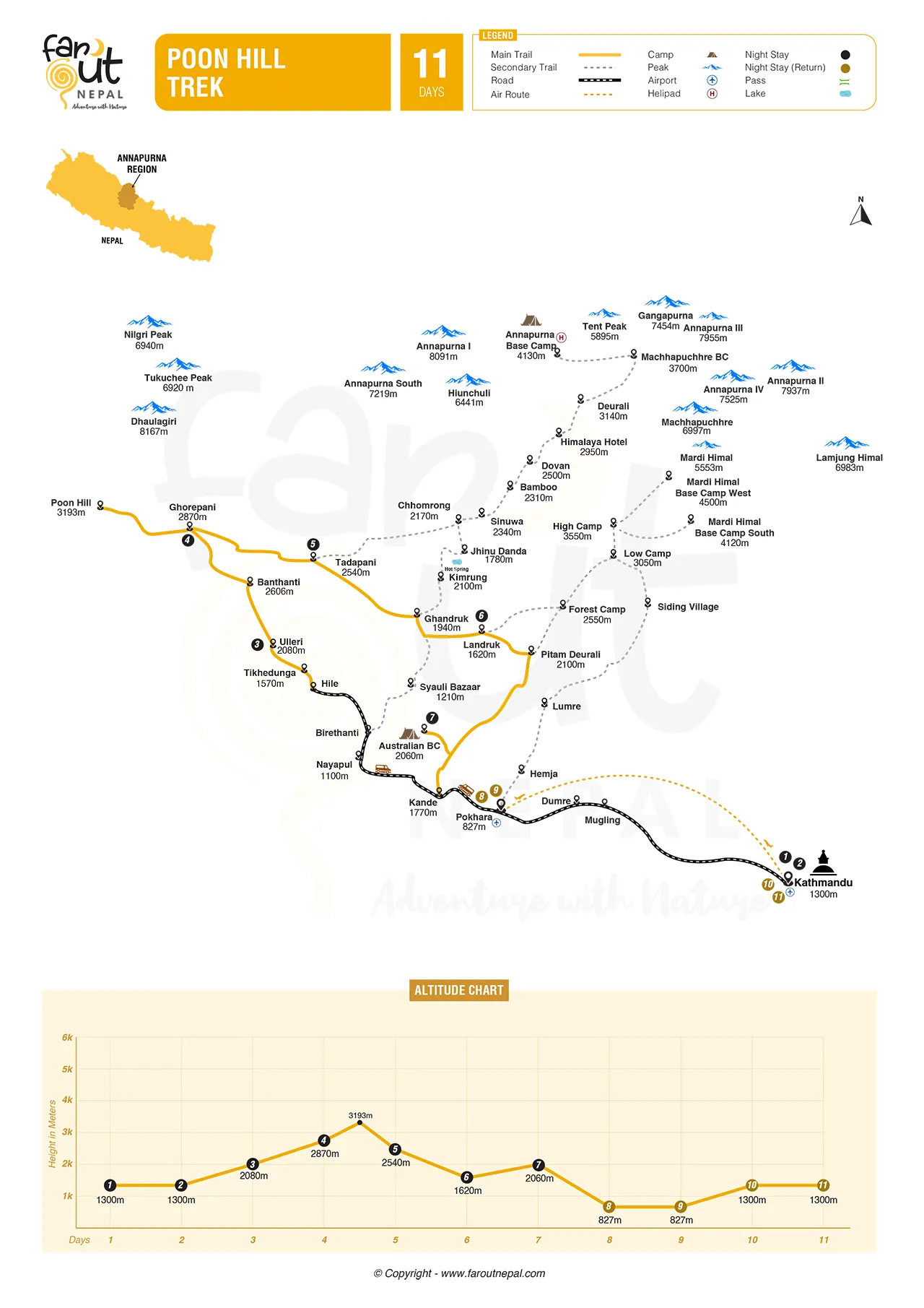
Trip map of Poon Hill Trek
Trip Information
Duration:
Our Poon Hill trek total duration is 11 days with 06 days trek and rest of the time spent in Kathmandu and Pokhara. In case if you have limited time, Poon Hill Trek can be done even within 03 days.
Elevation:
Our Poon Hill trek mostly hovers below 3,000m but only on the day climbing to viewpoint Poon Hill the elevation reaches 3,200 m.
Grading: Easy to Medium
Our Poon Hill trek is graded easy to medium with an ascent of around 1360 m/descent of 720 m. Trek reaches an elevation of 3,200 m and the walk is in a Himalayan terrain’s trails with lots of up and down, exposed, steep, walking through forest, crossing the river on suspension bridges. Walking hours will be in between 4 to 7 hours per day.
Though this is graded as an easy to medium trek in Nepal but for those who have not done that much of trek it can still prove to be a difficult one. The trek does not require any technical skill but has to be physically and mentally fit and should be able to walk around 5 to 7 hours per day. Trek will be in an ascending order initially then descends down while retreating back. The trail goes through diverse Himalayan terrains, rough, narrow and full of ups and downs.
Altitude Problem:
Since Poon Hill trek does not involve that much of walk in the high elevation so altitude problem is not much of an issue.
Preparation For the Trek:
Although graded easy to medium but trekking in the Himalayas always needs good preparation, planning so as to have a successful and enjoyable trek experience.
Mental Preparation:
Please do the reality check if the trek is suitable for you. This is a trek where the terrains are rough, accommodation is simple basic with sharing bathroom, simple meals (local food, Western food, Chinese food), no medical facilities on the trail except the small basic medical kit carried by the company. If you are having any medical problems, we recommend you consult with your doctor before undertaking the trip.
During the trek there might be stages where you get physically exhausted, and you would like to give it up this is when the mental strength becomes very important. You need to be patient, use positive visualization, may be meditation which can be a great tool to train the mind.
Physical Preparation:
This is a trek reaching up to an elevation of 3,200m in a terrain which involves steep, expose and lots of up and down trail. So it is crucial to start toning up your legs & body muscles, stamina, ready to take up the challenge. If you are regular trekker and has already done several treks so not much preparation is required. For those who are not a regular trekker or novice start training as early as possible. As for when you start training, you would want to begin anywhere from 3 months before your journey. The longer you train, the fitter and stronger you will become and thus, more likely to enjoy the trek without adding any additional stress to your body and avoid injury.
- Start hiking covering 9 – 10 kms per day with bit of weight 5-10kg. Try this quite frequently and increase the distance. This will slowly build strong muscles in your legs and body, also help as to how you move on the trail. Practice with the hiking boots that you plan on taking in order to avoid blisters during the trek.
- Also, you can build up your strength, endurance, stability and self-assurance doing a stair walking. You can start slowly and then gradually prolonged it for bit longer period.
- You can work on with treadmill as it will strengthen your calves and Achilles tendons and improves your cardio and leg endurance. This can be done by increasing the incline each week till you can tolerate 45-60 m at a 15% incline.
- Other fitness activities like swimming, cycling, jogging is all helpful
Season: Between March/End April and Between Mid October/Mid December
Weather plays an important role for having an enjoyable trek in the Himalayas because without the view of the snowy peak the trek in Nepal can be bit incomplete.
Though the trek can be done almost throughout the year with the exception in the Monsoon season but in order to enjoy the trek fully the ideal time is autumn between mid-October till mid-December where most of the time you can have unobstructed view of the lofty Himalayas.
Springtime between mid -March till end of April is another good time to trek in the Himalayas. But during this time weather can be bit hazy and also sometimes you can have rain. But since the weather pattern is changing its hard to be precise, we just have to count on our luck as well.
Access :
Drive to Hille the starting point of the trek (but option is driving bit higher as well)
Aircraft : Flight to Pokhara and back on a 75-seater aircraft (baggage allowance around 23 per person but for trekking 15 kg per person should be enough)
Type of Trek:
Poon Hill trek can be done in different ways like FULL PACKAGE TRIP and GAP BASIS
- FULL PACKAGE TRIP: We organize the require permit for the trek, arrange guide and porters, we reserve accommodation, provide meals and arrange transportation where required.
- GAP TREK STYLE : Almost the same arrangement like in the full package trip but just that we do not provide meals. Here you need to make the food payments directly in the lodges.
Typical Day In The Trek :
Usually, day begins around 6 am with tea or coffee and then washing and shaving. After you need to get back to your room and pack your gears, followed by breakfast in the restaurant which will be as per your choice. Then we start our trek which will be around 3 hours then have a lunch break – our guide will choose a good place to eat and also will see that you get an opportunity to enjoy the view of mountains. We again start our trek for around three to four hours and then we end our night in the Lodge. Dinner will be in the restaurant/lodge, and you get a menu to choose your meal.
Accommodation:
Your nights, during the trek, will be spent at basic simple lodges/guest houses made from stone, wood and cemented one. In it you have restaurant with dining hall having a fireplace or boiler to cozy up the place. Rooms are generally in twin sharing basis but in some you might have triple or more sharing room. They provide you with cotton pillows and a blanket, so we recommend you bring up your own sleeping bag. Most of the lodges have solar lighting system and hence are slightly dim. You’ll have to pay the additional amount for a hot shower, wifi, and charging facilities. During busy season time it is hard to get rooms even if you don’t reserve in advance due to limited lodges in the region.
Now a days in some section few lodges have sprung up offering better rooms and having attached bathrooms but still these kinds of lodges are limited.
Meals :
A typical lodge in this area offers an extensive menu based on noodles, rice, flour, potatoes, eggs and vegetables.
Breakfast offerings include muesli, a variety of porridges, pancakes and bread with jam or eggs.
For lunch it is worth considering what can be quickly prepared, with veg noodle soup being popular. Pancakes and Tibetan bread are also relatively quick to make. Increasingly toasted sandwiches are on menus too. Apple pie is generally delicious, deep fried in the same way as the spring rolls are.
Most meal choices are carbohydrate-heavy; exactly what trekkers require. All lodges serve tea, coffee, hot chocolate, hot lemon, soft drinks and beer (check its temperature first) and some places even offer wine.
Avoid having uncooked food like salads etc during the trek or even in Kathmandu.
Water During Trekking :
You can carry a good filter water bottle and used tap water for drinking. You can find water taps along the route. Having some sort of water purification system will save you a lot of money on the Poon Hill trek. Plus, it’s good for the environment. One liter of drinking water costs around NPR 100/US$1 depending on the place. You’ll need at least 2l of water per person a day if you buy it every time you can add NPR 200/US$2 pp. to your daily budget.
Don’t drink water directly from the tap or stream water you need to purify it either using water filter bottle or by purification tablets.
Electricity and Wifi
On your Poon Hill trekking trail, most of the teahouse has electric power. You can charge your mobile phone, camera, or other electronic devices. Some places offer solar system power, too. Sometimes, there can be a power cut, so for backup carrying a power bank or solar charger will be a good idea.
Most tea houses have internet facilities and may charge you extra money. You can connect during your trek with WIFI or mobile data. You can get a sim on arrival at the Airport and buy the date package for mobile data. The mobile data is not that expensive so having one stays you connected with the world.
Staff Support
You will have the support of a Govt. registered trekking guide who can speak Basic English language and well acquainted with the area. All our Guides have received training in basic skills and knowledge about administering first aid and emergency medication.
We provide porters to carry your personal baggage and gear leaving just the day pack to be carried by yourself. We provide one porter for every two trekkers and one porter generally carries a baggage weighing not more than 23 Kgs, i.e. 15 Kgs per trekker. So, you will need to pack your baggage accordingly.
Permits :
You only require two different permits — TIMS Card (Trekking Information Management System) and Annapurna Park Permit.
While issuing a TIMS Card & Annapurna Park ticket, you’ll require your passport, four passport size photos, insurance details, and contact details.
Trekking Equipment:
The weather in the Himalayas is always unpredictable, especially in the upper reaches. Therefore, it is essential to pack all the necessary equipment while trekking. Complete list of equipment will be forwarded upon confirmation of the trip. Most of the gears can either be bought or rented out in a different trekking shop in Kathmandu.
Insurance:
Insurance is a ‘MUST’ if you’re planning to trek in the Himalayas whether it might be a short easy trek or difficult one which involves walking in a difficult high-altitude terrain, crossing snowy passes, sometimes faces unpredictable weather and trail having no access to medical facilities. Insurance plays an important role in such a circumstances it covers you with helicopter evacuation which is very expensive, your medical bills or sometimes your accommodation and upgraded air journey.
But make sure to choose a right policy that covers emergency helicopter evacuation, medical costs, natural disasters, theft, and losses etc.
Visa Requirements:
All foreigners require a visa for entry into Nepal. You can get from a Nepalese embassy overseas or on arrival in Nepal. You can also try an online visa form Online Services (immigration.gov.np) before arriving and obtain the visa on arrival at Kathmandu airport. For obtaining the visa your passport should have atleast 6 months validity on the day of departure, one passport size photograph and the visa fee on US $ cash.
15 days USD$ 30 or equivalent convertible currency
30 days USD$ 50 or equivalent convertible currency
90 days USD$125 or equivalent convertible currency
Vaccinations and Medical:
You should obtain professional advice from a travel clinic or your local GP about the right vaccination to have before you arrive in Nepal. A dental check-up is a good idea as there will be no dental facilities while on the trek.
First Aid Kit :
We provide basic medical kit, but it is always safer to arrange your own medical kit as suggested by your physicians/doctor.
Environmental Concerns:
Far Out discourages all its clients from buying plastic mineral water bottles when up in the mountains and also abstaining from using hot water for baths that has been heated by burning firewood. We carefully select lodges that particularly use kerosene, solar energy, or cow dung instead of firewood for all heating, lighting and cooking purposes.
About Adventure Travel :
The concept of mountain trekking in itself is ‘adventure traveling’ which can be unpredictable most of the times. While traveling through the remote mountainous regions of Nepal, please do not expect standards you are used to at home, since these areas are still underdeveloped.
Reviews on Poon Hill Trek
Special Savings and Discounts for Group Travelers!
-
1 person
US$ 1995
-
2 -
3 person
US$ 1750
-
4 over
9999
US$ 1467
US$ 1995