


Complete Budget Breakdown for Your Manaslu Circuit Trek
Introduction
If you search for “Manaslu Circuit Trek cost,” you’ll find quotes anywhere from $700 to $4,500 for the same 14-day route. That spread isn’t a pricing error, but reflects real differences in group size, itinerary length, and what’s actually included. This won’t just be another price list. It’s a budget planner: by the end, you’ll know exactly what you’re paying for, what’s still missing from any quote you’ve received, and how much you should realistically set aside.
How Much Does the Manaslu Trek Cost?
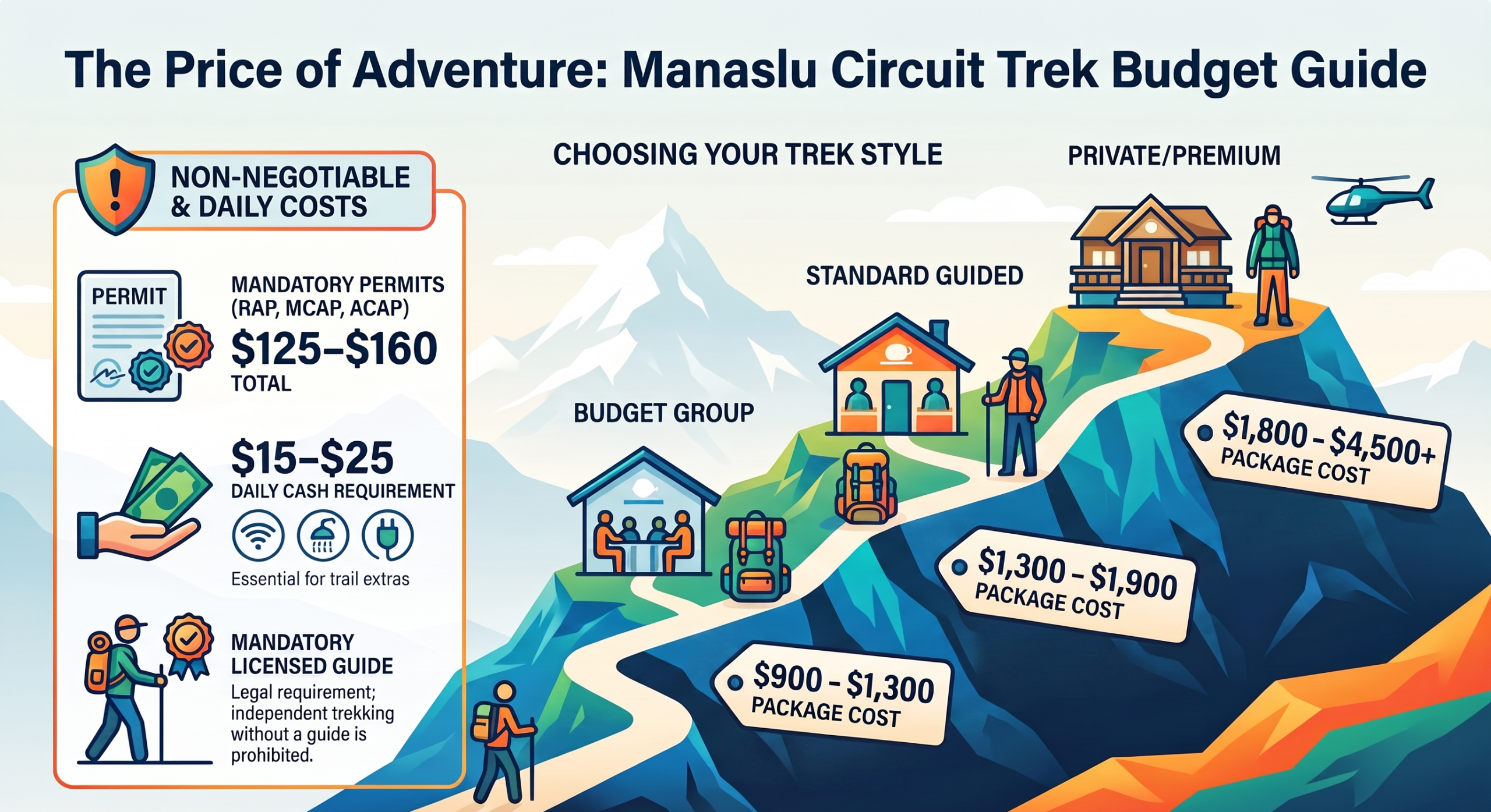
Most trekkers should budget $1,200–$2,800 for a standard 14-day guided Manaslu Circuit Trek, including permits, a licensed guide, teahouse accommodation, meals, and transportation. Solo trekkers typically pay somewhat more per person than those joining a group departure.
| Trek style | Typical cost (USD) | Best for |
| Budget group trek | $900–$1,300 | Cost-conscious trekkers joining a fixed departure |
| Standard guided trek | $1,300–$1,900 | Most first-time Manaslu trekkers |
| Private trek | $1,800–$2,800 | Flexible dates, custom pace, couples or families |
| Premium trek | $2,800–$4,500 | Trekkers prioritizing comfort and extra support |
Your total budget depends less on the advertised package price and more on factors such as permits, itinerary length, transportation, group size, and personal expenses.
Which Travel Style Fits You?
| If your priority is… | Consider… |
| Lowest overall cost | A fixed group departure |
| Flexible dates and pace | A private trek |
| Traveling with a partner or family | A private or customized itinerary |
| Comfort and extra support | A premium package |
Why Do Prices for the Manaslu Trek Cost Vary So Much?
Two agencies can quote wildly different prices for what looks like the same 14-day trek. The gap usually comes down to a handful of decisions, not markup:
Itinerary length: A 12-day itinerary and an 18-day itinerary cover the same route at different paces, but more days mean more nights of accommodation, meals, and guide/porter wages.
Group size: A licensed guide’s daily rate is largely fixed. On a group departure, that cost is split across everyone. On a private or solo trek, one person absorbs it alone, which is why private treks usually cost noticeably more per person.
Transportation choice: A shared local jeep from Kathmandu to the trailhead costs a fraction of a private vehicle, and this single decision can shift the total by hundreds of dollars.
Accommodation standard: Basic teahouses at $5–$15 a night look very different from upgraded rooms with attached bathrooms, where available.
Season: Permit fees are genuinely higher in peak season (roughly September–November) than in the off-season, and demand-driven package pricing follows the same pattern.
Guide-to-client ratio: Under the current regulatory cap, one licensed guide is responsible for a maximum of seven trekkers. Larger groups may need a second guide, which changes the cost structure.
Fixed Costs You Can’t Avoid for the Manaslu Trek
Three permits are mandatory for anyone trekking the Manaslu Circuit, and none of them are negotiable or skippable.
Restricted Area Permit (RAP): A government permit required for all foreign trekkers entering Manaslu’s restricted zone, issued through Nepal’s Department of Immigration and obtainable only through a registered trekking agency. It cannot be arranged independently. Rates run roughly $75–$100 per week, depending on season, with peak-season weeks priced higher than off-season ones.
Manaslu Conservation Area Permit (MCAP) & Annapurna Conservation Area Permit (ACAP): The ACAP is required once the route crosses into Annapurna Conservation Area territory near Larkya La Pass. Both are issued through the Nepal Tourism Board, not the Department of Immigration, and each typically costs around $25–$30.
A note on solo trekking: until March 2026, the RAP required a minimum of two foreign trekkers per application. On March 22, 2026, Nepal’s Department of Immigration removed that requirement, allowing solo foreign trekkers to obtain the permit individually, as confirmed by the Department and reported by the Kathmandu Post. The licensed-guide requirement was not affected by this change and remains mandatory for all trekkers, whether solo or not.
Package Costs: Guides, Porters, and Group vs. Private
A licensed guide typically costs $25–$35 per day, and a porter costs $18–$25 per day if you choose to hire one. On a group departure, the guide’s cost is divided among all participants on the trip. On a private departure, though, one trekker covers the full daily rate alone. This is one of the reasons why private treks and solo treks generally cost more per person than joining a group.
Since Manaslu is a restricted area, you cannot legally hire a guide independently or trek without one. The guide’s cost is a fixed part of any legitimate package, not an optional upgrade.
Check out our Manaslu Circuit Trek Difficulty guide to learn why a guide is mandatory for the Manaslu Circuit Trek.
What’s Usually Included in the Manaslu Trek Package?
| Item | Usually included? |
| Permits (RAP, MCAP, ACAP) | Yes |
| Licensed guide | Yes |
| Porter | Sometimes |
| Teahouse accommodation | Yes |
| Meals | Depends on the package |
| Transportation to/from the trailhead | Depends on the package |
| Airport transfer in Kathmandu | Depends on the package |
| Travel insurance | No |
Always confirm which of the “depends” items are covered before comparing two quotes, as a lower headline price often just means fewer of these are included.
Personal and Trail Expenses for the Manaslu Trek
Beyond the package price, budget for daily out-of-pocket costs:
- Hot showers ($2–$5)
- Wi-Fi ($2–$4/day). It is less reliable and pricier in higher villages like Samdo.
- Device charging ($2–$4)
- Bottled water or purification ($1–$2/day)
- Snacks
- Tipping (commonly $8–$12 per trekker per day, split between guide and porter, though this varies)
Hidden and Overlooked Costs
The costs most trekkers forget aren’t dramatic. They’re just easy to miss when comparing quotes:
- Travel insurance with helicopter rescue coverage above 4,000m (often required for the permit itself, and typically $30–$80 depending on duration).
- Nepal visa fees; paid on arrival.
- Kathmandu hotel nights before and after the trek, if not included in your package.
- Gear rental or last-minute equipment purchases.
- A contingency buffer for weather delays, like an extra teahouse night or two if Larkya La Pass is closed.
Building a small contingency fund into your total budget avoids the scramble of finding cash-only payment options in a remote village if plans shift.
How Much Cash Should You Carry?
Card payments are effectively nonexistent beyond Kathmandu. Villages past Machha Khola operate on a cash-only basis for teahouses, snacks, Wi-Fi, charging, and tips. ATMs are reliable in Kathmandu but scarce or nonexistent on the trail, so withdraw what you need before departure.
A common recommendation is $15–$25 per day in personal spending cash, plus a separate emergency reserve of $150–$300 that you hope not to touch.
Sample Budgets by Trekker Type
Budget traveller: ~$950 package + $200 personal spending + $150 emergency reserve = ~$1,300 total
Standard trekker: ~$1,600 package + $300 personal spending + $200 emergency reserve = ~$2,100 total
Private trekker: ~$2,200 package + $350 personal spending + $250 emergency reserve = ~$2,800 total
Premium trekker: ~$3,400 package + $400 personal spending + $300 emergency reserve = ~$4,100 total
Is the Cheapest Manaslu Trek Always the Best Value?
Not necessarily. A significantly cheaper quote is worth a second look, not automatic suspicion. Still, it’s fair to ask what’s different. We suggest trekkers consider guide licensing and experience, whether emergency evacuation support is genuinely arranged (not just mentioned), itinerary pacing for acclimatization, and what’s actually excluded versus quietly assumed. The goal isn’t to assume the cheapest option is worse, but to compare like for like before deciding.
How to Compare Manaslu Trek Prices Before Booking
Before booking, ask any agency to confirm, in writing:
- Which permits are included
- Whether a porter is included or optional
- Transportation mode (shared vs. private vehicle)
- Meal inclusion (full board vs. breakfast only)
- Insurance requirements and whether evacuation support is arranged
- Cancellation and rescheduling terms
- Guide-to-client ratio for your specific departure
A quote that clearly answers all of these questions is usually more trustworthy than one that simply states a single all-inclusive number.
Planning a Realistic Budget for the Manaslu Trek
The advertised package price is only one layer of what you’ll actually spend. Add mandatory permit fees, personal trail expenses, and a genuine emergency reserve, and most trekkers land closer to the higher end of any range they first see quoted. Once you know your total realistic budget, the next step is comparing it against a full itinerary → [Manaslu Circuit Trek — full itinerary and package].
Frequently Asked Questions
How much does the Manaslu Circuit Trek cost?
The Manaslu Circuit Trek cost typically ranges from $1,200 to $2,800 per person for a standard 14–16-day guided itinerary. The final price depends on the season, group size, itinerary length, accommodation standard, and whether you’re joining a group or booking a private trek. Most packages include permits, a licensed guide, accommodation, meals during the trek, and transportation.
Why is the Manaslu Trek more expensive than other treks in Nepal?
The Manaslu Circuit Trek is generally more expensive because it passes through a restricted area that requires a Restricted Area Permit (RAP) in addition to the Manaslu Conservation Area Permit (MCAP) and Annapurna Conservation Area Permit (ACAP). Trekking with a licensed guide is also mandatory, and the remote location means transportation and logistics cost more than on many other trekking routes.
Are permits included in the Manaslu Trek package price?
Yes, most reputable trekking agencies include all required permits in their advertised package price. However, inclusions vary between operators, so you should confirm whether the RAP, MCAP, and ACAP permits, along with guide fees, transportation, accommodation, and meals, are included before making a reservation.
How much extra spending money should I bring?
Most trekkers should budget around $15–$25 per day for personal expenses such as snacks, hot showers, charging devices, Wi-Fi, drinks, and small purchases at teahouses. Carrying an additional $150–$300 as an emergency reserve is also recommended, since ATM access is unavailable along most of the route.
Is tipping included in the Manaslu Trek cost?
No. Tips for your guide and porter are generally not included in the package price and are considered a personal expense. The amount varies depending on the size of your group, the length of the trek, and the level of service, but tipping is a common way to show appreciation for your trekking team.
Can I reduce the cost by joining a group trek?
Yes, joining a group trek is one of the most effective ways to reduce the overall Manaslu Trek cost because transportation, guide fees, and other shared logistics are divided among multiple trekkers. Private departures offer greater flexibility but usually cost more per person.
Do Indian and Nepali trekkers pay different permit fees?
Yes. Indian and Nepali citizens may be subject to different permit requirements and fee structures than other foreign nationals. The exact costs can change as government regulations are updated, so it’s best to confirm the latest permit fees with a registered trekking agency before planning your trip.
What costs are usually not included in the Manaslu Trek package?
Even when booking a comprehensive package, certain expenses are often excluded. These may include Nepal visa fees, international flights, travel insurance, trekking gear rental, personal snacks and drinks, charging electronic devices, Wi-Fi, hot showers, laundry, and tips for guides and porters. Reviewing the package inclusions carefully will help you avoid unexpected costs during the trek.
Is the Manaslu Circuit Trek worth the cost?
For many trekkers, yes. Although the Manaslu Circuit Trek costs more than some popular routes in Nepal, it offers a quieter trail, spectacular Himalayan scenery, authentic mountain villages, and fewer crowds than the Everest or Annapurna regions. For those seeking a remote trekking experience with rich cultural encounters, many consider it one of the best value-for-money adventures in the Himalayas.