

Which Season Should You Choose for the Langtang Trek?
The Langtang Experience
Most trekkers will tell you the best time for the Langtang Trek is autumn. They’re not wrong, but they’re not giving you the full picture either.
The Langtang region offers three distinct routes, each with its own seasonal logic. The Classic Langtang Valley trek and the Langtang–Helambu circuit follow a broadly similar seasonal pattern. The Langtang Ganja La Trek is different. It’s a high pass route, and with a narrower and more weather-dependent window than the valley routes below it.
Choosing your season isn’t just about the weather. It’s about matching conditions to the experience you’re actually looking for. This can be anything from the clearest possible mountain views, the quietest trails, the best conditions for crossing a 5,100m pass, or simply the most forgiving introduction to Himalayan trekking.
Here’s a complete breakdown of every season and every month across all three routes so you can make that decision with confidence.
Quick answer:
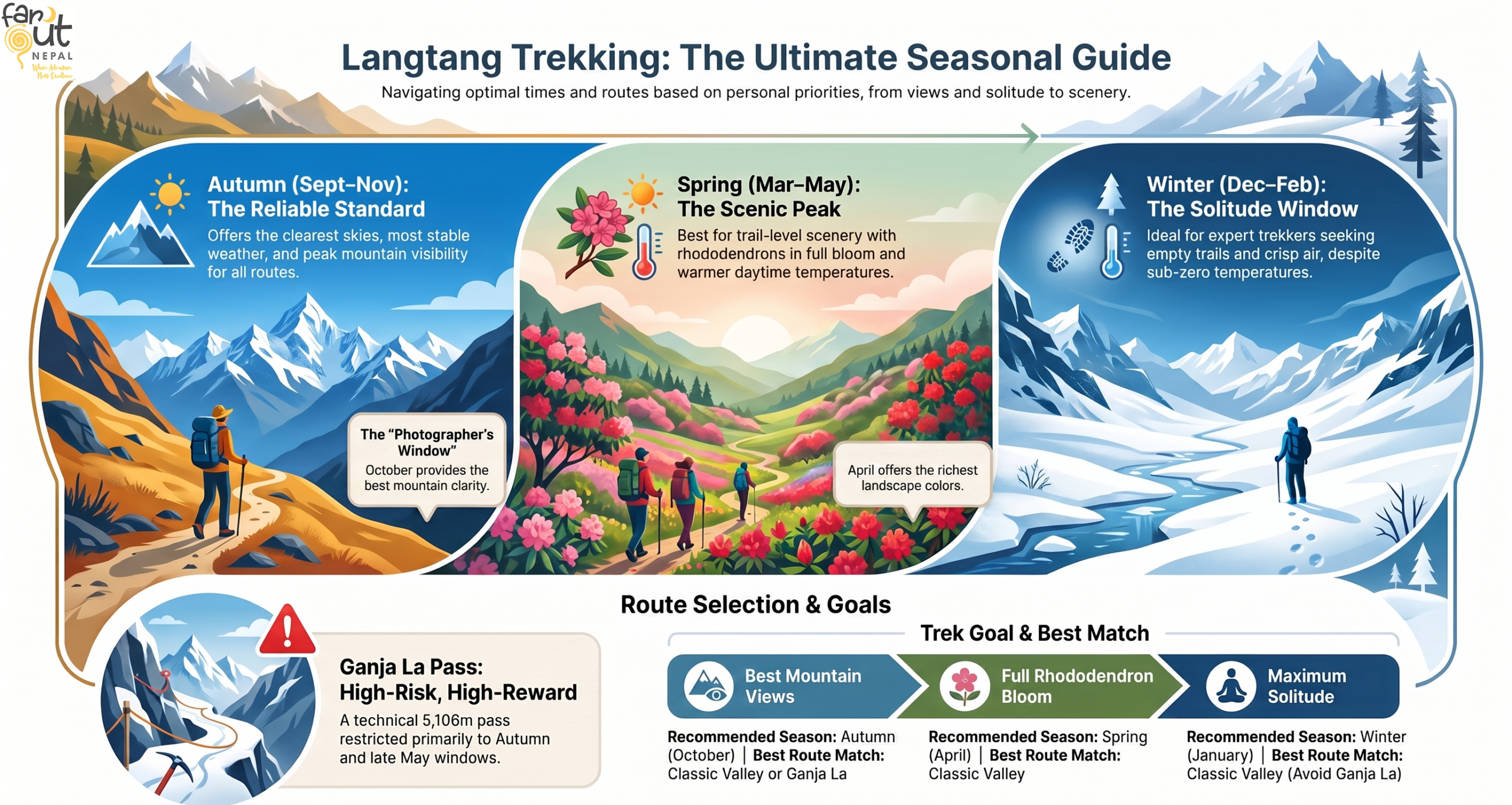
- Best overall → Autumn
- Best scenery → Spring
- Fewest crowds → Winter
- Pass crossing (Ganja La) → Autumn or late May
To learn about the route difficulty, see our [Langtang Trek Difficulty guide] →
Planning a Ganja La crossing specifically? The [Langtang Ganja La Trek page] covers the full route and departure options →
So, What Is the Best Time for the Langtang Trek?
Autumn is the best time for the Langtang Trek for most trekkers. October in particular offers the most reliable combination of clear skies, stable trails, and comfortable trekking temperatures. Spring runs a close second. The conditions are excellent, and the trail scenery is at its most vivid, though mountain visibility can be more variable. Winter is genuinely beautiful but demands more experience and preparation. Monsoon is a specialist choice.
| Season | Weather | Views | Crowds | Difficulty | Recommendation |
| Autumn (Sep–Nov) | Stable, dry | Excellent | High | Standard | Best overall |
| Spring (Mar–May) | Warming, some afternoon cloud | Very good | Moderate–High | Standard | Best for scenery |
| Winter (Dec–Feb) | Cold, clear | Good | Low | Harder | Solitude seekers |
| Monsoon (Jun–Aug) | Wet, humid | Poor | Very low | Harder | Not recommended for most |
The table above applies primarily to the Classic Langtang Valley route and the Langtang–Helambu circuit. The Ganja La Trek has a tighter seasonal window.
See the Ganja La route section below and the dedicated [Langtang Ganja La Trek page] for details →
Spring (March–May): Best for Views and Balanced Conditions
Spring is the season that turns the Langtang valley into something extraordinary below your feet rather than just above your head. While autumn earns its reputation for mountain clarity, spring earns its own for what happens at trail level.
Weather
March opens cool at altitude and genuinely cold above 3,500m, but temperatures climb steadily through April and into May. Daytime trekking conditions are comfortable across most of the route by mid-March. The key variable in spring is afternoon cloud. Moisture rising from the lower valleys builds cloud cover most afternoons from April onward. Mornings are reliably clearer, which has practical implications for photography and high-altitude views.
Trail Conditions
Trails are in good condition across the season. Snow lingers on the higher sections in early March, but is typically manageable on the Classic Valley and Helambu routes. May brings the warmest conditions and the longest daylight hours of this trekking calendar. However, it also marks the approach of monsoon departures in the final two weeks of May, which should be monitored against weather forecasts.
Visibility
Spring visibility is excellent on clear mornings and genuinely outstanding in the first half of March before significant cloud build-up becomes regular.
The trade-off versus autumn is real: post-monsoon skies in October are more consistently clear than pre-monsoon skies in April. If a guaranteed unobstructed view of Langtang Lirung is your primary objective, autumn edges spring on reliability. If the overall sensory experience of the trail matters as much as the summit panorama, spring holds its own.
Altitude Experience
Temperatures at altitude (Kyanjin Gompa: 3,870m) are milder in spring than in autumn’s later weeks or winter. This makes acclimatisation more comfortable for trekkers who struggle with cold temperatures and significantly reduces the gear burden. Kyanjin Ri (4,773m) is accessible throughout the spring season for trekkers seeking an additional altitude push from the valley.
Who Should Go in Spring
Spring suits trekkers for whom the journey through the forest and valley matters as much as the high-altitude experience. The rhododendron forests below Langtang are at full bloom from mid-March through April. Dense red and pink flowerings appear at the lower elevations, giving way to other species higher up. This is the season’s defining visual, and it’s one autumn simply cannot match.
If you’re a photographer whose subject is the landscape rather than exclusively the mountains, this is your season. Think of late March and April as the trail’s own version of peak light. This is not the crisp blue-sky clarity of October, but something richer and more layered.
Best routes in spring: Classic Langtang Valley, Kyanjin Ri extension. Ganja La is accessible in most years during spring, late April and May offer the most reliable window before the monsoon arrives.
Spring verdict: Best for trekkers whose priority is scenery and trail colour over guaranteed clear skies. Rhododendron forests are at peak bloom in March and April.
Views are excellent on clear mornings with some afternoon cloud from April. Ganja La is accessible for most of the season in good years. First-time trekkers will find spring conditions forgiving and rewarding.
Autumn (September–November): Best Overall Season
Autumn is the most reliable season for the Langtang Trek, and October is the single best month on the trekking calendar. After the monsoon clears, the skies above the Langtang valley are as clear as they get anywhere in Nepal. The combination of stable trails, comfortable temperatures, and exceptional mountain visibility makes this the season that delivers most consistently for the widest range of trekkers.
Stable Weather
The monsoon typically clears from the Langtang region by mid to late September. From that point through to mid-November, trekking conditions are as close to ideal as mountain weather allows. You can experience dry trails, low wind, reliable daytime temperatures, and skies that stay clear well into the afternoon. Late October and November bring noticeably colder nights, with temperatures below freezing at Kyanjin Gompa. But daytime trekking remains comfortable with the right layering system.
Crowd Expectations
Autumn is busy, and it’s worth being direct about that. October in particular draws the largest volume of trekkers of any month. The lower villages on the Classic Valley route, including Syabrubesi, Lama Hotel, and Langtang village, will have competition for teahouse beds at peak weekends.
Book accommodation in advance if you’re trekking in October. November is noticeably quieter while retaining most of autumn’s weather advantages, and is worth serious consideration for trekkers who want good conditions without the October peak.
Photography Conditions
October is the Photographer’s Window for Langtang. Post-monsoon air clarity is at its annual peak, with particulates washed out by months of rain, views to the high ridges unobstructed, and the great quality of light in the early morning. Langtang Lirung (7,227m) is visible in full from the valley in a way that is reliably available in October and less guaranteed in any other month.
Ganja La Conditions
Autumn is the primary season for the Ganja La Pass crossing. After the monsoon, the pass stabilises into its most predictable and accessible state of the year. Dry trail conditions, clear weather windows, and manageable snow levels at the pass make late September through November the window most guided departures target. Conditions begin to deteriorate meaningfully from December as winter snowfall accumulates.
If crossing Ganja La is your goal, autumn is the season to plan around.
Best for: First-time trekkers on the Classic Valley route, experienced trekkers targeting Ganja La, photography-focused trekkers, and anyone whose schedule gives them one window and needs the most reliable conditions.
Autumn verdict: The most reliable season across all Langtang routes. Post-monsoon skies deliver the clearest mountain views of the year. Trail conditions are stable and dry throughout. Ganja La is at its most accessible. Late October nights are cold, so layering and a quality sleeping bag are not optional. Book teahouses in advance for October departures.
Winter (December–February): Best for Solitude
Winter in Langtang is a different kind of trek. The trails empty out, the air gets sharp and cold, the mountains sit above you with a clarity that the busier seasons rarely produce, and the experience becomes something more demanding and more private than any other time of year.
For the right trekker, it’s exceptional. For the wrong one, it’s a serious miscalculation.
Snow Conditions
Snow arrives on the higher sections of the Classic Valley route from December, typically above 3,500m. By January, snow is possible from 3,000m upward, and trail conditions above Langtang village can be significantly harder than in other seasons. The route to Kyanjin Gompa remains doable for experienced trekkers but requires proper winter footwear, traction devices, and the ability to read changing trail conditions.
Ganja La is not recommended in winter. Snow accumulation around the pass creates route uncertainty, and conditions can change fast enough to make a crossing impractical or dangerous even for strong trekkers. Trekkers should be clear on this: winter is the one season to avoid for the Langtang Ganja La pass.
Cold Management
Temperatures at Kyanjin Gompa drop well below freezing overnight from December through February. January is the coldest month, with night temperatures of -10°C to -15°C at altitude, which are not unusual, and teahouse heating is basic at best. A four-season sleeping bag is essential, not a comfort upgrade. Trekkers who have not experienced extended sub-zero nights in mountain conditions should take this seriously before committing to a winter departure.
Trail Access
The Classic Valley route remains passable for experienced trekkers throughout winter, though progress is slower and some sections require more technical care than in other seasons. The Langtang–Helambu circuit’s lower altitude sections are more accessible in winter than the high valley, and parts of the Helambu route can be trekked with considerably less snow exposure than the Classic route.
Who Should Avoid Winter
Winter is not suitable for first-time trekkers, for solo trekkers without high-altitude winter experience, or for anyone whose schedule doesn’t allow flexibility for weather delays. The physical demands are genuinely higher, the margin for error is smaller, and the support infrastructure, like open teahouses, other trekkers on the trail, or rescue access, is thinner.
December vs January:
| December | January | |
| Temperature | Cold but manageable | Coldest month. Significant night freeze. |
| Snow on the trail | Possible above 3,500m | Likely above 3,000m |
| Ganja La | Rarely accessible | Not recommended |
| Difficulty vs autumn | Noticeably harder | The most demanding winter month |
| Best suited for | Experienced trekkers | Expert only |
January is the Solitude Seeker’s Month. If you want Kyanjin Gompa entirely to yourself, crisp air that makes the valley feel like a different world, and a trek that tests your self-sufficiency rather than your ability to book teahouses, January delivers all of that. It just asks for genuine winter trekking competence in return.
Winter verdict: Rewarding for experienced trekkers who know what they’re taking on. Beautiful, quiet, and more demanding than any other season.
December is the more forgiving entry point; January is expert territory. Ganja La is off the table. First-timers should choose a different season.
Monsoon (June–August): Best for Quiet Trails
Monsoon is the season most experienced trekkers dismiss in a sentence. That’s not entirely wrong. For the majority of trekkers, and particularly for anyone planning a Ganja La crossing, the monsoon is not the right choice. But it’s worth understanding what you’re actually trading off, because for a specific kind of trekker, the Classic Langtang Valley route in monsoon has a genuine appeal.
Rain Patterns
The monsoon reaches Langtang from June, bringing daily rainfall that typically peaks in July and gradually eases through August. Rain falls most heavily in the afternoon and evening. Mornings, though, can be surprisingly clear, particularly in the lower valley sections. This pattern is reliable enough that experienced monsoon trekkers plan their daily stages around it, starting early and reaching camp or a teahouse before the afternoon rain arrives.
Visibility
Mountain visibility is the clear casualty of monsoon trekking. Cloud cover is persistent above the mid-valley, and clear views to Langtang Lirung or the high ridges are the exception rather than the rule. The landscape compensation is real. The valley is intensely, almost aggressively green, and the lower forest sections are lush in a way that no other season replicates. This, however, will be disappointing for trekkers coming primarily for mountain views.
Trail Challenges
Lower sections of the Classic Valley route can be muddy and slippery after heavy rain. Leeches are present on the forest sections below Langtang village through the monsoon period and are a practical consideration rather than a minor nuisance. Stream crossings can be higher and faster than in other seasons. Trail debris and occasional minor landslides on steeper sections are a real risk.
When Monsoon Works
Monsoon makes most sense for trekkers combining a tight budget with significant prior trekking experience, or for those with a specific interest in the valley’s landscape rather than its high-altitude views.
Teahouses are available without booking, prices in some areas are lower, and the trail has a quality of quiet that peak season never approaches. The Classic Valley route to Kyanjin Gompa is the appropriate monsoon objective. The Langtang–Helambu circuit is manageable at its lower elevations, and Ganja La should not be attempted.
Best Time for Different Langtang Routes
The three Langtang routes have meaningfully different seasonal profiles. Understanding which route you’re trekking is the first step in choosing when to go.
| Route | Best Season | Alternative Season | Difficulty |
| Classic Langtang Valley | Autumn | Spring | Moderate |
| Langtang Ganja La Pass | Autumn | Late May | Challenging |
| Langtang–Helambu | Autumn | Spring | Moderate |
Classic Langtang Valley
The Classic route follows the Langtang Khola valley from Syabrubesi to Kyanjin Gompa and back. Its seasonal logic is the most straightforward of the three: autumn for reliability, spring for scenery, and winter for solitude with appropriate experience. The route’s moderate difficulty means it remains accessible across a wider seasonal range than the pass route.
Monsoon is possible on this route for experienced trekkers but comes with the visibility, trail condition, and leech trade-offs described above.
Langtang Ganja La Pass
Ganja La has a tighter seasonal window than either valley route, and that window shapes everything about when to plan this trek. The pass sits at 5,106m and is genuinely exposed to high-altitude weather systems in a way that the valley routes are not.
Autumn (late September–November) is the primary season. Stable post-monsoon conditions give the most reliable crossing weather and the best chance of the full experience. You will encounter clear skies at the pass, exceptional views in both directions, and dry trail conditions on the technical sections approaching and descending from the pass.
Late May offers a secondary window before the monsoon arrives. Conditions are good in most years, with the rhododendron-season scenery as a bonus on the lower sections. Departures should be planned for the earlier part of May to allow a buffer before the monsoon pattern establishes.
Winter and monsoon: Not recommended.
Langtang–Helambu
The Helambu circuit runs at generally lower altitude than the Classic Valley route, which has practical seasonal consequences. The lower elevation sections are more accessible in winter than the high valley and can be trekked with considerably less snow exposure. In the monsoon, Helambu’s lower reaches are more forgiving than the upper valley, though visibility limitations apply across the whole circuit.
Autumn and spring are the primary seasons, consistent with the Classic route. Helambu is worth specific consideration for trekkers who want a slightly different experience from the main valley, with the option of linking through to Langtang or returning via a different circuit.
Month-by-Month Langtang Trek Guide
| Month | Conditions | Difficulty | Recommendation |
| January | Coldest month. Snow likely above 3,000m. | High | Experienced trekkers only |
| February | Cold but improving. Late Feb warmer. | High | Experienced trekkers |
| March | Warming. Rhododendrons begin below 3,000m. | Moderate | Good, being the spring opening |
| April | Peak spring. Full rhododendron bloom. | Moderate | Excellent |
| May | Warm. Late May: last Ganja La window. | Moderate | Good, as it’s the last pre-monsoon month |
| June | Monsoon begins. Increasing rain. | High | Not recommended for Ganja La |
| July | Peak monsoon. Wet, low visibility. | High | Avoid for most routes |
| August | Monsoon continues. Late Aug: start of clearing. | High | Avoid unless experienced |
| September | Monsoon clearing. Trails are wet early month. | Moderate–High | Late Sept: conditions improve fast |
| October | Peak autumn. Best overall conditions. | Moderate | Best month of the year |
| November | Late autumn. Colder from mid-month. | Moderate | Excellent with fewer crowds than Oct |
| December | Cold. Snow possible above 3,500m. | High | Experienced trekkers. No Ganja La. |
October and April stand out as the two peak months across the full seasonal calendar. The former for mountain clarity and trail reliability, the latter for scenery and trail colour.
November is underrated. Conditions remain excellent, and the crowds that defined October have thinned considerably.
Choose Your Season Based on Your Trek Goal
The Far Out Season Selector below maps common trek goals to the season and route that best delivers them. Use it as a starting point, not a prescription. Your specific dates, experience level, and what you’re actually hoping to see will refine the answer further.
| Trek Goal | Recommended Season | Best Route Match |
| Best mountain views | Autumn | Classic Valley or Ganja La |
| Fewest crowds | Winter | Classic Valley |
| Snow on the trail | Winter | Classic Valley (avoid Ganja La) |
| Photography — landscapes | Spring (April) | Classic Valley |
| Photography — mountains | Autumn (October) | Classic Valley or Ganja La |
| Lower risk, first trek | Autumn | Classic Valley |
| Rhododendron scenery | Spring (March–April) | Classic Valley |
| Pass crossing | Autumn or late May | Ganja La |
| Budget travel | Monsoon | Classic Valley only |
The goal column above reflects what trekkers most commonly tell us they’re coming to Langtang for. If your goal isn’t listed, the principle is simple: autumn gives you the most reliable version of almost any Langtang experience. Spring gives you the most vivid. Winter gives you the quietest. Monsoon gives you the most demanding.
Common Seasonal Mistakes on the Langtang Trek
The most common planning errors on the Langtang Trek aren’t about choosing the wrong season outright. They’re about misreading what a season actually involves once you’re on the trail.
Packing for the wrong conditions. Autumn trekkers regularly overpack cold-weather gear for the valley sections while underestimating what Kyanjin Gompa nights in late October actually require. The reverse happens in winter, when trekkers who have read that winter is “possible” arrive without the four-season sleeping bags and thermal layers that make it comfortable rather than an endurance exercise. Pack for the conditions at altitude, not the conditions at the trailhead.
Treating altitude as a constant. Langtang’s altitude range, from roughly 1,500m at Syabrubesi to 3,870m at Kyanjin Gompa, with Kyanjin Ri pushing to 4,773m, means the seasonal experience at the start and end of the trek is genuinely different. Acclimatisation is more demanding in winter because cold amplifies altitude’s physiological effects. Trekkers who manage autumn conditions at Kyanjin Gompa without difficulty may find the same altitude meaningfully harder in January.
Assuming a shorter route is an easier one. A shorter Langtang itinerary in winter is not an easier choice than a longer one in autumn. Season changes the experience category, not just the conditions. The Langtang–Helambu circuit in autumn and the same circuit in monsoon are different treks in meaningful ways, not variations on the same experience.
Booking Ganja La without checking the pass window. The Ganja La Pass has a defined seasonal window, and booking a departure outside of it is the single most avoidable planning mistake on the Langtang trail. Winter and monsoon crossings are not a matter of being well-prepared. They are genuinely inadvisable regardless of experience level in most years. If Ganja La is on your itinerary, confirm the season before the booking, not after.
Final Verdict: When Should You Visit Langtang?
The Langtang Trek rewards trekkers who choose their season deliberately rather than defaulting to whatever dates are available.
Autumn (October–November) is the answer for most trekkers. If you have one window and need it to work, this is it. October for maximum reliability; November if you want excellent conditions with fewer people on the trail.
Spring (March–May), if the scenery along the route matters as much to you as the views above it. Rhododendrons in bloom, warming temperatures, and conditions that are forgiving for first-timers. Expect some afternoon cloud from April.
Winter (December–February) if solitude is the goal and your experience supports it. December is the more accessible entry point; January is for trekkers who know exactly what a sub-zero night at 3,870m involves.
Monsoon (June–August) only if you’ve trekked in Himalayan monsoon conditions before and you’re specifically coming for the Classic Valley. Ganja La is off the table.
Contact Far Out now, and book your Langtang trip today!