
Tag: underrated treks
So, Which Nepal Treks Are Actually Less Crowded in 2026?
Introduction
It’s October, and you’ve come to trek EBC, stopping at Namche Bazaar. Every teahouse is full by 2 pm. You can see trekkers queueing for the same viewpoint for a photograph. A guide from another company tells his group this is “the quiet season.”
We’ve been watching this happen for 25 years: this slow conversion of once-genuine routes into managed experiences. It’s nobody’s fault, though. Good trails get discovered. Discovered trails get developed. Developed trails get crowded.
However, Nepal is vast, and the permit system creates genuine barriers, so not every trail ends up as a “hidden gem.” Some routes stay quiet because they ask more of you. This is a guide to those less crowded trek routes, being honest about what’s changed, specific about what hasn’t.
Before the List: What “Less Crowded” Actually Means for Routes in Nepal
Most lists treat “remote” and “less crowded” as interchangeable terms. They’re not.
A trail can be geographically remote and still funnel every trekker through the same two teahouses. A restricted area can still see seasonal surges that make it feel anything but quiet. Understanding the difference is what separates a genuinely peaceful trek from a disappointing one.
Three things actually determine crowd experience on a Nepal trail:
Trail density: How many trekkers share the same path on any given day? Some routes have natural bottlenecks (river crossings, single-file passes) where even 20 people feel like a crowd.
Teahouse availability: Can you get a room without booking months ahead? In peak season on popular routes, teahouses are fully reserved by 2 pm. That changes the entire character of a trek.
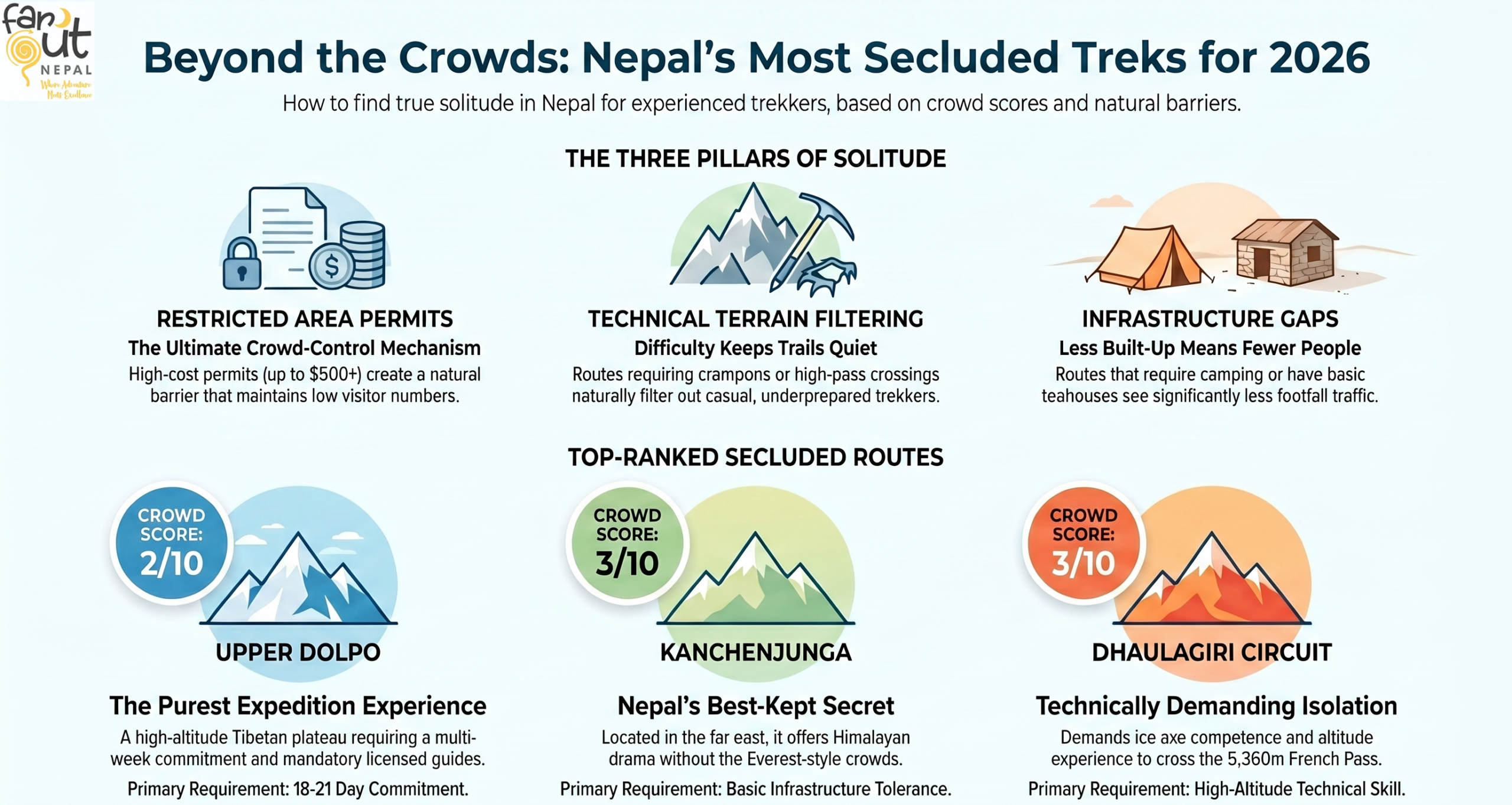
Permit volume: Certain areas require restricted area permits that cap annual visitor numbers. This is the most reliable crowd-control mechanism in Nepal trekking, and it’s the reason some routes have stayed genuinely quiet for decades.
One more thing most lists ignore: seasonality distortion. A trek labeled “quiet” is often only quiet in the off-season. Visit that same trail in October or April, and you may find yourself in a convoy. Where we mention seasonality below, take it seriously, as it changes everything.
These Were Considered “Hidden Gems,” But They’re Not Hidden Anymore
Before the ranked list, an honest disclaimer about three treks you’ll still find on most “less crowded” articles.
Mardi Himal: Still a beautiful trek worth doing. But quiet? Not in spring. It’s now a popular short-duration alternative to ABC. The teahouses above Forest Camp also fill fast in March and April. If you do it, go in November or early December.
Langtang Valley: The post-2015 earthquake rebuild brought improved infrastructure, and this, in turn, attracted more trekkers. The main Langtang trail now experiences consistent footfall traffic in both peak seasons. The Ganja La variation is a different story (more on that below).
Standard Annapurna Base Camp routes: Day-hikers and short-stay trekkers from Pokhara have significantly altered the lower sections of this trail. ABC itself remains stunning, but “less crowded” is no longer an accurate description for most of the route.
Far Out Nepal runs all three. But if your primary reason for looking at this list is genuine solitude, these aren’t your answer in 2026.
7 Less Crowded Treks in Nepal in 2026 (Ranked by Actual Crowd Experience)
Crowd Score is rated 1–10. Lower = quieter. Based on ground experience, permit data, and seasonal observation.
1. Upper Dolpo Trek
Crowd Score: 2/10
Best season for solitude: June–September (post-monsoon window), October
Upper Dolpo is in a category of its own. The restricted area permit (which is one of the most expensive in Nepal) keeps annual visitor numbers genuinely low. Large sections of the route are camping-only because teahouse infrastructure simply doesn’t exist. The landscape is a high-altitude Tibetan plateau: barren, ancient, and unlike anything else in Nepal.
Why it’s still quiet: The permit cost, the remoteness, the multi-week commitment, and the logistical complexity combine to create a natural filter. This isn’t a trek you stumble into. The people who do Dolpo have researched it for years.
Reality check: This is a serious undertaking. Minimum 18–21 days, camping sections, high passes, and very limited bailout options. A licensed guide is not optional, but legally required and genuinely necessary.
Who it’s for: Experienced trekkers with high-altitude experience and a tolerance for genuine remoteness, and time. Not a beginner’s trek by any means. Possibly the purest expedition trek experience.
2. Kanchenjunga Trek
Crowd Score: 3/10
Best season for solitude: April–May, October–November
Nepal’s far east is the country’s best-kept trekking secret. Kanchenjunga (the world’s third-highest peak) sees a fraction of the attention that Everest and Annapurna receive, despite offering comparable Himalayan drama. The approach from Taplejung is long, the infrastructure is basic by Nepal standards, and that combination keeps casual trekkers away.
Why it’s still quiet: It requires a flight or a long drive to Taplejung just to start. There’s no short version. The trek to both north and south base camps takes 3+ weeks, and overlaps with other popular routes is zero.
Reality check: Basic teahouses, variable food options, and a genuine sense of being far from help if something goes wrong. That last part is not meant to discourage; this is what makes it extraordinary.
Who it’s for: Trekkers who’ve done the classic routes and want something that shows Nepal in its rawest form.
3. Dhaulagiri Trek
Crowd Score: 3/10
Best season for solitude: October, April–May
One of our signature routes at Far Out Nepal, and one we’re genuinely proud to offer. The Dhaulagiri circuit via French Pass and Hidden Valley is technically demanding. But it’s also precisely why it stays quiet. The crowd self-selects out early.
Why it’s still quiet: French Pass (5,360m) and the Hidden Valley section require crampons, ice axe competence, and altitude experience. Most Nepal trekkers are not equipped or prepared for this level of terrain. It’s not considered a technical route to just sound fancy. It genuinely is.
Reality check: This trek routinely catches people off guard with its technical demands. You should be highly prepared to embark on this journey. The rewards of a near-private view of Dhaulagiri’s south face, the surreal Hidden Valley, and almost no other trekkers are proportional to the effort.
Who it’s for: Experienced trekkers with some high-altitude and winter terrain experience. People who read route descriptions carefully and aren’t prone to overestimating their fitness level.
4. Manaslu Circuit Trek
Crowd Score: 4/10
Best season for solitude: November, early April
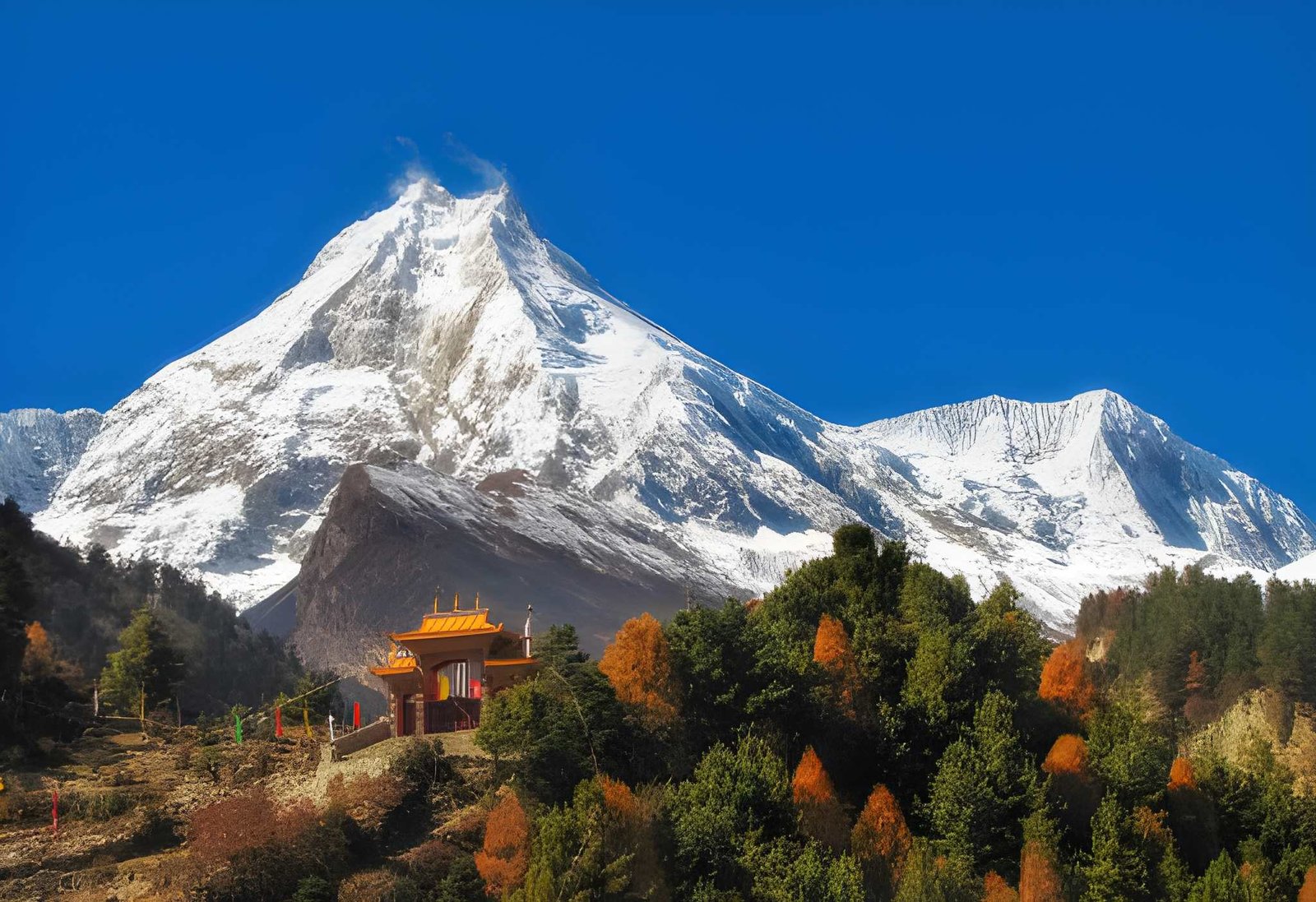
The honest assessment: Manaslu is growing. It is no longer the secret it was five years ago, and October now sees real traffic through certain sections. But it still registers significantly quieter than Annapurna Circuit or the Everest region, and the restricted area permit requirement maintains some natural filtering.
Why it’s still relatively quiet: The permit and mandatory guide requirement and the distance from Kathmandu add enough friction to keep it off the itinerary for shorter trips. The Larkya La pass (5,106m) also requires a level of preparation that filters out underprepared trekkers.
Reality check: If you’re doing this in October, particularly around the Samagaon to Samdo section, you will encounter other trekkers. It’s not the Annapurna Circuit crowded, but it has managed to meet solitude expectations. Go in November for a noticeably quieter experience.
Who it’s for: Trekkers ready to step up from the classic routes but not yet ready for the full commitment of Dolpo or Kanchenjunga, which is a genuinely rewarding middle ground.
5. Upper Mustang Trek
Crowd Score: 4/10
Best season for solitude: June–August (the monsoon bypass)
Upper Mustang sits in a rain shadow north of the Annapurna massif. This makes it one of the few Nepal treks that’s actually better in the monsoon months, when everywhere else is soaked and quiet-seekers are still looking for options.
The restricted area permit (now $50/day following a November 2025 policy change) still maintains a cost barrier, though easier access means crowd levels may gradually increase in the coming years.
Why it’s still quiet: The permit cost keeps casual visitors away. The landscape of the high-altitude Tibetan desert, ancient cave monasteries, and the walled city of Lo Manthang draws a specific kind of traveler rather than mass tourism.
Reality check: Infrastructure has genuinely improved in recent years. This is no longer a camping-only route. But “improved” is relative as expectations need to be calibrated to a remote Himalayan context, not a Kathmandu hotel.
Who it’s for: Trekkers interested in Tibetan Buddhist culture as much as mountain scenery. Anyone looking for a genuinely unique landscape that looks nothing like the rest of Nepal.
6. Everest Three Pass/Gokyo Trek
Crowd Score: 5/10
Best season for solitude: November, early May
Here’s a counterintuitive one: The Everest region itself, done differently. The Three Pass Trek of Cho La, Renjo La, and Kongma La shares the Everest approach as far as Namche Bazaar, then diverges sharply from the EBC highway. Most trekkers on the Everest trail are going to base camp and back. The passes filter them out by difficulty alone.
Why it’s still relatively quiet: Cho La Pass (5,420m) and the technical terrain around the three passes deters a large portion of EBC trekkers who are doing it as a bucket list item rather than a serious mountain experience. After Namche, the crowd thins significantly.
Reality check: You will share Namche, Tengboche, and Dingboche with EBC trekkers. You need to be ready for that. Above Dingboche and around the Gokyo Valley, the experience changes completely.
Who it’s for: Everest region enthusiasts who want the landscapes without the highway. Also suitable for trekkers who’ve completed the EBC and wish to return to the region via a different route.
7. Langtang Ganja La Trek
Crowd Score: 6/10
Best season for solitude: October–November, March
The distinction matters here. The standard Langtang Valley trek is no longer a quiet route. The Ganja La variation, which involves crossing the 5,122m Ganja La Pass into the Helambu region, is a fundamentally different experience. The pass creates a technical barrier that separates the casual Langtang visitor from the serious trekker.
Why it’s still relatively quiet: Ganja La requires a rope and an experienced guide for safe crossing. Most trekkers on the Langtang trail don’t attempt it. That one pass changes the entire crowd profile of the route.
Reality check: It has the highest score on this list for a reason. You will share the lower Langtang sections with standard route trekkers. The quieter experience begins at and beyond the pass itself.
Who it’s for: Trekkers with solid Nepal experience looking for a challenging variation on a familiar region. Good acclimatization profile for those building toward bigger objectives.
Which Less Crowded Trek Is Actually Right for You?
The list above covers a wide spectrum. Here’s how to filter it honestly.
If you want quiet but not remote, start with the Manaslu Circuit or the Everest Three Pass. Permit barriers do meaningful crowd-filtering, infrastructure is reasonable, and you’re not committing to a 3-week camping expedition. These are the accessible end of “less crowded.”
If you want genuinely off-beaten-path, Kanchenjunga or Dhaulagiri. Commit to 18–21 days, come with solid fitness and altitude experience, and accept that a guide is non-negotiable on both. The payoff is a Nepal that most trekkers never see.
If you want true expedition-level isolation, Upper Dolpo. This is the far end of the spectrum. Restricted permits, camping sections, and genuine remoteness. Not for everyone. That’s exactly the point.
Not sure which fits your actual experience level? We’ve been matching trekkers to the right routes for 25 years. Tell us where you’ve trekked before and what you’re looking for, and we’ll give you a straight answer→
A Note on Logistics: What Remote Treks Actually Require
A few realities worth knowing before you book anything on this list.
Restricted area permits: Dolpo, Mustang, Manaslu, and the Kanchenjunga area all require special permits beyond the standard TIMS and national park fees. These range from $90 to $500+, depending on the area and duration. Budget for them.
Guide requirements: Several of these treks legally require a licensed guide. Beyond legality, for routes like Dhaulagiri and Dolpo, a guide isn’t a luxury, but the difference between a safe trek and a serious incident. The terrain and isolation demand it.
Infrastructure expectations: “less crowded” often means “less built up.” Teahouse quality varies significantly on remote routes. Camping sections exist in Dolpo and parts of Kanchenjunga. If your comfort threshold requires guaranteed hot showers and Wi-Fi, calibrate expectations accordingly.
Cost reality: Remote treks cost more. Porters, permits, guide logistics, and longer duration all contribute. A Dolpo expedition costs significantly more than an EBC package. That’s not operator markup. It’s the genuine cost of reaching and supporting a journey in one of the world’s most remote regions.
Beyond Nepal: Himalayan Alternatives in Bhutan and Tibet
If you’ve read this far and the common narrative is “I want the Himalayas without the crowds” rather than “I specifically want Nepal,” two alternatives are worth knowing about.
Bhutan operates on a high-value, low-volume tourism model by government policy. The daily tourist fee structure limits mass tourism by design, which means trails and cultural sites that would be overwhelmed elsewhere remain genuinely accessible. Tiger Nest Hike and Snowman Trek offer Himalayan scenery with a crowd profile that Nepal’s open-access routes simply can’t match.
Tibet offers high-altitude landscapes and Tibetan Buddhist culture in a context that feels entirely distinct from anything in Nepal. The regulatory environment means visitor numbers are controlled, and overland routes through Central Tibet to Kailash offer a Himalayan experience of a different order entirely.
We run carefully designed small-group itineraries to both. If your interest extends beyond Nepal’s borders, our Bhutan and Tibet pages have the details.
Planning a Less Crowded Trek: Where to Start
The treks on this list are not plug-and-play packages. The permit systems, logistical complexity, and genuine remoteness of these routes require real planning, not a last-minute booking.
We’ve been running these specific routes for over two decades. Not just listing them. That distinction matters when something goes wrong at 5,000 meters, and the nearest road is four days away.
If one of these treks caught your attention, reach out with a quick inquiry. Tell us which route, your trekking background, and your timeframe. We’ll come back with a realistic breakdown: What it costs, what it requires, and whether it’s the right fit for where you are as a trekker.