
Author: Far Out Nepal
Altitude Sickness (AMS) Symptoms: Early Signs, Severity Levels & When to Worry
Introduction
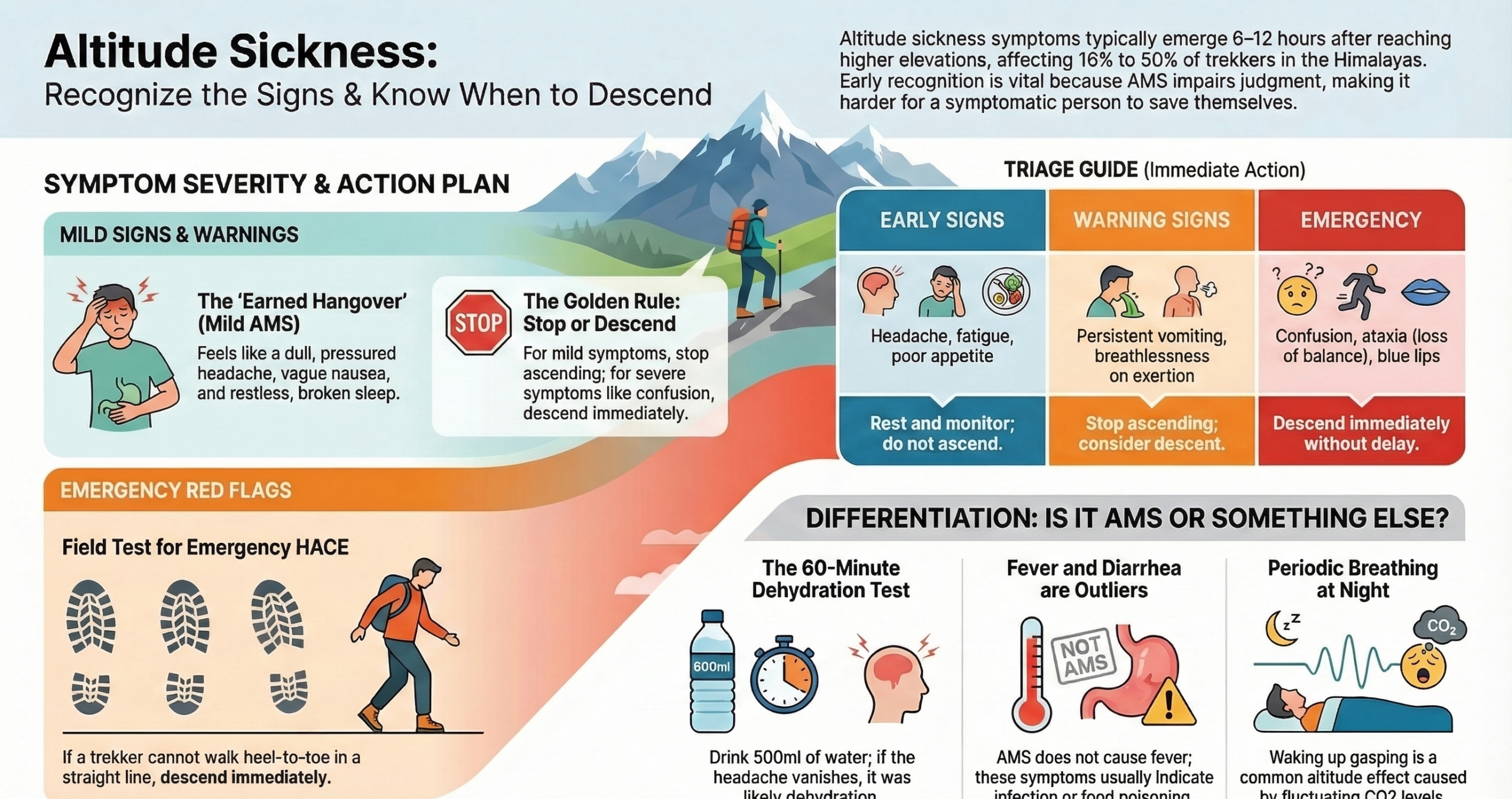
Altitude sickness symptoms usually begin to appear within 6–12 hours of reaching higher elevations. These symptoms typically range from mild headaches and fatigue to serious conditions affecting the lungs and brain. Studies in the Himalayas show AMS rates ranging from 16% to over 50%, depending on altitude and ascent speed.
This makes it one of the most common medical concerns for trekkers. Recognizing symptoms early and understanding what they actually mean is what keeps a great trek from becoming a medical emergency.
What Does Altitude Sickness Feel Like?
Most people expect altitude sickness to announce itself clearly. It rarely does and sneaks in quietly. The most honest description? It feels like a hangover you didn’t earn.
A dull, pressured headache that sits behind your eyes and wraps around your skull. A vague nausea that makes you want to vomit after smelling anything. A night of broken, restless sleep that leaves you more exhausted than when you went to bed.
What catches trekkers off guard is the subtlety. Initially, you feel off but not dramatically unwell. Many dismiss it as trail tiredness, a bad night’s sleep, or yesterday’s exertion. That dismissal is exactly where AMS gets dangerous.
The experience varies more than most expect. Some people feel genuinely terrible at mild AMS. Others feel only a little more tired. Fitness level doesn’t protect you, while experienced trekkers who lead the group on day one sometimes struggle most by day three. There is no reliable way to predict individual susceptibility in advance.
Early Signs of Altitude Sickness
The following symptoms typically appear first, often within hours of arriving at a new elevation:
- Headache: The defining symptom; throbbing or pressure-type, often worsening overnight
- Fatigue: Disproportionate tiredness that rest doesn’t fully relieve
- Loss of appetite: Food becomes unappealing, not just less enjoyable
- Mild dizziness: Lightheadedness, nausea (especially when standing or moving quickly)
- Sleep disturbance: Difficulty staying asleep, waking repeatedly, and feeling unrefreshed in the morning
A headache alone at altitude is classified as a high-altitude headache (HAH) and is extremely common. It becomes AMS when accompanied by at least one other symptom: nausea, fatigue, or dizziness. This combined symptom severity can reach a clinical threshold, which can be defined by the Lake Louise Scoring System.
If you wake up with a headache and no appetite after your first night at a new elevation, that combination deserves attention, not dismissal.
Altitude Sickness Symptoms by Severity
Mild Symptoms (Early AMS)
AMS is rare below 2,500m. Above 4,500m (which is the elevation of many popular Himalayan treks), more than half of the trekkers may be affected. Mild AMS is the most common presentation and, if managed correctly, is rarely dangerous.
- Headache that responds to ibuprofen or paracetamol
- Mild fatigue
- Reduced appetite
- Slight dizziness
- Disrupted sleep
At this stage, the right move is simple. Stop ascending. Rest at the same altitude. Most mild AMS resolves within 24–48 hours with acclimatization. The mistake people consistently make is pushing their ascent because they feel “only a little off.” That is how mild progresses to other stages.
Moderate Symptoms
Moderate AMS means your body is struggling to compensate. Symptoms intensify and begin interfering with normal functioning:
- Persistent headache that doesn’t fully respond to painkillers
- Nausea, possibly with vomiting
- Significant fatigue, where basic tasks feel effortful
- Breathlessness with mild exertion
- Reduced urine output
Do not ascend further. If symptoms don’t change (improve or worsen), even after 24 hours of rest at the same altitude, descending 300–500m is the right call. This is the stage at which ignoring symptoms creates a real risk.
Severe Symptoms (Emergency Warning Signs)
Severe AMS indicates progression toward HACE (High Altitude Cerebral Edema) or HAPE (High Altitude Pulmonary Edema). Both of these are life-threatening conditions and require immediate action.
HAPE is actually the more common cause of altitude-related death and can develop without preceding AMS symptoms in some cases. HACE, if untreated, can progress to coma and death within 12–24 hours due to brain herniation.
Descend immediately. Do not wait for morning.
- Breathlessness at complete rest
- Persistent dry cough, especially with pink or frothy sputum (HAPE)
- Confusion, disorientation, or unusual behavior
- Inability to walk a straight line (ataxia). A hallmark sign of HACE
- Extreme lethargy beyond normal exhaustion
- Blue lips or fingernails (cyanosis)
A useful field test for HACE: Ask the person to walk heel-to-toe in a straight line. If they can’t, even if they could before, descend immediately.
Specific AMS Symptoms Explained
Altitude Sickness Headache
The headache of AMS isn’t random. When oxygen levels drop, the brain triggers vasodilation, where the blood vessels widen in an attempt to push more oxygenated blood to the brain tissue. This increases intracranial pressure.
But the pain itself is generated through the trigeminovascular system. This is the same nerve pathway involved in migraines, which is why an AMS headache can feel remarkably similar to a migraine.
What makes it distinct from other headaches: It typically worsens overnight, peaks in the morning, and intensifies when bending forward or lying flat. Exertion makes it worse. It often doesn’t respond well to hydration alone, which is one of the key ways to differentiate it from a dehydration headache.
If ibuprofen isn’t meaningfully reducing it after a few hours, treat that as a signal, not a nuisance.
Nausea and Loss of Appetite
Hypoxia activates the sympathetic nervous system. This is the same stress-response system behind pre-adrenaline nausea. Simultaneously, the gut is deprioritized under low-oxygen conditions. Digestion slows. Food becomes unappealing.
In early AMS, this isn’t dramatic nausea, but a persistent, low-level queasiness. Many trekkers eat mechanically but find no enjoyment in food. Vomiting typically signals moderate-to-severe AMS, and when it appears, it matters beyond discomfort. Vomiting also accelerates dehydration and can delay acclimatization.
Dizziness and Fatigue
Dizziness at altitude stems from reduced oxygen reaching the vestibular system and brain. This is also compounded by the cardiovascular effort of compensating for hypoxia. It presents as lightheadedness, which is most noticeable when standing or changing positions quickly.
Fatigue runs deeper than just the tiredness after trekking. Muscles switch to less efficient anaerobic metabolism earlier than normal. Meanwhile, the body is working hard just to maintain basic function. There’s an increase in breathing rate, elevated heart rate, and heightened sympathetic activation. All of it burns energy. Fit, experienced trekkers are often the most surprised by how profound this fatigue feels.
Sleep Disturbances at Altitude
This is the most misunderstood AMS symptom, and the one most likely to be blamed on everything except the actual cause.
When you’re sleeping at an altitude, hypoxia triggers faster breathing (hyperpnea), which drops CO₂ levels. Low CO₂ signals the brain to temporarily stop breathing (apnea). Falling oxygen level then restarts the breathing drive, and the cycle repeats.
This is called periodic breathing, sometimes referred to as Cheyne-Stokes respiration at altitude. Each cycle lasts roughly 30 seconds to 2 minutes, though at altitude these cycles tend to be shorter and more frequent than in other clinical settings.
The result: Repeated micro-awakenings, often with a gasping or startled sensation. Vivid or unsettling dreams are common. You go to bed tired and wake up more exhausted, because you technically stopped breathing dozens of times overnight.
Many trekkers blame cold air, tent noise, or a new environment. If you’re consistently waking with a jolt at a new elevation, this is why.
Symptoms That Are Often Confused with Altitude Sickness
Knowing what altitude sickness is is just as important as knowing what it is. Once you’ve ruled out dehydration, food poisoning, or a common cold, what remains needs to be taken seriously.
Can Altitude Sickness Cause Fever?
No. Fever is not a symptom of AMS or HACE. If you have a fever above 38°C at altitude, think infection first, like viral illness, respiratory infection, or something requiring medical attention beyond altitude protocol.
The exception worth knowing: Fever can appear with HAPE, which is why HAPE is sometimes initially mistaken for pneumonia. But by that point, respiratory symptoms, including breathlessness at rest and a worsening cough, are dominant and hard to miss. A fever without those classic AMS markers points strongly away from altitude sickness.
Diarrhea at Altitude: AMS or Something Else?
Diarrhea is one of the most common medical complaints among trekkers in Nepal, but it is rarely caused by altitude. AMS only causes nausea and sometimes vomiting.
What actually causes trekker diarrhea in the Himalayas is far more mundane: contaminated water, unfamiliar food, traveler’s gut bacteria, including E. coli and Giardia. This is so prevalent in the first two weeks of a Nepal trip that many trekkers incorrectly attribute it to altitude when it needs an entirely different response of rehydration and possibly antibiotics, not descent.
Fever combined with diarrhea is almost certainly not AMS. Think food poisoning or infection.
AMS vs. Dehydration
This is the most practically useful distinction to understand, because dehydration and AMS frequently co-exist and share overlapping symptoms.
Where they overlap: headache, fatigue, nausea, dizziness.
Where they differ:
- Dehydration headache typically improves within 30–60 minutes of drinking water. AMS headache does not.
- Dehydration causes dry mouth, thirst, and dark urine. These are not typical AMS features.
- Altitude itself increases fluid loss through faster, drier breathing. Many trekkers arrive genuinely dehydrated without realizing it, which can worsen AMS symptoms.
A practical field approach: Drink 500ml of water and wait 45–60 minutes. If the headache eases meaningfully, dehydration was likely the cause. If it persists or worsens, treat it as AMS and act accordingly.
How AMS Symptoms Progress If Ignored
AMS follows a quick escalation when ascent continues despite symptoms.
Hours 6–12 after ascent: A dull headache begins, but is often dismissed as trail tiredness. Mild fatigue. Slight nausea. Easy to explain away.
Night 1: The headache intensifies when lying down. Sleep is fragmented by periodic breathing. Morning reveals worse symptoms than the evening before. This is a critical signal: if you feel worse after a night of rest, acclimatization is not happening.
24–48 hours with continued ascent: Headache becomes severe and unresponsive to medication. Vomiting. Profound fatigue. Breathlessness on minimal exertion. The body is no longer compensating.
Beyond this point: The transition to HACE or HAPE can happen within hours. Confusion appears. Coordination deteriorates. Breathing becomes labored at rest. This is a medical emergency with a narrow treatment window.
One critical and underappreciated factor:
AMS impairs judgment. The very condition requiring action makes it harder to recognize that you need to act. Guides, trek partners, and pre-agreed symptom plans matter here. You should not rely solely on self-assessment when symptomatic.
When to Be Concerned About Altitude Sickness Symptoms
Here’s a sobering finding from Nepal-based research: 63% of trekkers developed AMS symptoms despite 80% having prior knowledge of the condition.
Knowing about altitude sickness does not protect you from it. It also doesn’t guarantee you’ll recognize it in yourself.
Seek descent or emergency assistance when:
- Symptoms worsen after 24 hours of rest at the same altitude
- The headache becomes severe and doesn’t respond to ibuprofen
- Breathlessness occurs at rest, not just on the trail
- Coordination or balance deteriorates
- Confusion, unusual behavior, or extreme lethargy appear
- Any symptom from the severe category above is present
The golden rule of altitude: If in doubt, descend. Dropping even 300–500m can produce a dramatic improvement within hours. Altitude is the only reliable cure for AMS, and it works fast.
Do You Need Medication for These Symptoms?
Acetazolamide (sold under the brand name Diamox) is the most widely used medication for altitude sickness prevention and treatment. It works by inducing a mild metabolic shift that stimulates deeper, more frequent breathing, essentially accelerating what acclimatization does naturally over 3–5 days into roughly one.
It also directly reduces periodic breathing during sleep, which is why many trekkers on Diamox report significantly better rest at altitude. Importantly, it doesn’t mask symptoms, but supports the body’s actual adaptation process.
Whether you need it depends on your ascent profile, personal susceptibility, and trek itinerary. For dosage, timing, and a full breakdown of how to use it properly, see our complete altitude sickness medication guide.
Quick AMS Symptom Reference
| Category | Symptoms | Action |
| Early Signs | Headache, fatigue, poor appetite, mild dizziness, broken sleep | Rest, don’t ascend, monitor closely |
| Warning Signs | Persistent headache, nausea/vomiting, breathlessness on exertion | Stop ascending, consider descent |
| Emergency Signs | Breathlessness at rest, confusion, ataxia, pink/frothy cough | Descend immediately without any delay |
So, can we manage AMS symptoms?
Altitude sickness is manageable when you catch it early. The trekkers who get into serious trouble aren’t usually the ones who didn’t know the symptoms, but the ones who recognized them and kept climbing anyway.
Understand what your body is telling you. Know what AMS is and what isn’t. And when symptoms don’t resolve with rest, descend first and investigate later.
For a complete overview of causes, risk factors, and prevention strategies, see our complete altitude sickness overview guide.
What to Pack for Trekking in Nepal: Complete Gear List + Local Tips (2026 Guide)
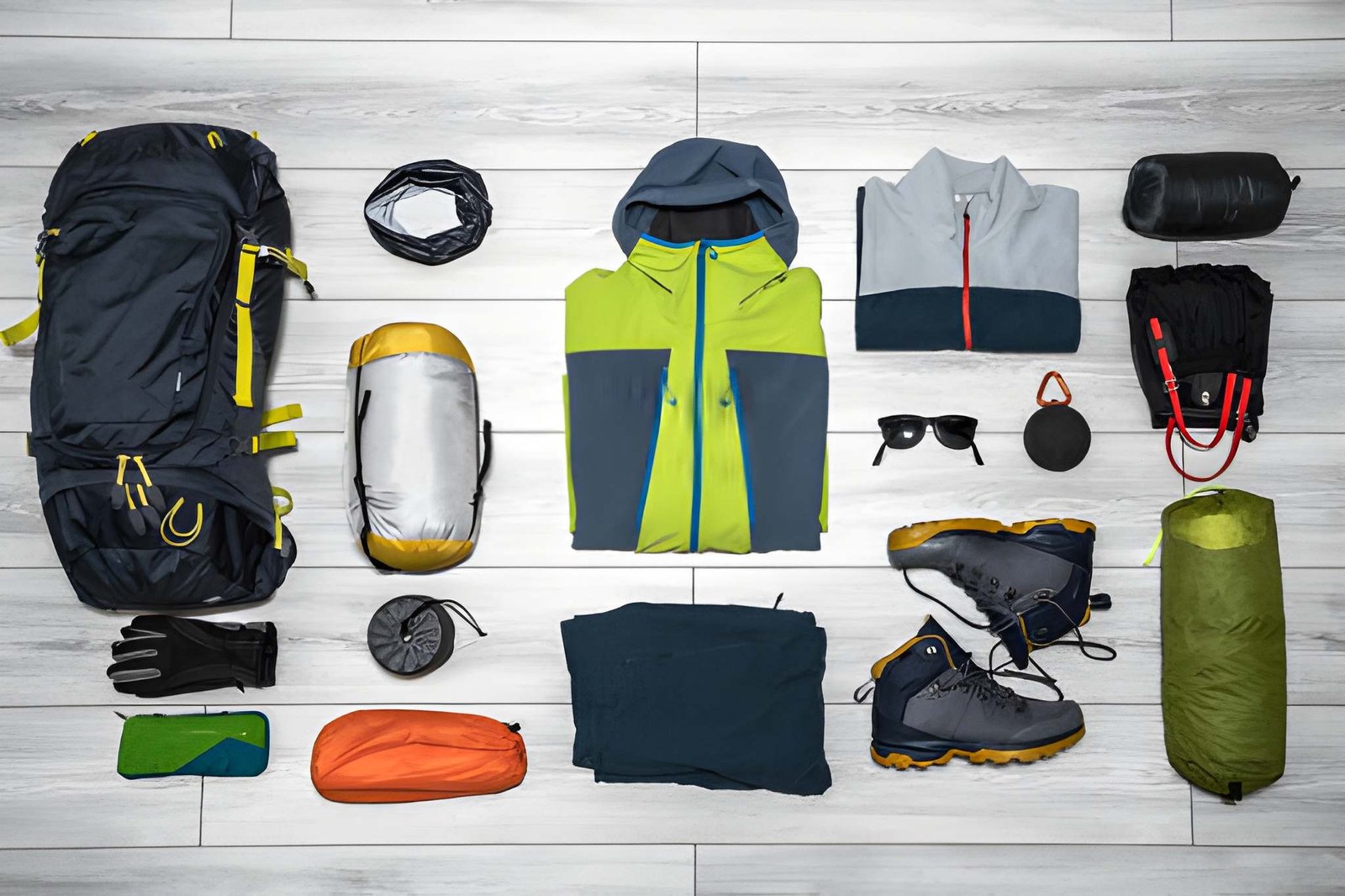
What trekking gears are needed when visiting Nepal
- Layered clothing (base, insulation, waterproof shell)
- Trekking boots: waterproof, broken-in before you fly
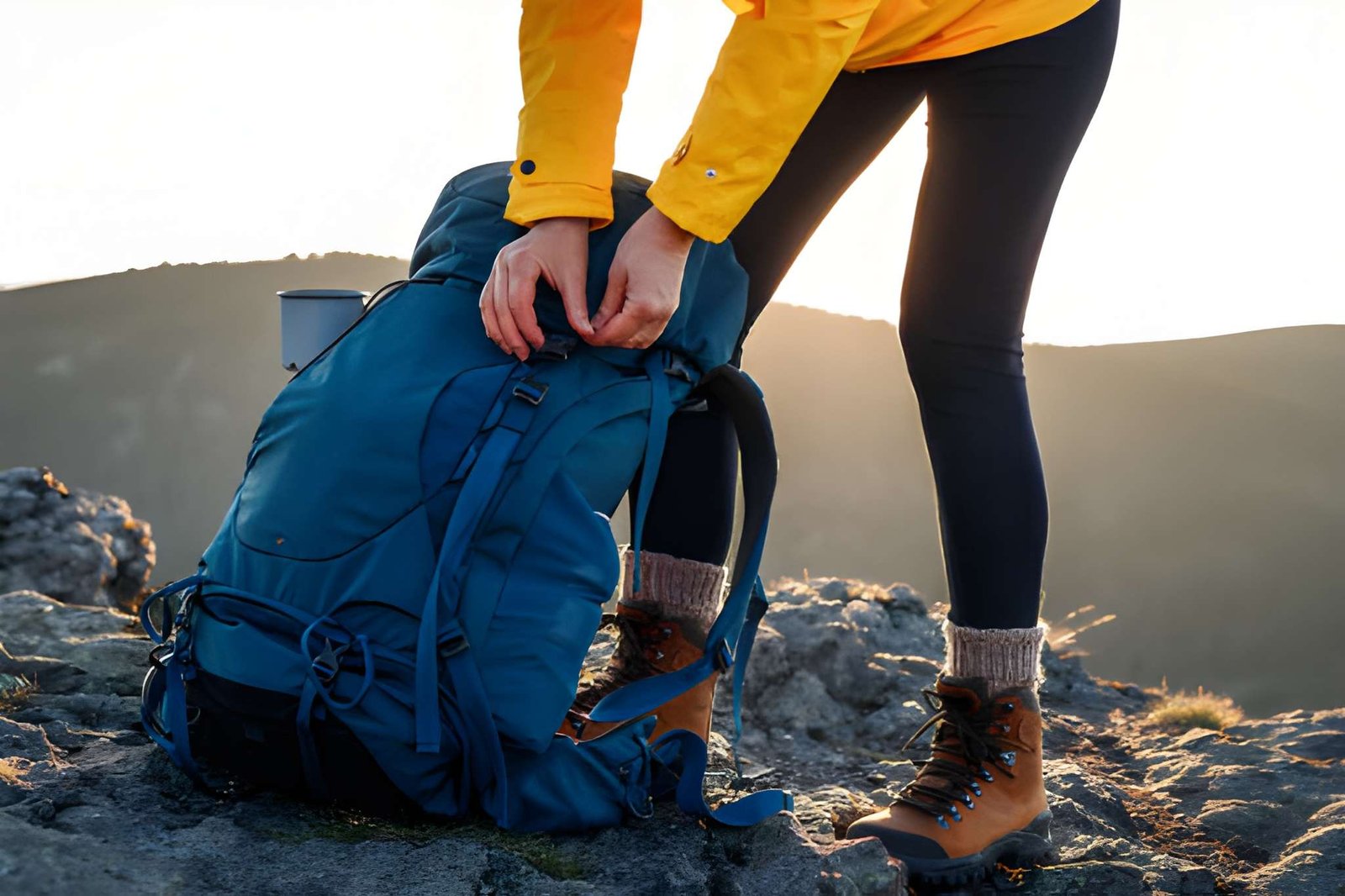
- Backpack (50–70L main + 25–30L daypack)
- Sleeping bag (-15°C rated, especially for high altitude)
- Trekking poles
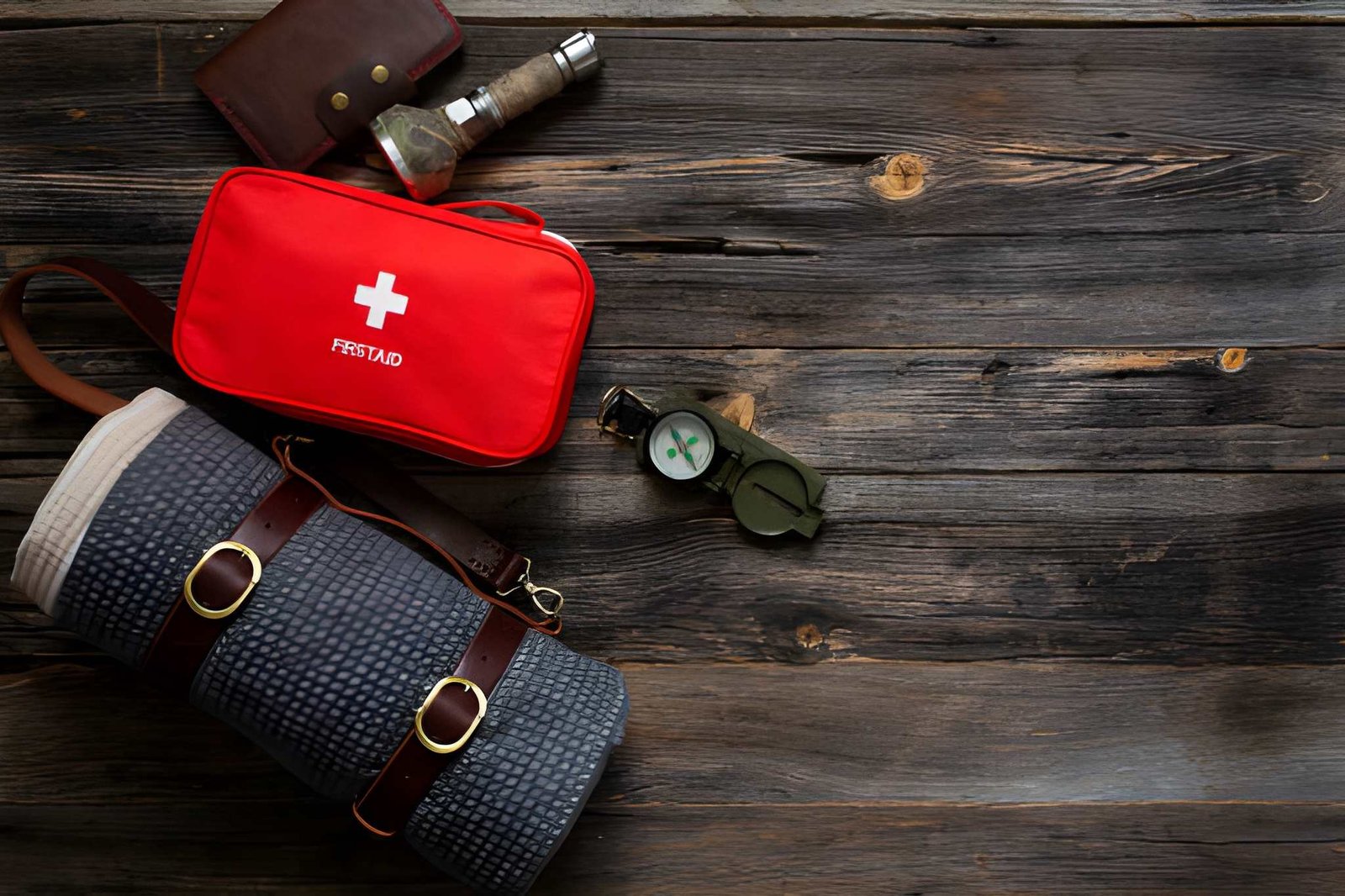
- Basic first aid, medications, and personal items
The good news is, you don’t need to pack everything for trekking in the Himalayas. Nepal ( especially Kathmandu) has excellent, affordable gear available to rent or buy. The rule of thumb is knowing what to bring from home, what to grab locally, and what to leave behind entirely.
Introduction: Stop Doom-Scrolling Gear Packing Lists
You’ve already read three packing lists this week. They all say, “Bring a warm jacket.” You already know that, though, since it’s common sense.
Here’s the thing: trekking in Nepal isn’t like hiking a trail back home. You’re dealing with altitude changes of 2,000m+ in a single trek, weather that flips from warm sun to freezing wind in an hour, teahouses that may not have heating systems, and trails where the nearest gear shop is miles behind you.
Generic advice won’t cut it. You need Nepal-specific guidance. You need to learn what the locals know, what experienced trekkers wish they’d known, and what’s actually available in Kathmandu before you head out.
That’s exactly what this guide covers: a complete gear list, what NOT to pack, the rent vs. buy question answered properly, and market prices so you can budget before you land.
The Complete Nepal Trekking Gear List
A complete setlist consists not only of what you wear on the trek, but also of your overall journey.
Clothing: The Layering System
Let’s forget individual brands for a second. In Nepal, how you layer matters more than what brand or how thick you’re wearing.
- Base Layer: The moisture manager and best friend of your skin. It always goes on first and stays on all day. Merino wool is the gold standard as it wicks sweat, regulates temperature, and doesn’t smell after three days (yes, really). Bring two sets of thermal tops and bottoms.
Our Advice: Avoid cotton entirely. Once wet, cotton stays wet and wet cotton at 4,500m is genuinely dangerous (including risk of hypothermia).
- Mid Layer: The warmth engine. A thin fleece works for moderate altitudes below. A thicker fleece or down jacket works best for the high stuff. The down jacket is one of many items you can easily rent in Kathmandu for $1–3/day. So, you don’t need to stuff one in your bag from home.
- Outer Layer: It’s your shield in the mountains. A waterproof, windproof shell jacket is non-negotiable. Even on bluebird days, wind above 3,500m is brutal. Rain is possible year-round. This layer doesn’t need to be heavy, but just needs to stop wind and water.
- Bottoms: One to two pairs of zip-off trekking trousers. The convertible style earns its weight as you’ll be in shorts at Namche (3,440m) and full trousers with thermals under them at Gorak Shep (5,140m).
- Accessories: Warm beanie, buff or balaclava, gloves (thin liner + waterproof outer), UV-protection sunglasses, and two to three pairs of wool hiking socks.
Footwear: The Steps You Take
Your boots are the single most important item you own on your treks. Get this wrong, and you’ll spend your Himalayan adventure hobbling between teahouses with blisters the size of momos.
- Waterproof hiking boots with ankle support and a solid grip
- Size them up slightly. Your toes should not be pressing forward on long descents
- Break them in for 3–4 weeks before you fly. Wear them on walks, errands, everywhere. New boots on day one of a two-week trek is a nightmare.
- Pack camp slippers or flip-flops for teahouse evenings. Your feet will thank you.
Backpacks & Storage
- Main pack: 50–70L with a rain cover. If using a porter, a waterproof duffel works great.
- Daypack: 25–30L that you carry yourself every day, including snacks, water, layers, camera, and documents.
- Store anything you don’t need on the trail at your hotel in Kathmandu. Most guesthouses offer free luggage storage.
Sleeping Gear
- Do you need a sleeping bag? Yes, for most treks, especially anything above 3,500m. Teahouse blankets exist but are thin, often damp, and shared with a lot of strangers. A sleeping bag rated to -15°C is recommended for EBC and high-altitude routes.
- The good news: Sleeping bags are very easy to rent in Kathmandu ($1–2/day). If you’re trekking a lower route or only in warmer months, a liner may be enough.
Essentials & Accessories
| Item | Notes |
| Headlamp + spare batteries | Power cuts are common; don’t rely on your phone |
| Trekking poles | Highly recommended. They save your knees on descents. |
| Power bank (20,000mAh+) | Charging at teahouses costs $1–3 per charge |
| Water bottle (metal) + purification tablets | Metal bottles can be heated on the teahouse stoves for free |
| Sunscreen SPF 50+ & lip balm | UV radiation increases significantly at altitude |
| First aid kit | Paracetamol, Ibuprofen, Diamox, blister kit, antiseptic |
| Toilet paper | Critical above 4,000m where water freezes |
| Cash in NPR | ATMs disappear fast once you leave the valley |
| Trekking permits | TIMS card + national park entry. Sort in Kathmandu. |
Clothing by Altitude: What to Wear Where
Most blogs hand you a list and leave you guessing. Here’s how it actually works on the trail:
| Altitude | Conditions | What You’ll Be Wearing |
| Below 2,500m | Warm days, cool evenings | T-shirt + zip-off trousers, fleece for evenings |
| 2,500–3,500m | Cool to cold, windy | Base layer + mid fleece + shell jacket |
| 3,500–5,000m+ | Cold days, very cold nights | Full thermal base + mid + down jacket + shell, beanie, gloves |
Trek-Specific Gear: EBC vs. Annapurna
Everest Base Camp Trekking Gear
EBC is the big one. Nights at Gorak Shep (5,140m) regularly drop to -15°C to -20°C in autumn and winter. Your gear needs to be rated for that, not just “pretty cold.”
EBC-specific additions beyond the standard list:
- Sleeping bag rated -15°C minimum (non-negotiable)
- Heavy down jacket (not just a fleece)
- Heavyweight waterproof gloves
- Microspikes for icy sections near the top
- Altitude medication (Diamox) should be consulted with a doctor before departure
Interested in trekking the EBC? Check out our EBC itinerary page & book your journey today.
Annapurna Region Treks
The Annapurna Circuit and its Base Camp trek are slightly lower in max altitude, but the weather is equally unpredictable. The standard list applies. You can get away with a slightly lighter sleeping bag on the Annapurna Base Camp route in spring, but don’t cut corners if trekking in October–November.
What NOT to Pack for Trekking in Nepal
This might be the most useful section in this entire guide.
Cotton clothing: We said it once, we’ll say it again. Cotton harms. Leave it in Kathmandu.
More than two of anything: You won’t change clothes the way you think you will. Trekkers wear the same things every day. Two pairs of trousers, two base layers, maximum.
A heavy “just in case” jacket from home: Down jackets are cheap and excellent in Kathmandu. Don’t haul one across the world.
Jeans: They weigh a ton, they’re slow to dry, and they’re restrictive. Leave them.
A full toiletries bag: Travel-size only. You won’t be using much of it.
Anything you haven’t used in the last month: If you haven’t needed it recently, you won’t need it at 4,500m either. This rule eliminates about 30% of most people’s pack.
Target pack weight: 8–12kg. Every extra kilo will feel like five by day four.
Should You Rent or Bring Trekking Gear in Nepal?
This is the question. And the honest answer is: you probably need less from home than you think.
Renting Trekking Gears in Nepal:
- Down jacket (~$1–3/day or $15–30 to buy)
- Sleeping bag (~$1–2/day)
- Trekking poles (~$1/day)
- Duffel bag (~$1/day)
Bring Trekking Gears from Home:
- Hiking boots (must be broken in and cannot be rented)
- Base layers and merino wool (fit and quality vary widely in rentals)
- Personal medications and first aid
- Daypack (fit matters)
The Quality Warning
Not all rental gear in Nepal is equal. Some shops have well-maintained, quality stock. Others have down jackets with the insulation compressed into nothing and sleeping bags that smell like six seasons of altitude trekking. Know who you’re renting from.
At Far Out, we help trekkers arrange quality-checked gear in Kathmandu. So, you’re not playing rental roulette before your trek. [Get in touch here.]
Cost of Trekking Gear in Kathmandu
One of the most common questions, and one almost nobody answers with real numbers. Here’s what you’re looking at in 2026:
| Item | Rent (Per Day) | Buy (Kathmandu) | Buy (Western Retail) |
| Down jacket | $1–3 | $20–60 | $150–300 |
| Sleeping bag (-15°C) | $1–2 | $30–80 | $150–400 |
| Trekking poles | $1 | $10–25 | $60–150, |
| Trekking boots | — | $30–100 | $120–300 |
| Waterproof shell jacket | $1–2 | $20–50 | $100–250 |
| Duffel bag (70L) | $1 | $15–30 | $60–120 |
Budget trekker (renting most items, buying essentials): $50–100 total gear spend in Kathmandu.
Mid-range trekker (buying quality local gear): $150–250.
Kathmandu prices are genuinely 50–70% lower than Western retail for equivalent gear. Budget travellers, this is great news.
Where to Buy or Rent Trekking Gear in Nepal
Kathmandu: The Main Hub
Thamel is the trekking gear epicentre of Nepal. Hundreds of shops, every item you need, and serious competition keep prices reasonable. The street to know is Tridevi Marg, where the better-stocked, imported-brand shops tend to cluster.
Tourist trap warning: Counterfeit gear is real. “North Face,” “Mammut,” and “Patagonia” jackets at $15 are not the real thing. They look convincing and fall apart in the cold. Either buy knowingly (a $15 fake is fine for low altitudes) or pay more for genuine stock from reputable shops.
Pokhara also has a solid gear scene in the Lakeside area, which is good for Annapurna region trekkers who fly direct.
Common Packing Mistakes Trekkers Make
Collected from real trekkers (and our own guides who’ve watched this unfold on trails for years):
- Not breaking in boots: Its the number one cause of trek-ruining blisters. Wear new boots for 3–4 weeks before departure.
- Ignoring the layering system: Buying a “really warm jacket” and thinking that’s sufficient. Temperature swings 20°C between midday and midnight at altitude. Layers are the system.
- Underestimating the cold above 4,000m: First-timers consistently say, “It was way colder than I expected.” It will be. Plan for it.
- Over-relying on cheap gloves: Your hands are exposed all day. Budget gloves fail fast. Get good ones.
- Forgetting a power bank: Teahouses charge $1–3 per device charge. On a 14-day trek that adds up fast, and power cuts are common.
- Not checking insurance altitude coverage: Many standard travel policies cap at 2,000–3,000m. If you’re heading to EBC (5,364m), you need a policy that explicitly covers high-altitude trekking. Check before you fly.
Pro Packing Tips from Far Out
A few final notes from people who’ve done this a few hundred times:
- Pack everything, then remove 20%. Seriously. Then remove a bit more.
- Use dry bags inside your pack. Even with a rain cover, moisture finds a way in.
- Test all gear before you leave home. Wear the boots, sleep in the sleeping bag, and check the headlamp batteries.
- Snacks are cheapest in Kathmandu. Stock up on nuts, energy bars, and electrolyte tabs before the trek. Prices at altitude can be 3–4x higher.
- Adjust for season. Pre-monsoon (March–May) and post-monsoon (Sept–Nov) are peak seasons with predictable conditions. Winter and monsoon require additional gear planning.
Final Word: Pack Smart, Trek Better
The best trekking kit isn’t the most expensive one or the most complete one. It’s the one that’s light enough not to slow you down, warm enough not to stop you, and smart enough to have been half-assembled in Kathmandu at a fraction of what you’d pay back home.
Pack with intention. Leave the “just in case” pile on your bedroom floor. And focus on what you actually came for: the mountains, the trail, and the kind of experience that makes every ounce of preparation worth it.
Need help putting it all together? Far Out works with trekkers to sort gear, permits, guides, and logistics before they hit the trail. No guesswork, no tourist traps. Just a smooth start to your Nepal adventure. Contact Far Out here.
Prices mentioned above are subject to change. Make sure to always consult an expert like Far Out Nepal on these things before you plan your trek.
Classic Everest Base Camp vs. Gokyo Lakes Trek: Which Route Should You Choose?
Introduction: EBC vs. Gokyo Lakes
Let’s be honest. If you’ve started searching up “EBC vs Gokyo,” you’re not looking for a casual trekking experience. You’re already deep in the trekking rabbit hole, probably with seven tabs open and hastily comparing trekking companies & packages.
We get it. This is one of the most exciting, yet also one of the most confusing, decisions you’ll make. Both routes are genuinely spectacular. Both routes also start at Lukla, and both put you in the shadow of the world’s highest peaks. The difference is what happens in between.
At Far Out Nepal, we’ve guided trekkers on both routes for over 25 years. We’ve seen first-timers moved to tears at Kala Patthar. We’ve watched photographers lose their minds completely at Gokyo Ri. And most importantly, we’ve forever guided trekkers who wanted the best of both, with our combined route circuit.
EBC or Gokyo: Two Routes, Two Completely Different Journeys
Before the comparison tables and altitude numbers, here’s the summary of each:
Classic EBC = The iconic route, which is a well-established and world-renowned pilgrimage. You will be face-to-face with the world’s highest peak, which is an euphoric experience in itself.
EBC via the Gokyo Circuit = The full picture. Sacred lakes, Nepal’s longest glacier, a 360° panorama of four eight-thousand-foot peaks, EBC itself, and a circuit route that never repeats a single step.
Now let’s go deeper.
The Classic Everest Base Camp Trek (14-17 Days)
The Classic EBC Trek welcomes over 40,000 trekkers every year to the Khumbu region, and the numbers don’t lie.
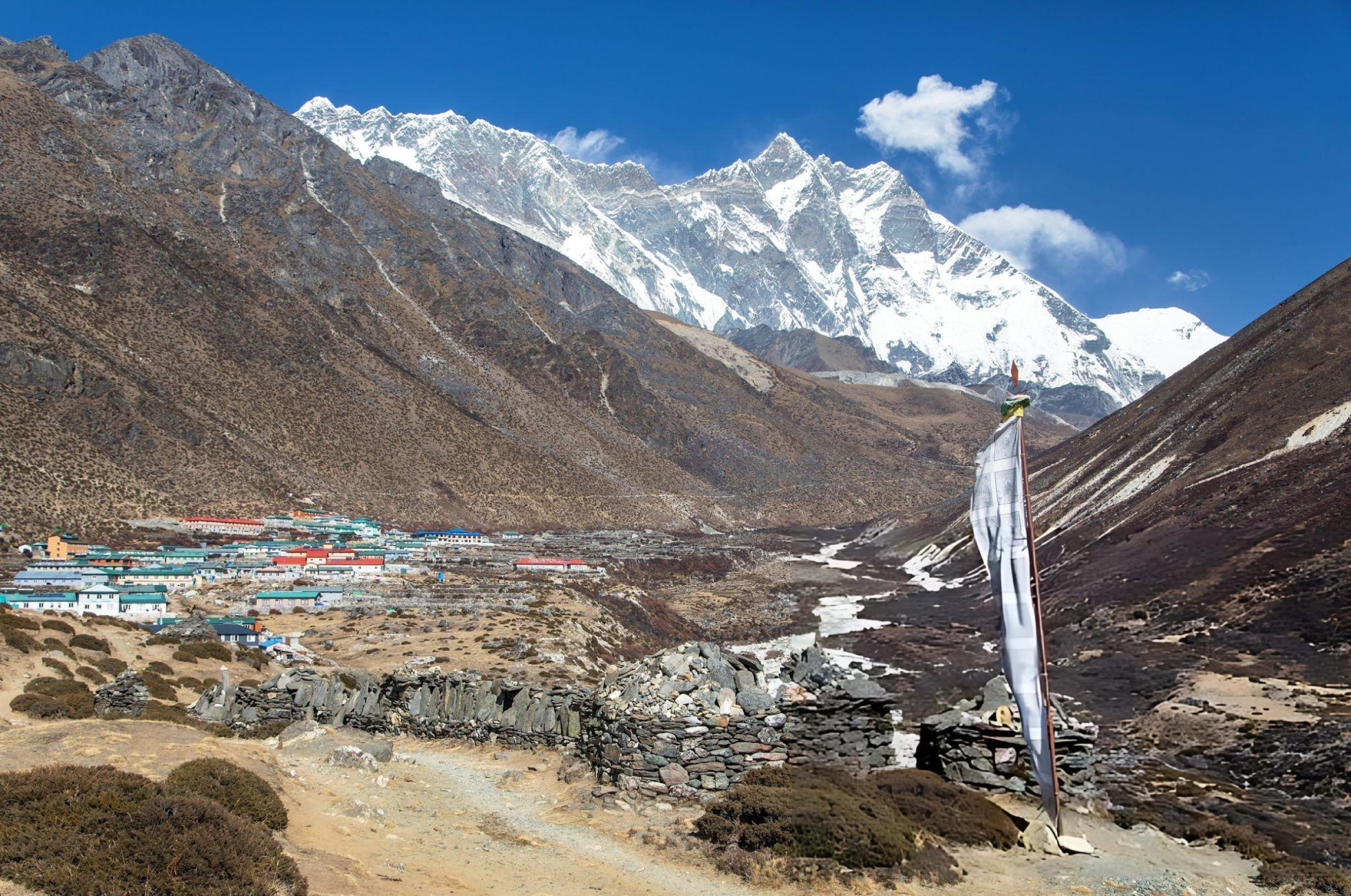
This is one of the world’s great trekking routes. Starting with a flight into Lukla (2,860 m), you follow the Dudh Koshi River through a string of legendary Sherpa villages: Phakding, Namche Bazaar, Phortse, Dingboche, etc., before arriving at Gorakshep and stepping onto the moraine of Everest Base Camp (5,340 m / 17,500 ft).
Our 17-day Classic EBC Trek covers approximately 130–140 km round trip, with two planned acclimatisation stops built in (Namche Bazaar and Dingboche). The summit moment (and yes, it feels like a summit) is Kala Patthar at 5,545 m / 18,192 ft, where Everest’s south face fills your entire field of vision roughly 9 km away.
One thing we are honest about that most agencies won’t tell you: the return trip retraces the same path. Same trail, same teahouses, same ridgelines, but in reverse. For some trekkers, that’s a meditative experience. For those seeking novelty, it’s a compelling reason to consider the Gokyo circuit. Worth knowing before you commit.
→ Ready to see the full day-by-day breakdown? View the Classic EBC Trek map here.
The EBC via Gokyo Lakes Route (18-20 Days)

This route shares the trail with the classic as far as Namche Bazaar, then turns northwest into the quieter, less-travelled Gokyo Valley. Instead of heading toward Lobuche, you trek through Dole and Machhermo before arriving at Gokyo village. Far Out Nepal’s 20-day EBC via Gokyo Lakes trek is a genuine circuit which combines both destinations, without backtracking, no repeated terrain, and new scenery every single day.
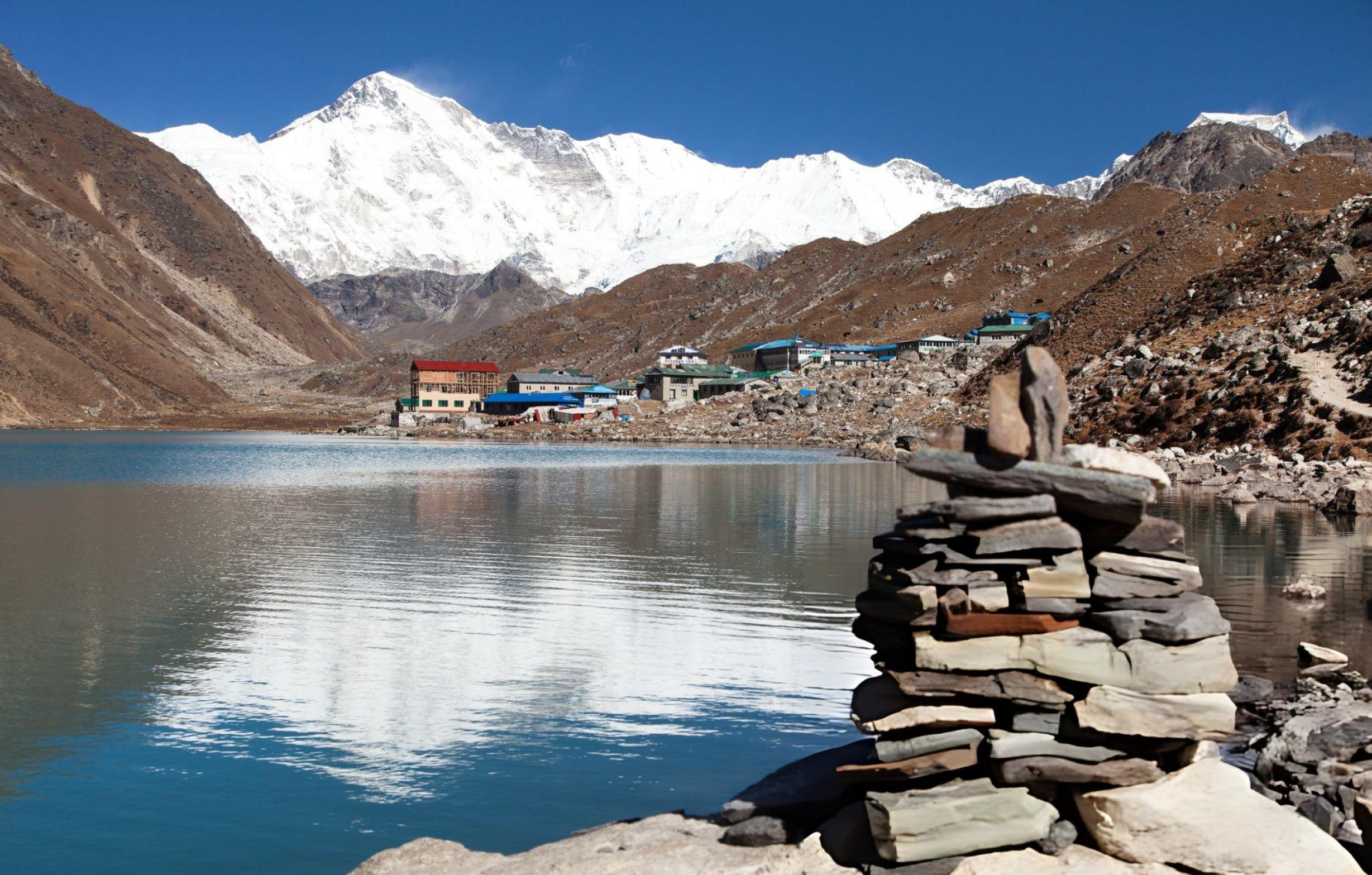
The village sits beside one of the most extraordinary landscapes in the Himalayas: a series of six turquoise glacial lakes, each shimmering at over 4,700 m, fed by the Ngozumpa Glacier (Himalaya’s longest glacier), stretching between 4,700 m and 6,000 m.
From Gokyo, you ascend Gokyo Ri (5,357 m), cross the dramatic Cho La Pass (5,420 m), and rejoin the classic EBC trail for the final push to Gorakshep, Base Camp (5,340 m), and Kala Patthar (5,645 m) on this route.
And about those lakes. The Gokyo Lakes aren’t just beautiful, they’re a Ramsar Wetland Site (No. 1692, designated in 2007), making them internationally recognised for their ecological significance. They are also sacred to both Hindus and Buddhists, with Sherpa communities honouring them for generations. Pilgrims still travel here for the annual Janai Purnima festival. You’re not just passing through a scenic valley. You’re walking through a living sacred landscape.
→ Curious about the full 20-day circuit? Explore the EBC via the Gokyo Lakes map here.
EBC or Gokyo: The Numbers That Matter
| Factor | Classic EBC | Everest Gokyo Circuit |
| Duration | 14-17 Days | 18-20 Days |
| Distance | ~130–140 km | ~160–175 km |
| Max Altitude | 5,545 m / 18,192 ft | 5,645 m / 18,520 ft |
| Grading | Difficult | Difficult |
| Crowds | High (40,000+ trekkers/year) | Moderate and noticeably quieter |
| Scenic Diversity | Mountains, glaciers, monasteries | Lakes, glaciers, passes, four 8,000m peaks |
| High Pass | None | Cho La Pass (5,420 m) |
| Glacier Walking | Limited | Extensive (Ngozumpa Glacier) |
| Route Type | Out-and-back | Full circuit without any repeated terrain |
| Group Size | 1–10 people | 2–10 people |
| Best Season | March–May / Oct–Nov | Mid-March–April / Mid-Oct–Nov |
| Best For | First-timers, bucket-list trekkers | Experienced trekkers, photographers, adventurers |
Route Differences Between Classic EBC vs. EBC via Gokyo Lakes Trek
Both treks start identically. Here’s where they diverge and how they eventually reunite:
| S.N. | Classic Everest Base Camp Trek Route | Gokyo Lakes and Cho La Pass Route |
| 1 | Arrive Kathmandu | Arrive Kathmandu |
| 2 | Drive → Ramechhap, fly → Lukla, trek → Phakding | Drive → Ramechhap, fly → Lukla, trek → Phakding |
| 3 | Phakding → Namche Bazaar (3,450 m) | Phakding → Namche Bazaar (3,450 m) |
| 4 | Namche acclimatisation | Namche acclimatisation |
| 5 | Namche → Tengboche (3,860 m) | Routes split: Namche → Dole (4,200 m) |
| 6 | Tengboche → Dingboche (4,360 m) | Dole → Machhermo (4,470 m) |
| 7 | Dingboche acclimatisation | Machhermo → Gokyo Lakes (4,790 m) |
| 8 | Dingboche → Lobuche (4,940 m) | Gokyo acclimatisation + Gokyo Ri ascent (5,357 m) |
| 9 | Lobuche → Gorakshep → EBC (5,340 m) | Gokyo → Thangnak (Cho La prep) |
| 10 | Kala Patthar → Pheriche | Cho La Pass crossing (5,420 m) → Dzongla |
| 11 | Pheriche → Namche | Dzongla → Lobuche (4,940 m) |
| 12 | Namche → Lukla | Lobuche → Gorakshep → EBC (5,340 m) |
| 13 | Fly → Ramechhap → Kathmandu | Gorakshep → Kala Patthar (5,645 m) → Pheriche |
| 15 | — | Descent → Namche → Lukla |
| 16 | — | Fly → Ramechhap → Kathmandu |
EBC or Gokyo: What Are You Actually Going to See?
Even if the region may be the same, what you’ll be seeing would be comparatively unique. While both routes are identical up to a certain point, they differ vastly in what they offer to trekkers, particularly in their destinations.
Classic EBC: Intimate, Epic, and Unforgettable
The classic route’s scenery doesn’t hit you all at once. It builds. Rhododendron forests give way to the magnificent Tengboche Monastery (3,860 m) with Ama Dablam (6,856 m) rising impossibly behind it. The trail passes through Phortse village, offering sweeping views of Kusum Kanguru (6,367 m), Thamserku (6,623 m), and Pumori (7,165 m), and gradually strips the landscape down to its raw glacial bones as you approach the Khumbu region.
Then comes Kala Patthar at sunrise.
Standing at 5,545 m, with Everest’s south face roughly 9 km in front of you. Nuptse, Lhotse, and the churning Khumbu Icefall are all visible as well. This is the kind of moment that rewires something in your brain permanently. This is what 40,000 people come for every year. And it delivers.
The Gokyo Circuit: The View That Changes Everything
Here’s the thing about Gokyo Ri. At 5,357 m, it is technically lower than Kala Patthar, but somehow offers what many experienced trekkers, Himalayan guides, and mountaineers describe as the better overall view of Everest.
Why? Because from Gokyo Ri, you see these eight-thousanders simultaneously: Cho Oyu (8,201 m), Mt. Everest (8,848 m), Lhotse (8,516 m), and Makalu (8,481 m). Let’s not forget Cholatse and Taboche, with the turquoise Gokyo Lakes shimmering directly below you and the Ngozumpa Glacier filling the valley between.
Kala Patthar puts you closer to Everest. Gokyo Ri shows you why Everest is the highest mountain in the world.
Comparing Difficulty and Altitude Between EBC & Gokyo
Both treks are graded “Difficult” by Far Out Nepal. Neither requires technical mountaineering skills, but both demand solid fitness, genuine respect for altitude, and a commitment to proper acclimatisation. This is not a weekend hike with a dramatic backdrop. It’s a multi-week high-altitude expedition.
On the Classic EBC, the challenge is sustained altitude accumulation across consecutive days above 4,000 m. The trail is well-established and well-marked, with teahouses spaced at regular intervals. Expect 5–7 hours of walking per day across steep trails, high ridges, and rugged Khumbu terrain. The two planned acclimatisation stops are non-negotiable and built into our itinerary.
On the EBC via Gokyo, the Cho La Pass (5,420 m) is the variable that changes everything. This is a steep, icy crossing with potential glacier walking with crampons. It is not technically difficult, but it demands strong fitness, proper acclimatisation, and ideally some prior high-altitude experience.
It also imposes a seasonal constraint: the Cho La Pass is generally unsafe between mid-December and mid-February due to the accumulation of snow and ice. That’s why our Gokyo trek’s best windows are mid-March to April and mid-October to November.
One counterintuitive advantage of the Gokyo route: the altitude profile through the Gokyo Valley is actually gentler in the early days. Trekking through Dole and Machhermo before reaching the lakes means more cumulative time above 4,000 m, building your altitude resilience before the Cho La and the final push to Kala Patthar.
💡 From Our Sherpa Guides: Never skip your acclimatisation days. Not even if you feel fine; altitude sickness doesn’t always announce itself early.
EBC or Gokyo: Who Should Choose Which Trek?
| Trekker Type | Best Choice | The Honest Reason |
| First-time Himalayan trekker | Classic EBC | Well-marked trail, dense teahouse network, simpler logistics |
| Experienced trekker wanting variety | EBC via Gokyo | True circuit, diverse terrain, the Cho La challenge |
| Photographer/content creator | EBC via Gokyo | Gokyo Ri’s lake-glacier-peak panorama is unmatched anywhere |
| Bucket-list / Everest-obsessed traveller | Classic EBC | Maximum time at Base Camp, closest proximity to Everest |
| Solo trekker craving solitude | EBC via Gokyo | Gokyo Valley trails are dramatically, blissfully quieter |
| Repeat Himalayan trekker | EBC via Gokyo | You’ve done EBC. Gokyo adds entirely new terrain and perspective |
| Short on time (under 18 days) | Classic EBC | The Gokyo circuit requires a minimum of 20 days with us |
Can’t Choose Between EBC or Gokyo? You Don’t Have To.
Here’s the thing nobody tells you at the start of your research: our combined route exists precisely for people who refuse to settle.
Our EBC Trek via Gokyo Lakes and Cho La Pass is the most complete trekking experience the Khumbu region offers. In 20 days, you get the sacred Gokyo Lakes, a sunrise on Gokyo Ri with four eight-thousanders in view, the drama of crossing Cho La at 5,420 m, Everest Base Camp (5,340 m), and Kala Patthar (5,645 m), with zero repeated trail. Every single day is new ground, and it’s the route we recommend to any trekker who has the time and the fitness for it.
EBC or Gokyo: Which is better for photography?
Gokyo, without much debate. The combination of turquoise lakes at 4,700–5,000 m, the Ngozumpa Glacier, Gokyo Ri’s multi-peak panorama, and the visual drama of the Cho La crossing provide photographers with a range of shots that the Classic EBC cannot match. Kala Patthar at sunrise is iconic, but Gokyo offers more depth, foreground, and variety across more shooting days.
So, Which One Should You Choose: EBC or Gokyo?
If you have 17 days or this is your first Himalayan trek, the Classic EBC is the ideal route. It is iconic for a reason. Standing at Kala Patthar with Everest in your face is one of those experiences that permanently divides your life into before and after.
If you have 20 days, some altitude under your boots, and you want a trek that keeps surprising you with sacred lakes, glaciers, four eight-thousanders in one place, a high-pass crossing, and zero repeated terrain, the EBC via Gokyo is the answer.
And if you’re sitting there thinking, “I want all of it.“ Well, that’s exactly the right instinct. The combined route was built for you.
Plan your Classic EBC Trek with Far Out Nepal →
Explore the EBC via the Gokyo Lakes circuit with Far Out →
Altitude Sickness: An Overview of Acute Mountain Sickness (AMS)
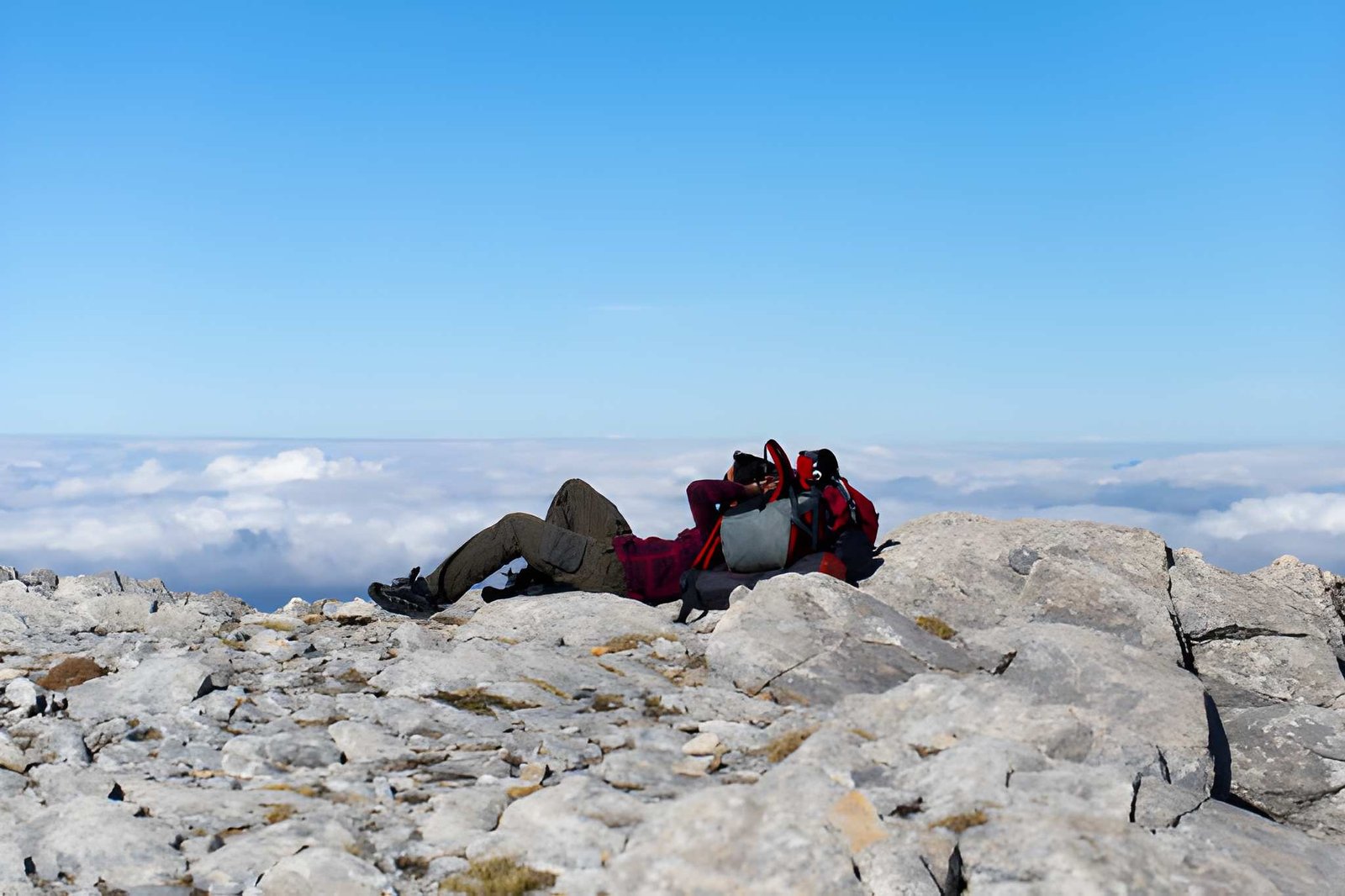
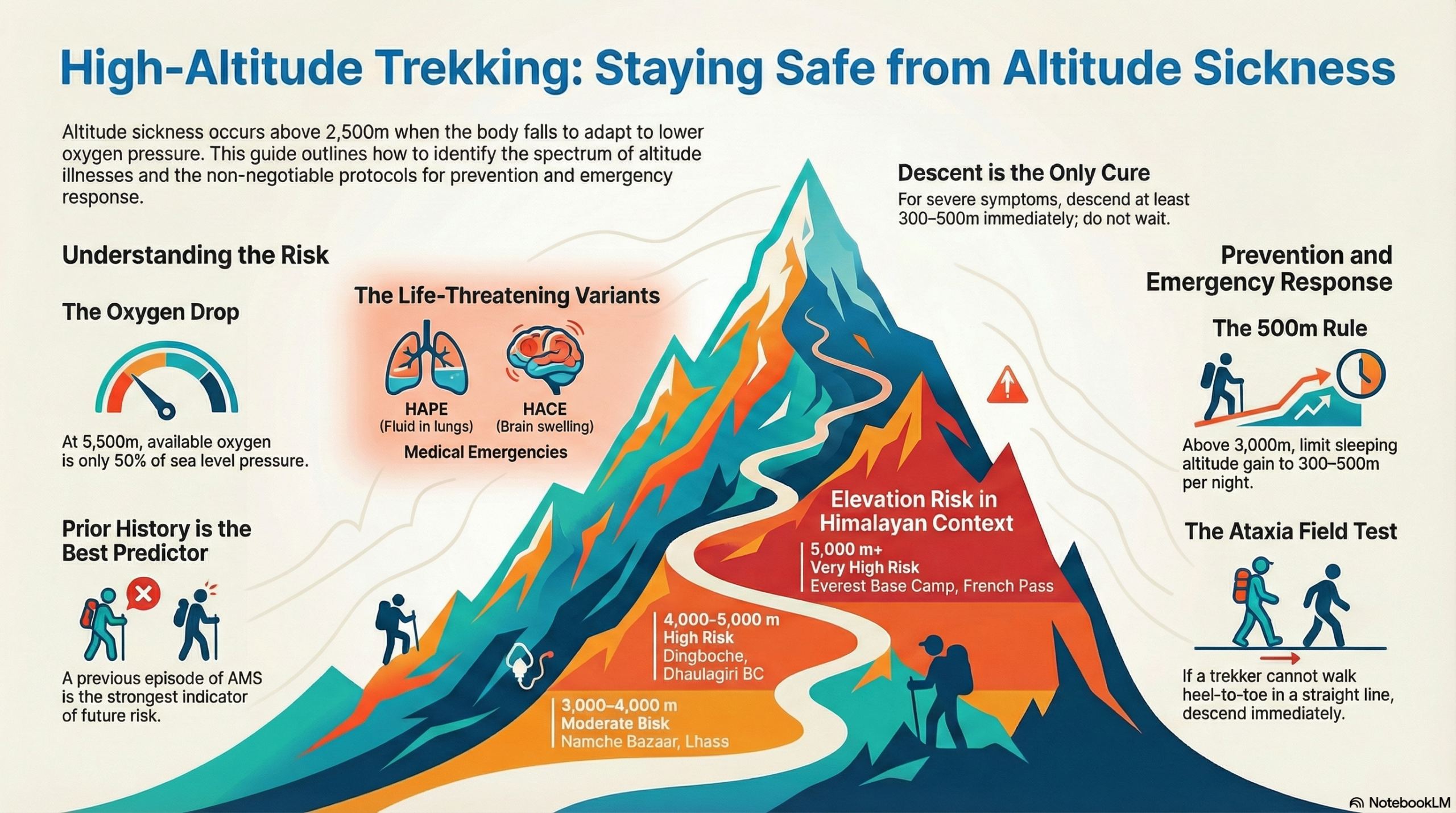
Altitude sickness or Acute Mountain Sickness (AMS) is a physiological response to the decrease in oxygen availability at high elevations, typically occurring above 2,500 m (8,200 ft). It develops when the body ascends faster than it can adapt to the drop in oxygen partial pressure, placing stress on the brain, lungs, and cardiovascular system.
Most trekkers experience some degree of AMS above 3,000 m. On popular Himalayan routes, the risk escalates significantly above 3,500 m and reaches its highest point above 5,000 m, where oxygen availability is roughly 50% of sea level.
AMS is the most common form, but altitude illness also includes two serious, life-threatening conditions: High-Altitude Pulmonary Oedema (HAPE) and High-Altitude Cerebral Oedema (HACE). Both require immediate descent and emergency care.
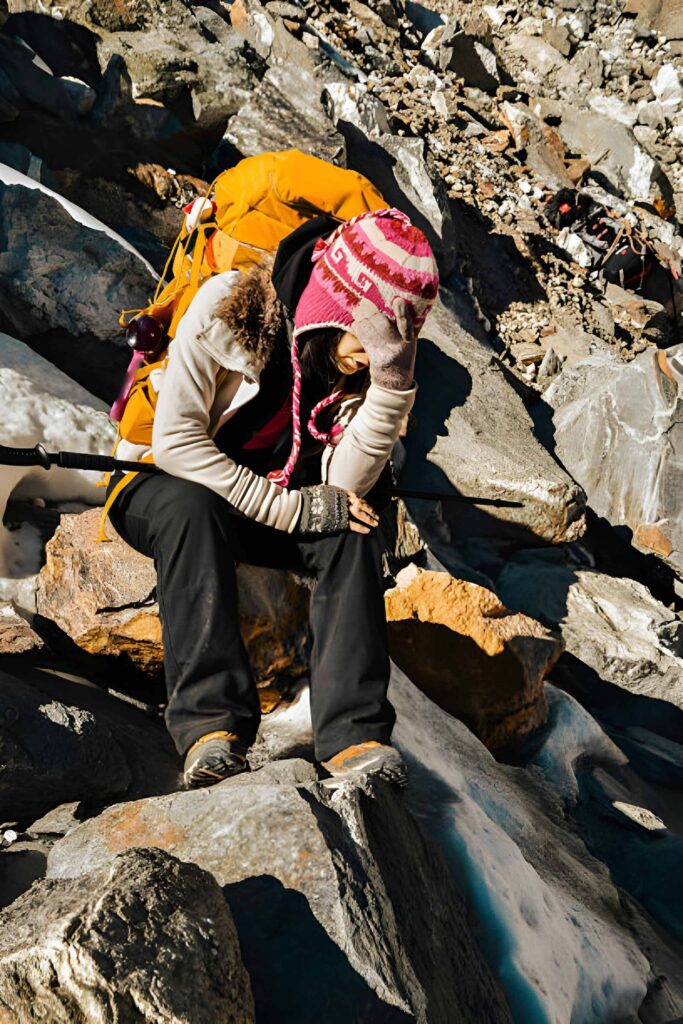
Note: This guide is intended as general educational content for trekkers planning high-altitude travel. It is not medical advice. Individual responses to altitude vary significantly, and nothing here should substitute for professional guidance from a qualified physician or certified mountain guide. If you or someone in your group is experiencing severe symptoms at altitude, descend immediately and seek professional help.
Why Does Altitude Sickness Happen?
As elevation increases, the atmospheric (barometric) pressure drops. Lower pressure means fewer oxygen molecules per breath, even though the percentage of oxygen in the air remains constant at 21%. At 3,500 m, available oxygen is approximately 65% of sea level. At 5,500 m, it falls to around 50%.
When the body ascends rapidly, it cannot compensate quickly enough. The physiological responses, like increased breathing rate, elevated heart rate, changes in blood chemistry, etc., take from days to weeks for stabilisation. If you ascend faster than this window allows, then AMS follows.
Individual Risk Factors
There is no reliable predictor of who will develop altitude sickness. Physical fitness offers minimal protection. Even the elite athletes are just as susceptible as casual trekkers. Key risk factors include:
- Rapid ascent rate above 3,000 m
- Sleeping at a new high altitude without adequate acclimatisation days
- Dehydration and overexertion during ascent
- Residence at or near sea level
- Genetic susceptibility (not yet predictable through standard testing)
- Age: Children and young adults may be at slightly higher risk in some studies, though the effect largely disappears when the ascent rate is controlled for
Altitude Risk Bands in the Himalayan Context
| Elevation | Risk Level | Reference Points |
| Below 2,500 m | Minimal | Kathmandu (1,400 m), Pokhara (820 m), Paro (2,200 m) |
| 2,500–3,000 m | Low–Mild | Lukla (2,860 m), Shana/Bhutan trail start |
| 3,000–4,000 m | Moderate | Namche Bazaar (3,440 m), Lhasa (3,656 m), Jangothang (4,080 m) |
| 4,000–5,000 m | High | Dingboche (4,360 m), Dhaulagiri BC (4,740 m), Namtso Lake (4,718 m) |
| 5,000 m+ | Very High | EBC (5,364 m), Kala Patthar (5,545 m), French Pass (5,360 m), Rinchen Zoe La (5,320 m) |
How AMS Risk Compounds
No single factor determines whether you will develop altitude sickness. The variables that matter most are your prior history with AMS, how fast you ascend, and the altitude you are targeting. A trekker with no prior AMS history ascending gradually to 4,000 m sits in a fundamentally different risk category than someone with a previous AMS episode pushing rapidly above 5,000 m.
These three variables are the foundation, but additional factors can push any row up one level: dehydration, alcohol consumption in the first 48–72 hours at a new elevation, overexertion on ascent days, and arriving at altitude with a pre-existing respiratory illness, all of which meaningfully increase risk beyond what the table reflects.
One finding worth noting: Prior AMS history is the strongest individual predictor by a significant margin. If you have experienced AMS before, assume you will experience it again unless your ascent profile is carefully managed. A previous episode does not confer any immunity or tolerance.
Types of High-Altitude Illness
Altitude illness exists on a spectrum. AMS is common and manageable with rest. HAPE and HACE are critical medical emergencies. Understanding their difference is the most critical safety knowledge for any high-altitude trekker.
Acute Mountain Sickness (AMS)
AMS is the most prevalent form, affecting an estimated 25–50% of trekkers above 3,500 m and up to 75% at elevations above 5,000 m on trekking routes, with rates climbing higher on rapid, unmanaged ascent profiles. It typically develops within 6–12 hours of reaching a new altitude. The defining feature is a headache, combined with at least one other symptom such as fatigue, nausea, or dizziness. AMS is graded using the Lake Louise Score (LLS), where a score of 3 or above (with headache present) indicates AMS. Moderate-to-severe scores are a clear signal to stop ascending.
High-Altitude Pulmonary Edema (HAPE)
HAPE involves fluid accumulation in the lungs and is the leading cause of altitude-related death among trekkers. It most often develops 2–4 days after arriving at altitude, more commonly on the second night at a given elevation than the first. Early signs include reduced exercise tolerance and a dry cough. As it progresses, breathlessness at rest and a productive cough with pink or frothy sputum develop. HAPE can deteriorate within hours. The occurrence is estimated at 1–6% of high-altitude travellers, depending on ascent rate and elevation profile.
HAPE is a medical emergency. If breathlessness occurs at rest or a persistent cough develops with pink or frothy sputum, immediate descent is required. Do not wait further.
High-Altitude Cerebral Edema (HACE)
HACE is the most severe form of altitude illness, involving swelling of the brain. It typically follows severe, untreated AMS. The hallmark symptom is ataxia: the loss of coordination or inability to walk a straight line. Confusion, altered consciousness, and severe headache unresponsive to pain relief are warning signs. HACE can progress to coma within 24 hours.
Incidence is estimated at less than 1% of high-altitude travellers, but mortality is high without rapid descent.
HACE is a life-threatening emergency. Any trekker showing confusion, extreme drowsiness, or loss of coordination at altitude must descend immediately. This is not a condition to monitor, but an emergency to act on.
| Feature | AMS | HAPE | HACE |
| Primary Organ | Brain/Systemic (Mild) | Lungs | Brain (Severe) |
| Severity | Common; manageable with rest | Emergency. The leading cause of death | Emergency; most severe form |
| Defining Sign | Headache + Nausea/Fatigue | Breathlessness at rest & pink/frothy spit | Ataxia (loss of coordination) & confusion |
| Urgency | Stop ascent; rest | Immediate descent is mandatory | Immediate descent is mandatory |
Symptoms of Altitude Sickness
Symptoms range from mild discomfort to a life-threatening emergency. Recognising where on this spectrum a person sits is the most important safety skill for any high-altitude trekker.
Mild AMS
Symptoms typically appear 6–12 hours after reaching altitude and may resolve with rest at the same elevation:
- Headache (dull or throbbing, often worse at night, defining indication)
- Fatigue and weakness
- Reduced appetite
- Difficulty sleeping, including irregular breathing during sleep
- Mild dizziness
Moderate AMS
If mild symptoms persist or worsen after 24 hours, or if the following develop, do not ascend further:
- Worsening headache not relieved by standard pain relief
- Nausea and vomiting
- Increasing fatigue and weakness
- Reduced urine output
- Shortness of breath on mild exertion
Severe AMS / Early HAPE or HACE
These are emergency warning signs. The trekker should not be left alone, and descent should begin immediately:
- Breathlessness at rest or with minimal movement
- Persistent dry or wet cough, especially with pink or frothy sputum
- Loss of coordination and inability to walk in a straight line (ataxia)
- Confusion, disorientation, or unusual behaviour
- Severe headache unresponsive to medication
- Extreme fatigue. Patient is unable to stand without assistance
Field test for ataxia: Ask the trekker to walk heel-to-toe in a straight line. If they cannot do this, treat it as a severe symptom and arrange descent.
How to Prevent Altitude Sickness: Overview
The single most effective prevention is controlled, gradual ascent. No supplement, food, or preparation can replace the body’s need for time to acclimatise. The following principles apply across all high-altitude treks:
- Ascend gradually. Above 3,000 m, limit sleeping altitude gain to 300–500 m per night. This is the most consistently supported guideline in wilderness medicine.
- Climb high, sleep low. Day hikes to higher elevations, followed by descending to sleep at lower altitudes, accelerate acclimatisation. This principle is built into most well-designed Himalayan itineraries.
- Build in acclimatisation days. Rest days at key elevations, like Namche Bazaar (3,440 m) and Dingboche (4,360 m) on the EBC route, are not optional padding. Skipping them significantly increases AMS risk.
- Stay hydrated. Aim for 3–4 litres of water per day at altitude. Dehydration worsens AMS symptoms and is common due to increased respiratory water loss in dry mountain air.
- Avoid alcohol and sedatives. Both suppress respiratory drive during sleep, impairing the body’s natural ventilatory response to altitude. This effect is most significant in the first 48–72 hours at a new elevation.
- Do not ascend with symptoms. If any AMS symptoms are present, rest at the current altitude until they fully resolve. This rule applies regardless of itinerary pressures.
For a full prevention guide, including acclimatisation schedules, training recommendations, and the role of medications, see our complete altitude sickness prevention guide.
Treatment of Altitude Sickness
Treatment depends on severity. The underlying principle across all levels is the same: do not ascend until symptoms resolve, and descend if they worsen or fail to improve.
Mild AMS: Rest at the current altitude. Do not ascend. Most mild AMS resolves within 12–48 hours with adequate rest and hydration. Ibuprofen (commonly used at 400 mg) has demonstrated efficacy for headache relief in clinical studies but does not treat the underlying cause.
Moderate AMS: Stop all ascent. If symptoms do not improve after 24 hours of rest, descend 300–500 m. Even a modest descent often produces rapid symptom relief. Supplemental oxygen, where available, can provide temporary relief.
Severe AMS, HAPE, or HACE: Descent is the only definitive treatment. There is no alternative. Descend immediately (at minimum 300–500 m), more if logistics allow
- Do not wait for morning or better weather if the trekker’s condition is deteriorating
- Supplemental oxygen reduces symptoms during descent but does not replace descent
- Portable hyperbaric chambers (e.g., Gamow bags) can simulate descent in emergencies and are carried by rescue teams on major Himalayan routes
Do not self-medicate based on information in this guide. Always consult a physician before your trek.
Medication options, including acetazolamide (Diamox) and dexamethasone, are covered in detail in our medication guide.
Natural Remedies: What the Evidence Says
Various foods and supplements are cited as altitude sickness aids, particularly in Himalayan and Andean cultures. The evidence for most is limited, and none replace acclimatisation.
- Ginger: some evidence for reducing nausea associated with AMS, but no demonstrated effect on core AMS progression
- Garlic: traditional use in Himalayan communities; no robust clinical evidence for altitude illness prevention
- High-carbohydrate diet: Carbohydrates require less oxygen to metabolise than fats or proteins, which may provide a marginal support for energy production at altitude. The effect is modest but supported by general physiology.
- Coca leaves / tea: widely used in South American high-altitude communities; evidence is anecdotal, and use is culturally and legally context-specific
Hydration, adequate sleep, and a conservative ascent profile remain the only interventions with consistent evidence.
Helicopter Evacuation Considerations
On major trekking routes in Nepal, helicopter evacuation is available in clear weather conditions. However:
- Flights depend on visibility and wind
- Patients may need to be moved to a landing zone
- Insurance verification or payment guarantee is required before dispatch
Remote circuits such as Manaslu or Dhaulagiri may involve staged evacuation due to terrain and weather constraints.
Evacuation is a logistical process, not an instant solution. Early decision-making significantly improves outcomes.
The Safety Hierarchy
Altitude emergency management follows a clear progression:
- Stop ascent
- Rest and reassess
- Descend if symptoms persist
- Evacuate if severe symptoms develop
When uncertain, descend. Altitude illness responds to elevation loss. Delay increases risk. A well-planned trek with built-in acclimatisation, experienced leadership, and a defined evacuation protocol reduces severe altitude complications from likely to unlikely.
Altitude Sickness on Popular Himalayan Treks
Nepal’s, Tibet’s, and Bhutan’s major trekking routes all pass through significant altitude bands. Risk profiles differ by route based on maximum elevation, rate of ascent, and availability of acclimatisation days.
| Trek or Region | Maximum Elevation (m) | Maximum Sleeping Altitude (m) | AMS Risk Level | Critical Acclimatisation Points | Key High-Altitude points | Route Specific Challenges |
| Everest Base Camp (Nepal) | 5,545 m | 5,364 m | Very High | Namche Bazaar (3,440 m), Dingboche (4,360 m) | Kala Patthar (5,545 m), Everest View Hotel (3,880 m) |
|
| Dhaulagiri Circuit (Nepal) | 5,360 m | 5,050 m | Very High | Italian Base Camp (3,660 m), Glacier Camp (4,200 m), Dhaulagiri Base Camp (4,740 m) | French Pass (5,360 m), Dhampus Pass (5,240 m) |
|
| Snowman Trek (Bhutan) | 5,320 m | Above 4,000 m | Very High / Compounding | Not in source | Rinchen Zoe La (5,320 m) |
|
| Lhasa and Beyond (Tibet) | 5,200 m | 5,200 m | Very High | Lhasa (3,656 m) | Everest North Base Camp (5,200 m), Rongbuk Monastery (5,100 m) |
|
| Manaslu Circuit (Nepal) | 5,106 m | 5,100 m | High to Very High | Dharmasala (4,460 m) | Larkya La Pass (5,106 m) |
|
| Langtang Valley (Nepal) | 4,984 m | 3,870 m | Moderate to High | Kyanjin Gompa (3,870 m) | Tserko Ri viewpoint (4,984 m) |
|
| Jomolhari Trek (Bhutan) | 4,930 m | 4,080 m | Moderate to High | Jangothang (4,080 m) | Yalila Pass (4,930 m) |
|
| Annapurna Base Camp (Nepal) | 4,130 m | 4,130 m | Moderate to High | Chhomrong (2,170 m) | Annapurna Base Camp (4,130 m) |
|
In Conclusion…
Altitude sickness is the single most important health risk on any high-altitude trek. Thankfully, it is also highly manageable with the right knowledge and pacing. Understanding the symptoms, respecting gradual acclimatization, and responding early to warning signs are what allow trekkers to safely reach destinations like Everest Base Camp, Annapurna Base Camp, and beyond. The mountains reward patience, not speed. When you prioritize acclimatization over ambition, you dramatically increase both your safety and your chances of success.
Planning a high-altitude trek?
Explore our carefully designed itineraries with built-in acclimatisation days and expert guidance to help you trek safely and confidently👉 Check out the Trips
Training for Everest Base Camp Trek: The Complete Preparation Guide
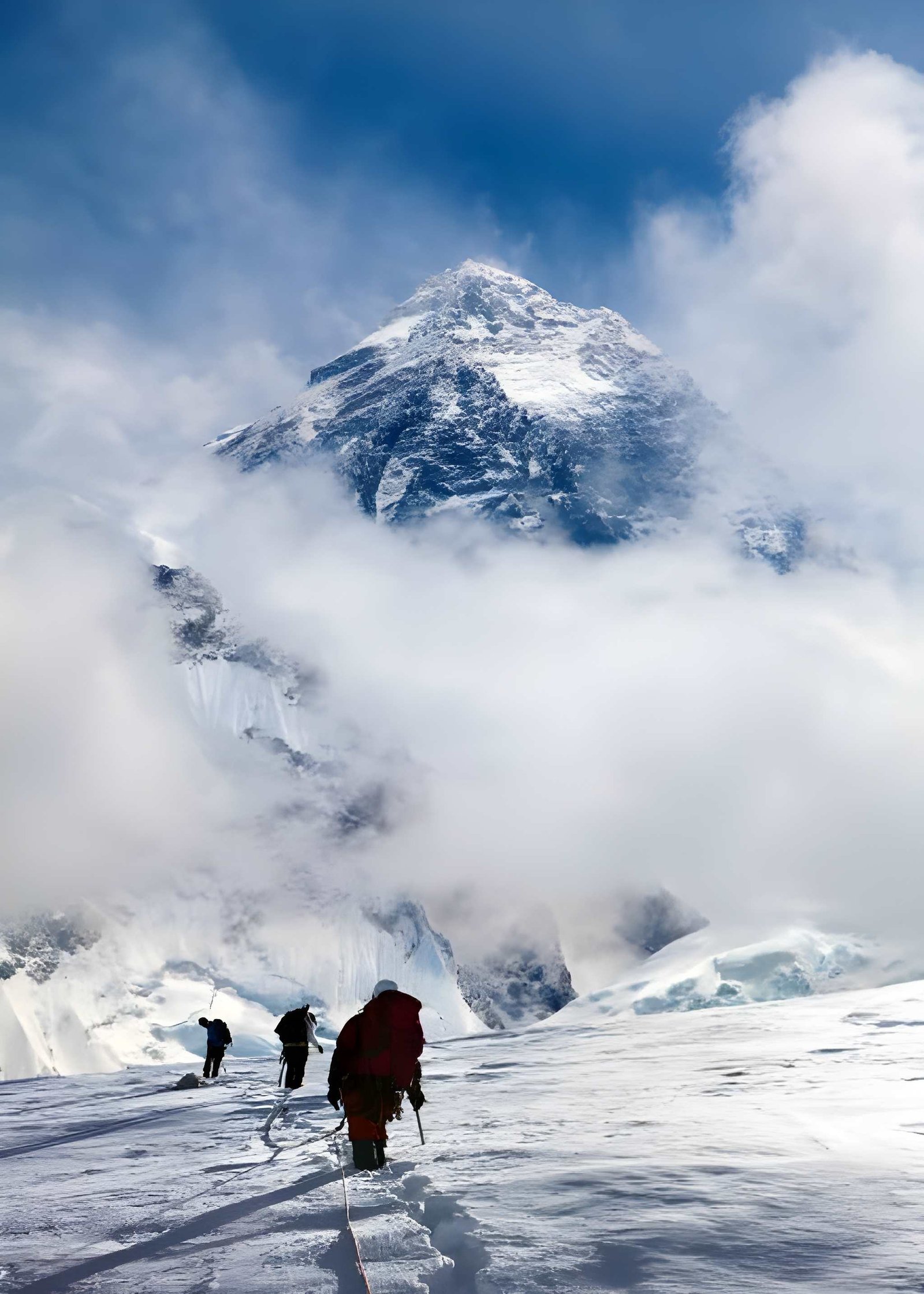
The Dream Is Real; But So Is the Climb
Standing at the foot of the world’s highest peak is one of those experiences that stays with you forever. The air is thin, the prayer flags are snapping in the wind, and the scale of the Himalayas is universal in a way no photograph can fully capture. But here’s the truth: reaching Everest Base Camp at 5,340m is not simply a matter of booking a flight to Lukla and showing up enthusiastic.
The trek covers roughly 130–140 km of rugged Himalayan terrain, with 5–8 hours of walking per day at altitudes that will genuinely test both body and mind. The encouraging reality? Most trekkers who adequately prepare complete the trek successfully. Those who fail typically underestimate the preparation required or attempt the trek without proper conditioning.
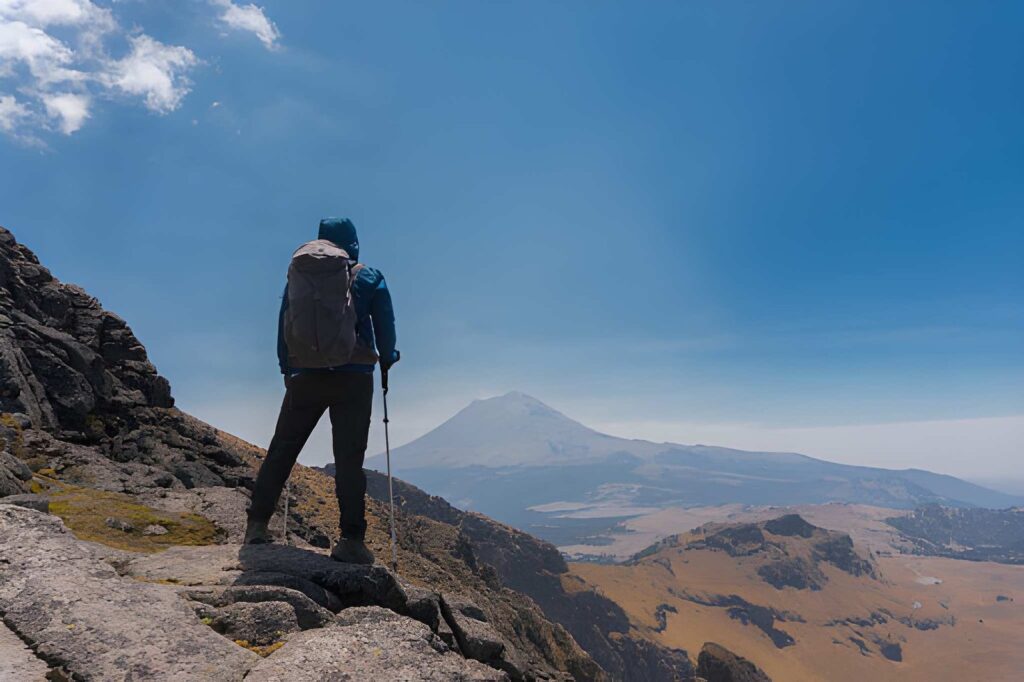
This guide gives you everything: a 12-week training plan, an easy-to-understand breakdown of what actually helps, a weight training guide built for trekking, altitude awareness, gear conditioning, and mental prep strategies. Consider this your complete preparation playbook.
Already convinced? Explore Far Out Nepal’s Classic EBC Trek. You can then come back and start training.
How Hard Is the Everest Base Camp Trek, Really?
The EBC trek is rated difficult, but not for the reasons most people assume. There’s no technical climbing, no rope work, no crampons. It’s hard because of three compounding factors: sustained daily effort over 13+ trekking days, significant altitude gain, and cumulative physical and psychological fatigue.
| Factor | What It Means on Trail | How Training Addresses It |
| Max Altitude | 5,545m at Kala Patthar (with variations at the Gokyo Route). This is roughly 50-55% of sea-level oxygen | Aerobic base training, acclimatisation schedule |
| Daily Trekking | 5–8 hours on rocky, uneven trail each day | Long hikes, back-to-back training days |
| Total Distance | ~130–140 km round trip | Progressive weekly mileage build-up |
| Terrain | Rocky, steep, often icy in higher sections | Weighted hikes, stair climbing, trail running |
| Technical Skill | None required. This is trekking, not peak climbing | Focus entirely on endurance and strength |
| Duration | 13+ days of consecutive trekking effort | Multi-week progressive training, not single-session fitness |
The altitude is the wildcard. At 5,000m+, your body works roughly 40% harder than at sea level to deliver oxygen to your muscles. This means that even well-conditioned trekkers, such as runners, swimmers, and footballers, can struggle without altitude-specific preparation. Fitness helps enormously. But it doesn’t make you immune.
Cardio Training for EBC: What Each Activity Gives You
Not all cardio is equal when preparing for the Everest Base Camp trek. Different sports build different physiological qualities, where some map far more directly to the demands of the trail than others. Here’s an honest, sport-by-sport breakdown.
| Sport | Aerobic Base | Leg Strength | Downhill Control | Pack Load Simulation | Trek Specificity | Verdict |
| Hiking (loaded) | Very High | High | Very High | Very High | Very High | The gold standard. Non-negotiable. |
| Stair Climbing | High | High | Low | Moderate | High | Best gym substitute for the trail. |
| Running (trail) | Very High | Moderate | Moderate | Low | Moderate | Excellent aerobic base builder. |
| Cycling | Very High | Moderate | Very Low | Very Low | Moderate | Great base builder, low joint stress. |
| Swimming | High | Low | Very Low | Very Low | Low | Excellent recovery and lung training. |
| Football/Soccer | Moderate | Moderate | Low | Very Low | Low | Good base activity, not sufficient alone. |
| Basketball / Tennis | Moderate | Moderate | Low | Very Low | Low | Useful for general conditioning only. |
| Yoga / Pilates | Low | Moderate | Very Low | Very Low | Low | Excellent supplement. Never primary training. |
Hiking is irreplaceable. Loaded hiking builds leg strength, balance, cardiovascular endurance, and mental tolerance for long days simultaneously. Start flat and short; build to steep and long over 12 weeks.
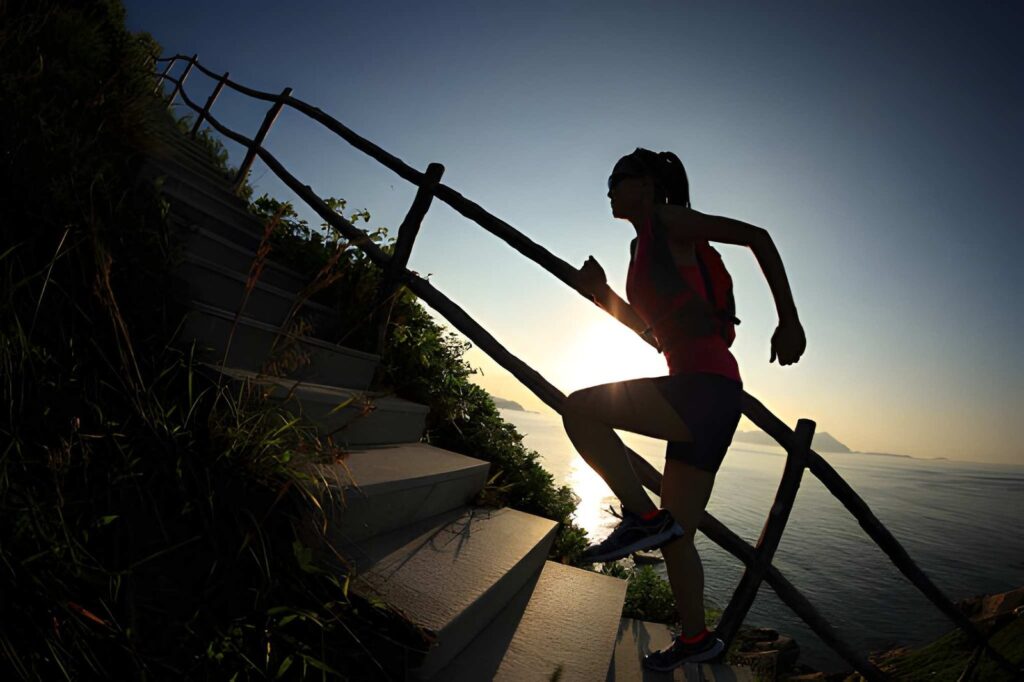
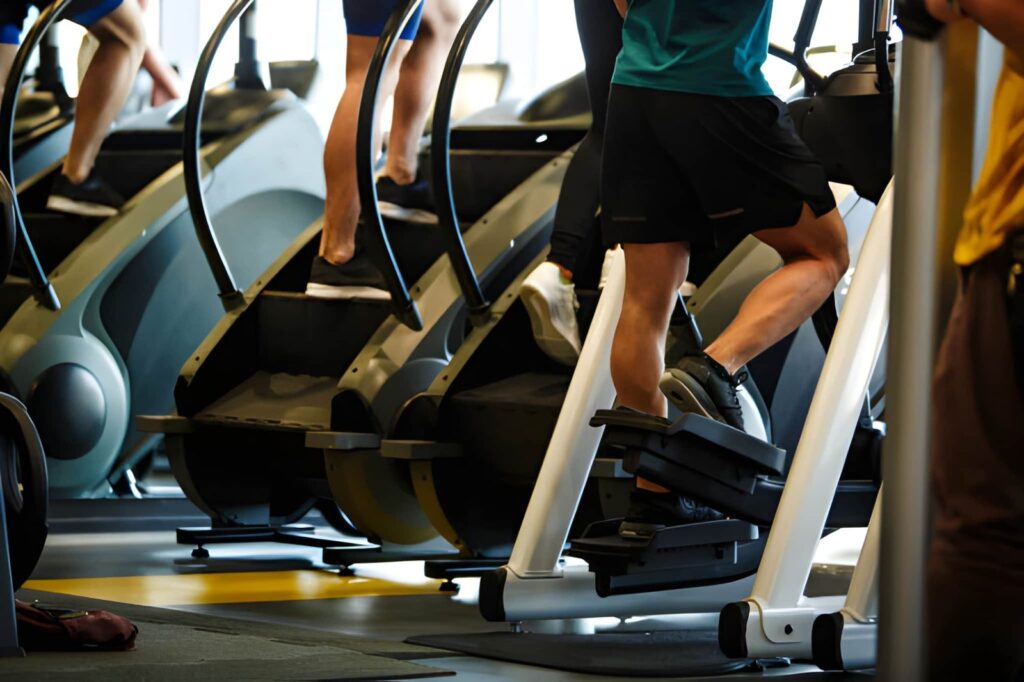
Stair climbing is the most underrated EBC tool. It replicates the rhythmic, sustained uphill effort of the trail better than any other gym machine. Thirty to 45 minutes daily over 8–10 weeks is what trekkers consistently credit for getting them to Base Camp.
Cycling is the best low-impact aerobic complement to hiking. It helps build the cardiovascular base that sustains you at altitude without the joint stress of running. Long rides of 90+ minutes in Zone 2 heart rate are the target.
Swimming builds exceptional lung capacity and diaphragmatic breathing control. These qualities pay real dividends at altitude when every breath matters. It won’t build your hiking legs, but it makes your lungs and heart significantly more efficient.
Football and other sports are more useful than most trekkers realise. A 90-minute football match covers 10–13 km of varied-intensity movement and builds leg power, cardiovascular capacity, and mental toughness. The limitation is its interval nature. Basically, it doesn’t build the long, sustained aerobic base EBC demands. Use it as your base activity and supplement with hiking and stair climbing.
The ideal cardio strategy: No single sport is sufficient on its own. The most effective preparation combines hiking (specificity), cycling or swimming (aerobic base with low injury risk), and stair climbing (trail simulation). If you play a sport like football or basketball, keep it, and build your specific EBC training around it.
Weight Training for the EBC Trek: What to Lift and Why
Weight training is essential, not optional. The trail demands sustained leg power for uphill climbs, core stability for uneven terrain, and shoulder endurance for carrying a loaded pack hour after hour.
Key Muscle Groups for EBC
| Muscle Group | Why It Matters on EBC | Primary Exercises | Priority |
| Quads and Glutes | Power for uphill climbs: the dominant trail movement. | Squats, step-ups, lunges, leg press | Critical |
| Hamstrings | Brake control on steep descents. Underrated by most trekkers | Romanian deadlifts, hamstring curls, Nordic curls | Critical |
| Calves | Absorb impact on rocky terrain across 8+ hours per day | Weighted calf raises, single-leg raises | High |
| Core (deep stabilisers) | Stabilise spine under pack weight on uneven ground | Planks, dead bugs, bird-dogs, pallof press | Critical |
| Glute Med / Hip Abductors | Lateral knee stability on uneven, rocky trail | Lateral band walks, clamshells, single-leg squats | High |
| Upper Back and Traps | Carry pack weight without fatigue or postural collapse | Rows, face pulls, shrugs | Moderate |
| Shoulders | Support pack straps over multi-hour trekking days | Overhead press, lateral raises, rear delt flys | Moderate |
| Ankles (stability) | Prevent ankle rolls on boulder-field terrain above 4,000m | Single-leg balance, Bosu ball, ankle circles | Moderate |
For structure, two to three strength sessions per week is the sweet spot. A sample week in the peak phase:-
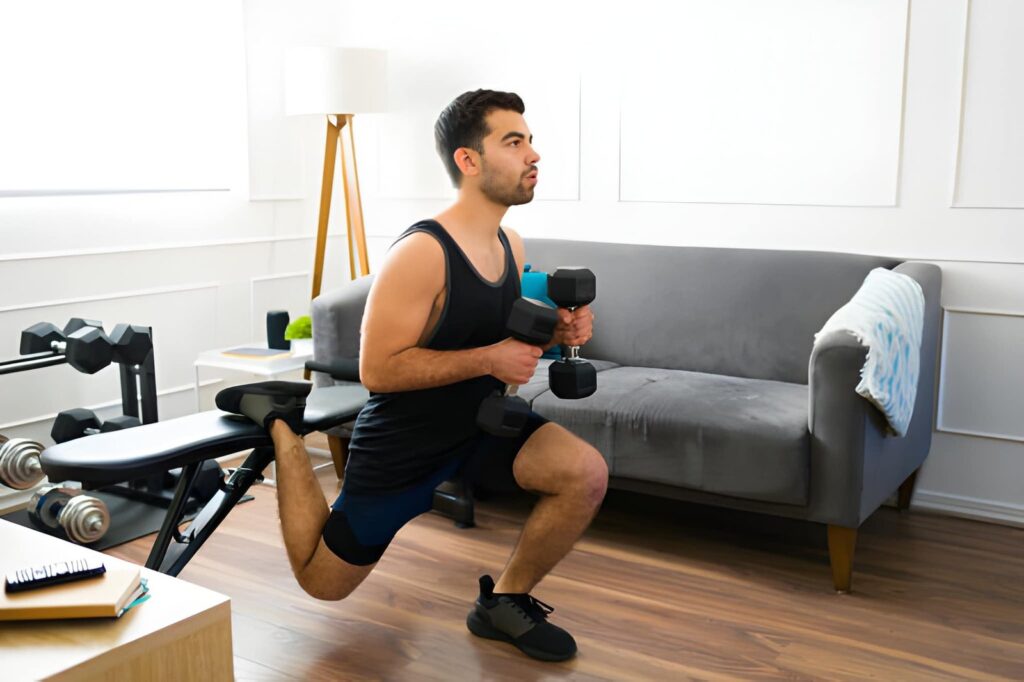
- Monday: legs (squats, RDL, step-ups, calf raises)
- Wednesday: full body (rows, press, lunges, core)
- Saturday: long loaded hike. Rest or do yoga on the remaining days.
Your 12-Week EBC Training Plan
This plan integrates cardio, weight training, and hiking progressively across three phases: Build (Weeks 1–4), Peak (Weeks 5–10), and Taper (Weeks 11–12).
| Week | Phase | Cardio Focus | Weight Training | Hiking / Practice | Pack Weight | Rest Days |
| 1–2 | Build | 30 min jog or cycle x3/week | 2x full body: squats, lunges, rows, plank, calf raises | 1 flat day hike. You need to focus on duration, not pace | Day pack only | 2 |
| 3–4 | Build | 45 min run and stairs x3/week | 2x split: legs day (squats, RDL, step-ups) and upper/core day (rows, press, dead bugs) | 1–2 hikes with mild incline | 5–7 kg | 2 |
| 5–6 | Peak | 60 min trail run or stair climb x3/week | 3x split: heavy legs, upper back and shoulder, core and stability | 1 long hike (600m+ elevation gain) | 7–10 kg | 1–2 |
| 7–8 | Peak | 75 min trail run or stair master | 3x split: Bulgarian split squats, Nordic curls, weighted rows, loaded planks | 1 weekend multi-hour hike | 10–12 kg | 1–2 |
| 9–10 | Peak | Combo: run, stair, and short hike on the same day | 3x; maintain loads from Weeks 7–8, no new PRs | 2-day back-to-back hikes (simulate consecutive trek days) | 12–14 kg | 1 |
| 11–12 | Taper | Lighter cardio. 30–40 min, lower intensity | 2x maintenance only, reduce loads by 30%, full range of motion | 1 final long hike at trek pace | Trek pack weight | 2–3 |
Fitness level guide: Beginners start at Week 1. Regularly active individuals (3+ workouts per week) begin at Week 3. Advanced athletes can compress Weeks 1–6 into four weeks and move to the peak phase earlier.
Do not train to failure in the 3 weeks before departure. The goal in the taper phase is maintenance, not progress. Arriving at Lukla with sore muscles from a heavy leg day two days prior is a preventable mistake that undermines months of preparation.
Altitude and Acclimatisation: What You Need to Know
Altitude is the one variable that fitness alone cannot overcome. Above 3,000m, oxygen levels drop significantly, and your body adapts over days, not hours. The golden rule is simple: climb high, sleep low. Ascend during the day; descend to sleep at a lower elevation. This stimulates adaptation without triggering sickness, and it’s why a well-structured itinerary builds dedicated rest days into the schedule.
Watch for AMS symptoms above 3,500m. Common symptoms include headache, nausea, fatigue, and disrupted sleep. If they appear, stop ascending. Drink 3–4 litres of water daily. You should also consult your doctor about Diamox at least 4–6 weeks before departure.
Gear, Nutrition and Mental Prep
- Break in your boots 8–10 weeks out. New boots at altitude after six hours on a rocky trail is a reliable recipe for blisters that jeopardise your entire trek. Wear the same sock combination you’ll use on the trail (people choose the merino liner under a thicker hiking sock).
- Train with your actual pack, loaded progressively from 5 kg to 12–14 kg. This builds the specific endurance gym exercises that can’t be replicated and reveals gear problems before the trip.
- Eat consistently during training, even when not hungry. Many trekkers lose their appetite above 4,000m. Dal bhat is the trail staple: carb-heavy, calorie-dense, and available everywhere with unlimited refills. Pack trail mix, energy bars, and dried fruit as pocket fuel.
- Pace like a Sherpa, not a tourist. The most common first-timer mistake is starting too fast. Slow your pace to where you can hold a full conversation; that is the sustainable speed.
Mental Preparation: The Training You Should Not Miss Out
The mind quits before the body does. This is an observable pattern on the EBC trail, not a motivational cliché. By Day 9 or 10, when the altitude is disturbing your sleep, your legs carry accumulated weeks of fatigue, and the trail keeps ascending regardless, the gap between those who reach Base Camp and those who turn back is almost entirely psychological.
Mental resilience is trainable. Here is how.
Pacing practice: On long training hikes, deliberately resist the urge to push hard. Practice the Sherpa pace, which is slow, consistent, and sustainable enough to hold a full conversation. Sherpas overtake trekkers effortlessly because they have mastered energy conservation, not because they are superhuman.
Diaphragmatic breathing: Belly breathing is more oxygen-efficient than shallow chest breathing, which makes a meaningful difference at altitude. Practice it consciously during cardio training until it becomes automatic.
Mental chunking: On hard days, do not think about how far Base Camp is. Think about the next teahouse. Then the next village. Break the journey into achievable segments. It is deceptively simple and genuinely effective.
Mindfulness practice: Ten minutes of daily meditation builds the focus and equanimity that long, hard trekking days demand. The ability to stay present and non-reactive under physical duress is a tangible advantage at altitude.
Visualisation: Spend a few minutes each week imagining standing at Kala Patthar. Imagine the view of Everest at dawn and the feeling of finishing. This is sports psychology, not mysticism, and it measurably improves performance under stress.
Common Mistakes to Avoid During Training
- Skipping long hikes: Gym fitness and trail fitness are not the same thing
- Neglecting hamstrings and calves: The descent from Kala Patthar will expose this immediately
- Overtraining in the final two weeks: Arrive rested, not depleted
- Underestimating altitude: AMS doesn’t respect fitness levels; follow the acclimatisation schedule
- Testing new gear on the trail: Everything must be worn and proven during training
- Skipping rest days: Adaptation happens during recovery, not during effort
Tips from Experienced EBC Trekkers (Across Social Platforms)
“The stair master saved my trek.” Multiple experienced trekkers report that 30–45 minutes on the stair master daily (over 8–10 weeks) was the most effective single gym exercise for EBC prep. It replicates the trail’s sustained, rhythmic uphill effort better than anything else.
“Slow is fast.” First-time trekkers almost universally start too fast. Every experienced high-altitude trekker eventually says the same thing: slow your pace to where you can hold a comfortable conversation, and you will reach Base Camp. Race the trail, and the altitude will stop you.
“Train on tired legs.” Schedule back-to-back hiking days in Weeks 8–10. It is the cumulative fatigue of Days 2, 3, and 4 on the trail that breaks unprepared trekkers. Building this specific resilience is what separates those who reach Base Camp from those who don’t.
Ready to Trek? Your Final Preparation Checklist
The Everest Base Camp trek is one of the most transformative journeys on earth. It challenges you, humbles you, and rewards you in equal measure. Here is what every well-prepared trekker has in common:
- 12-week plan covering cardio, weight training, and hiking
- Hiking and stair climbing as primary cardio; cycling, swimming, and sports as supplements
- Hamstrings and calves are trained as seriously as quads
- Back-to-back hiking days in peak weeks
- All gear is broken in 8–10 weeks before departure
- AMS awareness and acclimatisation schedule understood
- Pacing, breathing, chunking, and visualisation practised
- 3–4 litres of hydration and calorie-dense food on the trail
The mountain will be there. The question is: will you be ready?
Book your Everest Base Camp Trek with Far Out Nepal. Get expert guides, an acclimatisation-optimised itinerary, and full support from Kathmandu to Base Camp.
Bhutan The Land of Gross National Happiness